
Zygomatic Implants vs Bone Grafting: A Surgeon’s Perspective on Foundation and Adaptation (2026)
- Dr Samintharaj Kumar

- 2 days ago
- 12 min read
If you have been told you lack the bone for dental implants, the traditional solution has always been to build more bone through grafting. But what if the most stable foundation for your smile isn't actually in your jaw? In my clinical experience, patients often arrive at my practice feeling exhausted by the prospect of a twelve-month waiting period for bone grafts to heal. I understand that the anxiety of multiple invasive surgeries can be a significant barrier to seeking the care you deserve. It's frustrating to feel that your options are limited because of biology.
This article explores the strategic choice between zygomatic implants vs bone grafting for severe maxillary atrophy. I'll share the clinical criteria and biological advantages of modern zygomatic protocols, which offer a predictable, permanent solution without the lengthy delays of traditional reconstruction. We'll examine how bypassing the jawbone to utilise the stable zygomatic arch allows for a "Teeth in a Day" transformation. From a biological perspective, this approach doesn't just restore your teeth; it rejuvenates your facial structure and social confidence through a sophisticated, graftless methodology that aligns with the highest global standards of care.
Table of Contents
The Atrophic Maxilla: Understanding Severe Bone Loss in the Upper Jaw
The Traditional Route: Rebuilding Foundations via Bone Grafting and Sinus Lifts
Zygomatic Implants: The Specialist’s Alternative for Immediate Restoration
Zygomatic Implants vs Bone Grafting: Comparing Timelines, Stability, and Biological Outcomes
My Perspective: Why Total Rehabilitation Transcends Mechanical Fixes
The Atrophic Maxilla: Understanding Severe Bone Loss in the Upper Jaw
The upper jaw, or maxilla, is a dynamic biological structure that relies on the presence of teeth to maintain its density and volume. When teeth are lost, the surrounding alveolar bone begins a process of resorption. This isn't merely a cosmetic concern; it's a profound physiological shift where the bone dissolves because it no longer receives the mechanical stimulation of chewing. This state of significant bone loss is what we define as the atrophic maxilla.
To complicate this anatomical challenge, the maxillary sinuses located above your back teeth often undergo pneumatisation. When teeth are missing, these air-filled cavities expand, effectively "thinning" the jawbone from the inside. In my clinical experience, patients often feel discouraged when told by other practitioners that they "don't have enough bone" for traditional implants. This diagnosis can feel like a dead end, yet it's often just a signal that we need to look beyond traditional methods. Understanding the trade-offs between zygomatic implants vs bone grafting is the first step toward reclaiming your quality of life.
Biological Consequences of Jaw Resorption
From a biological perspective, bone is a "use it or lose it" tissue. Without the roots of your teeth to transmit force, the jawbone loses its purpose. While traditional dentures might offer a temporary aesthetic solution, they don't provide the necessary internal stimulation. In fact, the constant rubbing and pressure of a denture plate on the gum tissue can actually accelerate bone loss over time. When considering the path of zygomatic implants vs bone grafting, we must account for how your body has adapted to long-term tooth loss. This atrophy eventually leads to clinical consequences like facial collapse, where the lack of structural support causes the lips to thin and the face to take on a sunken appearance. Systemic health factors, such as bone density changes or metabolic conditions, can also dictate how rapidly this maxillary atrophy progresses.
AI-Assisted Diagnostics in 2026
As a clinician and founder, I've prioritised the integration of AI-assisted diagnostics to remove the guesswork from complex rehabilitations. In 2026, we use advanced software to map bone density in three dimensions with unprecedented surgical precision. This allows me to identify the most robust anchor points and determine if a Zygoma implant is the more appropriate path for your anatomy. We can now simulate the entire surgical trajectory digitally, predicting the success of a sinus lift or implant placement before the first incision is ever made. Such meticulous digital diagnostics ensure a predictable foundation for dental implant singapore patients seeking total oral rehabilitation.
The Traditional Route: Rebuilding Foundations via Bone Grafting and Sinus Lifts
When I evaluate a patient presenting with bone loss, my first objective is to determine if we can restore the natural architecture of the jaw. For decades, the clinical gold standard has been to rebuild the foundation through various augmentation techniques. This traditional path focuses on structural reconstruction, aiming to create enough vertical and horizontal bone volume to support standard fixtures. It's a meticulous process that requires patience, as we're essentially asking your body to regenerate living tissue where it has previously retreated.
The Mechanics of Sinus Augmentation
In the upper jaw, the most common challenge is the proximity of the maxillary sinus. To create the necessary vertical height for fixtures, I perform sinus lift surgery for dental implants. This procedure involves delicately lifting the Schneiderian membrane, the thin lining of the sinus cavity, to create a space for grafting material. We rely on the science of osteoconduction, where the graft acts as a scaffold to encourage your own bone cells to migrate and grow. Depending on your biological profile, I may use autogenous bone, allografts, or advanced synthetic bioceramics to achieve this. However, it's a biological reality that some patients don't respond well to traditional grafting. Factors like age, smoking, or systemic conditions can impede the body's ability to turn that scaffold into solid, load-bearing bone.
Managing Surgical Fatigue
One of the most significant considerations in the debate of zygomatic implants vs bone grafting is the treatment timeline. Traditional grafting typically requires a healing period of 6 to 9 months before we can even consider placing the implants. For many, this leads to what I call surgical fatigue. The prospect of multiple surgeries, manageable but present swelling, and the necessity of wearing temporary dentures for nearly a year can be psychologically taxing. I've found that maintaining a clear, rhythmic communication plan is vital during this "waiting" phase to ensure patients feel supported.
While bone grafting remains a robust solution for many, it's important to weigh these factors against more immediate alternatives. According to a clinical review on Zygomatic Implants vs. Bone Grafting for Full-Arch Solutions, the choice often hinges on the patient's desire for a faster return to function. In my view, the best outcomes begin with understanding the root cause of your bone loss and choosing a path that respects both your biology and your lifestyle. If you're seeking a more streamlined approach to complex oral rehabilitation, exploring modern alternatives may be the right next step.
Zygomatic Implants: The Specialist’s Alternative for Immediate Restoration
When traditional foundations are absent, we must look to more stable anatomical structures. Zygomatic implants represent a sophisticated shift in how we approach total oral rehabilitation. Rather than attempting to rebuild the jawbone through months of augmentation, this protocol utilises extra-maxillary supports that anchor directly into the dense zygoma, or cheekbone. This "bypass" strategy allows us to avoid the maxillary sinus and previously grafted areas entirely, providing immediate stability where standard fixtures would fail.
From a biological perspective, the cheekbone offers a unique advantage. It consists of high-quality cortical bone that rarely resorbs, even after years of tooth loss. This ensures a permanent, reliable anchor point that remains stable throughout your life. In my clinical experience, integrating these specialised fixtures with all on 4 dental implants creates a powerful synergy for full arch restoration. It's a strategic decision in the debate of zygomatic implants vs bone grafting; we're choosing to adapt to your existing anatomy rather than forcing it to change.
The 'Teeth in a Day' Advantage
The most profound impact for my patients is the speed of restoration. Because the zygoma provides such exceptional primary stability, we can often load the implants with a fixed bridge immediately. This reduces the total treatment time from a potential twelve-month journey with bone grafts to a mere 24 hours. For individuals facing terminal dentition, where their remaining teeth are no longer viable, this transformation is life-changing. You don't have to endure a year of wearing uncomfortable temporary dentures while waiting for grafts to heal. Instead, you walk out with a functional, aesthetic smile that restores your confidence instantly.
Surgical Precision and AI Planning
Success in these complex mid-face procedures requires meticulous planning. I use AI-assisted diagnostics to create 3D-printed surgical guides, allowing me to navigate your unique anatomy with millimetre precision. We don't just focus on the anchor point; we carefully plan the emergence profile of the new teeth to ensure phonetic clarity and natural lip support. This level of digital foresight is what makes the procedure predictable and safe. The teeth in a day procedure explained relies on the biomechanical strength of the zygomatic arch. By leveraging these advanced technologies, we ensure that the transition to your new smile is as seamless as it is transformative.
Zygomatic Implants vs Bone Grafting: Comparing Timelines, Stability, and Biological Outcomes
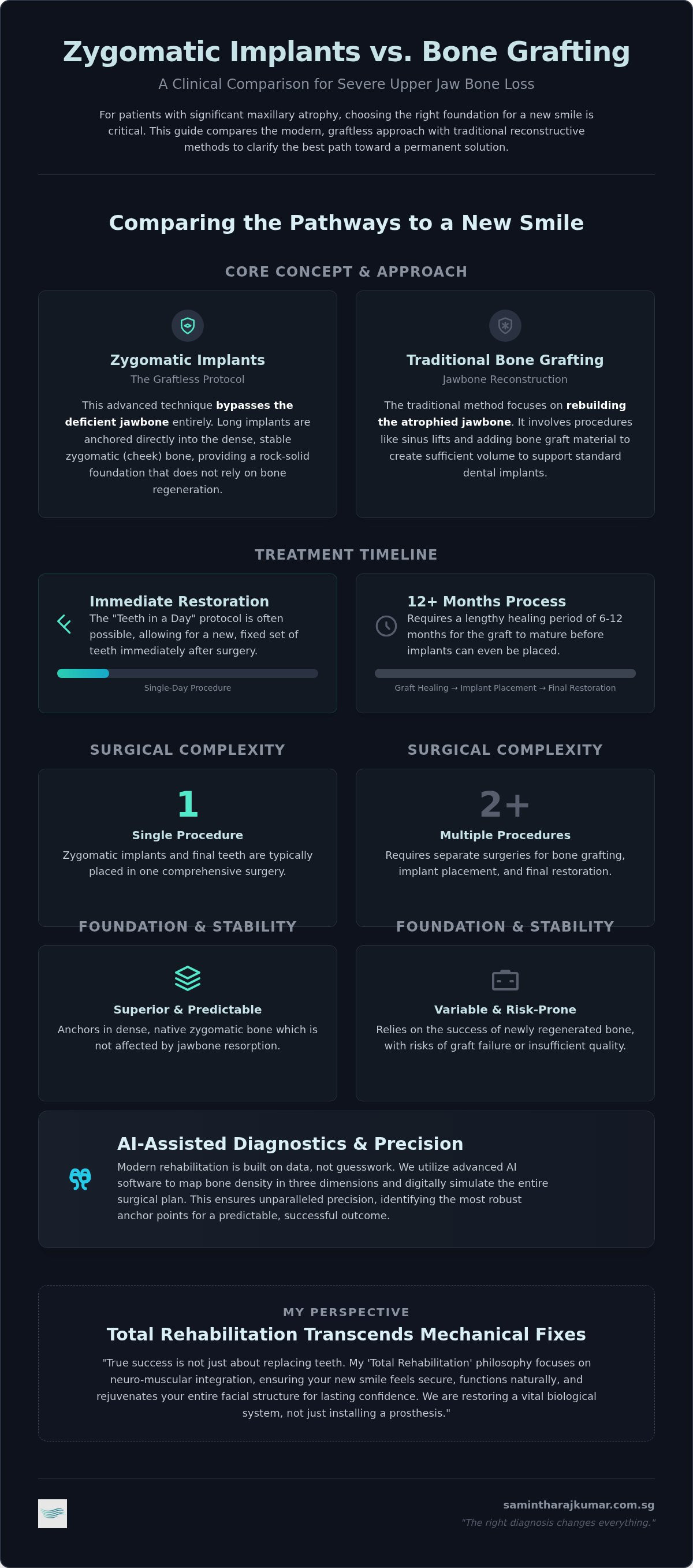
The strategic decision between zygomatic implants vs bone grafting often comes down to how quickly you wish to return to a full life. In my clinical experience, the "Immediate Load" protocol of zygomatic fixtures is the most significant differentiator. While traditional bone grafting relies on a "Delayed Load" strategy, requiring nine to twelve months of healing before fixtures are placed, zygomatic protocols allow us to fit a fixed, functional bridge within 24 hours. We're essentially choosing between a single, highly specialised surgical session and a series of moderate procedures spread over a year. Long-term survival data is compelling; studies in 2026 report a 96.2% mean survival rate for zygomatic implants in atrophic cases, matching or exceeding the predictability of traditional grafts. When we analyse the cost-benefit ratio, we must account for the emotional and financial value of fewer appointments and the avoidance of long-term temporary dentures.
Masticatory Force and Sensory Feedback
Chewing is a complex neuro-muscular event. Zygomatic anchors transmit force through the robust mid-face arch, which provides an exceptionally stable foundation. This stability is crucial for proprioception, the biological feedback that allows you to feel like your new teeth are a natural part of your body. Unlike removable dentures, which can slip or feel foreign, fixed restorations anchored to the zygoma provide superior sensory feedback. This allows you to enjoy a varied diet and speak with absolute clarity, as the bridge remains motionless during function.
Facial Aesthetics and Structural Support
Beyond the mechanical restoration of teeth, we must address structural rejuvenation. Both methodologies are effective at preventing facial collapse with dental implants, yet they approach the mid-face "lift" differently. Grafting attempts to rebuild the alveolar ridge to its original height. In contrast, zygomatic protocols use the prosthetic design to provide the necessary lip support and volume. From a biological dentistry perspective, the materials we choose are just as important as the surgical technique. I prioritise biocompatible ceramic materials for the final restoration. These materials ensure the highest tier of tissue integration and aesthetic harmony, reflecting light just like natural enamel. If you're ready to explore a permanent solution for your smile, I invite you to learn more about our specialist zygomatic protocols.
My Perspective: Why Total Rehabilitation Transcends Mechanical Fixes
In my clinical experience, the technical debate regarding zygomatic implants vs bone grafting is only half the story. While the surgical choice is critical, the true success of a procedure is measured by how well the restoration integrates into your life. As a clinician and founder, I believe that surgery is merely the beginning of the journey. The ultimate goal is functional integration, where your new teeth don't just look natural but behave as a seamless extension of your body. The best outcomes begin with understanding the root cause of bone loss, allowing us to choose a path that respects your biological heritage while embracing modern innovation.
From a biological perspective, I've seen that the transition to a full arch restoration involves more than just healing tissue. It requires a profound neuro-muscular adaptation. This "Brain-to-Bridge" connection is often overlooked in traditional implantology, yet it's the key to moving beyond a mechanical fix toward total oral rehabilitation. My visionary approach integrates AI-assisted diagnostics and biological dentistry to reduce surgical trauma, ensuring that your body and mind can adapt to your new smile with ease and speed.
The Neuro-muscular Transition
When we replace a full set of teeth, your brain effectively needs a "reprogramming" period. Mastering speech and chewing with a new prosthesis isn't instantaneous; it's a skill that requires neuro-muscular mastery. I often recommend specific phonetic drills for my zygomatic restoration patients, such as repeating "S" and "T" sounds, to help the tongue find its new landmarks. This phase represents a significant psychological shift. You move from being a "dental patient" burdened by limitations to a "functional eater" who can participate in social situations with absolute certainty. This mental transition is just as vital as the physical osseointegration of the implants themselves.
The Future of Implantology
My vision for the future of dentistry is one where "no bone" is never accepted as an excuse for a poor quality of life. At Nuffield Dental, we're dedicated to pioneering regional standards for complex oral surgery, ensuring that even the most challenging cases of maxillary atrophy have a predictable solution. We use AI to refine our surgical trajectories and biological materials to accelerate healing, constantly pushing the boundaries of what's possible. Ultimately, the metric of clinical success isn't just a stable implant or a beautiful bridge. The true reward is the transformation of a patient's confidence. Seeing a person regain their ability to smile, speak, and eat without hesitation is why I continue to innovate in this field. The right diagnosis changes everything, and the best outcomes begin with understanding the root cause.
Reclaiming Your Quality of Life through Clinical Innovation
The journey toward a permanent smile shouldn't be defined by the limitations of your jawbone. We've explored how the choice between zygomatic implants vs bone grafting depends on your clinical needs, biological profile, and desired timeline. While grafting remains a reliable method for structural reconstruction, zygomatic protocols offer an immediate, graftless alternative that achieves "Teeth in a Day" even in cases of severe atrophy. My focus is on total oral rehabilitation that integrates seamlessly with your neuro-muscular system, ensuring your new teeth feel like a natural part of you.
As a clinician and founder, I combine specialist expertise in Zygomatic and Pterygoid systems with a commitment to biological dentistry and ceramic implants. At Nuffield Dental, we prioritise a patient-centered philosophy that values your comfort and long-term well-being alongside technical excellence. The best outcomes begin with understanding the root cause. Explore the possibilities of total rehabilitation with Dr Samintharaj Kumar. I'm here to guide you toward a predictable, permanent solution that restores not just your teeth, but your social confidence and functional excellence.
Frequently Asked Questions
Am I a candidate for zygomatic implants if I have been told I have no bone?
Yes, you're likely an ideal candidate for this specialised protocol. Zygomatic implants are specifically designed for patients with severe maxillary atrophy where the upper jawbone has resorbed significantly. Instead of relying on the jawbone, we anchor these fixtures into the dense zygoma bone. In my clinical experience, this bypass strategy provides a stable foundation even when traditional implants have been deemed impossible by other practitioners.
How long is the recovery period for zygomatic implants vs bone grafting?
The timeline for zygomatic implants vs bone grafting differs significantly. With bone grafting, you typically wait six to nine months for the graft to mature before implants are placed. In contrast, zygomatic protocols allow for immediate loading. Most of my patients receive a functional, fixed bridge within 24 to 72 hours. While initial soft tissue healing takes about two weeks, the return to function is almost immediate compared to the traditional route.
Will zygomatic implants change the way I speak or sound?
Any full arch restoration requires a brief period of neuro-muscular adaptation. Because the bridge has a slightly different emergence profile than natural teeth, your tongue needs to learn new landmarks for certain sounds. I recommend specific phonetic drills to master "S" and "T" sounds. Most patients find their speech returns to normal within a few weeks as the brain "reprograms" its mastery of the new dental architecture.
Is a sinus lift or a zygomatic implant more painful?
Both procedures are performed under intravenous sedation or general anaesthesia to ensure you feel no discomfort during surgery. Post-operatively, zygomatic implants may involve slightly more swelling of the mid-face compared to a localised sinus lift. However, because zygomatic protocols consolidate the process into a single surgical session, many patients find the overall experience less taxing than the multiple surgeries and extended healing phases required for traditional grafting.
Can zygomatic implants fail, and what happens if they do?
While success rates for zygomatic implants are exceptionally high, often exceeding 96% in 2026 studies, failure can occur if osseointegration is interrupted. If a fixture fails to bond with the bone, it's typically removed. Once the site has healed, we re-evaluate the anatomy using AI-assisted diagnostics. From a biological perspective, we then determine if a replacement implant or an alternative such as a pterygoid implant is the most appropriate next step.
What is the cost difference between bone grafting and zygomatic protocols?
Zygomatic protocols involve higher initial surgical fees due to the specialist expertise and advanced technology required. However, when comparing zygomatic implants vs bone grafting, you must consider the total cost of the journey. Traditional grafting involves multiple surgeries, several sets of temporary prosthetics, and significant chair time over twelve months. Many patients find that the "Teeth in a Day" approach offers better long-term value by reducing the overall treatment duration.
How do I clean and maintain zygomatic dental implants long-term?
Maintenance is similar to natural teeth but requires specific tools to reach under the bridge. I advise using a water flosser and specialised interdental brushes to keep the space between the bridge and the gum tissue clean. Regular professional hygiene appointments are essential to monitor the health of the soft tissue; for those looking for a dedicated family practice for their routine care, you can find out more about the services at 7 Pearls Dental. As a clinician and founder, I emphasise that meticulous home care is the foundation of a restoration's lifelong success.
Currently, the long-body fixtures required for zygomatic anchoring are manufactured from high-grade titanium to ensure the necessary biomechanical strength. However, we prioritise biocompatibility for the visible restoration. I frequently use ceramic materials for the final bridge to achieve superior aesthetic harmony and tissue health. This combination allows us to leverage the strength of titanium for the foundation while utilising the biological advantages of ceramic for the functional smile.


Comments