
All-on-4 Recovery: A Specialist Surgeon’s Guide to Total Rehabilitation (2026)

What if the success of your full-arch restoration depended less on the surgery itself and more on the biological symphony that follows? While the concept of new teeth in a single day is revolutionary, the true transformation lies in a disciplined all on 4 recovery. I recognise that the prospect of post-surgical pain or the fear of implant failure creates significant anxiety for many. It is a natural response when you are investing in a life-changing procedure and navigating the shift from chronic dental issues to total oral rehabilitation.
In this guide, I will demystify the healing process by drawing on my clinical experience and the latest 2026 protocols to show you exactly how we achieve success rates as high as 98%. My goal is to provide you with a clear, surgeon-led roadmap that replaces confusion with confidence. We will examine the day-by-day healing timeline, the science of zirconia integration, and the specific lifestyle adjustments required to restore up to 90% of your natural bite force for the next twenty years.
Key Takeaways
Master the critical first 72 hours by following my specialist inflammatory management protocols to facilitate early cellular attachment.
Navigate the biological phases of all on 4 recovery with a clear understanding of osseointegration and the transition to secondary stability.
Safeguard your implants during the integration phase by adhering to a specific "No-Chew" nutritional roadmap and high-protein liquid rehabilitation.
Identify the clinical differences between standard post-surgical healing and genuine red flags to ensure your recovery remains on a predictable path.
Explore the emotional and functional benefits of total rehabilitation, moving beyond surgery to a life of restored confidence and bite force.
Table of Contents The Immediate Post-Operative Phase: The First 72 Hours The 6-Month Biological Journey: Understanding Osseointegration Nutritional Rehabilitation: A Protocol for Safe Loading Addressing Common Concerns and Clinical Red Flags My Perspective: Total Rehabilitation and the Future of Your Smile
The Immediate Post-Operative Phase: The First 72 Hours
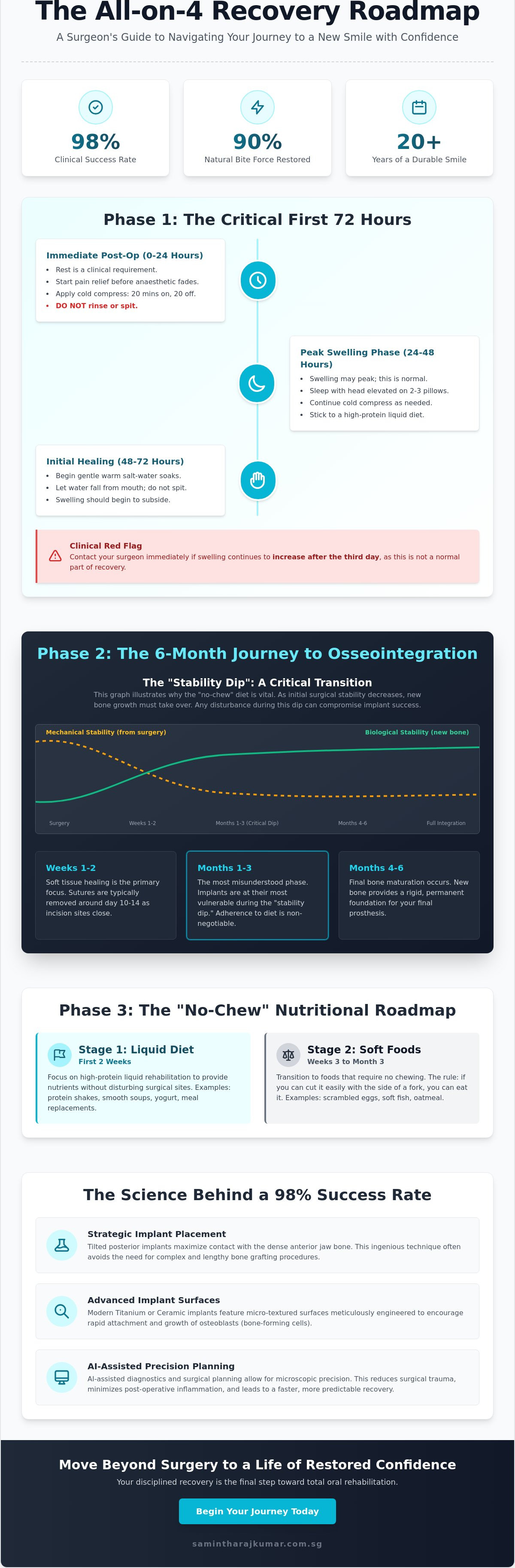
The first three days following your surgery represent a critical window where your body initiates the complex biological process of integration. In my clinical experience, the success of an all on 4 recovery is heavily influenced by how we manage the initial inflammatory response during this period. This isn't merely about patient comfort; it's about creating a stable environment for early cellular attachment. At Nuffield Dental, I use AI-assisted diagnostics to plan every implant placement with microscopic precision, which significantly reduces surgical trauma. However, the biological work begins the moment you leave the clinic.
From a biological perspective, the first 72 hours are about stability. Your body is working to secure the implants through a process called primary stability. Any excessive movement or disturbance to the surgical sites can jeopardise this. I often tell my patients that rest is a clinical requirement, not a luxury. By keeping your heart rate low and avoiding strenuous activity, you allow the blood clots to stabilise and the soft tissue to begin its initial closure. This period of stillness is the foundation of total rehabilitation.
Managing Discomfort and Swelling
Proactive management is always more effective than reactive treatment. I recommend starting your prescribed pain relief before the local anaesthetic fully wears off to maintain a consistent level of comfort. Swelling typically peaks around 48 to 72 hours post-surgery. To manage this, apply a cold compress to the external jaw area for 20 minutes at a time, followed by a 20-minute break, during the first 24 hours. Additionally, sleeping with your head elevated on two or three pillows helps reduce hydrostatic pressure in the facial tissues, which limits swelling and speeds up the initial healing phase. If you notice swelling that continues to increase after the third day, this is a clinical red flag that requires a professional review.
Immediate Oral Hygiene Protocols
Maintaining a sterile environment is essential, yet you must be incredibly gentle. For the first 24 hours, you must avoid all vigorous rinsing or spitting. This is vital because the suction created can dislodge the blood clots that are essential for healing. On the second day, I advise transitioning to very gentle salt-water soaks. Simply let the warm saline solution sit in your mouth and then let it droop out into the sink without force. This protocol keeps the surgical sites clean while the soft tissue settles around your temporary prosthesis, ensuring a seamless and predictable all on 4 recovery as you transition into the next phase of your rehabilitation.
The 6-Month Biological Journey: Understanding Osseointegration
Many patients view the months following surgery as a passive waiting game. In my clinical experience, this couldn't be further from the truth. Your all on 4 recovery is an active biological marathon where your bone tissue is constantly remodelling and strengthening. We call this silent phase osseointegration. It's the critical window where the titanium or ceramic surfaces of your implants become one with your living anatomy. This process isn't instantaneous; it requires a specific sequence of cellular events to ensure long-term success.
During weeks one and two, our primary focus is soft tissue healing. I typically remove sutures around day 10 or 14. By this point, the initial incision sites have closed, but the deeper work is just beginning. The period between month one and month three is often the most misunderstood. This is the "stability dip." Mechanical stability from the initial surgical placement begins to decrease as the bone around the implant softens. Simultaneously, new bone starts to form, building biological stability. This transition is why professional monitoring is vital. We must ensure the implants remain undisturbed while they are at their most vulnerable. By months four to six, final bone maturation occurs, providing the rigid foundation needed for your permanent smile.
The Science of Bone Fusion
From a biological perspective, osseointegration is the direct structural connection between living bone and the implant surface. The All-on-4 protocol is ingenious because it strategically utilises the dense bone in the anterior jaw. By tilting the posterior implants, we maximise bone contact and stability without needing extensive grafting. Modern implant surfaces are meticulously engineered. Whether we use titanium or ceramic implants, the surface is often micro-textured to encourage rapid cellular response. This ensures that osteoblasts, the cells responsible for bone formation, can attach and thrive effectively, leading to a success rate that remains between 95% and 98% in 2026.
Transitioning to the Final Prosthesis
I only move toward the final restorative phase once I've confirmed that stability is absolute. We check for a lack of mobility and ensure the soft tissue is healthy and contoured. During your final appointments, we replace the temporary bridge with a permanent, precision-milled zirconia or ceramic arch. This is the culmination of your journey. To understand the broader scope of this process, I recommend reviewing my Full Mouth Rehabilitation checklist for a detailed clinical perspective. Ensuring your all on 4 recovery stays on track requires a partnership between surgeon and patient. If you're ready to discuss a tailored plan for your smile, you can learn more about our specialist dental services.
Nutritional Rehabilitation: A Protocol for Safe Loading
In my clinical experience, the most challenging aspect of an all on 4 recovery isn't the surgical procedure itself, but the dietary discipline required in the months that follow. While the "Teeth in a Day" protocol provides immediate aesthetic results, these temporary teeth are primarily for appearance and speech during the initial healing phase. From a biological perspective, any premature mechanical stress can lead to micromovements. If an implant moves more than 100 microns during the early stages of osseointegration, the body may respond by forming fibrous tissue instead of bone, which can lead to implant failure. This is why I enforce a strict "No-Chew" rule to protect the integrity of your total rehabilitation.
As a clinician and founder, I view nutrition as a vital component of the surgical prescription. The goal isn't just to avoid damage, but to provide the building blocks your body needs for rapid tissue repair and bone fusion. Mechanical rest allows the primary stability we achieved during surgery to transition seamlessly into biological stability. By following a structured loading protocol, we ensure that your implants remain undisturbed during the critical stability dip that occurs between weeks three and six.
The First Two Weeks: Liquid Foundations
For the initial 14 days, your diet must consist entirely of high-protein liquids and very soft, non-chewable foods. Hydration is paramount, but you must avoid using straws. The suction created by a straw generates negative pressure in the oral cavity, which can dislodge blood clots and interfere with the early healing of the surgical sites. I recommend nutrient-dense smoothies, blended soups, and protein shakes. Managing the psychological aspect of this restriction is often the hardest hurdle. I encourage my patients to view this fortnight as a "metabolic reset" that prioritises systemic health and surgical success over immediate culinary variety.
The Soft Food Phase: Months 1 to 4
Once we've confirmed the initial soft tissue healing at your two-week review, you can transition to "fork-tender" foods. This includes anything you can easily mash with the side of a fork, such as flaky fish, scrambled eggs, well-cooked pasta, and soft avocados. It's essential to continue avoiding nuts, seeds, crusty breads, or anything with a "crunch." These textures require a grinding motion that puts lateral stress on the implants. I also advise my patients to practice bilateral chewing. By consciously distributing food to both sides of the mouth, you balance the force across the entire arch, preventing any single implant from being overloaded. This disciplined approach is what allows us to eventually restore up to 90% of your natural bite force once the final bridge is fitted. The best outcomes begin with understanding the root cause of healing, and in this case, patience is the ultimate clinical tool.
Addressing Common Concerns and Clinical Red Flags
In my clinical experience, the psychological weight of an all on 4 recovery can be as significant as the physical healing itself. It's perfectly natural to scrutinise every sensation in the days following surgery. While our 2026 success rates remain consistently high at 98%, distinguishing between expected healing and clinical red flags is essential for your peace of mind. For instance, bruising and swelling are normal inflammatory responses. However, if you experience a foul taste, persistent discharge, or a fever, these are signs that require immediate professional attention. These symptoms may indicate an early-stage infection that needs swift intervention to protect your investment.
As a clinician and founder, I leverage AI-powered planning and digital imaging to monitor your progress with extreme precision. We don't just rely on a visual inspection; we use comparative data to track bone density changes and soft tissue response over time. This level of oversight is why regular check-ups at a specialised dental clinic are non-negotiable. These visits allow us to intercept potential issues, such as minor prosthetic misalignments, before they compromise your total rehabilitation. The "Teeth in a Day" protocol offers a remarkable immediate transformation, but it's the professional monitoring during the following months that secures your long-term outcome.
When to Contact Your Surgeon
You should contact my team immediately if you experience persistent numbness beyond the first 24 hours. While some tingling is expected as the local anaesthetic wears off, prolonged loss of sensation can indicate nerve irritation that requires assessment. Another critical concern is mobility. Your temporary bridge should feel like a solid, immovable part of your anatomy. If you detect even the slightest movement in the prosthesis or the implants themselves, we need to address it instantly. Early intervention is also the key to managing peri-implantitis, an inflammatory condition that can affect the tissues surrounding the implants if oral hygiene isn't meticulously maintained.
Lifestyle Adjustments: Smoking and Activity
From a biological perspective, smoking is the single greatest risk factor for All-on-4 failure. It constricts blood flow and significantly impairs the body's ability to oxygenate healing tissues, increasing the risk of failure by nearly 10% in some clinical studies. Regarding physical activity, I advise patients to wait at least 7 to 10 days before returning to high-impact exercise. Increasing your heart rate too soon can cause throbbing at the surgical sites and lead to secondary bleeding. Long-term success is a commitment to both professional maintenance and personal discipline. If you have concerns about your current healing progress, our team is here to provide a comprehensive clinical assessment.
My Perspective: Total Rehabilitation and the Future of Your Smile
In my clinical experience, the months following surgery represent far more than a simple healing period. I view an all on 4 recovery as the vital bridge between a clinical intervention and a fundamentally transformed life. As a clinician and founder, I have witnessed the profound emotional shift that occurs when a patient moves from the anxiety of dental failure to the absolute confidence of a functional, beautiful smile. We are not merely replacing missing teeth with titanium and zirconia; we are restoring the person. This involves a holistic commitment to your systemic health, facial aesthetics, and long-term quality of life.
It is important to recognise that the All-on-4 dental implants cost in Singapore reflects this high level of specialised care and the sophisticated biological monitoring required for success. When you invest in this procedure, you are investing in a 20-year survival rate that exceeds 90% and a protocol designed to restore up to 90% of your natural bite force. This value is found in the meticulous planning, the use of AI-assisted diagnostics, and the peace of mind that comes from being under the care of a specialist team throughout your total rehabilitation.
Beyond the Surgery: A Life-Changing Result
Reflecting on the thousands of patients I have treated, the result is consistently life-changing. A successful all on 4 recovery allows you to engage with the world without the "barrier of fear" that often accompanies tooth loss. My philosophy centers on a holistic approach where we consider how your new smile supports your facial structure and overall well-being. I believe the All-on-4 protocol remains the gold standard for full-arch restoration because it provides immediate function while respecting the biological limits of the human jaw. It is a visionary solution that balances surgical innovation with predictable, long-term outcomes.
The Best Outcomes Begin with Understanding
I always encourage my patients to be active participants in their own healing. Your discipline during the nutritional phases and your commitment to oral hygiene are what transform a surgical success into a lifelong legacy. At Nuffield Dental, we take pride in our history of providing advanced surgical care that prioritises the patient journey as much as the technical execution. We remain dedicated to ecosystem-building in healthcare, ensuring that every patient benefits from international protocols and cutting-edge science. Ultimately, the right diagnosis and a structured recovery protocol change everything. The best outcomes begin with understanding the root cause.
Securing Your Legacy of Oral Health
Achieving a life-changing result through full-arch rehabilitation is a journey that extends well beyond the surgical chair. In my clinical experience, a successful all on 4 recovery is built on the foundation of biological understanding and patient discipline. We've explored how the first 72 hours set the stage for cellular attachment and how the six-month window of osseointegration demands professional monitoring to ensure long-term stability. By adhering to a structured nutritional protocol and recognising clinical red flags, you protect an investment designed to last for decades.
As a clinician and founder, my commitment is to provide global standards of excellence through Nuffield Dental. Whether we're utilising standard or zygomatic protocols, our goal is to restore your confidence through a seamless transition to total rehabilitation. I believe every patient deserves a visionary approach to care that prioritises both technical mastery and personal comfort. The best outcomes begin with understanding the root cause. Explore our approach to All-on-4 at Nuffield Dental.
Your journey toward a transformed smile is a path we walk together. With the right guidance and clinical expertise, you can look forward to a future defined by function, aesthetics, and lasting health.
Frequently Asked Questions
Is the All-on-4 recovery process painful?
Managed discomfort is expected, but acute pain is quite rare when following our prescribed protocols. In my clinical experience, most patients describe the sensation as a dull ache or pressure rather than sharp pain. By starting your pain relief medication before the local anaesthetic wears off, you can maintain a comfortable baseline. Most minor discomfort typically resolves within the first 5 to 7 days as the initial inflammatory response subsides.
Can I go back to work the day after All-on-4 surgery?
I recommend taking at least 3 to 5 days off to focus entirely on your recovery. While you may feel capable of working, your body needs to direct its energy toward early cellular attachment and tissue repair. Returning to a high-stress or physically demanding environment too soon can increase swelling and blood pressure. A short period of dedicated rest is a vital clinical requirement for a successful all on 4 recovery.
How long do I have to stay on a soft food diet after All-on-4?
You must adhere to a "fork-tender" soft food diet for approximately 3 to 4 months. This timeline is non-negotiable because it mirrors the biological process of osseointegration. We must protect the implants from micromovements during the stability dip, which occurs as the bone remodels. Once I've confirmed that the implants are fully integrated and we've fitted your final zirconia bridge, you can return to enjoying a full range of foods.
What happens if an All-on-4 implant fails during recovery?
If an implant fails to integrate, we typically remove it, allow the site to heal for a few months, and then place a new one. While the failure rate is low, approximately 2.17% according to 2026 clinical data, we are prepared for this possibility. Because the All-on-4 protocol uses strategic positioning, the temporary bridge often remains stable even if one site requires additional attention. My priority is always ensuring the long-term success of your total rehabilitation.
How do I clean my All-on-4 implants during the healing phase?
Cleaning begins with gentle salt-water soaks starting 24 hours after surgery. You must avoid vigorous brushing or water flossers near the surgical sites for the first two weeks to protect the delicate soft tissue. Once the initial healing is complete, I'll guide you on using a super-soft manual brush and specific interdental tools. Maintaining a sterile environment is essential to prevent peri-implantitis and ensure a seamless all on 4 recovery.
Can I smoke after getting All-on-4 dental implants?
You should ideally quit smoking entirely, or at the very least, abstain for 2 to 3 months post-surgery. Smoking is the single greatest risk factor for implant failure because it constricts blood flow and reduces oxygen levels in the bone. Clinical studies show that smoking can increase the risk of failure by nearly 10%. Protecting your investment requires a commitment to a healthy biological environment that allows for predictable bone fusion.
What is the success rate of All-on-4 full-arch rehabilitation?
The 10-year survival rate for All-on-4 implants is exceptionally high, ranging between 95% and 98%. With modern AI-assisted diagnostics and high-tier materials like zirconia, these results have become incredibly predictable. Long-term data from 2026 indicates that the 20-year survival rate remains over 90% when patients follow professional maintenance protocols. This high success rate makes it the gold standard for patients seeking a permanent solution to total tooth loss.
How much swelling is normal after the procedure?
Moderate swelling is a normal part of the healing process and typically peaks between 48 and 72 hours. You might also notice some minor bruising around the jawline or cheeks, which is expected. Using a cold compress for 20-minute intervals during the first 24 hours and sleeping with your head elevated will significantly reduce this. If you notice swelling that begins to increase after the fourth day, it's important to contact the clinic for a review.

Comments