
Zygoma: The Specialist’s Guide to Cheekbone-Anchored Dental Rehabilitation (2026)

The most stable foundation for your future smile isn't actually in your jaw; it's in the zygoma, or cheekbone. In my clinical experience, many patients arrive at my practice feeling defeated after being told they simply don't have enough bone for traditional implants. This diagnosis often leads to a deep fear of being stuck with loose dentures forever or the anxiety of facing years of complex, painful bone grafting procedures. I believe that total rehabilitation should be accessible even when the maxilla has significantly deteriorated.
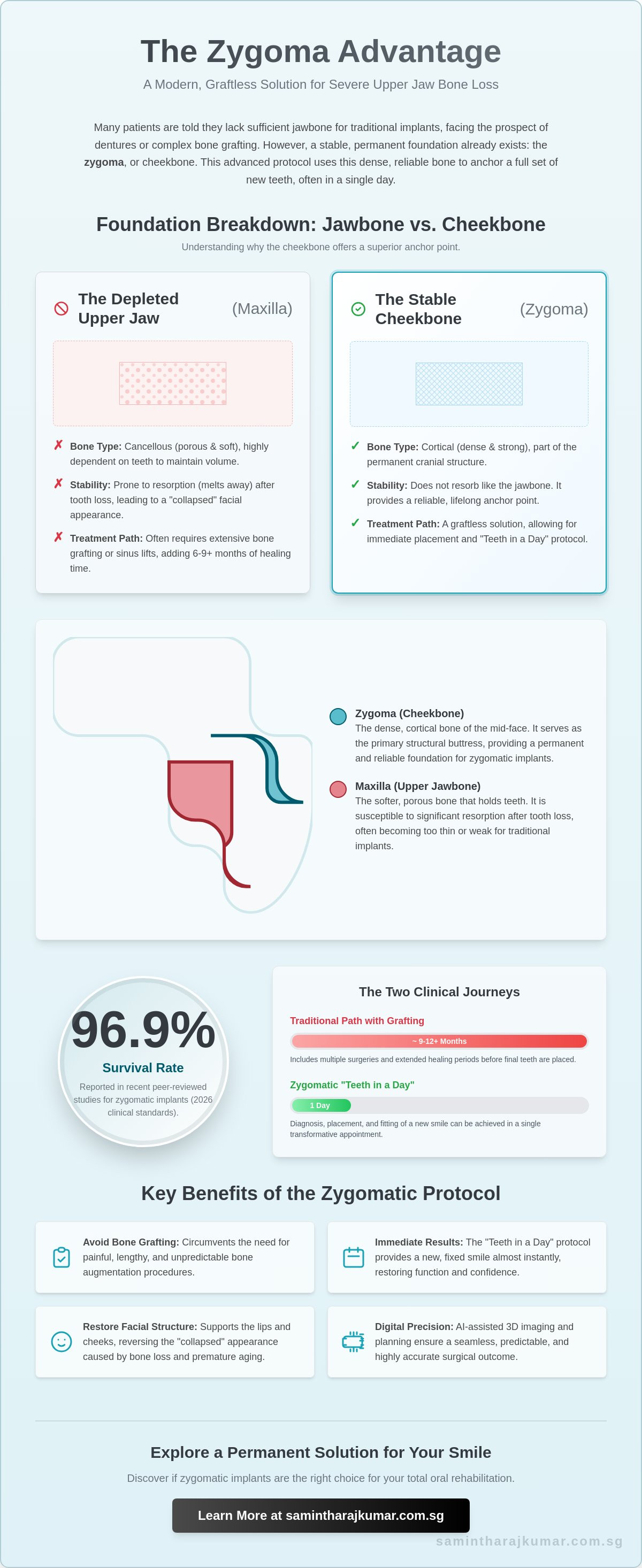
As a clinician and founder, I've seen how these specialised anchors serve as a sophisticated, graftless solution for those seeking a permanent transformation. This guide will explain how we use cheekbone-anchored protocols to achieve life-changing results without the need for traditional bone augmentation. We'll explore the latest 2026 clinical standards, including the 96.9% survival rate reported in recent peer-reviewed studies, and preview how our digital workflows ensure your journey toward a confident, stable smile is both seamless and predictable.
Key Takeaways
Understand why the zygoma offers a denser, more reliable anchor for dental rehabilitation than a depleted upper jaw.
Learn how zygomatic implants allow you to avoid the lengthy timelines and discomfort associated with traditional sinus lifts and extensive bone grafting.
Discover the role of AI-assisted 3D imaging in achieving the clinical precision necessary for a seamless "Teeth in a Day" transformation.
Recognise the biological reasons why the maxilla shrinks over time and how specialised protocols can restore your natural facial structure and confidence.
Explore my personal philosophy on total rehabilitation and why I believe every patient deserves a permanent solution, regardless of their current bone volume.
Table of Contents What is the Zygoma? Understanding the Anatomy of the Cheekbone When the Jawbone Fails: The Challenge of Severe Maxillary Atrophy Zygomatic Dental Implants: A Life-Changing Alternative to Bone Grafting The Clinical Journey: Precision Diagnostics and Specialist Placement My Perspective: Why Total Rehabilitation Begins with the Zygoma
What is the Zygoma? Understanding the Anatomy of the Cheekbone
The zygoma is far more than a contributor to facial symmetry. It is a paired bone of the human skull that forms the prominence of the cheek. The zygoma is the primary buttress of the mid-face. In my clinical experience, patients are often surprised to learn how it protects the eye and anchors the powerful muscles of mastication. By understanding the Anatomy of the Cheekbone, we can appreciate its role as a structural shield for the orbital contents and a crucial bridge for facial expression. While the jawbone is designed to support teeth, the zygomatic bone is designed to support the entire architecture of the face.
The Zygomatic Arch and Process
The zygomatic arch is a remarkable biological structure. It represents the junction of the temporal and zygomatic bones, creating a literal bridge across the side of the face. This arch is critical for facial aesthetics; it provides the "high cheekbone" look that many associate with youth and vitality. From a surgical standpoint, I distinguish between the malar bone, which is the main body of the cheek, and the zygomatic process. The process is the projection that reaches out to meet other cranial bones. This complex architecture ensures the mid-face remains stable under the immense pressure of chewing and protects the temporal muscle that sits beneath it. Its structural integrity remains even when the lower facial bones begin to change.
Why Bone Density Matters in the Zygoma
From a biological perspective, the zygoma is fundamentally different from the alveolar jawbone. The maxilla, or upper jaw, is largely cancellous; it is porous, soft, and highly dependent on the presence of teeth to maintain its volume. When teeth are lost, the maxilla often begins to melt away. In contrast, the zygoma is predominantly cortical bone. This means it is dense, hard, and incredibly strong.
I often describe the zygoma to my patients as 'basal bone'. This classification is vital because basal bone does not resorb like the jawbone does after tooth loss or long-term denture wear. It remains a permanent foundation for health. Because it is part of the stable cranial structure, it provides a predictable anchor point that doesn't disappear over time. This unique density is the reason why we can achieve such high success rates in total oral rehabilitation, even for patients who have been told they have 'no bone' left. It is a reliable, life-long asset in restorative dentistry.
When the Jawbone Fails: The Challenge of Severe Maxillary Atrophy
After tooth loss, the maxilla undergoes a natural but destructive process called resorption. Without the mechanical stimulation of tooth roots, the bone simply melts away. In my clinical experience, this often results in a scenario where there is insufficient height or width to support a standard dental implant singapore. While traditional approaches suggest a bone graft or sinus lift, these procedures often require six to nine months of healing before an implant can even be placed. For many, this represents a significant barrier to care and a long road of uncertainty.
From a biological perspective, relying solely on the maxilla when it has severely atrophied can lead to unpredictable outcomes. This is where the zygoma provides a more predictable alternative. A systematic review on zygomatic implant reliability confirms that anchoring into the cheekbone offers high success rates without the morbidity of extensive grafting. As a clinician and founder, I view maxillary atrophy not as a dead end, but as a clinical challenge that necessitates a more sophisticated, specialist intervention. We must look beyond the traditional jawbone to find a stable foundation.
The Clinical Consequences of Bone Loss
Bone loss isn't just a dental issue; it's a structural one. When the mid-face loses its foundation, it creates a "collapsed" appearance, prematurely ageing the patient by allowing the lips to sink and the chin to appear protruded. I see many individuals struggling with false teeth singapore that slip or cause painful ulcers because there is no ridge left to hold them. This instability leads to a restricted diet and a profound loss of self-esteem. Total rehabilitation aims to restore both function and the natural contours of the face, ensuring you can eat and speak with complete confidence once again.
Why Some Patients are Told 'No' to Implants
Many patients come to me after being told they aren't candidates for implants. Often, a general dentist identifies that the sinus cavity is too close to the gum line, leaving no safety margin for standard fixtures. The specialised equipment and training required for zygoma protocols are often absent in generalist practices. If you've been told "no" elsewhere, it's often because your case requires the advanced diagnostics and surgical mastery found in a specialist environment. Understanding the root cause is the first step toward a permanent solution.
In my experience, the emotional toll of being told you have "no bone" is immense. It creates a sense of hopelessness that you'll be stuck with dentures forever. However, modern maxillofacial techniques have evolved significantly. We don't just look at what's missing; we look at the surrounding anatomy to find a new, denser foundation. This shift from a bone-centric to an anatomy-centric philosophy is what allows us to deliver life-changing results for those who thought they were out of options.
Zygomatic Dental Implants: A Life-Changing Alternative to Bone Grafting
Zygomatic implants represent the pinnacle of complex oral rehabilitation. Unlike standard fixtures that rely on the alveolar jawbone, these are extra-long, specialised implants designed to bypass atrophied areas. They anchor directly into the zygoma. In my clinical experience, this approach is the most efficient way to restore a smile when the maxilla has significantly resorbed. These implants range from 30mm to 52.5mm in length, providing a level of stability that standard 10mm implants simply cannot match in a compromised jaw.
From a biological perspective, the cheekbone is an ideal host. It is immune to the resorption that typically follows tooth loss. This inherent stability allows us to utilise "immediate loading" protocols, often referred to as "Teeth in a Day". Instead of waiting six months for a bone graft to heal, we can often fit a fixed, functional bridge within 24 hours of surgery. This drastically reduces the total treatment timeline. As a clinician and founder, I've seen how this efficiency transforms the patient experience, replacing months of uncertainty with immediate, life-changing results.
Zygomatic vs. Traditional Implants
The biomechanical advantages are clear. Anchoring in dense cortical bone provides superior torque, which is the primary requirement for immediate loading. This means you don't have to wear removable dentures while waiting for healing. The transition is seamless, professional, and designed for long-term endurance.
The 'No Bone' Solution for Total Rehabilitation
The Clinical Journey: Precision Diagnostics and Specialist Placement
Success in complex rehabilitation isn't just about surgical skill; it's about the data we gather before the first incision. In my clinical experience, the path to a stable smile begins with high-resolution 3D Cone Beam Computed Tomography (CBCT). This allows us to map the zygoma with absolute clarity, identifying the dense bone corridors that will support your new foundation. We look beyond the surface to understand the unique topography of your skull, ensuring that every implant is placed in the most biologically sound position.
From a biological perspective, the precision of this mapping is what prevents complications. By identifying the exact boundaries of the maxillary sinus and the orbital floor, we can navigate these delicate areas with total confidence. As a clinician and founder, I've seen how this meticulous preparation lowers the "barrier of fear" for patients, replacing anxiety with the security of a well-defined plan. The transformation begins long before you enter the surgical suite.
Step 1: The Digital Blueprint
We don't leave anything to chance in 2026. I've integrated AI-assisted diagnostics into our workflow to ensure sub-millimetre precision during the planning phase. This technology analyzes bone density in real-time, allowing us to virtually plan the implant trajectory to avoid vital nerves and the sinus cavities. We then translate this digital plan into reality using custom-milled surgical guides. These guides act as a literal GPS for the surgery, ensuring the zygoma is engaged at the perfect angle for maximum stability. When choosing a dental clinic, it's essential to look for these advanced imaging capabilities, as they are the hallmark of modern specialist care.
Step 2: The Surgical Protocol
The surgical experience itself is designed for total comfort. Most of my patients opt for IV sedation or general anaesthesia, ensuring they remain relaxed and unaware of the complexities of the procedure. We perform these surgeries in a strictly controlled, sterile specialist environment, adhering to the highest international protocols for maxillofacial surgery. My "Total Rehabilitation" philosophy means we address function and aesthetics simultaneously. While the implants are anchored, our laboratory team crafts a high-quality provisional bridge. This is the essence of "Teeth in a Day". You wake up with a fixed set of teeth that immediately restores your facial structure and your confidence.
The immediate post-operative phase is a period of rapid transformation. While some minor swelling is expected, the psychological shift of leaving the clinic with a secure, non-removable smile is profound. It's the final end to the era of loose dentures and dietary restrictions. Consult with our specialist team to map your journey toward total oral rehabilitation.
My Perspective: Why Total Rehabilitation Begins with the Zygoma
In my clinical experience, the zygoma remains the most underutilised asset in restorative dentistry. While many practitioners focus on the limitations of a depleted jawbone, I look upward to the cheekbone's enduring strength. As a clinician and founder, I believe every patient deserves a permanent solution, regardless of their current bone volume. We shouldn't settle for the compromise of removable dentures when modern science offers a fixed, biological alternative. My goal is to bridge the gap between perceived impossibility and clinical reality.
Providing this level of surgical care in Singapore is part of a larger "nation-building" perspective. I want to ensure our patients have access to global standards of excellence without needing to travel abroad. By establishing a specialised centre for complex maxillofacial rehabilitation, we contribute to a healthcare ecosystem that values ethical scale and technological innovation. It's about creating a legacy of care that transforms lives within our community. Total rehabilitation is the standard we should all strive for.
The Philosophy of the Nuffield Legacy
My commitment to the Nuffield legacy is rooted in the adherence to international protocols, specifically the Malo Clinic standards. From a biological perspective, I prioritise health-centric outcomes, incorporating ceramic implants and metal-free options where appropriate to align with a holistic view of dentistry. Looking toward the future, I'm excited about the continued evolution of AI-driven diagnostics. By May 2026, our ability to simulate surgical outcomes with sub-millimetre precision has reached a level that ensures total predictability for every patient. This marriage of technology and surgical mastery is the future of the zygoma protocol.
A Life-Changing Transformation
The shift I see in my patients after rehabilitation is as much psychological as it is physical. They move from a state of constant anxiety about their teeth to a life defined by quiet confidence. It's important to recognise that the dental implant cost singapore represents an investment in a lifelong foundation. This isn't just a temporary fix; it's a structural restoration that allows you to eat, speak, and smile without fear for decades to come.
Ultimately, my work is about restoring a person's sense of self and their quality of life. A stable smile is the cornerstone of social and nutritional health. When we secure the foundation, we secure the future. The best outcomes begin with understanding the root cause.
Empowering Your Future with Total Rehabilitation
Choosing to look beyond a depleted jawbone is the first step toward a permanent, functional smile. We've explored how the zygoma provides a biologically stable foundation that traditional implants cannot match, allowing for immediate loading and a seamless transition to new teeth. As a specialist in Zygomatic and Pterygoid protocols, I've dedicated my career to refining these complex procedures to ensure they're accessible to those who were once told their cases were impossible.
As the founder of Nuffield Dental Holdings, I've built a practice where clinical mastery meets AI-assisted maxillofacial diagnostics. This combination ensures that your treatment is planned with sub-millimetre precision, prioritising your long-term well-being and comfort. My philosophy is simple: total rehabilitation should be a life-changing experience that restores your ability to eat, speak, and smile with absolute certainty. The right diagnosis changes everything. Begin your journey toward total rehabilitation with Dr Samintharaj Kumar. Your path to a confident, stable future starts with understanding the unique potential of your own anatomy.
Frequently Asked Questions
Can I get dental implants if I have no jawbone left?
Yes, total rehabilitation is possible even with zero remaining alveolar bone. By using the zygoma as an anchor point, we bypass the atrophied maxilla entirely. In my clinical experience, this is the definitive solution for patients who've worn dentures for decades or suffered from severe periodontal disease. We utilise the dense, stable bone of the cheeks to provide the support that your jaw can no longer offer.
Are zygomatic implants more painful than traditional ones?
The surgical experience is remarkably comfortable because we perform the procedure under intravenous sedation or general anaesthesia. From a biological perspective, the cheekbone has fewer sensory nerve endings than the soft tissues of the gum. Most patients report that the post-operative recovery is very similar to standard implant surgery. My focus is always on ensuring a seamless, pain-free transition to your new smile.
How long do zygomatic implants last?
These implants are engineered to be a permanent, lifelong solution for your oral health. Because they're anchored in dense cortical bone that doesn't resorb, they provide a much more stable long-term foundation than traditional fixtures in a thin jaw. While the prosthetic bridge may require maintenance after 15 or 20 years, the titanium anchors themselves are designed to last for the rest of your life.
What is the success rate of zygoma-anchored dental rehabilitation?
The success rate for this specialist procedure is exceptionally high, with long-term survival rates exceeding 95% in most clinical literature. A retrospective study published in January 2026 tracked patients over an average of 67 months and found a survival rate of 96.9%. As a clinician and founder, I attribute these results to meticulous digital planning and the use of AI-assisted diagnostics to ensure perfect placement.
Is a sinus lift better than getting zygomatic implants?
A sinus lift is a traditional regenerative approach, but zygomatic implants are often a superior choice for those wanting faster results. Sinus grafting requires multiple surgeries and a six to nine-month waiting period for bone maturation. In contrast, the zygomatic protocol allows for "Teeth in a Day," providing immediate function and aesthetics. I prefer this graftless approach because it reduces the overall surgical burden on the patient.
How much do zygomatic dental implants cost in Singapore for 2026?
While I don't provide fixed estimates without a clinical consultation, global market data for 2026 indicates that full-arch zygomatic rehabilitation typically ranges from $35,000 to $55,000 per arch in high-tier medical hubs. This reflects the complexity of the surgery, the specialised titanium hardware, and the advanced digital workflows required. In Singapore, this is viewed as a premium investment in your long-term quality of life and facial structure.
What happens if a zygomatic implant fails?
If an implant fails to integrate, we typically remove it and allow the site to heal before considering a replacement or an alternative anchor. Failure is rare, occurring in less than 4% of cases according to recent 2025 market analysis. In my experience, early detection through our rigorous follow-up protocols allows us to manage any issues before they affect the stability of your bridge. The best outcomes begin with understanding the root cause.
Who is the ideal candidate for a 'Quad Zygoma' procedure?
The ideal candidate for a Quad Zygoma is someone with severe bone loss across the entire upper arch who cannot support standard fixtures. This often includes patients who've been told they're "not a candidate" for dental implants elsewhere. It's a visionary solution for total maxillary atrophy, providing a fixed set of teeth when no other biological foundation remains in the jaw. The right diagnosis changes everything.

Comments