
Beyond the Scalpel: Alternatives to Traditional Gum Grafting

What if the path to reversing gum recession didn't require the invasive "harvesting" of tissue from the roof of your mouth? In my clinical experience, patients often seek alternatives to traditional gum grafting because they feel a profound sense of anxiety regarding the discomfort of a second surgical site on the palate. It's a valid concern that frequently leads people to delay necessary care. You deserve a solution that respects your biological integrity while delivering the aesthetic and functional results you expect from a specialist practice.
I want to show you how modern biological dentistry and minimally invasive techniques like the Chao Pinhole® Surgical Technique offer a more comfortable path to restoring gum health. By prioritising these advanced protocols, we can now stimulate your body’s innate regenerative potential without the need for extensive incisions or sutures. This guide explores how we move beyond the scalpel to achieve a balanced, healthy smile with significantly less downtime. We'll look at the science of these biological treatments and how identifying the root cause of your recession ensures a result that truly lasts.
Table of Contents
The Science of Gum Recession: Why Biological Integrity Matters
The Evolution of Periodontal Care: Moving Beyond Traditional Grafts
Modern Alternatives: Laser Therapy and the Chao Pinhole® Surgical Technique
Assessing Candidacy: Is a Minimally Invasive Approach Right for You?
My Perspective: A Holistic Approach to Total Oral Rehabilitation
The Science of Gum Recession: Why Biological Integrity Matters
In my clinical experience, many patients initially view gum recession as a purely cosmetic concern. I prefer to define it more accurately as a loss of protective biological barriers. When the gum line retreats, it exposes the underlying root surface, which lacks the resilient enamel found on the crown of the tooth. This isn't just a "toothy" smile; it's a structural failure that leaves the tooth's foundation vulnerable to external stressors. While aggressive brushing is frequently cited as the cause, I've found that recession is often a symptom of deeper structural imbalances. The relationship between jaw structure and facial aesthetics is profound, and if we don't address these underlying issues, even the most advanced alternatives to traditional gum grafting may only provide a temporary solution.
As a clinician and founder, I'm particularly concerned with how recession affects long-term restorative success. For instance, the longevity of a dental implant singapore depends heavily on the quality of the surrounding soft tissue. Without a robust biological seal, the implant remains susceptible to inflammation and bone loss. Understanding why the recession occurred is the first step toward a total oral rehabilitation that stands the test of time.
The Clinical Consequences of Untreated Recession
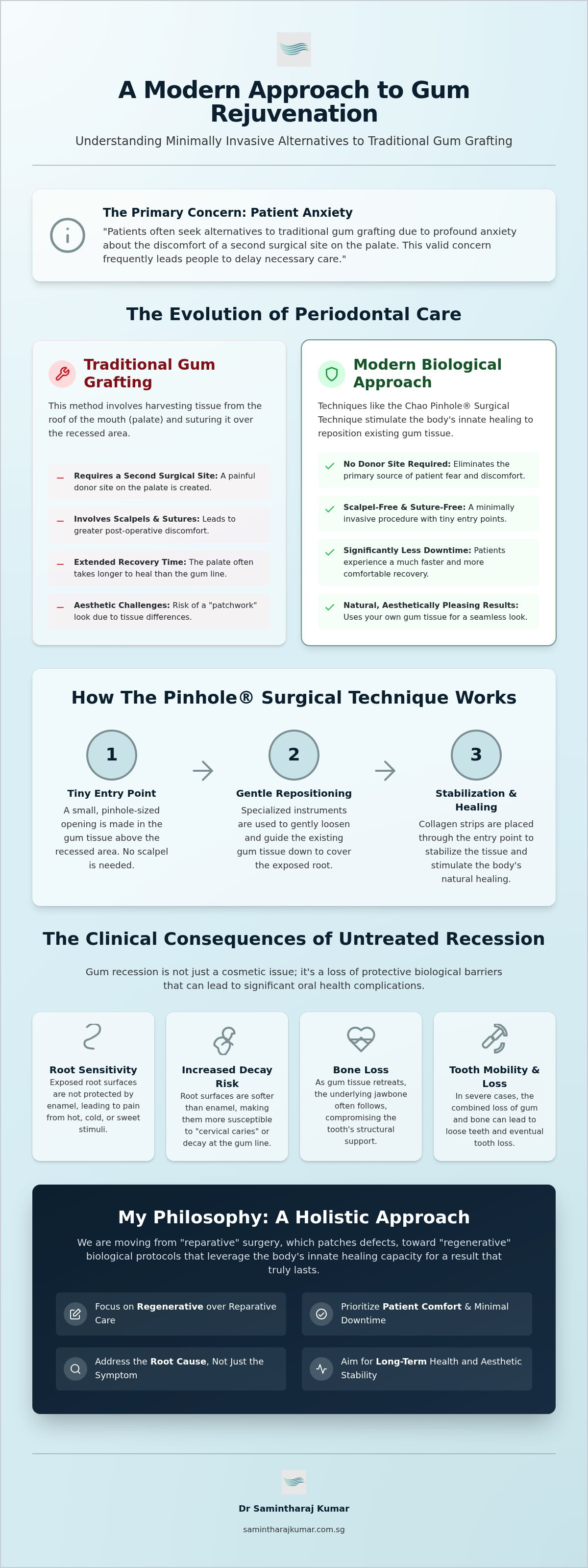
Ignoring receding gums leads to significant clinical complications. Root sensitivity is often the first sign, followed by an increased risk of cervical caries, which is decay occurring at the gum line. As the soft tissue retreats, the underlying bone often follows suit. This bone loss can eventually lead to tooth mobility and, in severe cases, tooth loss. Beyond the functional risks, the impact on the "pink aesthetic" is substantial. A harmonious smile requires a balanced frame of healthy gum tissue. When this frame is uneven, it compromises the patient's confidence and the overall outcome of any smile makeover.
From a Biological Perspective: The Role of Soft Tissue
From a biological perspective, we must distinguish between attached gingiva and alveolar mucosa. The attached gingiva is the firm, keratinised tissue that is bound tightly to the bone. The alveolar mucosa is the looser, darker tissue that allows for movement of the lips and cheeks. Maintaining a thick band of keratinised tissue is essential for oral health because it acts as a resilient seal. This seal protects the tooth or implant from bacteria and mechanical trauma. Historically, Traditional Gum Grafting was the standard method for restoring this tissue, but modern biological dentistry now allows us to achieve these goals with far greater patient comfort.
The Evolution of Periodontal Care: Moving Beyond Traditional Grafts
For decades, traditional gum grafting was considered the only viable solution for recession. This method typically involves a connective tissue graft, where a piece of tissue is harvested from the roof of the mouth and sutured over the exposed root. While effective, it necessitates a "second surgical site" on the palate. In my clinical experience, the fear of this harvesting process is the primary reason patients avoid treatment. They aren't just afraid of the procedure; they are anxious about the morbidity of the donor site and the recovery that follows. As a clinician and founder, I've seen how this fear prevents patients from seeking essential care, often until the recession has reached a critical stage.
We are currently witnessing a fundamental shift in periodontal philosophy. We are moving away from merely "reparative" surgery, which focuses on patching a defect, toward "regenerative" biological protocols. These advanced alternatives to traditional gum grafting leverage the body's innate healing capacity. By choosing techniques that work with biology rather than against it, we can achieve profound results while maintaining the highest levels of patient comfort.
The Limitations of the Traditional Approach
Traditional approaches have clear drawbacks that often deter patients. Recovery times are extended because the palate frequently takes longer to heal than the gum line itself. There's also the aesthetic challenge of the "patchwork" look. Harvested tissue may have a different thickness, colour, or texture compared to the native gums, which can be particularly noticeable during a smile makeover. Furthermore, treating multiple sites of recession in a single session using traditional methods is often too traumatic for the patient, necessitating multiple appointments spread over several months.
The Shift Toward Minimally Invasive Dentistry
Modern periodontal care is now defined by micro-surgical precision. Advancements in specialised instruments allow us to manipulate tissue through tiny entry points, often no larger than a pinhole. The integration of growth factors and biocompatible materials further enhances the body's ability to regenerate lost tissue. Evidence supports this shift toward gentler care. A 10-year evaluation of the Pinhole Surgical Technique highlights how these advancements provide stable, long-term results while significantly reducing surgical trauma. By adopting these alternatives to traditional gum grafting, we establish a new standard for total rehabilitation. We focus on the entire patient journey, ensuring that the path to a healthy smile is as sophisticated as it is restorative. The best outcomes begin with understanding the root cause of your recession.
Modern Alternatives: Laser Therapy and the Chao Pinhole® Surgical Technique
The future of periodontal care isn't found in a scalpel; it's found in the refinement of biological access. In my clinical experience, the Chao Pinhole® Surgical Technique stands as one of the most significant alternatives to traditional gum grafting available today. Unlike conventional methods that require large incisions and tissue harvesting, this technique allows me to treat multiple teeth through a single, tiny entry point. By eliminating scalpels and sutures, we drastically reduce the physiological stress on the patient. Most of my patients find they can return to their normal daily routines within 24 hours, a stark contrast to the weeks of discomfort often associated with palatal harvesting.
As a clinician and founder, I view these advancements as part of a broader shift toward patient-centred innovation. We aren't just covering a root; we're restoring the mouth's natural architecture with minimal disruption. This approach allows for a level of precision and comfort that was previously unattainable in complex oral rehabilitation.
The Chao Pinhole® Surgical Technique Explained
This method utilises specialised instruments designed to gently loosen the existing gum tissue from within. Once loosened, the tissue is carefully glided over the exposed roots to restore the natural gum line. To ensure stability during the initial healing phase, I place small collagen strips through the entry point. These strips act as a biological scaffold, supporting the tissue as it reattaches to the tooth. This approach is particularly effective for full-arch rejuvenation, where treating the entire smile in a single session would otherwise be too invasive for the patient to endure comfortably.
Laser Periodontal Therapy: A Biological Reset
Before we can rejuvenate the gum line, we must ensure the biological foundation is healthy. From a biological perspective, active infection or inflammation will compromise any restorative effort. This is where laser therapy becomes essential. Lasers allow me to selectively target and vaporise diseased tissue and bacteria without harming the healthy gums surrounding them. It's a precise, decontamination-focused "cleaning of the slate."
Beyond decontamination, the laser stimulates blood flow and triggers the body’s natural healing response through a process known as photobiomodulation. This "biological reset" is a cornerstone of my approach to cosmetic dentistry singapore. By integrating laser care with the Pinhole technique, we provide a comprehensive framework that addresses both the underlying infection and the physical recession. It's about moving beyond simple repairs to achieve a state of functional excellence and enduring health.
Assessing Candidacy: Is a Minimally Invasive Approach Right for You?
While the benefits of modern alternatives to traditional gum grafting are significant, I always emphasise to my patients that clinical success is rooted in biological readiness. Not every patient is an immediate candidate for regenerative techniques. In my clinical experience, the most enduring results occur when we treat the mouth as an integrated system rather than a collection of isolated teeth. We must ensure the biological environment is stable before we begin the process of rejuvenation. This often involves "cleaning the slate" by addressing any active periodontal disease or inflammation that could compromise the healing of newly positioned tissue.
As a clinician and founder, I utilise AI-assisted diagnostics to bring a new level of precision to the planning phase. These tools allow us to analyse the exact volume of tissue required for restoration and predict how the gums will respond to minimally invasive manipulation. By combining this data with 3D imaging, I can map out a personalised treatment plan that respects your unique anatomy. This meticulous approach is what distinguishes a specialist practice from generalist care; we don't just aim for a "patch"; we aim for total biological integration.
Prerequisites for Pinhole and Laser Success
Success in regenerative gum surgery requires several key factors to align. First, there must be an adequate thickness of remaining gum tissue to work with. If the tissue is too thin or entirely absent, we may need to discuss alternative restorative paths. Systemic health also plays a vital role. Smoking, for instance, significantly impairs blood flow and the body's ability to produce collagen, which is why I require a commitment to a cessation programme before proceeding. Finally, I always search for the root cause of the recession. If aggressive brushing or bruxism (teeth grinding) is the culprit, these habits must be corrected to ensure the recession doesn't return after treatment.
What to Expect During the Consultation
During your consultation, we use high-definition 3D imaging to assess both your bone levels and tissue topography. This is a critical step because gum health is inextricably linked to the underlying bone structure. We will also discuss the long-term impact of your dental health on your overall appearance, including preventing facial collapse with dental implants should tooth loss be a factor. Every mouth is different, and your treatment mapping will be entirely bespoke. My goal is to provide a clear, logical progression from diagnosis to restoration. The best outcomes begin with understanding the root cause of your specific condition.
My Perspective: A Holistic Approach to Total Oral Rehabilitation
As a clinician and founder, I've always believed that the most successful outcomes in dentistry are those that respect the body's natural design. In my clinical experience, we often treat the mouth as a series of mechanical problems to be solved. However, the future of surgery is found in biology. I view gum health as the "frame" for the masterpiece of a reconstructed smile. Without a healthy frame, even the most beautiful restorative work loses its impact. This is why I've prioritised finding the best alternatives to traditional gum grafting for our patients. It's about total rehabilitation that considers your long-term well-being alongside technical excellence.
From a biological perspective, the integration of Nuffield Dental’s global standards into every local patient’s care plan ensures a level of consistency and security that is rare in generalist practices. We don't just aim to cover an exposed root; we aim to restore the biological integrity of the entire oral environment. Choosing minimally invasive care has a profound impact on a patient’s overall quality of life. It replaces the dread of surgery with the confidence that they are in capable, experienced hands, prioritising comfort as much as clinical success.
Innovation and the Patient Journey
I invested in the Chao Pinhole® Surgical Technique for our clinics because it represents a visionary leap in patient care. By adopting this protocol, we've transformed the patient journey from one of surgical anxiety to one of predictable comfort. Continuous education and maintaining international clinical protocols are hallmarks of our practice. We don't just follow trends; we set benchmarks for care. Reflecting on the transformative power of a healthy smile, I've seen how it restores not just a person's oral function, but their entire social presence and self-esteem.
The Future of Periodontal Rejuvenation
The potential of growth factors and even stem cell therapy in future gum care is a topic that deeply excites me. These biological tools will allow us to push the boundaries of what is possible in soft tissue regeneration. As we continue to build a legacy of excellence in Southeast Asian healthcare, our focus remains on innovation that serves the patient first. Choosing alternatives to traditional gum grafting is a strategic decision to embrace the future of medicine. Ultimately, the best outcomes begin with understanding the root cause. When we address the source of recession, we ensure that the beautiful results we achieve today are built on a foundation that lasts a lifetime.
Restoring Your Smile with Biological Precision
The evolution of periodontal care has moved us toward a future where comfort and clinical excellence are no longer mutually exclusive. By prioritising biological integrity through alternatives to traditional gum grafting, such as the Chao Pinhole® Surgical Technique and specialised laser therapy, we can restore the natural architecture of your gums without the trauma of traditional surgery. As a clinician and founder, I've dedicated my career to complex full-mouth restorations that respect the body's innate healing potential.
My practice is built on the belief that a healthy smile is the foundation of overall well-being. We combine global clinical standards with a deeply personal approach to ensure your journey is as seamless as the results. Whether we're addressing sensitivity or preparing a stable base for ceramic implants, the focus remains on long-term functional aesthetics and your quality of life. The best outcomes begin with understanding the root cause. Explore our approach to Total Rehabilitation.
I look forward to helping you rediscover the confidence that comes with a healthy, balanced smile.
Frequently Asked Questions
Is Pinhole surgery as permanent as a traditional gum graft?
Pinhole surgery is designed to be a long-term solution comparable to traditional grafting. Because the technique repositions your existing tissue rather than relying on a separate graft, it integrates naturally with the surrounding area. In my clinical experience, the longevity of the result depends heavily on maintaining excellent oral hygiene and addressing the underlying causes of the original recession, such as bruxism or aggressive brushing habits.
How long is the recovery time for non-surgical gum rejuvenation?
Recovery from minimally invasive alternatives to traditional gum grafting is remarkably swift. Most patients return to their normal daily activities within 24 hours of the procedure. Unlike traditional surgery, there are no large incisions or sutures to heal. You may experience minor swelling or sensitivity for a few days, but the absence of a painful donor site on the palate significantly improves the overall post-operative experience.
Does the Chao Pinhole technique hurt during the procedure?
The procedure is performed under local anaesthetic, ensuring you remain comfortable throughout the session. While you might feel some minor pressure as the tissue is gently repositioned, you should not experience pain. As a clinician and founder, I prioritise patient comfort; many of my patients find the process far less intimidating than they initially feared. The lack of scalpels and sutures naturally minimises intra-operative trauma.
Can I get gum rejuvenation if I have dental implants?
Yes, restoring gum health around dental implants is often essential for their long-term stability. A robust band of healthy tissue acts as a biological seal, protecting the implant from bacteria and inflammation. Whether you have ceramic dental implants or traditional systems, we can adapt these minimally invasive techniques to rejuvenate the soft tissue around the restoration, ensuring the functional and aesthetic success of your total rehabilitation.
What is the cost difference between Pinhole surgery and traditional grafting?
The cost of Pinhole surgery is generally comparable to traditional grafting when treating individual teeth. However, the value becomes more apparent when treating multiple sites in a single session. Because we don't need to harvest donor tissue or manage a second surgical site, the process is often more efficient. I recommend a comprehensive consultation to assess the complexity of your case and provide a bespoke, personalised treatment map.
Are there any risks associated with laser gum treatment?
Laser gum treatment is exceptionally safe when performed by a certified specialist. The primary risks, though rare, include temporary sensitivity or minor swelling. Because lasers selectively target diseased tissue while preserving healthy gums, the risk of collateral damage is significantly lower than with traditional surgery. From a biological perspective, using light energy to decontaminate the area actually reduces the risk of post-operative infection and stimulates natural healing.
How many teeth can be treated in one session of Pinhole surgery?
One of the greatest advantages of this technique is the ability to treat an entire arch, or even the whole mouth, in a single session. Traditional grafting often requires multiple appointments because harvesting tissue from the palate is limited and traumatic. With the Pinhole technique, we can rejuvenate multiple teeth efficiently, allowing you to achieve a balanced, healthy smile without the need for repeated surgical interventions over several months.
Will my gums recede again after an alternative treatment?
Gums can recede again if the original cause of the recession is not addressed. While alternatives to traditional gum grafting effectively restore the gum line, they don't change the underlying habits that led to the problem. I focus on identifying the root cause, whether it's teeth grinding, misaligned teeth, or improper brushing. By managing these factors alongside the rejuvenation, we ensure the longevity of your restored biological barriers.


Comments