
Wisdom Tooth Surgery in Singapore: A Specialist Surgeon’s Perspective on Oral Rehabilitation

Most patients view the removal of a third molar as a painful rite of passage, yet I've always seen it as a vital strategic intervention for the longevity of your smile. I understand that the prospect of wisdom tooth surgery singapore often brings a wave of apprehension, from the fear of post-operative swelling to the complex anxieties surrounding potential nerve proximity. It's a significant medical step. It's perfectly natural to feel hesitant when you're balancing clinical necessity against the desire for a seamless, pain-free recovery.
In this article, I'll share my perspective as a specialist surgeon on why precision matters at every stage of the process. You'll gain a clear understanding of the clinical indicators for surgery, the advanced surgical protocols I use to safeguard your wellbeing, and the structured recovery pathways that ensure minimal downtime. We'll also address the practicalities of navigating Medisave claims and total costs, providing the clarity you need to move forward with absolute confidence in your oral rehabilitation journey.
Table of Contents
The Burden of Impacted Wisdom Teeth: Understanding the Clinical Problem
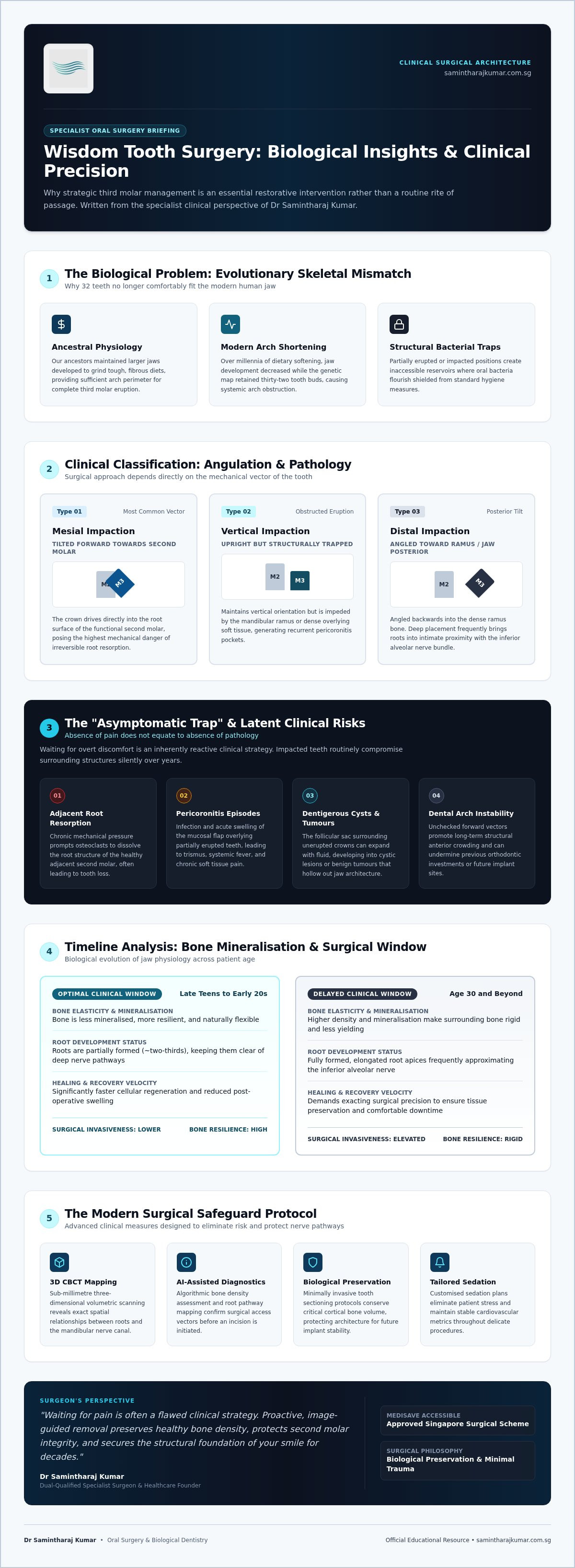
In my clinical experience, the arrival of third molars, or wisdom teeth, often represents a biological conflict between our evolutionary past and our modern physiology. As our diets have softened and our jaw sizes have reduced over millennia, the space required for these final four teeth has diminished. This mismatch frequently leads to impaction, where the tooth is unable to erupt into its functional position. When you consider wisdom tooth surgery singapore, it's vital to view it not as a standard extraction, but as a corrective measure for a structural imbalance.
Many patients arrive at my clinic only once they experience the sharp distress of pericoronitis, an inflammation of the gum tissue surrounding a partially erupted tooth, or a persistent, dull ache in the posterior jaw. However, waiting for these symptoms to manifest is often a reactive approach that overlooks the silent damage occurring beneath the surface.
To better understand the clinical nature of this procedure, watch this helpful video from the National Dental Centre Singapore:
The clinical presentation of these teeth varies significantly. We typically categorise them based on their angulation: mesial (tilted forward), distal (tilted backward), or vertical (upright but stuck). Understanding the impacted wisdom teeth classification and pathology is essential for planning a precise surgical approach that minimises trauma to the surrounding bone and nerves. When we plan your wisdom tooth surgery singapore, we look far beyond the immediate discomfort to ensure the long-term stability of your entire dental arch.
Why Impaction Happens: A Biological Perspective
The core issue lies in the developmental mismatch between our modern skeletal structure and our dental map. While our ancestors required large jaws for a fibrous diet, modern humans often lack the arch length to accommodate thirty-two teeth. This creates "food traps" in partially erupted or soft tissue impactions, where bacteria thrive in areas that are impossible to clean. Fundamentally, impaction is a structural obstruction within the dental arch rather than a simple error in growth.
The Asymptomatic Trap
What many patients don't realise is that the absence of pain doesn't equate to the absence of pathology. Impacted teeth can silently cause the resorption of the roots of adjacent second molars, leading to the loss of perfectly healthy teeth. In neglected cases, we also see the development of dentigerous cysts or even tumours within the jawbone. Relying on pain as a signal for intervention is a dangerous clinical strategy that often leads to more complex oral rehabilitation later in life. This is why I advocate for early specialist screening to protect your functional health.
Clinical Consequences: Why Delayed Intervention Matters
In my clinical experience, patients often operate under the misconception that a lack of pain equates to a lack of pathology. This "wait and see" approach is frequently a flawed strategy. From a biological perspective, the consequences of delaying wisdom tooth surgery singapore can be both profound and irreversible. One of the most significant risks I observe is root resorption of the adjacent second molars. When an impacted tooth exerts constant pressure against its neighbour, it can trigger a process where the body begins to break down the healthy root structure of the functional tooth. By the time a patient feels discomfort, the structural integrity of that second molar may already be compromised.
The complexity of the procedure also evolves as we age. In our late teens and early twenties, the jawbone is less mineralised and the roots of the third molars are often not fully formed. This makes the surgery less invasive and the recovery significantly faster. As we progress into our thirties and beyond, bone density increases. This higher mineralisation makes the bone less flexible, requiring greater surgical precision and often leading to increased post-operative swelling. There's also the systemic factor to consider. Chronic oral inflammation from a partially erupted tooth isn't just a local nuisance. It adds to the body's total inflammatory load, which we now understand has broader implications for long-term systemic health.
Structural Integrity and Dental Crowding
Impacted wisdom teeth often act as a disruptive force within the dental arch. They exert a mesial pressure that can lead to late-onset crowding, even in patients who have previously completed orthodontic treatment. If you are planning for future cosmetic dentistry singapore, maintaining the alignment of your arch is a critical prerequisite. Functionally, this affects the balance of your bite and the longevity of any aesthetic restorations. A stable, well-aligned foundation is essential for any comprehensive smile design.
The Complexity of the Inferior Alveolar Nerve
This is where precision matters most. The roots of the lower wisdom teeth sit in close proximity to the inferior alveolar nerve, which provides sensation to the lower lip and chin. As these roots mature, they often develop "hooks" or curves that can wrap around the nerve canal. Delaying surgery allows these roots to fully develop, which complicates the extraction and increases the risk of sensory changes. The SingHealth guide to impacted wisdom teeth highlights that early intervention is the most effective way to mitigate these anatomical risks. In my practice, I use advanced 3D mapping to visualise these relationships with sub-millimetre accuracy. If you're concerned about the positioning of your third molars, a detailed clinical assessment can help us plan a path that prioritises your long-term safety and comfort.
My Philosophy: Precision Oral Surgery and Biological Integrity
In my clinical experience, the real differentiator between a routine extraction and a specialist surgical intervention lies in the underlying philosophy of the practitioner. I've always believed that wisdom tooth surgery singapore should be approached as a foundational step in a patient’s journey toward total oral rehabilitation. My "biological first" approach prioritises the preservation of healthy tissue and the long-term integrity of the jawbone. We aren't merely removing a tooth. We are safeguarding the functional aesthetics of your smile for decades to come.
As a clinician and founder, I've worked to establish Nuffield Dental not merely as a clinic, but as an institution of excellence. This means moving beyond the cold, traditional clinical model to embrace a patient-centered philosophy that prioritises comfort alongside technical excellence. Even in what some might consider a basic extraction, I integrate principles of full mouth rehabilitation to ensure the final outcome supports a balanced bite and a healthy oral microbiome.
A Founder-Clinician Perspective on Innovation
The systems I've built at Nuffield prioritise patient safety and diagnostic accuracy above all else. What many patients don't realise is that precision in planning determines longevity. By adhering to rigorous international protocols and leveraging global medical networks, I ensure that my practice in Singapore remains at the cutting edge of surgical science. I view every procedure as an opportunity for total restoration. This visionary approach allows us to transform a potentially stressful surgical event into a seamless, life-enhancing experience. This level of care is reflected in the comprehensive Mayo Clinic overview of wisdom tooth extraction, which outlines the standard clinical expectations that we strive to exceed through our specialised techniques.
Biological Dentistry and Regenerative Protocols
From a biological perspective, the healing environment we create is just as important as the surgery itself. This is where the real differentiator lies. I utilise Platelet-Rich Fibrin (PRF) therapy, which involves centrifuging a small sample of the patient's own blood to create a concentrated fibrin scaffold. When placed in the extraction site, PRF significantly accelerates soft tissue healing and bone regeneration. I also employ Ozone therapy to deeply disinfect the surgical area without the need for harsh chemicals. These biological protocols aren't just "extras". They are essential components of premium care that reduce post-operative discomfort and ensure a rapid return to your daily lifestyle. My philosophy has always been that the best outcomes begin with understanding the root cause and supporting the body’s natural ability to heal.
The Patient Journey: From Digital Diagnostics to Seamless Recovery
In my clinical experience, the journey through wisdom tooth surgery singapore is a meticulously orchestrated sequence designed to replace apprehension with clinical certainty. I've built a workflow that leverages the latest in digital diagnostics to ensure that by the time you sit in the chair, the surgery has already been completed virtually in my mind. This level of preparation is the real differentiator in modern oral surgery. It transforms a complex procedure into a predictable, manageable experience for every patient.
The Role of 3D Diagnostics
What many patients don't realise is that a standard 2D OPG X-ray often lacks the depth required for complex impactions. It cannot show the exact spatial relationship between the tooth roots and the inferior alveolar nerve. This is where 3D CBCT imaging becomes indispensable. It allows me to map the sub-millimetre anatomy of your jaw and plan the precise vector of tooth delivery. By planning every movement before the first incision, I can significantly reduce surgical time and minimise trauma to the surrounding tissue.
Managing Patient Anxiety and Comfort
Anxiety is a significant barrier to care, and I've designed our clinical environment to lower these emotional hurdles. We offer a spectrum of sedation options, including Local Anaesthesia, IV Sedation, and General Anaesthesia, all tailored to your specific needs and comfort level. My philosophy has always been that a premium environment should feel like a sanctuary rather than a clinical theatre. I apply a "Teeth in a Day" mindset even to extractions, ensuring our workflow is as efficient as it is gentle for the patient.
During the procedure, I often utilise piezosurgery, which is an advanced ultrasonic technology. It selectively cuts mineralised bone while sparing the delicate soft tissues and neurovascular bundles. This level of precision matters because it allows for maximum bone preservation. Once the tooth is removed, we perform biological disinfection to eliminate residual bacteria and place regenerative scaffolds to accelerate healing. The final step is a structured recovery protocol, where we provide clear, sequential guidance and follow-up care to ensure you return to your lifestyle with minimal downtime. If you're ready to experience a more precise approach to care, I invite you to explore our diagnostic screening options.
The right diagnosis changes everything. By integrating these advanced steps into a single, cohesive journey, we ensure that your recovery is as seamless as the surgery itself. Precision in planning determines longevity, and my goal is always to provide a outcome that supports your long-term oral health and systemic well-being.
Long-Term Impact: My Perspective on Future Oral Health
In my clinical experience, a successful wisdom tooth extraction is less about the immediate relief and more about the decades of health that follow. What many patients don't realise is that a problematic third molar is a ticking clock for periodontal disease. By removing these teeth before they cause deep pocketing or bone loss, we protect the structural support of the adjacent second molars. Functionally, this affects your ability to maintain a healthy, stable smile well into your later years. I've always believed that proactive care is the most effective form of oral rehabilitation.
From a biological perspective, preserving the posterior jawbone is critical for your future options. If you ever require a dental implant singapore later in life, the quality and volume of your bone will be the real differentiator. Proactive wisdom tooth surgery singapore ensures that we don't lose that precious structural foundation to chronic infection, root resorption, or cyst formation. As a clinician and founder, I've watched the evolution of oral surgery in Southeast Asia with great pride. We're moving away from reactive extractions and towards a future defined by biological integrity and digital precision.
A Legacy of Functional Excellence
Removing a problematic wisdom tooth is an investment in your 80-year-old self. There's a profound, evidence-based connection between chronic oral inflammation and systemic longevity. I view my role as both a healer and a strategic healthcare leader, ensuring that the decisions we make today contribute to a legacy of functional excellence. It's about total rehabilitation, not just a quick fix. My philosophy has always been to build a system that prioritises long-term well-being and functional stability over temporary solutions. What this means for the future of healthcare is a shift towards interceptive surgery that prevents complex disease before it starts.
Navigating Costs and Medisave in Singapore
I believe premium healthcare requires absolute financial transparency. In Singapore, wisdom tooth surgery singapore is often a claimable surgical procedure under Medisave, provided the case involves surgical components like bone removal or tooth sectioning. At Nuffield Dental, we take personal accountability for our patients' journeys, which includes assisting with the administrative complexities of claims. We want you to focus on your recovery while we handle the logistics of the process. Precision in planning determines longevity, and that precision extends to how we manage the patient experience from the first consultation to the final follow-up. The best outcomes begin with understanding the root cause. The future of healthcare lies in earlier detection and better decisions.
Securing the Longevity of Your Functional Smile
As a clinician and founder, I've seen how addressing impacted teeth today prevents significant oral health crises decades later. We've explored how wisdom tooth surgery singapore serves as a critical foundation for total oral rehabilitation, protecting your adjacent teeth and maintaining essential bone density. By integrating advanced 3D diagnostics with biological protocols like PRF, I've ensured that Nuffield Dental operates as a premium, Medisave-accredited surgical facility where patient safety meets technical excellence.
My philosophy has always been that the best care is interceptive rather than reactive. As a dual-qualified specialist surgeon, I've developed founder-led clinical protocols that prioritise your long-term systemic health alongside immediate comfort. You don't have to navigate this journey with apprehension. The right diagnosis changes everything, and precision in planning determines longevity.
The best outcomes begin with understanding the root cause. Consult with Dr Samintharaj Kumar for a specialist assessment.
Your journey toward a healthier, more stable future is a shared commitment to excellence, and I look forward to guiding you through it.
Common Questions Regarding Wisdom Tooth Surgery
Is wisdom tooth surgery in Singapore covered by Medisave?
Yes, surgical extractions of impacted wisdom teeth are claimable under the Ministry of Health Table of Surgical Procedures. Routine extractions of fully erupted teeth don't qualify for these claims. For wisdom tooth surgery singapore, the claimable amount typically ranges from $720 up to $1,920 per tooth, depending on the complexity of the case. My team at Nuffield Dental handles the administrative process to ensure you can utilise your CPF savings efficiently and transparently.
How much pain should I expect during and after the surgery?
You shouldn't feel any pain during the procedure itself because we utilise effective local anaesthesia or intravenous sedation to ensure your total comfort. Post-operative discomfort is a natural part of the healing process, but it's well-managed with prescribed analgesics. In my clinical experience, using biological protocols like Platelet-Rich Fibrin significantly reduces inflammation. Most patients find that any dull ache or swelling peaks within the first 48 hours before steadily subsiding over the next few days.
What is the difference between a simple extraction and wisdom tooth surgery?
A simple extraction involves removing a tooth that has fully erupted and is visible in the mouth. I perform this using standard dental instruments without the need for incisions. In contrast, wisdom tooth surgery is required for impacted teeth that are stuck beneath the gum or bone. This surgical approach involves making a small incision, potentially removing a small amount of bone, and sectioning the tooth for a gentle, precise delivery that preserves the surrounding tissue.
How long is the recovery time for an impacted wisdom tooth surgery?
Most patients require three to five days of rest before they feel comfortable returning to their regular daily routine. While the initial soft tissue healing occurs within the first week, the underlying bone takes several months to fully remodel and fill the extraction site. I provide structured recovery protocols and follow-up care to monitor your progress. Using regenerative techniques during wisdom tooth surgery singapore often results in a faster, more comfortable healing journey with minimal downtime.
Can I have all four wisdom teeth removed at once?
Yes, removing all four wisdom teeth in a single session is a very common and efficient approach. This is especially effective when performed under IV sedation, as it allows you to complete the entire surgical phase and recovery period in one go. From a biological perspective, this limits the body's inflammatory response to a single event. It's often the preferred choice for patients with busy lifestyles who want to minimise their total time away from work or studies.
Are there risks of nerve damage with wisdom tooth surgery?
There's a small anatomical risk because the lower wisdom tooth roots sit near the inferior alveolar nerve. However, what many patients don't realise is that modern diagnostics have made this risk extremely low. By using 3D CBCT mapping, I can see the exact relationship between the tooth and the nerve with sub-millimetre precision. This allows me to plan a surgical vector that avoids the nerve entirely, ensuring your sensory safety and providing peace of mind.
What should I eat after my surgery to ensure proper healing?
I recommend a diet of soft, nutritious foods at room temperature for the first few days following your procedure. Options like smoothies, mashed avocado, lukewarm soups, and yoghurt are excellent choices for maintaining nutrition without irritating the surgical site. It's vital that you don't use straws, as the suction can dislodge the blood clot and lead to a dry socket. Avoid spicy, crunchy, or acidic foods until the area has significantly healed and your comfort allows.
When can I return to work or exercise after the procedure?
Most patients return to light office work after two or three days of rest. However, you should avoid strenuous exercise or heavy lifting for at least five to seven days. Increased blood pressure from physical exertion can trigger bleeding or throbbing at the surgical site, which may delay healing. I always advise listening to your body's signals. If you feel a pulsing sensation in your jaw during activity, it's a clear sign to rest for another day.


Comments