
How to Verify Dentist Qualifications: A Specialist's Guide

What if the post-nominal letters on a clinic's website are the only thing standing between a transformative restoration and a traumatic surgical failure? I recognise the profound anxiety many patients feel when facing complex procedures like ceramic implants or full-arch rehabilitations. It's natural to feel overwhelmed by the alphabet soup of dental titles or the complexity of official medical registers. Understanding how to verify a dentist's qualifications is not merely a bureaucratic exercise; it's the most essential step you can take to ensure your clinician possesses the surgical mastery your care demands.
I'll guide you through the precise steps to verify a practitioner’s credentials, providing you with the clarity needed to choose a surgeon with a proven clinical pedigree. We'll demystify the differences between generalists and specialists, such as the distinction between a BDS and an MDS, and look at how to navigate professional registers with confidence. By the end of this guide, you'll have a clear checklist for verification and the peace of mind that comes from knowing you're in truly expert hands. My goal is to replace your uncertainty with a sense of security, grounded in international standards of technical excellence.
Table of Contents
The Necessity of Clinical Due Diligence in Modern Dentistry
In my clinical experience, I've observed a common misconception: the belief that a standard dental licence automatically equates to surgical mastery. While every practitioner is trained to provide essential care, the "all-rounder" generalist model is rapidly evolving. We're moving toward a specialist-led landscape where complex rehabilitations require a deeper clinical pedigree. If you're considering advanced treatments like Zygomatic dental implants or full-arch restoration, understanding how to verify a dentist's qualifications becomes your primary safeguard against systemic risks. Undergoing surgery without this verification can lead to avoidable failures, prolonged recovery times, and functional instability.
My philosophy has always been that a well-informed patient is a safer patient. When you take the time to look beyond the surface of a practice, you aren't just checking a box; you're securing your long-term health and emotional renewal. To better understand how to evaluate a practitioner's standards, watch this helpful video:
The Problem: Title Confusion in the Dental Industry
Identifying the difference between a dentist who simply "does" implants and a dedicated specialist is often difficult for the layperson. Marketing terms frequently obscure actual clinical qualifications, creating a landscape where "expert" is a self-applied label rather than a formal designation. Many patients feel a psychological barrier when questioning a professional's credentials, yet this transparency is the foundation of trust. I've always maintained that a visionary leader in medicine welcomes these questions. Without a clear understanding of how to verify a dentist's qualifications, you might inadvertently choose a clinician who lacks the specific training for your unique anatomical needs, particularly in cases involving bone loss or facial aesthetic rejuvenation.
Why Precision in Verification Matters for Longevity
Specialist training directly impacts the success rate of complex surgical procedures. When we look at the hierarchy of dental degrees, we see that postgraduate mastery involves years of focused study beyond the initial qualification. This advanced education is what allows a surgeon to manage unexpected surgical complications with composure and precision. Functionally, this expertise affects the long-term stability of your dental restoration, ensuring that your investment in a smile makeover or ceramic dental implants remains functionally excellent for decades. Choosing a practitioner with the right clinical pedigree isn't just about the initial procedure; it's about the lasting legacy of your health and the profound personal impact of a successful restoration.
Understanding the Hierarchy of Dental Qualifications
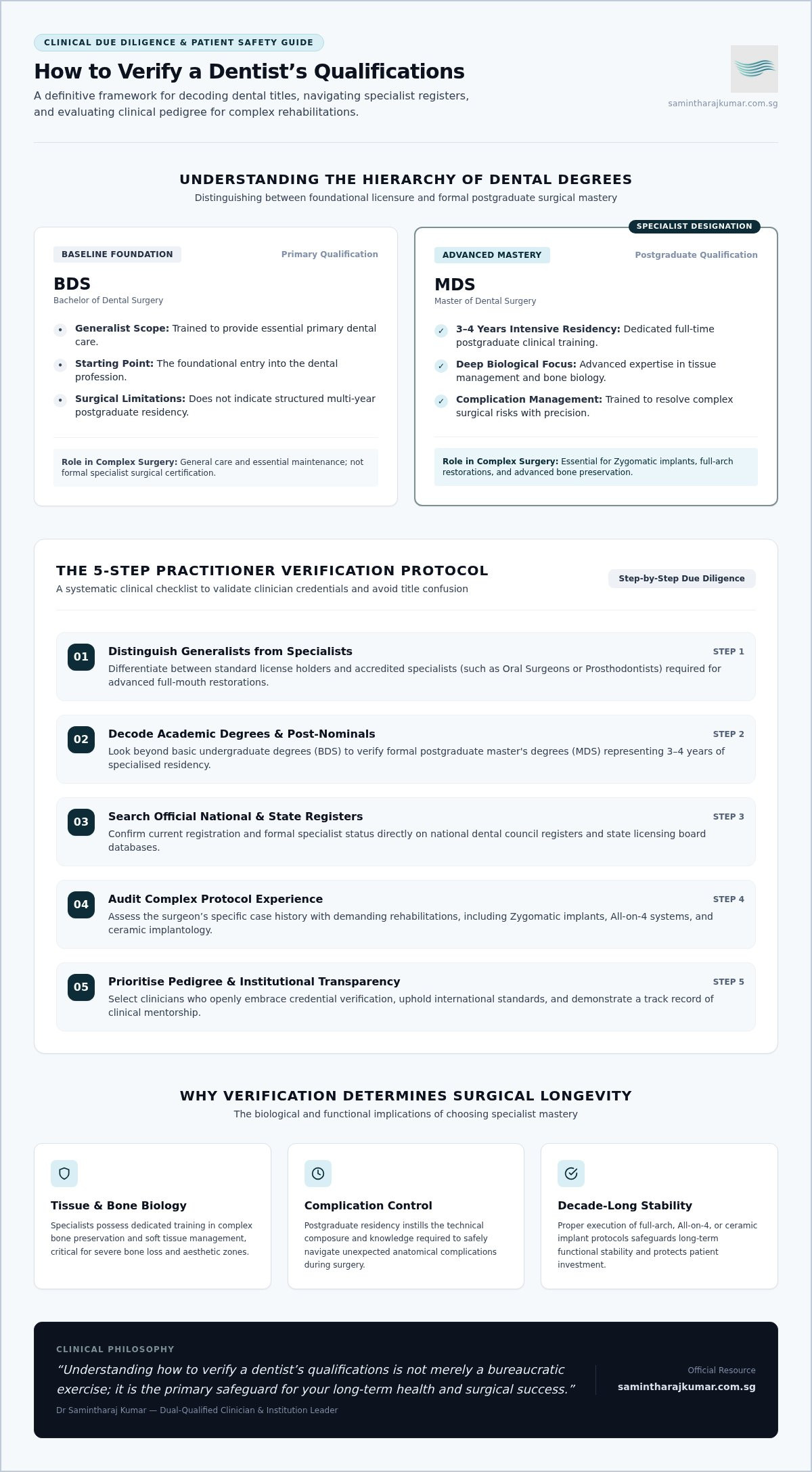
What many patients don't realise is the significant gap between basic and advanced degrees. A Bachelor of Dental Surgery (BDS) is a respectable foundation, but it's the starting point of a career, not the peak of surgical expertise. In contrast, a Master of Dental Surgery (MDS) involves three to four years of intensive postgraduate residency. From a biological perspective, these specialists have significantly deeper training in complex tissue management and bone biology, which is essential for the success of procedures like ceramic dental implants. Understanding this hierarchy is the first step in knowing how to verify a dentist's qualifications with precision.
When you're researching a practitioner, the "Specialist Register" is your most vital tool. This isn't a casual list; it's a legal safeguard that distinguishes practitioners like Oral Surgeons or Prosthodontists from generalists. You can often cross-reference these details through state dental board licensing directories or national council databases. These registers confirm that the clinician has met the stringent educational and clinical requirements necessary to hold a specialist title.
General Practitioner vs. Registered Specialist
A general dentist is an essential "all-rounder" who manages routine maintenance, fillings, and preventative care. However, a registered specialist has undergone years of additional, full-time clinical training in a specific field, such as periodontics or oral surgery. This rigour is why I've built Nuffield Dental on a foundation of specialist-led care. I believe patients facing complex rehabilitations deserve a level of precision that only dedicated specialist training can provide. Knowing how to verify a dentist's qualifications ensures you don't mistake a generalist's interest in a topic for a specialist's mastery of it.
Dual-Qualification: The Intersection of Medicine and Dentistry
The real differentiator in advanced surgery often lies in dual-qualification. Being qualified in both medicine and dentistry allows a clinician to view oral health through a systemic lens, rather than just focusing on the teeth. This dual perspective is invaluable when performing intricate procedures like Wisdom Tooth Surgery or Zygomatic Dental Implants, where the proximity to vital structures requires a surgeon's eye. It ensures that your systemic health is managed with the same meticulous care as your dental restoration. If you'd like to learn more about my specific approach to complex rehabilitations, you can review my clinical background here. This intersection of disciplines is what allows for a truly transformative and safe patient experience.
How to Verify a Dentist’s Qualifications: A 5-Step Checklist
I believe that transparency is the bedrock of the patient-clinician relationship. For those seeking complex care, such as All-on-4 or Zygomatic dental implants, the verification process should be systematic and uncompromising. Knowing how to verify a dentist's qualifications allows you to move beyond marketing claims and into the realm of clinical fact. It's a proactive step that replaces surgical anxiety with the confidence that you're in the hands of a practitioner with the right clinical pedigree.
Step 1: Access the official online register of the National Dental Council or the relevant Medical Board.
Step 2: Search for the practitioner using their full name or their professional registration number.
Step 3: Look specifically for "Specialist" status. A general license allows basic practice, but only those on the specialist register are legally recognised as Oral Surgeons, Prosthodontists, or Periodontists.
Step 4: Confirm the validity of their current Annual Practising Certificate. This ensures the clinician is in good standing and legally permitted to perform procedures.
Step 5: Review their affiliations with prestigious international clinical bodies, academies, or Royal Colleges.
Navigating Official Regulatory Databases
Most national registers offer a public search portal designed specifically for patient safety. When you search, pay close attention to the date of initial registration and the specific area of specialty. If a practitioner’s name doesn't appear, it's essential to pause. While it might be a simple spelling discrepancy, it could also indicate that the clinician isn't licensed to practice in that jurisdiction or for that specific specialty. I always encourage my patients to be meticulous; a surgeon who values their clinical mastery will never be offended by your diligence.
Evaluating Institutional Heritage and Affiliations
Certificates on a clinic wall are only one part of the narrative. I look for fellowships with renowned institutions like the Royal Colleges, as these indicate a commitment to global standards of excellence that go far beyond basic requirements. Leadership roles, teaching appointments, or research contributions in clinical institutions further demonstrate that a practitioner is an educator and innovator in their field. When choosing a dental clinic in 2026, these markers of institutional heritage help distinguish a high-tier specialist practice from a generalist volume clinic. This level of scrutiny ensures your journey toward comprehensive restoration is managed by a clinician who prioritises technical excellence and profound personal impact.
Beyond the Certificate: Assessing Clinical Experience and Innovation
As a clinician and founder, I've always believed that certificates are the baseline of professional standing, not the ceiling of clinical capability. While knowing how to verify a dentist's qualifications through official registers is a vital first step, it only reveals the minimum standard of entry. True mastery is forged through years of performing complex rehabilitations and a relentless commitment to innovation. In modern dentistry, the difference between a functional outcome and a truly transformative one often lies in the surgeon's familiarity with advanced protocols and their integration of cutting-edge technology.
The trajectory of modern medicine is steering toward hyper-specialisation. This shift ensures that patients receive care from practitioners who don't just "do" a procedure but live and breathe it. In my practice, I've integrated digital diagnostics and AI-assisted screening to refine our surgical planning. This isn't about replacing the human element; it's about providing a layer of safety and precision that was previously impossible. Understanding how to verify a dentist's qualifications alongside their commitment to these modern tools is what distinguishes a visionary practice from a traditional one.
Procedure-Specific Mastery
When you consult with a surgeon, don't hesitate to ask direct questions about their specific history with the procedure you require. You should feel empowered to ask, "How many of these specific procedures have you performed in the last year?" A specialist who values transparency will be proud to share their experience. It's equally important to review "Before and After" cases of similar complexity to yours. Seeing the tangible results of a Teeth in a Day procedure explained through real-world outcomes provides a level of reassurance that no certificate can match.
Commitment to Biological and Functional Excellence
A visionary leader in dentistry looks beyond the immediate cosmetic fix to understand the root cause of oral health issues. This involves a deep commitment to biological excellence, such as the use of ceramic dental implants for patients who prioritise biocompatibility. Functionally, this approach affects how your bite alignment is measured and restored, ensuring that your new smile is not just beautiful but also durable and comfortable. If you're seeking a clinician who prioritises this level of meticulous detail, I invite you to explore our specialist-led approach to total rehabilitation. By focusing on the intersection of science and personal care, we ensure that every restoration has a profound personal impact on your quality of life.
My Perspective: Why I Believe Transparency is the Foundation of Trust
I've always maintained that the best outcomes begin with a profound understanding of the root cause and the clinician’s capability. In my view, transparency isn't just a professional obligation; it's the foundation of the trust required for complex medical procedures. When I founded Nuffield Dental, I did so with a visionary approach: building an institution that prioritises specialist-led care over generalist volume. This model ensures that every patient has access to a clinician who has achieved a level of mastery that goes far beyond basic training. Understanding how to verify a dentist's qualifications is a crucial skill for any patient, as it empowers you to make decisions based on verified expertise rather than self-applied titles.
My philosophy on mentorship is deeply rooted in developing the next generation of surgical leaders. I believe that as an educator and innovator, my legacy isn't just the successful rehabilitations I perform, but the standards of excellence I instil in others. The future of healthcare lies in earlier detection, better decisions, and a commitment to global standards. We're moving toward an era where verified expertise is the primary currency of care, ensuring that patients receive treatment that's both medically rigorous and deeply personal.
A Reflection on Clinical Accountability
I personally oversee the clinical protocols at my practice because I recognise the weight of responsibility that comes with performing full mouth rehabilitation. These procedures are life-changing, and they require a level of precision that leaves no room for error. Trust isn't something that's simply given; it's earned through a combination of rigorous credentials and a compassionate, patient-centred philosophy. When you're looking for a surgeon, knowing how to verify a dentist's qualifications provides the objective proof that your clinician possesses the technical excellence required for your safety and long-term well-being. My use of the first person in my communications is a deliberate choice; it bridges the gap between a large institution and personal accountability.
The Path Forward for Patients
Your health is your greatest asset, and you should never feel that you must compromise on the quality of your surgeon. The right diagnosis changes everything when it's paired with the right expertise. It's the difference between a temporary fix and a permanent restoration that offers emotional renewal and functional excellence. For those seeking total oral restoration, reviewing a specialist’s perspective on dental implants can provide the necessary context for your journey. By prioritising clinical pedigree and institutional heritage, you ensure that your care is managed by a mentor and healer who values the transformative power of modern medicine.
Securing Your Clinical Future with Verified Expertise
Choosing a clinician for complex restorative work is one of the most significant decisions you'll make for your long-term health. I've shared the essential steps on how to verify a dentist's qualifications because I believe that transparency is the bedrock of patient safety. By checking official registers and understanding the hierarchy of dental degrees, you move from a place of uncertainty to one of informed confidence. You now know that a specialist title isn't just a label; it's a legal safeguard representing years of rigorous, postgraduate surgical training.
As a dual-qualified surgeon and the founder of Nuffield Dental, I remain committed to maintaining global standards in complex rehabilitation. My perspective is that technical excellence must always be balanced with compassionate, patient-centred care. The best outcomes begin with understanding the root cause of your dental concerns and ensuring your surgeon possesses the clinical pedigree to address them. Explore our specialist-led approach at Nuffield Dental to see how verified expertise can transform your quality of life. You deserve a restoration that is as durable as it is beautiful, delivered by hands you can trust.
Frequently Asked Questions
How can I check if my dentist is a registered specialist?
Access the national dental council or medical board's online register to begin your search. You can search by the practitioner's full name or registration number. Look for a specific "Specialist" designation under their entry, which confirms they've completed advanced residency in fields like oral surgery or prosthodontics. Knowing how to verify a dentist's qualifications ensures you select a clinician with the specific expertise your complex procedure requires.
What is the difference between an implant dentist and an oral surgeon?
An "implant dentist" is often a general practitioner with an interest in the field, whereas an oral surgeon is a registered specialist. Specialists undergo several years of full-time, accredited residency training beyond their basic degree. This training focuses on surgical precision, tissue management, and bone biology. I believe this distinction is vital for patient safety, as specialists are equipped to handle complex anatomical challenges and surgical complications with greater clinical mastery.
Can any dentist perform All-on-4 or Zygomatic implant surgery?
While any licensed dentist can technically perform surgery, advanced protocols like All-on-4 or Zygomatic implants demand specialist-level expertise. These procedures involve significant bone management and proximity to vital structures like sinuses and nerves. I prioritise specialist-led care because these complex rehabilitations require a deep understanding of surgical anatomy. Choosing a practitioner with a specialist pedigree reduces risks and ensures the long-term functional stability of your restoration.
What qualifications should I look for in a ceramic dental implant specialist?
Look for a Master of Dental Surgery (MDS) and registration on the specialist register for oral surgery or periodontics. For ceramic dental implants, it's also beneficial to find a clinician who understands biological dentistry and tissue biocompatibility. I recommend checking for fellowships with international academies or Royal Colleges. These affiliations signal a commitment to global standards and the technical excellence necessary for successful metal-free implant integration.
Is it rude to ask my dentist about their qualifications and experience?
It's never rude to ask about credentials; in fact, a visionary clinician welcomes your diligence. Transparency is the foundation of trust in a professional consultation. I encourage patients to ask about a surgeon's specific success rates and their history with complex cases. A practitioner who values clinical accountability will be proud to share their pedigree and explain how their advanced training directly benefits your surgical outcome and personal well-being.
What happens if I have surgery with an unqualified practitioner?
Undergoing complex surgery with an under-qualified practitioner increases the risk of surgical failure and long-term complications. These can include nerve damage, implant rejection, or poor aesthetic results. Without specialist training in bone biology and tissue management, a clinician may struggle to manage unexpected intra-operative challenges. I've always maintained that understanding how to verify a dentist's qualifications is the most effective way to safeguard your health and ensure a successful restoration.
Do international dental qualifications count the same as national ones?
International qualifications are highly respected but must be recognised by your national dental council to allow for local registration. Many specialists hold fellowships from renowned international institutions or Royal Colleges, which often indicate a higher tier of expertise. However, the legal right to practice as a specialist depends on being listed on the local specialist register. I value these global affiliations as they reflect a commitment to international clinical protocols and surgical excellence.
How often do dentists need to renew their clinical licences?
Dentists typically renew their Annual Practising Certificate every year. This renewal requires evidence of continuing professional education to ensure they remain at the cutting edge of modern medicine. As a mentor and educator, I believe this ongoing learning is essential for maintaining clinical mastery. Verification of a current certificate is a key step in the verification process, ensuring your clinician is in good standing and legally authorised to practice at the highest standard.


Comments