
Ceramic Dental Implants: A Patient’s Guide to Materials, Evidence and Care

The choice between ceramic and titanium shouldn’t be made on a slogan. If you’re considering ceramic dental implants, it’s understandable to want a clear explanation of what they’re made from, how they may interact with your body and whether they could suit your needs. In my clinical experience, material matters, but it is only one part of a sound treatment decision.
Ceramic implants are commonly made from zirconia, a strong, tooth-coloured ceramic. But “biocompatible” does not mean one material is automatically better for every patient. It describes how a material interacts with the body, and that needs to be considered alongside your oral health, the implant site, your bite and the restoration being planned. Titanium also has a substantial evidence base, so a fair comparison needs more than blanket claims.
In this guide, I’ll explain what ceramic implants are and what biocompatibility means in practical terms. I’ll also look at how ceramic and titanium options are assessed, what the evidence can and cannot tell us, and which questions can help clarify your treatment plan. My aim is to help you approach material choice with confidence, as part of careful planning for function, comfort and long-term oral health.
Table of Contents
What Are Ceramic Dental Implants, and What Problem Do They Address?
Biocompatibility in Ceramic Dental Implants: What the Evidence Can Tell You
Ceramic vs Titanium Dental Implants: How to Compare the Options Fairly
Considering Ceramic Dental Implants: What to Discuss During Assessment
My Approach to Ceramic Dental Implantology: Precision Before Material Choice
What Are Ceramic Dental Implants, and What Problem Do They Address?
Losing a tooth can leave you weighing more than how to fill a visible gap. You may also want to understand what replacement involves, how its parts work together and why one material might be considered over another. A material name alone cannot tell you whether a treatment plan fits your mouth, so clear information matters.
In brief, ceramic dental implants are implants made from a ceramic material and placed in the jaw to support a replacement tooth. The implant is the component beneath the gum; the restoration is the visible, tooth-shaped part attached to it. They work together as part of one plan, but they are not the same thing.
How does a dental implant support a replacement tooth?
A dental implant provides a foundation for a planned restoration where a tooth is missing. The implant component is placed in the jaw and, as healing progresses, it can become integrated with the surrounding bone. For an individual missing tooth, the restoration is often a crown. This is the part you can see when you smile or speak.
This distinction is useful during a consultation. Choosing an implant material is only one part of treatment planning; the position and form of the replacement tooth matter too. A general overview of the dental implant explains the implant’s role in supporting a restoration and describes osseointegration, the process of integration with bone. Your own plan depends on your clinical assessment.
What does ‘ceramic’ mean in implant dentistry?
In implant dentistry, “ceramic” commonly refers to zirconia-based material. Zirconia is a ceramic compound used in some implant systems. The term describes the material, not a guaranteed biological response or treatment result. The material name alone cannot determine whether treatment is suitable for you or predict your individual response.
Implant systems may differ in design and construction, so evidence about one system should not automatically be applied to every ceramic implant. In my clinical experience, precise language matters: it is reasonable to ask what an implant is made from, while recognising that composition is only one part of the clinical picture.
Ceramic implantology is an option for replacing a missing tooth, not a universal recommendation. I offer ceramic dental implantology and consider it within a wider assessment of oral health, the missing tooth and the restoration being planned. The same principle applies when comparing ceramic with titanium: neither material label, on its own, determines what is appropriate for an individual.
My aim is to make that decision understandable rather than reduce it to claims that one material is automatically safer, more natural or more successful. A careful conversation starts with what needs replacing and how the proposed implant and restoration fit into your overall treatment plan.
Biocompatibility in Ceramic Dental Implants: What the Evidence Can Tell You
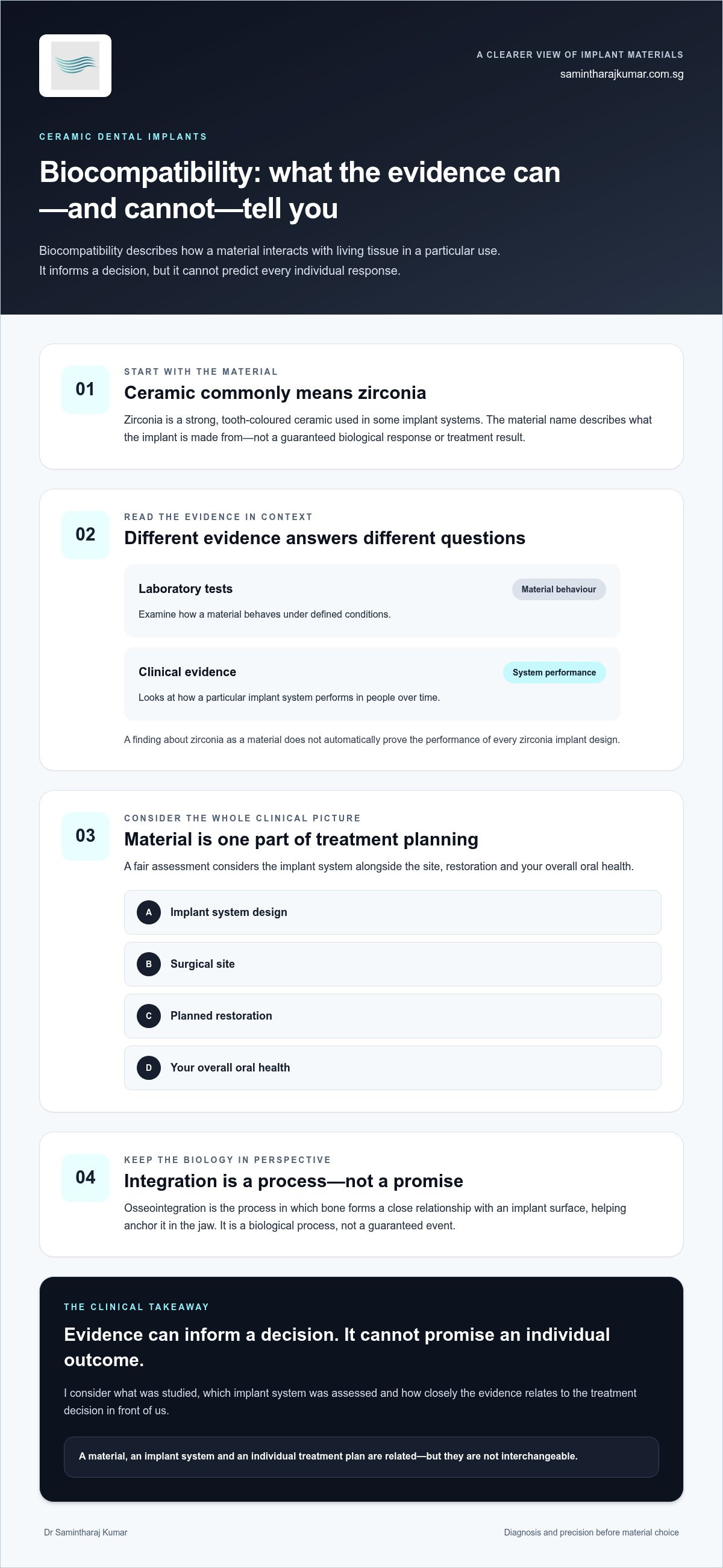
“Biocompatible” can sound like a simple verdict: a material either agrees with the body or it does not. Clinically, the question is more specific. Biocompatibility describes how a material interacts with living tissue in a particular use. It is useful when assessing an implant, but it cannot predict how treatment will go for an individual patient.
For ceramic dental implants, the material’s biological properties need to be considered alongside the implant system’s design, the surgical site, the restoration and your overall oral health. A positive finding about a material is not the same as evidence that every system or treatment plan will produce the same result.
How should patients understand biocompatibility claims?
A laboratory test can examine how a material behaves under defined conditions. Clinical evidence looks at how a particular implant system performs in people over time. Both can be informative, but they answer different questions. A finding about zirconia as a material, for example, should not automatically be treated as proof about every zirconia implant design or every patient’s response.
Osseointegration is the process in which bone forms a close relationship with an implant surface, helping the implant become anchored in the jaw. It is a biological process, not a guaranteed event. The US Food and Drug Administration’s Dental Implants: What You Should Know provides general patient information about implant materials and evaluation. It is a helpful reference, but an overview cannot replace assessment of a specific case.
Evidence about a material can inform a treatment decision, but it cannot promise clinical success for an individual. That distinction matters. It keeps a scientifically useful term from becoming a blanket assurance about safety, integration or long-term results.
What questions does implant research need to answer?
When I consider evidence, I look at what was studied and how closely it relates to the decision in front of us. Research may focus on material properties, a particular implant system or outcomes in a group of patients. These are related, but they are not interchangeable. A result from one system may not apply to another with different design features.
Follow-up also shapes what a study can tell us. Shorter observation may describe early healing, while longer observation is needed to understand outcomes over time. The number and type of patients studied, the restoration used and the way complications are reported all influence how confidently findings can be applied to an individual.
For patients, practical questions include:
Does the evidence relate to the specific implant system being considered?
What outcomes were measured, and for how long were patients followed?
How do my oral health, treatment goals and planned restoration affect the decision?
My approach is to discuss what is known, what remains uncertain and how those points relate to your clinical picture. If you’re exploring ceramic implant treatment, a considered conversation can put material evidence into context rather than treating it as a prediction.
Ceramic vs Titanium Dental Implants: How to Compare the Options Fairly
Comparing implant materials is most useful when the question is not “Which is best?” but “Which option fits this treatment plan, and why?” Titanium has a longer history of use and a substantial body of clinical research. Ceramic systems have their own evidence, but findings need to be interpreted in relation to the particular system studied. Neither point, on its own, decides what is appropriate for you.
Material choice should be based on clinical assessment, relevant evidence and your treatment goals, not a blanket claim that one material is right for everyone. A fair comparison considers the implant and restoration together, as well as the evidence supporting the specific system being discussed.
What should a balanced implant comparison include?
The table offers a starting framework, not a verdict. Details vary between implant systems, so a general comparison cannot replace an individual treatment plan. It can, however, help you identify what needs to be understood before deciding.
Research history matters because it affects how much clinical experience is available to inform a decision. But time in use is not the only consideration, and a broad claim about either material should not be mistaken for a direct comparison of every system. I look for evidence that is relevant to the proposed implant, the restoration and the clinical question being asked.
Does a preference for metal-free care settle the decision?
A wish to avoid metal can be meaningful to a patient, and I make space for that preference in the conversation. It is one part of a decision, though, rather than proof that ceramic is automatically suitable or that it removes all health risks. A preference should be weighed alongside examination findings, treatment goals and the evidence for the system being considered.
If you’re considering ceramic dental implants, ask how the proposed system is supported by clinical evidence, how its restorative design fits your needs and which findings from your assessment guide the recommendation. I use those questions to keep the discussion balanced and personal. The aim is not to favour a material in advance, but to make a reasoned choice for the whole treatment plan.
Considering Ceramic Dental Implants: What to Discuss During Assessment
An online checklist cannot determine which implant material is right for you. An assessment should be a conversation about what you want to address, your oral health and the clinical information available. A preference for ceramic may be important, but it cannot by itself establish whether that option is suitable.
Which questions help clarify your treatment goals?
I begin by understanding what matters to you. Is your priority replacing a particular missing tooth, restoring comfortable function or planning for a wider restoration? What concerns do you have about materials, and what has shaped those preferences? These questions help me understand your aims without treating a preference as a diagnosis.
Function and restoration belong in the same discussion as material. The replacement tooth needs to be considered in relation to its position and the wider plan for your mouth. I may explore points such as:
What you hope the replacement will help you do comfortably.
Whether you have a preference for ceramic or titanium, and why.
How the proposed restoration fits your treatment goals.
What questions or concerns you want addressed before deciding.
There’s no need to arrive with a fixed answer. Clear questions make the discussion more useful, especially when online information presents broad claims without explaining how they apply to an individual case.
How does a specialist develop an individual plan?
In my assessment, I consider the relevant clinical findings alongside your goals, then explain how they inform the options. The recommendation should reflect the whole case, including the missing tooth and the restoration being planned, rather than a material preference in isolation. Suitability cannot be determined from a short checklist or a general description of ceramic implants.
For complex implantology, careful planning is particularly important. My expertise includes ceramic implantology, complex implantology and oral surgery, and I approach material selection as one part of comprehensive treatment planning. That expertise provides context for the discussion, not a promise of a particular outcome.
Patients considering a broader rehabilitation can also read my perspective in Dental Implant Singapore: A Specialist’s Perspective on Total Oral Rehabilitation. It places implant decisions within the context of the mouth as a whole, rather than viewing a single tooth in isolation.
A considered assessment should leave you understanding what information supports the recommendation, how it relates to your priorities and what questions remain. I can help put ceramic dental implant assessment into the context of your clinical needs and treatment goals.
My Approach to Ceramic Dental Implantology: Precision Before Material Choice
My philosophy has always been to understand the clinical picture before recommending a material. A patient may arrive with a clear preference, or with conflicting information about ceramic and titanium. I listen to those concerns. Then I bring the discussion back to the diagnosis, treatment goals and evidence relevant to the proposed plan.
Precision matters because implant treatment is not simply a choice between two materials. The missing tooth, surrounding oral health and planned restoration all form part of the decision. Ceramic implantology is one of my areas of expertise, but that does not make it the right choice for every person. My responsibility is to explain how the options relate to the individual case, including what is known and what cannot be predicted in advance.
How does my implantology experience inform this discussion?
I am a Diplomate and Fellow of the International Congress of Oral Implantologists, and I lecture nationally and regionally on implant dentistry. These roles inform my ongoing engagement with the field, but credentials are not a guarantee of a particular result. I see them as a responsibility to approach each case thoughtfully, communicate clearly and keep the patient’s needs at the centre of planning.
In my clinical experience, a useful material discussion is specific rather than ideological. Instead of assuming that ceramic or titanium is automatically preferable, I consider how the choice fits the proposed implant system and restorative plan. I also make room for your priorities. A decision is more meaningful when the reasoning is understandable and you can take part with confidence.
What is the next step if you are exploring ceramic implants?
The next step is a considered clinical conversation, not a commitment to a material. I want to understand what you hope to address, review the relevant findings and explain how they guide the options. Bring the questions that matter to you, including what you have read about ceramic implants. Together, we can distinguish a personal preference from a clinical recommendation and identify where further explanation is needed.
This approach is especially valuable when treatment forms part of a broader restoration plan. The aim is to understand the role of the proposed implant within your overall oral health, rather than make a decision based on one feature in isolation. My experience in complex implantology and oral surgery supports careful planning, while each recommendation remains specific to the patient and their clinical circumstances.
If you’re considering ceramic dental implants, I invite you to explore the options with me in a conversation about your goals, assessment and material choices. The best decisions begin with understanding, and precision in planning gives that conversation a clear clinical foundation.
Make Your Next Step an Informed One
A sound treatment decision should leave you with more than a material preference. It should leave you clear about the reasoning behind the plan and how it relates to what you want to achieve. Take time to consider which questions still matter to you before moving forward.
For ceramic dental implants, the next step can be a conversation focused on your priorities and the clinical details that shape your options. Understanding the rationale helps you take an active part in decisions about your care, without feeling pressured to reach an answer before you’re ready.
To continue the conversation, explore my approach to ceramic dental implantology. Thoughtful questions are a valuable beginning, and an informed next step can bring greater confidence.
Frequently Asked Questions
What are ceramic dental implants made from?
Most are made from zirconia-based ceramic, though the exact material and construction depend on the implant system. Before treatment, ask for the system’s name and the manufacturer’s material information, then clarify which components of your proposed restoration are ceramic. This helps you understand what “ceramic” refers to in your plan, rather than assuming the term describes every part of the finished tooth replacement.
Are ceramic dental implants biocompatible?
Biocompatibility findings can help inform treatment, but they do not predict an individual outcome. A practical question is whether the evidence being discussed relates to the specific implant system proposed for you, rather than zirconia in general. I would also clarify what the evidence measured and whether it reflects the clinical question you’re concerned about. That makes broad claims easier to interpret without treating them as a personal guarantee.
Are ceramic implants better than titanium implants?
Can ceramic dental implants be considered if I prefer metal-free options?
Yes. You can raise a metal-free preference as part of your treatment conversation, including what matters most to you about that choice. It may also help to clarify whether your preference concerns the implant itself, the restoration or both. That gives me a more precise understanding of your priorities and allows them to be considered alongside the clinical plan, without assuming that the preference alone determines suitability.
How does a dentist assess whether ceramic dental implants may be suitable?
A useful assessment should explain how the clinical findings connect to the proposed treatment, rather than offer a simple yes-or-no checklist. Ask which findings matter most in your case, how they influence the restoration being planned and what alternatives have been considered. The purpose is to understand the reasoning behind a recommendation and how it addresses your individual treatment goals.
How long do ceramic dental implants last?
No single lifespan can be promised for every implant. Longevity is best discussed in relation to the specific system, your individual circumstances and the follow-up plan. Ask what ongoing review is recommended and what changes your dental team will monitor over time. This gives you a more useful basis for thinking about long-term care than treating one reported lifespan as a prediction for your own implant.
How much do ceramic dental implants cost?
The fees for implant surgery vary with the complexity of the case and the number of implants required. The scope of a treatment plan, including the procedures and components involved, depends on your individual needs. A clinical assessment is the starting point for understanding the treatment proposed and its associated fees.



Comments