
Chao Pinhole Surgery Recovery Timeline: A Specialist Surgeon’s Perspective (2026)
- Dr Samintharaj Kumar

- 2 minutes ago
- 12 min read
What if you could reverse years of gum recession in less time than a standard lunch break, all without the use of a single scalpel or suture? In my clinical experience, many patients approach me with a deep-seated fear of the traditional grafting process, often dreading the painful donor site and the weeks of restricted living that typically follow. It's a valid concern, as the conventional approach can feel like a significant disruption to your personal and professional life.
As a clinician and founder, I've seen how the Chao Pinhole Surgical Technique transforms this narrative by working in harmony with your body’s natural regenerative capabilities. This guide offers a comprehensive look at the chao pinhole surgery recovery timeline, detailing the biological healing stages and what you can realistically expect in the days following the procedure. From a biological perspective, the focus here is on preserving tissue integrity and ensuring a swift, comfortable return to your routine. I'll outline the precise milestones of your recovery, from the immediate post-operative hours to the long-term stabilisation of your restored gumline.
Key Takeaways
Understand how a scalpel-free and suture-free approach eliminates the trauma typically associated with traditional gum grafting.
Discover the specific milestones of the chao pinhole surgery recovery timeline, from the critical first 48 hours to the six-week mark of internal tissue maturation.
Learn why meticulous root preparation and clinical precision are essential for achieving a predictable, high-tier outcome.
Identify the functional factors, such as bite alignment, that ensure your gum restoration remains stable and healthy for the long term.
Table of Contents
What is the Chao Pinhole Surgical Technique? A Biological Shift in Gum Restoration
The Chao Pinhole Surgical Technique (PST) represents a significant departure from traditional periodontal interventions. In my clinical experience, patients often feel overwhelmed by the prospect of invasive surgery, particularly when they begin to research What is Gum Recession? and its standard treatments. PST is a scalpel-free and suture-free method that prioritises the preservation of existing anatomy. Rather than harvesting tissue from the roof of your mouth, we create a tiny entry point, no larger than a pinhead, to gently loosen and reposition the existing gum tissue over the exposed roots.
From a biological perspective, it's more accurate to define the Chao Pinhole Surgical Technique as a biological repositioning of native tissue rather than a traditional tissue transplant. This distinction is fundamental to understanding why the chao pinhole surgery recovery timeline is so much more efficient than conventional methods. By keeping the blood supply intact and avoiding large incisions, we foster an environment where the body can focus entirely on reattachment rather than repairing surgical trauma.
To better understand this concept and see the technique in action, watch this helpful animation:
Pinhole vs. Traditional Grafting: Why the Recovery Differs
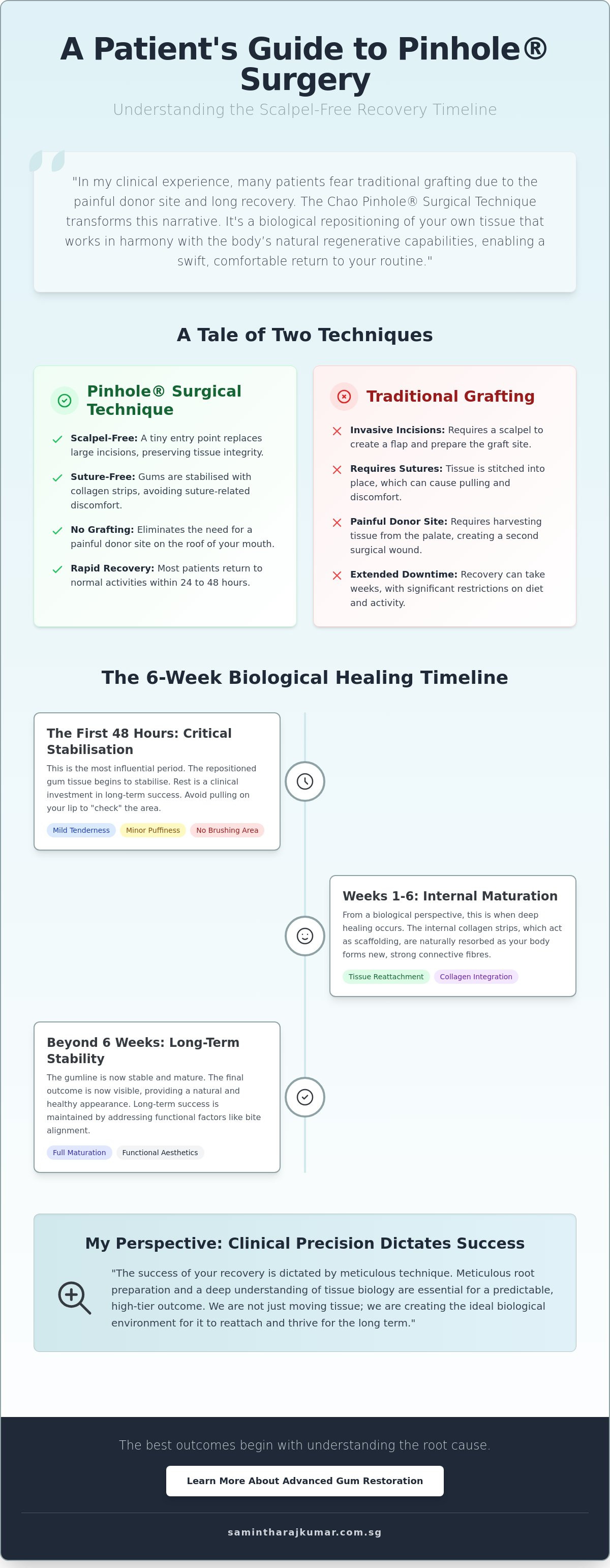
Traditional gum grafting is a two-site procedure. It requires a donor site, usually the palate, which often causes more post-operative discomfort than the actual treatment area. PST differs because it:
Eliminates the need for a donor site, significantly reducing surgical trauma.
Minimises the inflammatory response by avoiding large incisions and scalpels.
Removes the risk of suture-related complications or that distracting "pulling" sensation.
This lack of surgical tension is a primary reason why many of my patients return to their social and professional obligations within 24 to 48 hours. By removing the need to heal a secondary wound in the palate, we streamline the body's recovery resources toward the treated gums.
The Role of Collagen in Your Healing Journey
The structural integrity of the newly positioned gum is maintained through the strategic placement of collagen strips. These strips act as internal scaffolding, holding the tissue in place against the tooth root while your body initiates the formation of new connective fibres. As a clinician and founder, I value this approach because it utilises the body's own regenerative potential rather than relying on external grafts.
The collagen is not a permanent fixture; it naturally resorbs as your own tissue matures and takes over the structural support. This biological integration is why the success rate is remarkably high, with studies showing patient satisfaction rates exceeding 95%. It provides a stable foundation that allows the chao pinhole surgery recovery timeline to progress smoothly from initial placement to long-term functional excellence.
The First 48 Hours: Managing the Immediate Recovery Phase
In my clinical experience, the initial window following the procedure is the most influential period for tissue orientation. The first 24 to 48 hours are critical for stabilising the repositioned gum tissue. While the lack of scalpels means you won't face the heavy inflammation of traditional surgery, the chao pinhole surgery recovery timeline still relies on a quiet biological environment to succeed. Most patients report only mild tenderness; this is easily managed with standard over-the-counter relief. Any minor puffiness usually peaks at the 48-hour mark before rapidly subsiding. I often tell my patients that prioritising rest in the first 24 hours is a clinical investment in long-term stability.
Immediate Post-Operative Protocol
The most common mistake I see is the urge to "check" the results in the mirror. You must avoid pulling your lip or cheek to look at the treated area. This seemingly harmless movement can create tension that displaces the internal collagen scaffolding before it has a chance to bond with the underlying root. Instead, focus on external care. Using cold compresses on the face intermittently during the first day helps to minimise the inflammatory response. This proactive approach ensures the tissue remains undisturbed during the most vulnerable phase of reattachment.
Dietary Guidelines for Tissue Protection
Nutrition plays a vital role in cellular repair, but the mechanical act of eating must be modified to protect the surgical site. For the first two days, opt for "no-chew" foods such as lukewarm soups, smoothies, and yoghurt. From a biological perspective, we must maintain a neutral environment. Avoid spicy or acidic foods that might irritate the delicate pinhole entry site. These substances can cause a stinging sensation and trigger minor localised swelling that we want to avoid during this early phase.
There is a specific reason why we insist you avoid straws during this period. Straws create negative pressure and suction within the oral cavity. This suction can dislodge the delicate blood clot forming at the pinhole site. This clot is essential because it serves as the primary matrix for healing. By keeping the mechanical stress low, you allow the primary healing phase to conclude without interruption. As a clinician and founder, I believe that the best outcomes begin with understanding the root cause of your recession and respecting the biological requirements of the recovery process.
The 6-Week Biological Healing Timeline: What to Expect Internally
While many of my patients feel entirely "back to normal" within just a few days, the internal chao pinhole surgery recovery timeline follows a much more deliberate biological cadence. It's a common misconception that once the tiny entry point closes, the work is finished. In reality, the most sophisticated part of the healing process happens beneath the surface where the eye cannot see. Understanding these stages is essential for maintaining the long-term success of the procedure.
During Weeks 1 and 2, the pinhole entry site typically closes within 24 to 48 hours, but the initial attachment of the gum tissue to the tooth root is only just beginning. From a biological perspective, this is a delicate phase of cellular migration. By Weeks 3 and 4, the collagen strips we meticulously placed begin to resorb. This is a critical transition where your body's natural Type I collagen takes over the structural support. By the time we reach Week 6, the tissue has reached a stable, "mature" state. Internal remodelling continues for several months as the new attachment strengthens and the tissue density increases.
Surface Healing vs. Deep Integration
The fact that the pinhole disappears so rapidly is often deceptive. Because the gums are still maturing underneath, I advise against using electric toothbrushes on the treated site for the first few weeks. The high-frequency vibrations can disrupt the newly forming collagen fibres before they've fully calcified. In my clinical experience, gentle rinsing is far superior to mechanical cleaning in these early stages; it maintains hygiene without risking the integrity of the repositioned tissue. We want to avoid any friction that could cause the tissue to shift before the deep integration is complete.
Monitoring Your Progress: Clinical Milestones
We look for specific clinical markers during your follow-up appointments to ensure everything is on track. A healthy, vibrant pinkness in the gums is a positive sign of successful vascularisation and robust blood flow. This indicates that the repositioned tissue is receiving the nutrients it needs to thrive. As a clinician and founder, I've integrated AI-assisted diagnostics into our protocols to track tissue volume stability with high precision. This allows us to monitor your progress at the 1-week and 3-week marks with data-driven accuracy. By comparing these digital scans, we can confirm that the biological integration is proceeding exactly as planned, providing a level of certainty that traditional visual checks alone cannot offer.
My Perspective: Why Clinical Precision Dictates Your Recovery Success
In my clinical experience, the perceived "speed" of a patient's journey through the chao pinhole surgery recovery timeline is often a direct reflection of clinical meticulousness. While the technique is celebrated for its minimally invasive nature, the efficiency of the healing process isn't accidental. As a clinician and founder, I believe the preparation of the root surface is as vital as the surgery itself. If the root isn't decontaminated and prepared to receive the tissue, the biological bond will be compromised, regardless of how small the entry point is. The "Pinhole" is merely the gateway; the true biological outcome is determined by the internal environment we create during the procedure.
I often tell my patients that the best outcomes begin with understanding the root cause of the recession. Whether it's due to aggressive brushing, orthodontic history, or bite misalignment, we must address the "why" to ensure the "how" remains permanent. Precision matters. When we treat gum recession, we aren't just moving tissue; we're restoring a biological seal that protects the tooth's foundation for decades to come.
Common Misconceptions About Pinhole Downtime
A frequent myth I encounter is that "no sutures" equates to "no care required." While it's true that you won't have the traditional discomfort of stitches, your compliance is still essential for success. I prioritise a holistic approach, ensuring your underlying oral health is robust enough to support the restoration. This is particularly relevant for those struggling with sensitivity from exposed tooth roots. For these patients, the Pinhole technique doesn't just offer a faster recovery; it provides almost immediate relief from the sharp pain caused by thermal changes, as the exposed dentin is finally shielded by healthy, repositioned tissue.
The Philosophy of Minimally Invasive Restoration
My transition toward Pinhole surgery as a primary solution for functional aesthetics was driven by a desire to reduce patient trauma. There is a profound emotional impact when a patient sees an immediate "smile makeover" in the mirror without the bruising or swelling associated with traditional grafting. It changes their relationship with dental care. We aren't just restoring a gum line; we're restoring a patient's confidence in their oral health and their willingness to seek proactive treatment. This philosophy of care prioritises long-term well-being and functional excellence. If you're ready to explore how this approach can benefit you, I believe the best outcomes begin with understanding the root cause of your concerns.
Beyond Healing: Restoring Long-Term Functional Aesthetics
Successfully navigating the initial weeks of the chao pinhole surgery recovery timeline is a significant milestone. It's only the first step toward a lifetime of functional excellence. From a biological perspective, we've restored the physical barrier that protects your tooth roots. Now, our focus shifts to preserving that stability for the decades ahead. Long-term success depends on addressing the mechanical forces that caused the recession initially. If bite alignment issues remain uncorrected, those same pressures could eventually challenge the new gum position.
As a clinician and founder, I view this procedure as part of a comprehensive, specialist-led journey. The Chao Pinhole Surgical Technique cost in Singapore reflects this integrated approach to care. We aren't simply performing a procedure; we're building a defensive shield. A restored gum line acts as a vital barrier against future root decay and eventual tooth loss. It protects the structural integrity of your entire smile and ensures the longevity of your natural dentition.
Maintaining Your Results for the Decades Ahead
Your role in the years following surgery is just as important as mine. I recommend customised oral hygiene programmes that prioritise gentle care. This includes specific soft-bristle techniques designed to clean effectively without abrading the delicate gingival margins. In my clinical experience, annual clinical reviews are non-negotiable. These visits allow us to monitor tissue stability and bone health using the same precision diagnostics we used during your initial recovery. It's about proactive preservation rather than reactive repair. We want to ensure that the attachment remains robust as you age.
The Transformative Power of Modern Gum Restoration
Pinhole surgery often serves as the cornerstone of a broader plan for total oral rehabilitation. When we address recession, we often see a profound psychological shift in our patients. It's the move from hiding a smile due to sensitivity or aesthetics to displaying a sign of health and vitality. This renewed confidence often encourages better overall self-care. It creates a positive feedback loop for your oral health that extends far beyond the surgical site.
Finalising your restoration is more than a clinical outcome. It's the beginning of a new chapter in your functional aesthetics. The right diagnosis changes everything; your journey to restoration is a partnership between specialist expertise and patient commitment. The best outcomes begin with understanding the root cause, and our goal is to ensure your smile remains a source of pride for a lifetime.
A Vision for Regenerative Excellence
Navigating the chao pinhole surgery recovery timeline is a process of biological renewal rather than simple surgical repair. We've explored how a scalpel-free approach reduces immediate downtime while internal maturation ensures the long-term stability of your restored gumline. From the critical first 48 hours to the final integration of natural collagen, every stage is an opportunity to reinforce the foundation of your oral health. In my clinical experience, the transition from sensitivity to comfort is one of the most rewarding aspects of this modern technique.
My commitment as a clinician and founder is to provide a level of care that blends pioneering expertise in complex oral rehabilitation with the precision of AI-assisted diagnostics. We don't just aim for a faster recovery; we aim for a transformative impact on your quality of life that stands the test of time. The best outcomes begin with understanding the root cause. Explore our approach to specialist gum restoration at Nuffield Dental.
Your journey toward a healthy, confident smile is a partnership we value deeply, and I look forward to helping you achieve a restoration that feels as natural as it looks.
Frequently Asked Questions
How long do I need to take off work after Chao Pinhole surgery?
Most patients return to their professional duties within 24 to 48 hours. Because there are no scalpels or sutures, the systemic impact is significantly lower than traditional surgery. In my clinical experience, if you have the procedure on a Friday, you're typically ready for a full Monday schedule. I suggest avoiding high-stress presentations immediately after to ensure you remain relaxed during the initial stabilisation phase.
Is the Chao Pinhole Surgical Technique painful during recovery?
You should expect mild tenderness rather than acute pain. The lack of a donor site in the palate eliminates the primary source of post-operative discomfort found in traditional grafting. Most of my patients manage their symptoms effectively with standard over-the-counter analgesics for the first day or two. From a biological perspective, the minimal tissue trauma ensures a much smoother transition through the chao pinhole surgery recovery timeline.
When can I start brushing my teeth normally again?
You can resume normal brushing in the treated area after approximately six weeks. During the initial stages, mechanical friction from a toothbrush can dislodge the delicate collagen scaffolding. I provide a specialised antibacterial rinse to maintain hygiene without physical contact. Once the tissue has matured and integrated with the root surface, we'll guide you on transitioning back to a soft-bristled manual or electric toothbrush.
Can I exercise immediately after my Pinhole procedure?
I recommend avoiding strenuous exercise for at least 48 hours following the procedure. Physical exertion increases your heart rate and blood pressure, which can lead to unnecessary swelling or bleeding at the pinhole site. It's better to allow the primary blood clot to stabilise undisturbed. You can typically resume light walking after two days, but wait for my clinical clearance before returning to high-impact gym sessions.
What happens if I accidentally touch or brush the surgical site?
Don't panic if a minor accidental contact occurs, but stop the activity immediately. The repositioned tissue is held by internal collagen, so a single light touch rarely causes total failure. However, if you notice significant bleeding or a visible shift in the gum position, contact my team at Nuffield Dental. We use AI-assisted diagnostics during follow-ups to ensure the tissue remains exactly where it was placed for optimal results.
Are the results of Pinhole surgery permanent?
The results are designed to be long-lasting, with clinical studies showing stable coverage for over 14 years. While the procedure effectively restores the gumline, its permanence depends on your commitment to oral health. You must address the original cause of recession, such as aggressive brushing or teeth grinding. As a clinician and founder, I emphasise that maintaining a stable bite is essential for preserving your functional aesthetics for decades.
How does Pinhole recovery compare to traditional gum grafting?
Pinhole recovery is substantially faster and more comfortable than traditional grafting. Traditional methods involve two surgical sites and sutures, which increase the inflammatory response and healing time. With the Pinhole technique, we eliminate the palate wound entirely. This biological shift means you'll experience less swelling and a quicker return to your normal diet, making the chao pinhole surgery recovery timeline much more predictable for busy professionals.
Will I need to take antibiotics during my recovery?
I usually prescribe a short course of antibiotics as a prophylactic measure. In my clinical experience, maintaining a sterile environment is vital for the successful integration of the collagen strips. While the procedure is minimally invasive, the mouth is naturally full of bacteria. These medications ensure that your body's resources are focused entirely on tissue reattachment rather than fighting off potential localised infections during the critical first week of healing.


Comments