
Clinical Treatments for TMJ Pain: A Cause-Led Guide

What if the most effective next step for jaw pain isn’t a procedure, but a clearer understanding of what is driving it? Clicking, tenderness or restricted movement can feel worrying, especially when it’s unclear whether the cause lies in the joint, surrounding muscles or a wider pattern of pain. In my clinical experience, clinical treatments for tmj pain should follow careful assessment, not a one-size-fits-all menu.
It’s reasonable to wonder whether you need exercises, medication, a dental appliance or something more involved. The answer depends on your symptoms, examination findings and treatment goals. I begin by understanding how the pain affects everyday activities and what may be contributing to it, then discuss possible next steps. Imaging may be considered when the diagnosis is unclear or further investigation is needed.
In this guide, I explain how clinical assessment shapes treatment, compare conservative approaches such as self-care and physical therapy with medication and selected procedures, and suggest questions to raise during a consultation. Not every option is appropriate for every person, and more invasive care isn’t automatically the better choice. The aim is to address the factors behind your symptoms while supporting comfort and function over time.
Table of Contents
Clinical Treatments for TMJ Pain: What Symptoms Can Tell You
Jaw pain can make an ordinary meal uncomfortable. You might notice restricted movement, clicking when you open your mouth, tension around the jaw or difficulty chewing. These experiences are real, but they don’t point automatically to one diagnosis or treatment. In my clinical experience, the first task is to understand what the symptoms are doing, when they occur and how they affect daily function.
A useful distinction: The temporomandibular joint, or TMJ, connects the lower jaw to the skull. Temporomandibular disorders, or TMDs, affect that joint or related structures. Jaw pain is a symptom, not a diagnosis by itself.
This distinction matters because a sound or sensation can have different significance for different people. Clicking, for example, doesn’t establish the cause of pain, and pain alone doesn’t show which structure is involved. A broad overview of temporomandibular joint dysfunction can explain the terminology, but a clinical assessment is needed to relate general information to an individual’s symptoms and findings.
Which TMJ symptoms should prompt clinical assessment?
Consider seeking clinical assessment if jaw pain, stiffness or recurring tension persists, returns or interferes with eating, speaking, or opening and closing your mouth. Clicking or popping may also be worth discussing, particularly if it occurs alongside discomfort or restricted movement. Note how long symptoms have been present, whether they change over time and which activities bring them on. No single sound or symptom is enough to identify a specific disorder.
These details help shape the consultation. Discomfort only while chewing may describe a different functional pattern from stiffness on waking or a locking sensation during movement. Such patterns are useful information, not a diagnosis in themselves. I consider them alongside examination findings rather than treating one symptom as proof of a particular cause.
Why the same jaw pain can lead to different treatment plans
Two people may use the same words, such as “jaw pain”, yet describe different experiences. One may be troubled by limited opening; another may report tenderness or difficulty chewing. The pattern, duration and effect on function can differ, as can the examination findings. Assessment helps me distinguish the patient’s experience from what I can observe and identify clinically, so treatment discussions reflect the individual picture.
This is why clinical treatments for tmj pain shouldn’t be selected from a symptom checklist alone. I begin by listening, then consider movement and function before discussing which approach may fit. If you’re unsure which clinician to consult, the question of what kind of doctor treats TMJ is also worth exploring as you prepare for care. Symptoms guide the questions; assessment helps guide the next decision.
How Clinicians Assess TMJ Pain Before Recommending Treatment
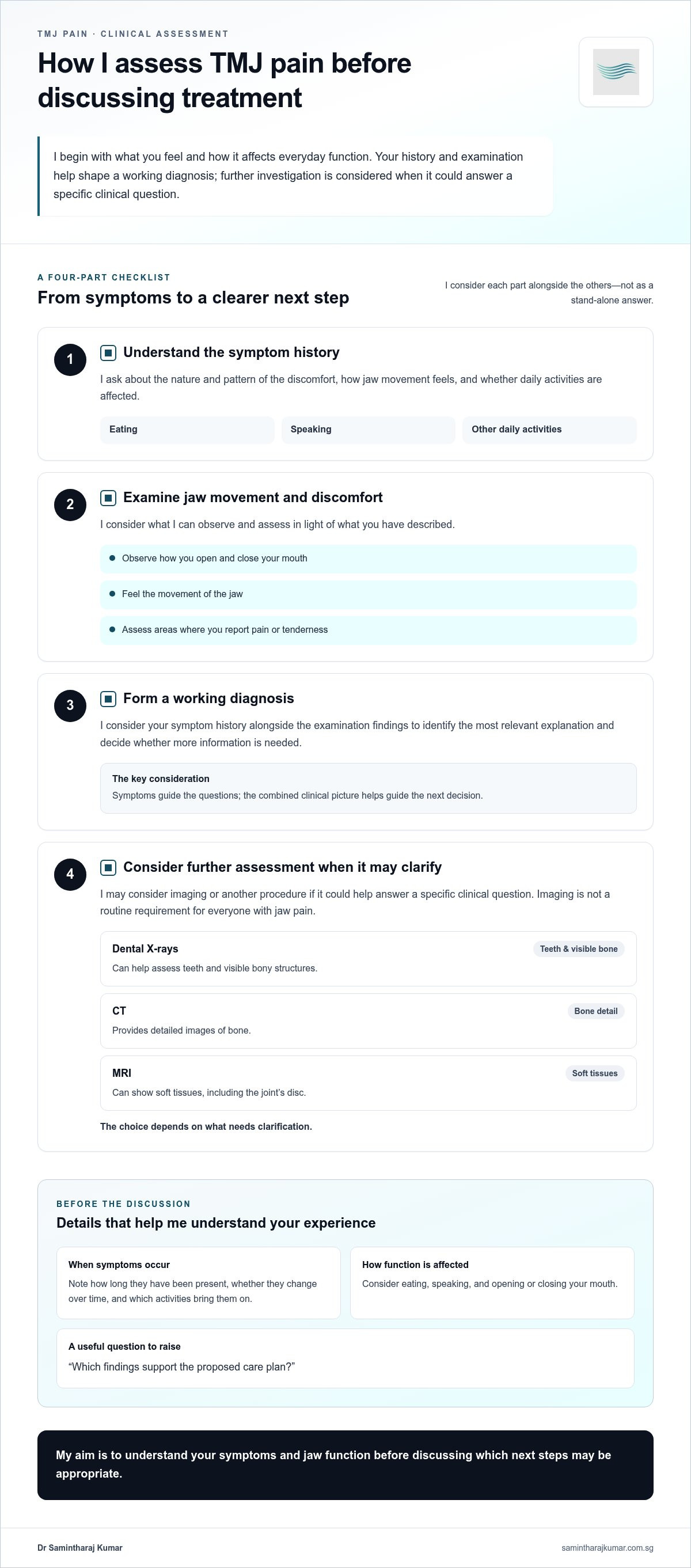
A careful assessment moves from what you feel to what can be observed, then considers whether further investigation would clarify the clinical picture. I don’t treat a scan as a substitute for listening or examination. The aim is to understand your symptoms and jaw function before discussing which next steps may be appropriate.
Symptom history: I ask about the nature and pattern of discomfort, how jaw movement feels, and whether eating, speaking or other daily activities are affected.
Jaw examination: I may observe how you open and close your mouth, feel the movement of the jaw and assess areas where you report pain or tenderness.
Working diagnosis: I consider your history alongside examination findings to identify the most relevant explanation and decide whether more information is needed.
Further assessment: Imaging or another procedure may be considered if it could help answer a specific clinical question.
Examination findings help determine whether the clinical picture is clear or whether additional information could clarify your symptoms. This keeps investigations purposeful rather than automatic.
What happens during a TMJ pain examination?
The consultation is a conversation as well as an examination. I’ll ask what you’ve noticed and how it affects your jaw function, then assess movement and areas of discomfort in light of what you’ve described. The findings help shape a working diagnosis and the next discussion, but no single observation necessarily provides a complete answer.
For example, the significance of discomfort during movement depends on the broader history and examination findings. I explain how those pieces of information fit together, including where uncertainty remains. This can make the reasoning behind a proposed test or treatment clearer. The Mayo Clinic guidance on TMJ disorders also outlines examination and diagnostic options.
When might imaging or arthroscopy be considered?
Imaging is considered when the clinical question calls for it, not as a routine requirement for everyone with jaw pain. Different methods show different structures. Dental X-rays can help assess teeth and visible bony structures; CT provides detailed images of bone, while MRI can show soft tissues, including the joint’s disc. The choice depends on what needs clarification.
Arthroscopy involves inserting a small camera into the joint. In selected circumstances, it may help a clinician examine the joint and may also have a treatment role. It isn’t a universal step in assessment. My approach to TMJ pain management is to relate each proposed investigation to the patient’s symptoms, function and examination, so the purpose of the next step is clear before a treatment plan takes shape.
Clinical treatments for tmj pain should follow a reasoned assessment, not a scan or procedure chosen without a clear clinical question. Precision begins with knowing what information is needed, and why.
Comparing Clinical Treatments for TMJ Pain by Their Purpose
Treatment options are easier to compare when you ask what each is intended to address, rather than assuming they are alternatives with the same purpose. Some approaches focus on movement and function; others support coping with persistent pain or may be considered for a specific joint problem. In my clinical experience, the discussion should start with the assessment and the patient’s goals.
The comparison below describes broad roles, not a prescription. A clinician considers the findings, the impact on daily function and how different elements may fit together.
What roles can non-surgical therapies play?
Physical therapy may address movement and function, while manual approaches involve hands-on care. Because jaw mechanics are closely connected to the head and neck, some individuals also explore upper cervical evaluation with providers like Precision Spinal Care to understand how spinal alignment may contribute to surrounding tension. Therapeutic exercise focuses on planned movement practice. Psychological approaches may help a person work with stress, pain responses or coping as part of a biopsychosocial model, which recognises that pain can involve interacting physical and psychological factors. This does not make pain less real. Therapy choices should reflect the assessment and the activities the person wants to manage.
When are medication or procedures discussed?
Medication may be discussed alongside other approaches when a clinician considers it appropriate. Its role depends on the person’s circumstances, so it should not be self-prescribed or treated as a promise of relief. Procedures also differ: arthrocentesis involves flushing the joint, while arthroscopy uses a small camera to examine the joint and may have a treatment role in selected cases. Other surgery is a distinct, more involved category, not a routine starting point.
What many patients do not realise is that more intervention doesn’t automatically mean a better fit. Clinical treatments for tmj pain should be discussed in proportion to the findings, the purpose of each option and the person’s priorities. I use that reasoning to make the care conversation clearer, with attention to function and the factors each approach is intended to address.
How to Discuss a TMJ Pain Treatment Plan with Your Clinician
A useful consultation is a conversation, not a test you need to pass. You don’t need to arrive with a diagnosis. A short, clear account of what you’ve noticed can help me understand how jaw symptoms affect your life and what you hope to manage. That gives us a practical starting point for discussing clinical treatments for tmj pain in the context of your assessment.
Before your appointment, note when symptoms began, how they vary and which activities are affected. Be specific: perhaps chewing firm foods feels uncomfortable, speaking for a long time increases tension, or opening your mouth feels more restricted at certain times. Include what you have already tried and what you noticed, without assuming what the symptoms mean.
Questions that clarify the proposed treatment
You’re entitled to understand the reasoning behind a care plan. I welcome questions that connect the examination to the next step and make the purpose of each option clearer. You might ask:
Which assessment findings relate to the symptoms or functional concerns I’ve described?
What is this treatment approach intended to help with in my case?
What alternatives could be considered, and how do their roles differ?
How will we review progress, and what might prompt a change to the plan?
These questions help distinguish a treatment’s intended goal from a guaranteed result. They also make room to discuss practical considerations, such as whether the approach fits your priorities and everyday routine. A sound plan should be understandable, proportionate to the findings and open to review as the clinical picture develops.
How to make follow-up discussions more useful
Between appointments, keep a brief record of symptom patterns and changes in jaw function. A few notes are usually more useful than trying to remember every detail later. Focus on observations rather than labels: what you were doing, what felt different and whether a daily activity became easier or harder.
Better: Note if eating or speaking feels more comfortable, and in what circumstances.
Unchanged: Record symptoms or limitations that remain much the same.
More difficult: Describe any new or increased difficulty in movement or daily function.
At follow-up, this information helps us discuss what has changed without relying on guesswork or self-diagnosis. If you’re also considering how specialist knowledge fits into your care, learning what to look for in a TMJ specialist can help you prepare for an informed discussion. I use each review to revisit the goals and consider whether the plan still reflects your needs.
If jaw pain is affecting your daily function, you can discuss your TMJ pain concerns as part of a cause-led clinical assessment. My aim is to make the reasoning clear, so decisions are grounded in your symptoms, examination and priorities.
Dr Samintharaj Kumar’s Cause-Led Approach to TMJ Pain Management
My approach to TMJ Pain Management begins with the person, not a predetermined treatment. I consider the symptoms they describe, how jaw function is affected and what the clinical examination reveals. Together, these details help me understand what matters most to the patient and frame a proportionate discussion about possible next steps. They don’t allow me to promise a particular outcome, but they do make the reasoning behind care more considered.
Why I begin with the patient’s experience and clinical findings
In my clinical experience, listening carefully is essential before assigning a label or discussing a treatment category. A person’s account can show what they find most limiting, whether that is eating comfortably, speaking or another aspect of daily life. The examination adds clinical context. I bring these perspectives together rather than allowing one symptom to define the entire problem.
Function makes the conversation practical. If a patient’s priority is a particular daily activity, that concern can help shape meaningful goals for care and later discussion. My role is to explain how the reported experience and clinical findings relate, including when the available information leaves questions to explore. This is where precision matters: it supports a treatment discussion that reflects the individual rather than a generic idea of jaw pain.
What patients can expect from a considered care discussion
I aim to make the consultation educational and clear. We can discuss what the assessment suggests, which care directions may be relevant and why, while keeping the patient’s comfort and priorities in view. The conversation should support shared understanding, not pressure someone towards a particular procedure or imply that one approach suits everyone.
A useful discussion can clarify:
The reasoning: how the symptoms and examination inform the clinical picture.
The purpose: what a possible care direction is intended to address.
The goals: which aspects of function or comfort matter to the patient.
The uncertainties: what remains unclear and may need further consideration.
Patients should have space to ask questions, reflect on the explanation and understand what is being proposed before deciding how to proceed. Clarity is part of patient-centred care. It helps ensure decisions are grounded in a meaningful discussion of the assessment, rather than assumptions about what jaw pain must require.
I provide TMJ Pain Management with a focus on facial pain, clinical precision and patient comfort. To learn more about my approach, explore my clinical approach to TMJ care.
The right diagnosis changes the quality of the next decision. My philosophy has always been to take the time to understand the clinical picture, then make the care conversation proportionate to it. That is the foundation of a thoughtful, individual approach.
Take the Next Step with Greater Clarity
Your next step doesn’t need to be a decision about a specific treatment. It can simply be a clearer conversation about what your symptoms mean and what you hope to improve. The most thoughtful clinical treatments for tmj pain begin with understanding the individual, then weighing possible directions against their needs and clinical findings.
My philosophy is to make that reasoning clear and keep the discussion centred on function, comfort and informed choice. I bring this perspective to my clinical work as a Diplomate and Fellow of the International Congress of Oral Implantologists, while recognising that every TMJ care discussion must be grounded in the person’s own assessment.
If you would like to learn more about how I approach TMJ pain management, explore my clinical approach to TMJ pain management. A thoughtful conversation can help you move forward with greater confidence. The right diagnosis changes the quality of the next decision.
Frequently Asked Questions
Can TMJ pain go away without clinical treatment?
Yes, jaw pain can sometimes settle without formal clinical treatment, although I can’t predict that from the symptom alone. I’d consider whether it is easing, recurring or affecting everyday activities before discussing what to do next. If discomfort continues or interferes with eating or jaw movement, an assessment can help clarify whether monitoring or a more active approach is appropriate.
What is the first clinical treatment for TMJ pain?
There isn’t a single first treatment I would recommend for everyone. I first consider the person’s symptoms, examination findings and priorities, then discuss an approach that fits that picture. For one person, the initial conversation may focus on conservative care; for another, a different direction may be relevant. I explain the intended role of an option so the patient can make an informed decision.
Are TMJ injections or surgery always needed for jaw pain?
No. I don’t treat injections or surgery as automatic responses to jaw pain. Their relevance depends on the clinical findings and the concern being addressed. If a procedure is being considered, I would want the discussion to cover its purpose and the other options that may be appropriate. A procedure should not be assumed necessary simply because pain is present.
Can physical therapy help with TMJ pain?
Physical therapy may be a useful part of care for some people, particularly if jaw movement or function is a concern. For patients seeking hands-on care, clinics providing physiotherapy and manual therapy Miami demonstrate how targeted soft-tissue work and joint mobilization can help alleviate tension around the jaw and neck. I would consider how it relates to the individual’s examination and what they want to manage, rather than recommending it based on pain alone. If we discuss therapy, I would clarify its intended role and how we can assess whether it remains relevant to the patient’s goals.
How do clinicians diagnose a TMJ disorder?
I form a working diagnosis by considering the patient’s account alongside clinical examination findings. The assessment may include looking at jaw movement and examining areas associated with discomfort. If the picture remains uncertain, I may consider whether further assessment could answer a specific question. I explain how the findings inform my reasoning, while recognising that a diagnosis should reflect the whole clinical picture rather than one isolated sign.
Can medication alone treat TMJ pain?
Medication may have a role, but I wouldn’t assume it addresses every factor contributing to a person’s jaw pain or functional difficulty. Whether it is suitable depends on individual circumstances and should be discussed with a clinician. I consider medication in the context of the wider care plan, including its intended purpose and whether other approaches may also be relevant. Clinical treatments for tmj pain should be guided by assessment, not by medication alone.



Comments