
Credentials to Look for in a Dental Implant Specialist: A Surgeon’s Guide (2026)
- Dr Samintharaj Kumar

- May 31
- 12 min read
The most expensive component of a dental implant isn't the titanium screw or the ceramic crown; it's the clinical judgment of the surgeon performing the procedure. In my clinical experience, many patients approach me feeling overwhelmed by the vast price differences and conflicting advice they find online. You likely feel that choosing the right practitioner shouldn't feel like a gamble, yet the distinction between a general dentist and a dedicated surgeon remains surprisingly opaque. Understanding the specific credentials to look for in an implant specialist is the first step toward ensuring your oral rehabilitation is a lifelong success rather than a temporary fix.
I believe that clinical excellence is a synthesis of specialist training, biological philosophy, and technological mastery. In this guide, I'll explain the critical qualifications and advanced certifications, such as Diplomate status from the American Board of Oral Implantology, that distinguish an expert from a practitioner who simply performs occasional placements. We will examine how digital workflows and AI-assisted diagnostics have redefined the standard of care in 2026. By the end of this article, you'll have a clear framework to evaluate any clinician, providing the peace of mind that comes from being in truly capable hands.
Key Takeaways
Understand why complex rehabilitations require surgical expertise beyond general dentistry to ensure long-term stability and avoid common complications.
Identify the specific credentials to look for in an implant specialist, including board certifications and international fellowships that signify a mastery of global surgical standards.
Discover how AI-assisted diagnostics and digital workflows serve as a hallmark of clinical excellence, enhancing precision during the placement of dental implants.
Learn the importance of a biological approach to dentistry and the specialist qualifications required for the successful integration of biocompatible ceramic implants.
Equip yourself with the critical questions to ask during your consultation to ensure your surgeon prioritises your personal well-being alongside technical mastery.
Table of Contents
Beyond the DDS: Why Specialist Credentials Matter in Implantology
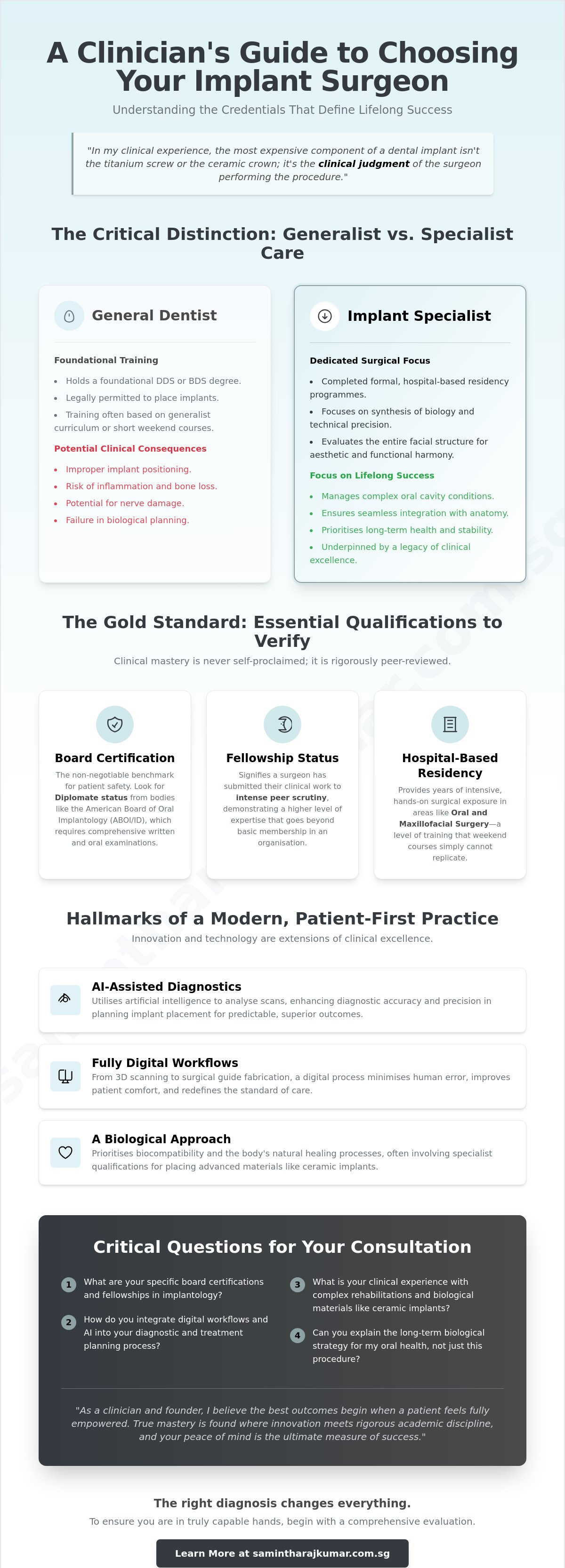
While a Doctor of Dental Surgery (DDS) or Bachelor of Dental Surgery (BDS) degree provides the foundational license to practice dentistry, it is merely the beginning of a surgeon's journey. In my clinical experience, many patients are surprised to learn that any general dentist is legally permitted to place an implant. However, the legal right to perform a procedure does not equate to clinical mastery. When researching the credentials to look for in an implant specialist, you must look beyond the initial degree to find evidence of dedicated surgical focus. A successful outcome for modern dental implants requires a synthesis of biological understanding and technical precision that a generalist curriculum simply cannot cover in depth.
To gain a deeper understanding of how to differentiate between practitioners and the value of a second opinion, watch this brief overview on finding the right specialist:
The Clinical Consequences of Generalist vs Specialist Care
The gap between generalist and specialist care often manifests in the long-term viability of the restoration. Improper implant positioning can lead to persistent inflammation, bone loss, or even nerve damage. These are not just technical errors; they are failures in biological planning. Specialists are specifically trained to manage the complexities of the oral cavity, ensuring that the implant integrates seamlessly with your existing anatomy. From a biological perspective, we don't just look at the gap where a tooth is missing. We evaluate the entire facial structure, ensuring that the final result supports both your long-term health and your natural aesthetics.
A Foundation in Oral and Maxillofacial Surgery
As a clinician and founder, I believe that the most robust credentials to look for in an implant specialist are rooted in formal, hospital-based residency programmes. These intensive years of training provide a level of surgical exposure that weekend courses cannot replicate. This high-tier expertise is particularly vital for complex rehabilitations. For instance, the teeth in a day procedure explained in our clinical protocols relies on immediate loading, which requires absolute precision in primary stability. Specialist training ensures that whether we are performing a single placement or a total oral rehabilitation, the procedure is underpinned by a legacy of clinical excellence and a commitment to the patient's lifelong well-being. True mastery is found where innovation meets rigorous academic discipline.
The Gold Standard: Essential Qualifications and Board Certifications
Clinical mastery is never self-proclaimed; it is rigorously peer-reviewed. When patients ask me about the credentials to look for in an implant specialist, I often point them toward the distinction between basic membership and advanced fellowship. Many practitioners belong to implant organisations, but a Fellowship or Diplomate status signifies that the surgeon has submitted their work to intense scrutiny. For example, the American Board of Oral Implantology (ABOI/ID) requires a Diplomate to pass comprehensive written and oral examinations, proving a high level of expertise that goes far beyond standard dental school training.
Board Certification and Fellowship Status
In my clinical experience, board certification is the only non-negotiable benchmark for patient safety. It ensures the clinician understands the complexities of Dental implant surgery, including the management of the sinus cavity and bone density variations. As a clinician and founder, I look for surgeons who maintain standing with international bodies like the Academy of Osseointegration. These affiliations aren't just badges of prestige; they are commitments to global standards. You should always verify a surgeon's standing with their national regulatory body to ensure their clinical records reflect this level of dedication.
Expertise in Advanced Protocols: All-on-4 and Zygomatic Implants
Total oral rehabilitation requires a different tier of surgical skill than single-tooth replacement. If you are considering all on 4 dental implants, the specialist must demonstrate mastery in immediate loading protocols and prosthetic design. Cases involving severe bone loss often necessitate Zygomatic or Pterygoid implants. These procedures involve anchoring implants into the cheekbone or the pterygoid plate, areas that demand an intimate knowledge of maxillofacial anatomy. I believe documented success rates in these complex cases are one of the most vital credentials to look for in an implant specialist today.
True expertise is also found in those who lead the industry. I prioritise surgeons who serve as educators and mentors, as teaching a protocol requires a deeper level of understanding than simply performing it. This commitment to continuous education ensures we are always at the forefront of innovation. If you're ready to explore what a bespoke treatment plan looks like, understanding our clinical philosophy is a good place to start. The best outcomes are built on a foundation of verified skill and transparent communication.
Assessing Expertise in Complex and Biological Implantology
Modern implantology has evolved beyond the simple goal of replacing a missing tooth. We now understand that the long-term success of any restoration depends heavily on the body’s systemic response to the materials we introduce. From a biological perspective, the credentials to look for in an implant specialist must include a deep understanding of material science and biocompatibility. It is no longer enough to be a skilled technician; a surgeon must be a biologist who understands how different materials interact with the immune system and soft tissues. This philosophy ensures that your rehabilitation is not just functional, but health-optimising.
Specialisation in Ceramic Dental Implants
Zirconia or metal-free options represent a significant shift in surgical protocol. In my clinical experience, placing ceramic dental implants requires a different surgical skillset than traditional titanium. Ceramic is a high-performance material that demands absolute precision in angulation and initial stability because it does not allow for the same degree of mechanical adjustment as metal. When evaluating a surgeon, look for specific training from international societies dedicated to metal-free implantology. These credentials signify that the clinician understands the unique healing patterns of zirconia, which often results in superior gum health and reduced plaque accumulation compared to metal alternatives.
Multi-Disciplinary Mastery: Surgery Meets Aesthetics
The most successful outcomes occur when surgical expertise is paired with an eye for cosmetic dentistry. An implant specialist must be a master of soft tissue management. If the surgeon lacks credentials in gum contouring or bone regeneration, the final result may look like an artificial replacement rather than a natural tooth. I believe that a surgeon’s ability to manage bone loss and tissue volume is just as critical as their ability to place the implant itself. This multi-disciplinary approach ensures that the final prosthesis aligns perfectly with your facial harmony and lip line.
As a clinician and founder, I advocate for patients to seek out surgeons who have met the rigorous standards set by the American Board of Oral Implantology/Implant Dentistry. This certification process involves a two-part examination that tests both surgical and restorative knowledge. It serves as a vital indicator that the specialist can handle the complexities of total oral rehabilitation. Choosing a partner who understands the intersection of biology, material science, and aesthetics is the most effective way to ensure your new smile feels as natural as it looks. The best outcomes begin with understanding the root cause of bone and tissue degradation before a single incision is made.
The Role of Innovation: AI Diagnostics and Advanced Surgical Protocols
As a clinician and founder, I view a practice’s investment in technology as one of the most significant credentials to look for in an implant specialist. It is a tangible reflection of a surgeon's commitment to the highest global standards of safety and precision. In my clinical experience, the transition from traditional methods to a fully digital workflow is not merely a matter of convenience; it is a fundamental shift in how we ensure predictable outcomes for complex medical procedures. When a specialist integrates the latest innovations, they are choosing to replace guesswork with data-driven certainty.
AI-Assisted Diagnostics and Planning
In 2026, artificial intelligence has become an indispensable partner in the surgical planning process. AI-assisted diagnostics allow us to analyse 3D CBCT scans with a level of granularity that the human eye might overlook, identifying subtle bone density variations and mapping the exact path of neural structures. From a biological perspective, this foresight is essential for reducing surgical trauma. By using computer-guided surgery, we can place implants through minimal incisions, which significantly accelerates the healing phase and reduces post-operative discomfort. This advanced imaging is also vital for diagnosing multi-faceted issues, such as determining what kind of doctor treats tmj and identifying how jaw joint dysfunction might complicate your restorative journey.
In-House Laboratory and Ecosystem Integration
The best outcomes in implantology are achieved when the surgeon maintains total control over the restorative chain. A specialist practice that features an integrated in-house laboratory ensures that there is no "lost in translation" moment between the surgical placement and the final dental prosthesis. This ecosystem allows for real-time adjustments and ensures that every crown or bridge is crafted to match the precise angulation of the implant. When you evaluate a surgeon, ask about the clinical heritage of their protocols and whether they utilise a closed-loop digital system. This level of institutional building ensures that every component of your treatment is overseen by a single, accountable authority. If you value a practice that prioritises this level of meticulous planning, discover our integrated surgical ecosystem and see how we redefine the patient experience. The right diagnosis changes everything, and it begins with the most advanced tools available to modern medicine.
My Perspective: Choosing a Partner for Your Total Oral Rehabilitation
As a clinician and founder, I have always believed that the most sophisticated surgical technology is secondary to the trust established between a patient and their surgeon. Total oral rehabilitation is a life-altering event. It shouldn't be treated as a transaction. In my clinical experience, many patients come to me after feeling like a number in a high-volume practice where speed is prioritised over biological integrity. True clinical mastery involves knowing when not to operate just as much as knowing how to perform the surgery itself. When you are assessing the credentials to look for in an implant specialist, you are essentially looking for a partner who will be accountable for your long-term health and functional well-being.
The Interview: Questions for Your Potential Specialist
The initial consultation is your opportunity to interview the surgeon. Don't be afraid to ask direct questions. A confident specialist will welcome the scrutiny. I recommend asking the following to gauge clinical depth:
How many of these specific procedures have you performed this year? High-tier expertise in complex cases like zygomatic implants or ceramic restorations requires constant practice to maintain surgical "muscle memory."
Can you show me long-term case studies of similar rehabilitations? Anyone can show a photo of a result on day one. A true specialist can show you how that work has stood the test of time, five or ten years later.
What is your protocol for managing surgical complications? Clinical excellence isn't just about things going right; it's about having the hospital-based residency training to respond effectively if they don't.
Conclusion: The Right Diagnosis Changes Everything
Choosing a surgeon is about more than just checking boxes on a list of degrees. It is about finding a clinician who views your oral health from a biological perspective and values the legacy of their work. Identifying the right credentials to look for in an implant specialist ensures you aren't just buying a product, but investing in a lifetime of health. Seeking a second opinion is never a sign of disrespect to a practitioner; it is a vital step in your own education. Whether you are seeking dental implants or a full smile makeover, the goal is functional and aesthetic renewal that feels as natural as it looks. The best outcomes begin with understanding the root cause of your dental challenges. The right diagnosis changes everything.
A Vision for Long-Term Clinical Excellence
Your path to a restored smile is as much about the surgeon's philosophy as it is about their technical mastery. We have explored how the synthesis of board certifications, AI-assisted precision, and biological material science creates a foundation for success. As a clinician and founder of Nuffield Dental with a global presence across London and Singapore, I have seen how prioritising these standards protects patients from the limitations of generalist care. My focus on complex Zygomatic and All-on-4 protocols is rooted in a commitment to providing solutions that are as durable as they are aesthetic.
Ultimately, identifying the critical credentials to look for in an implant specialist isn't just a clinical task; it's a vital investment in your future self. This journey is about more than just replacing teeth; it's about functional renewal and the peace of mind that comes from being in expert hands. The best outcomes begin with understanding the root cause. Explore the standards of specialist care at Nuffield Dental. I am confident that with the right partnership, your transition to total oral rehabilitation will be a transformative and positive experience.
Frequently Asked Questions
Is a periodontist or an oral surgeon better for dental implants?
Both specialists bring unique strengths to the restorative process. Oral surgeons have extensive training in complex bone grafting and maxillofacial anatomy, while periodontists focus on the health of the supporting soft tissues. In my clinical experience, the best choice depends on your specific needs. If your case involves significant bone loss or requires zygomatic protocols, an oral surgeon’s hospital-based training is often the preferred pathway for a safe and predictable outcome.
What specific certifications should I look for in an implant dentist?
You should prioritise Diplomate status from the American Board of Oral Implantology or Fellowships from the Academy of Osseointegration. These are the gold-standard credentials to look for in an implant specialist because they require rigorous peer-reviewed examinations and years of documented surgical success. As a clinician and founder, I believe these certifications serve as a vital safeguard, ensuring your surgeon operates at the highest tier of international clinical protocols.
Can a general dentist legally perform dental implant surgery?
Legally, any licensed dentist can perform the procedure, but there is a profound difference in training. A general dentist may have completed a short course, whereas a specialist has undergone years of full-time, postgraduate surgical residency. This depth of education is what allows a specialist to manage unexpected biological complications and ensure the long-term stability of your total oral rehabilitation. Clinical mastery is earned through thousands of hours of dedicated surgical focus.
How do I verify a dental specialist’s credentials?
You can verify a clinician’s standing by searching the public registers of national bodies like the Singapore Dental Council or the General Dental Council in the UK. Additionally, most prestigious boards, such as the ABOI/ID, maintain online directories of their certified Diplomates. I always encourage patients to be proactive during the initial consultation; ask to see evidence of their specialist registration and long-term case studies of similar rehabilitations they've performed.
Why are specialist dental implants more expensive than generalist options?
The investment in specialist care reflects a commitment to clinical excellence and patient safety. Specialists utilise premium, biocompatible materials and advanced AI-assisted diagnostics to minimise surgical trauma and improve predictability. When you choose a specialist, you aren't just paying for the implant itself; you're investing in the surgeon’s decades of training and a clinical ecosystem designed to ensure a lifelong, functional result rather than a temporary fix.
What is the success rate of dental implants when performed by a specialist?
Specialists typically achieve exceptionally high success rates because they're trained to identify and mitigate risk factors before surgery begins. By using advanced 3D imaging and guided surgical protocols, we can ensure precise placement and optimal osseointegration. While no medical procedure is without risk, a specialist’s ability to manage complex bone density issues and soft tissue health significantly reduces the likelihood of long-term implant failure or biological complications.
Should I look for a specialist who uses AI and digital planning?
Yes. In my clinical experience, AI-assisted diagnostics are essential credentials to look for in an implant specialist in 2026. This technology allows us to map neural structures and bone volume with sub-millimetre precision, removing the guesswork from the surgical process. Digital planning leads to less invasive procedures, faster recovery times, and a final prosthesis that aligns perfectly with your natural facial aesthetics and jaw function.
What credentials are needed for complex Zygomatic or All-on-4 procedures?
These procedures require a higher tier of maxillofacial expertise and specific training in immediate loading protocols. For zygomatic implants, the surgeon must have extensive experience anchoring restorations into the cheekbone, a task that demands an intimate knowledge of mid-face anatomy. I recommend looking for a specialist who can demonstrate a significant volume of successful full-arch rehabilitations and who maintains active memberships in international zygomatic surgical networks.


Comments