
Success Rate of Teeth in a Day: A Surgeon’s Perspective on Clinical Outcomes (2026)
- Dr Samintharaj Kumar

- Jun 12
- 13 min read
Is the remarkable speed of immediate loading a shortcut that compromises your long-term health, or is it the new gold standard in restorative science? I've met many patients who feel a deep-seated anxiety about the "immediate" nature of this surgery, worrying that the success rate of teeth in a day might not match traditional, slower methods. It's natural to feel cautious when "fast" is often equated with "fragile" in a medical context, yet the clinical reality is far more encouraging than most realise.
As a clinician and founder, I believe that immediate success is a mechanical achievement, while long-term survival is a biological one. In my clinical experience, the key to a predictable outcome lies in the intersection of surgical precision and biological harmony. In this article, I'll provide you with the clinical reassurance you need by examining statistical outcomes from a specialist’s perspective. We'll explore the 2026 survival data showing rates as high as 96.4% for single implants, the science of immediate loading, and my philosophy on ensuring your restoration remains a permanent legacy of health and confidence.
Key Takeaways
Understand why global clinical literature and current 2026 data confirm that the success rate of teeth in a day remains exceptionally high, often ranging between 95% and 98% for most patients.
Learn the vital distinction between mechanical "primary stability" and biological osseointegration, and how immediate loading can actually encourage healthy bone growth.
Discover why the traditional approach of waiting months is no longer the only path to a permanent bond, as modern protocols offer immediate function with clinical excellence.
Identify how specific systemic factors like smoking and diabetes impact your recovery and the precise protocols used to safeguard your long-term surgical success.
Gain insight into the role of biological dentistry and ceramic implants in maintaining soft tissue health and ensuring your new smile is as healthy as it is beautiful.
Table of Contents
Understanding the Clinical Success Rate of Teeth in a Day
When we speak about "Teeth in a Day," we are referring to a sophisticated protocol known as immediate functional loading. In my clinical experience, patients often arrive with a mix of excitement and skepticism, wondering if a procedure performed so quickly can truly endure. It's vital to understand that this isn't a shortcut. It is a highly engineered surgical approach where a fixed prosthesis is attached to dental implants within 24 hours of their placement. For a comprehensive overview of dental implants and their evolution, one can see how these protocols have moved from experimental to a global standard of care.
To better understand this concept, watch this helpful video:
The success rate of teeth in a day is remarkably high, with global clinical literature citing benchmarks between 95% and 98%. However, as a clinician and founder, I make a sharp distinction between a "survival rate" and a "success rate." Survival simply means the implant remains in the jaw. Success, conversely, means the implant is functional, the surrounding soft tissue is healthy, and the patient experiences no pain or infection. I believe true success is determined long before the first incision is made through meticulous planning and biological assessment.
The 98% Benchmark: What the Data Tells Us
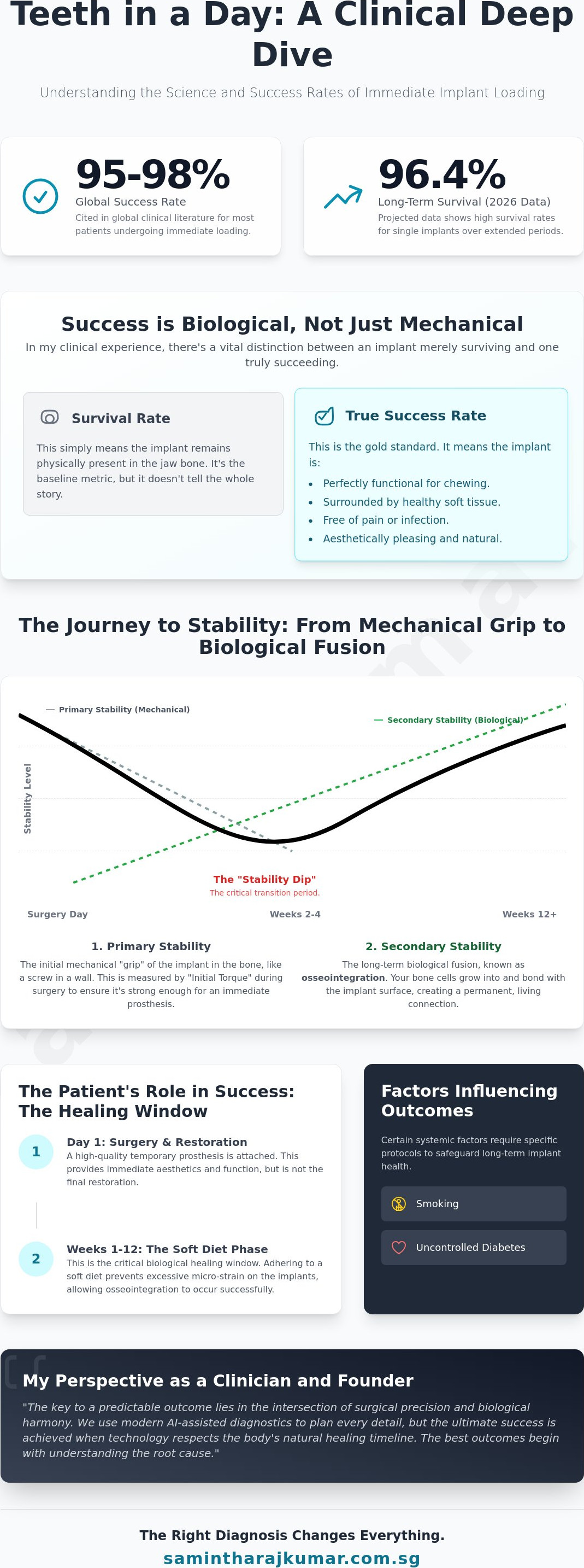
Current 2026 data confirms that short-term survival for immediate implants remains between 95% and 98%. Long-term studies over 10 years show that protocols like All-on-4 maintain a success rate of approximately 95%. These figures have been bolstered recently by modern AI-assisted diagnostics. At Nuffield Dental, we use these tools to simulate bone density and stress distribution before surgery, ensuring the mechanical "grip" of the implant is sufficient to support immediate loading. This precision reduces the margin for human error and elevates the predictability of the outcome.
Immediate Loading vs. Immediate Restoration
It's essential to clarify the difference between putting a tooth on an implant and actually chewing with it. Immediate restoration refers to the aesthetic placement of a crown or bridge on the day of surgery so you don't leave the clinic with gaps. Immediate loading means those implants are actually participating in the forces of biting.
The "Day 1" outcome is almost always a high-quality temporary prosthesis. From a biological perspective, the first 8 to 12 weeks are a critical healing window. During this time, I require patients to adhere to a soft diet phase. This prevents excessive micro-strain that could disrupt the delicate process of bone cells knitting to the implant surface. The best outcomes begin with understanding the root cause of why these biological timelines exist.
The Science of Stability: Why Immediate Load Implants Succeed
From a biological perspective, the success of immediate loading isn't magic. It's physics followed by biology. On the day of your surgery, we achieve what we call primary stability. This is the mechanical "grip" of the implant within the bone. Think of it like a screw in a wall. However, this mechanical grip naturally weakens as the bone around the implant undergoes a remodelling phase. This creates a "stability dip," usually between weeks two and four. Navigating this window is where the surgeon’s expertise becomes the defining factor in the success rate of teeth in a day. If the mechanical grip fades before the biological fusion takes over, the implant can fail. My job is to ensure that transition is seamless.
Secondary stability is the biological process of osseointegration, where your bone cells actually grow into the surface of the implant. To ensure this happens predictably, I measure "Initial Torque" during placement. If the torque doesn't meet my strict clinical threshold, I won't load the implant immediately. This conservative, safety-first approach is why we can maintain such high predictability. Understanding the risks and benefits of dental implants is essential, as the science of stability relies on a healthy partnership between the patient’s biology and the surgeon’s technique.
The Role of Bone Density and Quality
I use 3D CT scans to map out the highest density areas of your jaw, allowing us to anchor implants where they will be most secure. For patients with severe bone loss, we often utilise Zygomatic Dental Implants or pterygoid protocols. These specialised implants anchor into the denser, non-resorbing bone of the cheek or skull. This technique allows us to ensure the success rate of teeth in a day remains high even in challenging cases where traditional implants might struggle to find purchase. A personalised clinical consultation is always the first step in mapping this bone architecture.
Biocompatibility and Material Science
The materials we choose are just as critical as the surgical technique. While titanium is the historical standard, I've seen a growing preference for Ceramic Dental Implants. These are highly biocompatible and naturally resist the accumulation of plaque. Modern surface textures on these implants are engineered to encourage faster bone cell attachment, accelerating the move toward secondary stability. This biological-first approach reduces the risk of peri-implantitis, ensuring that your restoration isn't just a temporary fix, but a long-term legacy of health. The best outcomes begin with understanding the root cause of how materials interact with your unique physiology.
Comparing Traditional vs. Immediate Load Success Metrics
As a clinician and founder, I view traditional and immediate loading protocols as complementary rather than contradictory. A common question in my practice is whether waiting six months for a traditional implant results in a "better" bond than the "Teeth in a Day" approach. While the traditional method remains a gold standard for specific complex cases, current 2026 data indicates that the success rate of teeth in a day is statistically comparable to delayed loading in healthy patients. In many instances, immediate loading offers a distinct biological advantage that traditional methods simply cannot replicate: the stimulation of bone through controlled micro-strain.
From a biological perspective, bone is a dynamic tissue that responds to functional demand. Just as muscles strengthen with exercise, bone density can be encouraged by the gentle, controlled forces of chewing. This micro-strain signals the body to remodel and mineralise the bone around the implant more actively. This early loading provides a significant psychological success factor. Leaving the clinic with a complete smile immediately transforms a patient’s mental well-being. I've found that when patients feel the restoration is part of their identity from day one, they're often more diligent with hygiene and dietary protocols during the critical healing window.
Clinical Outcomes: A Side-by-Side Analysis
In healthy non-smokers, failure rates for both protocols hover between 2% and 5%. One technical benefit of immediate loading is the management of the "micro-gap." By attaching the prosthesis on the day of surgery, we create an early biological seal. This can reduce the risk of bacterial contamination at the implant-abutment interface compared to traditional methods where the site might be exposed to the oral environment multiple times. Long-term maintenance remains identical; both paths require professional hygiene sessions twice a year to ensure the surrounding tissue remains healthy and free of inflammation.
Functional Adaptation and Speech
Proprioception, your body's innate sense of its own position, plays a vital role in how you perceive your new smile. The brain begins the complex process of speaking and chewing with a new prosthesis much sooner with immediate loading. This early engagement allows the neuromuscular system to adapt to new bite alignments more fluidly than if there were a long gap without teeth. While the final permanent bridge is fitted after osseointegration is complete, the temporary phase is a vital period for functional training. The best outcomes begin with understanding the root cause of how your brain and jaw work together to accept a new restoration.
Mitigating Risks: Factors that Influence Your Long-term Outcome
I often tell my patients that the surgical procedure is only half the journey. The other half is how your body responds and how you protect that investment in the months following the operation. While the success rate of teeth in a day is remarkably high, these statistics are not a guarantee of immunity from biological or mechanical challenges. In my clinical experience, achieving a predictable outcome is a partnership between the surgeon’s precision and the patient’s commitment to post-operative care. We must identify and mitigate specific risk factors before the first incision is made.
The "Big Three" risks I monitor most closely are smoking, uncontrolled diabetes, and bruxism. From a biological perspective, nicotine is a potent vasoconstrictor. It constricts blood vessels and significantly reduces the flow of oxygen and essential nutrients to the healing bone. This doesn't just slow down recovery; it can actively starve the site, preventing the bone from knitting to the implant surface. Similarly, uncontrolled blood sugar levels can impair the immune response, making the site more vulnerable to early infection. This is why the teeth in a day procedure explained in our clinical pillars relies so heavily on strict patient selection and pre-surgical optimisation.
Systemic Health and Oral Microbiome
Success is often dictated by the health of your oral microbiome and your overall immune status. If active periodontal disease is present in other areas of the mouth, those bacteria can migrate to the new implant sites, leading to early inflammation. For complex rehabilitation cases, I often perform comprehensive blood work to assess your regenerative capacity. I want to ensure your body is prepared to handle the demands of immediate loading. Managing the host response is critical; your immune system is the ultimate arbiter of whether an implant is accepted or rejected.
Mechanical Protection: The Night Guard and Diet
Once we achieve primary stability, mechanical protection becomes our priority. For patients with bruxism (teeth grinding), a custom-fitted night guard is a non-negotiable insurance policy for their new smile. It absorbs the nocturnal forces that could otherwise cause the implants to shift during the critical healing window. I also enforce the "Rule of Thumbs" for the first 12 weeks: if you cannot easily cut your food with the side of a fork, it should not be on your plate. This prevents excessive lateral pressure during the transition from mechanical to biological stability. The best outcomes begin with understanding the root cause of potential complications. If you are ready to explore a smile makeover designed around your unique health profile, I am here to guide that transition.
My Perspective: The Intersection of Technology and Biological Integrity
As a clinician and founder, I believe the most significant variable in the success rate of teeth in a day isn't just the hardware we use. It's the philosophy behind the surgical execution. While many practices focus on the convenience of speed, my priority is the biological integrity of the restoration. I've spent my career building an institution where we don't just replace teeth; we restore a person’s functional legacy. This requires a meticulous blend of visionary technology and an empathetic, patient-centred approach that looks decades into the future rather than just days.
In my clinical experience, the move toward "Metal-Free" biological dentistry has been transformative for long-term outcomes. By utilising Ceramic Dental Implants, we're able to offer a solution that is exceptionally kind to the soft tissues. These materials don't just look natural; they resist the bacterial colonisation that often leads to inflammation. From a biological perspective, a healthy gum seal is the first line of defence for an implant. When we combine these materials with AI-assisted diagnostics, we can virtually "perform" your entire surgery in a digital environment before you even arrive at the clinic. This level of precision ensures that the success rate of teeth in a day remains a clinical reality for my patients.
The Nuffield Protocol for High-Success Rehabilitation
At Nuffield Dental, our protocol is built on uncompromising quality. We use only premium, clinically-validated implant systems that have been rigorously tested in global medical networks. Our approach is multi-disciplinary, involving a team that ranges from specialist oral surgeons to master ceramists. We don't just treat the gap in your smile; we prioritise identifying the root cause of the initial tooth loss. Whether it was due to systemic health issues or mechanical wear, addressing the origin is the only way to prevent future complications and ensure a lifetime of functional excellence.
Your Journey Toward Total Rehabilitation
The journey begins with a fundamental question: if you are a candidate for teeth in a day, what does that mean for your long-term health? A restored smile does more than just improve your appearance. It revitalises your ability to nourish yourself, improves your speech, and restores a profound sense of confidence that radiates into every aspect of your life. I view every rehabilitation as a piece of history we're writing together. It's about creating a legacy of health that allows you to live without the shadow of dental anxiety. The best outcomes begin with understanding the root cause, and the right diagnosis changes everything.
Securing Your Legacy of Health and Confidence
The decision to undergo total oral rehabilitation is a significant milestone in your personal health journey. We've explored how the success rate of teeth in a day is anchored in a sophisticated blend of mechanical precision and biological harmony. With clinical benchmarks for 2026 consistently reaching between 95% and 98%, the evidence supports this protocol as a transformative standard of care for the modern patient. I've seen how AI-driven diagnostics and premium materials have removed the traditional guesswork, replacing uncertainty with a predictable path to renewal.
As a Fellow of the Royal College of Surgeons (England) and the founder of Nuffield Dental Holdings, my commitment is to ensure that your restoration is built on a foundation of technical excellence. I specialise in complex All-on-4 and Zygomatic protocols because I believe every patient deserves a solution that respects their unique biology. Your long-term functional excellence is the true measure of our success.
The best outcomes begin with understanding the root cause. Explore the future of your smile with Dr Samintharaj Kumar. I look forward to guiding you toward a life of health and renewed confidence.
Frequently Asked Questions
What is the actual success rate of Teeth in a Day compared to traditional implants?
In healthy patients, the success rate of teeth in a day is statistically comparable to traditional protocols, typically ranging between 95% and 98%. While traditional methods involve a waiting period of several months, immediate loading relies on high primary stability achieved on the day of surgery. From a biological perspective, both methods aim for the same end goal of osseointegration, which is the permanent fusion of the implant to your bone.
Can Teeth in a Day fail after the first year?
Implant failure can occur after the first year, though it's less common than early-stage complications. Late failures are often attributed to peri-implantitis, an inflammatory condition affecting the tissues around the implant, or mechanical overload from chronic teeth grinding. Maintaining a strict professional hygiene schedule is the most effective way to protect your restoration for the long term and ensure your functional legacy remains intact.
Does smoking significantly lower the success rate of same-day implants?
Smoking is one of the most significant risk factors for failure because nicotine constricts the blood vessels in the jaw. This reduced blood flow starves the healing bone of oxygen and nutrients needed for the implant to fuse correctly. In my clinical experience, smokers face a higher risk of both early and late complications, which is why I always discuss smoking cessation as part of the treatment plan.
What happens if a Teeth in a Day implant fails to osseointegrate?
If an implant fails to bond with the bone, it must be removed to allow the site to heal properly. Once the area has recovered, we re-evaluate the bone quality and may perform a bone graft before attempting a replacement. A single failed implant doesn't mean the entire restoration has failed; we simply adjust the protocol and re-evaluate the biological environment to ensure the next attempt is successful.
Are success rates lower for patients with osteoporosis or low bone density?
Low bone density doesn't automatically disqualify you from success, provided we use the correct surgical protocol. For patients with significant bone loss, I often utilise Zygomatic Dental Implants or pterygoid anchors that bypass the weaker areas of the jaw. These specialised techniques allow us to achieve high stability even when traditional bone volume is lacking, ensuring the predictability of the outcome remains high.
How does the All-on-4 protocol affect the success rate of full-arch replacement?
The All-on-4 protocol has an excellent track record, with clinical data showing approximately 95% survival over a ten-year period. By tilting the posterior implants and splinting them together with a fixed bridge, we distribute the biting forces more evenly across the jaw. This mechanical arrangement protects the individual implants during the critical phase of biological healing, making it a highly reliable solution for total rehabilitation.
Is the success rate of ceramic implants different from titanium ones?
Clinical studies show that ceramic dental implants have success rates that are largely comparable to traditional titanium versions. Ceramic options are particularly beneficial for patients with metal sensitivities or those who prioritise soft tissue health. Because ceramic is highly biocompatible, it often results in a healthier gum seal, which is a vital factor in preventing the inflammation that can lead to long-term implant failure.
How much does the skill of the surgeon impact the success rate of immediate load implants?
The surgeon’s expertise is perhaps the most critical variable in the success rate of teeth in a day. Accurate placement and the decision to load the implant immediately require precise measurements of "Initial Torque" and bone density. As a clinician and founder, I believe that meticulous digital planning and surgical experience are what turn a complex procedure into a predictable, life-changing outcome for the patient.


Comments