
How Dentists Measure Bite Alignment: A Surgeon’s Perspective on Occlusal Precision (2026)

What if I told you that the thin strip of coloured paper your dentist asks you to "bite and grind" on is often as subjective as a weather forecast? While articulating paper has served the profession for decades, it only illustrates where teeth touch, not the intensity or the sequence of that contact. In my clinical experience, understanding how dentists measure bite alignment has transitioned from these static visual cues into a precise, data-driven science that prioritises your long-term comfort and functional stability.
I recognise how exhausting it is to live with persistent jaw clicking or the sight of uneven wear on your dental restorations, especially when previous explanations have felt vague or dismissive. You deserve more than a "best guess" when it comes to your oral health. In this article, I'll reveal the advanced clinical methods and technologies I use to measure and restore perfect bite harmony. We'll look at why traditional impressions have remake rates as high as 18% and how I use tools like the T-Scan Novus digital system to provide the objective data needed for lasting TMJ relief and restorative success.
Key Takeaways
Distinguish between a beautiful smile and a functional bite to ensure your dental restorations and natural teeth last a lifetime.
Explore the transition from traditional articulating paper to digital analysis to see how dentists measure bite alignment with objective, millisecond-level precision.
Identify the biological warning signs of malocclusion, such as abfraction lesions, before they lead to significant structural failure or chronic TMJ discomfort.
Gain insight into how AI-assisted diagnostics allow us to predict functional outcomes and customise treatment plans for more predictable surgical results.
Understand what to expect during a non-invasive clinical occlusal evaluation and how this data-driven approach helps resolve persistent jaw pain.
Table of Contents
Understanding Occlusion: Why Bite Alignment is More Than Just 'Straight Teeth'
The Evolution of Measurement: From Articulating Paper to Digital Analysis
The Clinical Stakes: What Happens When Bite Alignment is Overlooked?
My Perspective: Integrating AI and Biological Principles in Bite Assessment
Restoring Harmony: What to Expect During Your Occlusal Evaluation
Understanding Occlusion: Why Bite Alignment is More Than Just 'Straight Teeth'
In my clinical experience, patients often arrive at my practice focused primarily on the visual symmetry of their smile. While "straight teeth" are a desirable aesthetic outcome, they don't always equate to functional harmony. Understanding Occlusion requires looking far beyond the surface. We must distinguish between static occlusion, which is how teeth touch when the jaw is closed, and dynamic occlusion, which involves how teeth interact during the complex movements of chewing and speaking. Malocclusion is a misalignment of the teeth or jaws that disrupts functional harmony and triggers structural wear.
To better understand this concept, watch this helpful video:
The Science of Dental Articulation
From a biological perspective, your bite is a sophisticated neuromuscular event rather than a simple mechanical closure. The temporomandibular joint (TMJ) acts as the primary fulcrum for every movement your jaw makes. Within the periodontal ligament, specialised mechanoreceptors sense even the slightest variations in bite pressure, sending constant feedback to the brain to adjust jaw position. This is why even a sub-millimetre discrepancy in how dentists measure bite alignment can trigger chronic facial pain or debilitating migraines. The body attempts to compensate for these tiny imbalances, leading to muscular fatigue and joint strain that often goes undiagnosed for years.
Identifying the Root Cause of Misalignment
As a clinician and founder, I believe a successful diagnosis begins with identifying whether the issue is skeletal or dental in nature. Skeletal malocclusion involves the relationship between the upper and lower jaw bones. Conversely, dental malocclusion refers specifically to tooth positioning. Missing teeth significantly compromise this stability. The remaining teeth often drift into the vacant space, collapsing the dental arch and shifting the entire occlusal plane. When evaluating how dentists measure bite alignment, we must look at this bone-to-tooth relationship carefully.
This is a critical consideration in our dental implant Singapore protocols. We don't just replace a tooth; we must account for the complex occlusal forces to ensure the new restoration integrates perfectly into the existing biological system. This precision prevents premature failure of the implant and ensures long-term comfort for the patient. The best outcomes begin with understanding the root cause of the shift.
The Evolution of Measurement: From Articulating Paper to Digital Analysis
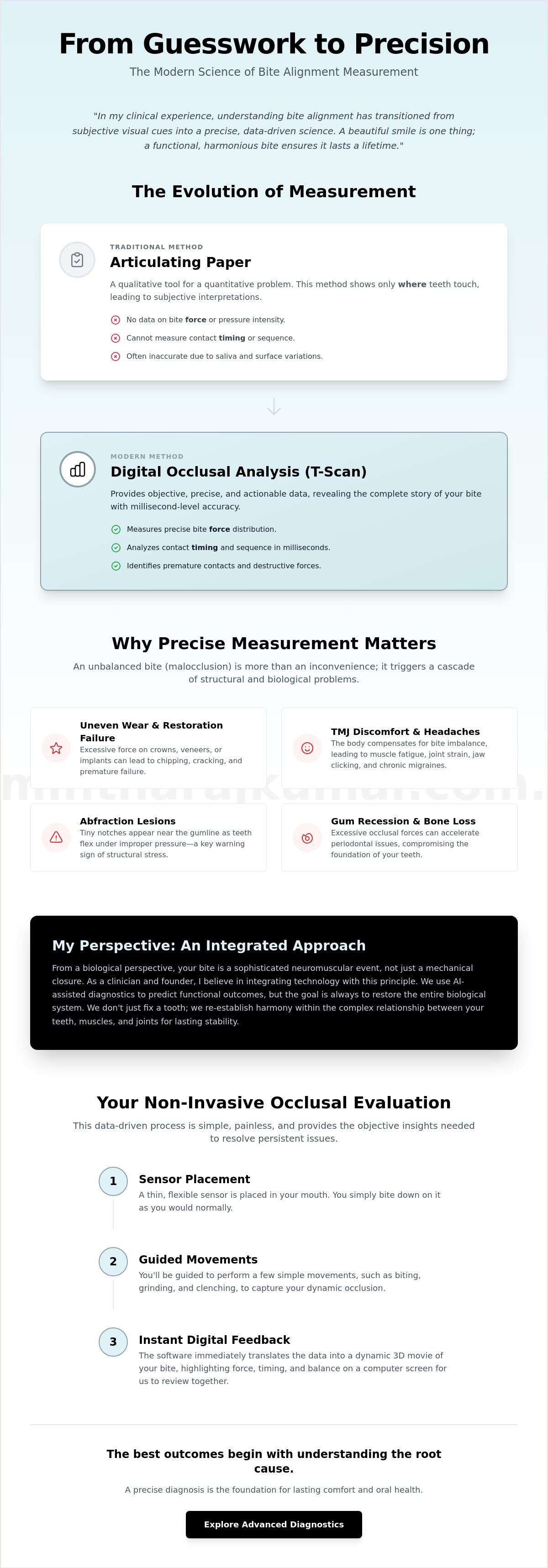
Historically, the dental profession relied heavily on a "bite and look" approach. In my clinical experience, the history of how dentists measure bite alignment has transitioned from subjective observation to millisecond-level precision. While articulating paper remains a common sight in many clinics, it's essentially a qualitative tool being used for a quantitative problem. It shows us where teeth touch, but it tells us nothing about the force or the timing of that contact.
The Limitations of Traditional Articulating Paper
Traditional paper leaves coloured "smudge marks" on the teeth. Many practitioners assume a darker or larger mark indicates higher pressure, but this is often a misleading diagnostic assumption. A large mark might simply reflect a broader surface area of contact rather than excessive force. Additionally, saliva and tongue movement frequently interfere with the accuracy of these markings. This leads to a trial-and-error approach to bite adjustment that can compromise the structural integrity of your natural teeth.
Digital Occlusal Analysis (T-Scan Technology)
To move beyond clinical guesswork, I utilise digital occlusion technologies such as the T-Scan Novus system. This technology employs ultra-thin, hand-held sensors that record thousands of data points per second during a single closure. As a clinician and founder, I have seen how these digital diagnostics eliminate the "remake" culture in modern dentistry. By visualising the "Centre of Force" in real-time, we can ensure that pressure is balanced across the entire dental arch.
From a biological perspective, the timing of a bite is as critical as the force. If one side of your mouth contacts even a fraction of a second before the other, it creates a neuromuscular imbalance. This level of detail is vital when I am fine-tuning all on 4 dental implants. Because implants lack the natural cushioning of a periodontal ligament, the bite must be perfectly balanced to ensure maximum longevity and prevent bone loss.
Beyond the teeth, we integrate CBCT imaging to see the 3D relationship between the jaw bone and the bite. This ensures that the functional alignment we create is supported by the underlying skeletal structure. Transitioning to these digital workflows ensures that your treatment is based on hard data rather than intuition. Comprehensive restoration requires this level of digital mastery.
The Clinical Stakes: What Happens When Bite Alignment is Overlooked?
From a biological perspective, an imbalanced bite is a slow-motion trauma to the oral system. It isn't just about localised discomfort; it's a systemic failure that compromises the longevity of every tooth and restoration in your mouth. When we overlook the precision of how dentists measure bite alignment, we allow micro-stresses to accumulate into macro-failures. One of the most visible signs I see in my clinical practice is the development of abfraction lesions. These are small, wedge-shaped notches that appear at the gumline. They occur because excessive occlusal force causes the tooth structure to flex, eventually causing the enamel to chip away at its thinnest point near the root.
Structural Damage and Tooth Wear
This structural degradation often triggers a "domino effect" across the dental arch. A single high-pressure point on a molar can lead to accelerated periodontal disease, as the surrounding bone recedes under the constant, unnatural stress of the bite. For patients with high-end ceramic restorations, the stakes are even higher. Without precise balancing, these materials are at risk of fracture because they cannot absorb the shock of a misaligned strike. Over time, a collapsed bite reduces the vertical dimension of the face, which can lead to premature ageing and a sunken appearance around the mouth. We often utilise advanced imaging for bite alignment to identify these stress patterns before they lead to irreversible tooth loss.
The TMJ Connection and Neuromuscular Relief
The consequences of malocclusion aren't limited to the teeth themselves. The brain is remarkably adept at compensating for a bad bite, but this comes at a heavy neuromuscular cost. It forces your jaw muscles to overwork to find a comfortable resting position, leading to chronic tension headaches and referred neck pain. If you experience persistent clicking, popping, or restricted movement, it may be time to consult a tmj specialist singapore. In some cases, I recommend exploring the benefits of botox for teeth grinding. This treatment acts as a biological "reset," deprogramming muscle memory and allowing the neuromuscular system to relax while we address the underlying occlusal cause.
As a clinician and founder, I've seen how the right diagnosis changes everything. Understanding how dentists measure bite alignment with surgical precision is the only way to halt this cycle of trauma and restore functional peace to your oral environment. The best outcomes begin with understanding the root cause of the imbalance.
My Perspective: Integrating AI and Biological Principles in Bite Assessment
As a clinician and founder, I've always maintained that our work is as much about biological engineering as it is about surgical skill. In my clinical experience, the traditional model of dentistry often focuses on repairing damage after it occurs. I advocate for a shift toward "Biological Dentistry." This philosophy treats the mouth as an integrated biological unit where the teeth, muscles, and bone must function in a state of equilibrium. When we discuss how dentists measure bite alignment, we aren't just looking for points of contact; we are looking for the root cause of functional disharmony. Treating a symptom without addressing the underlying occlusal force is merely a temporary delay of further structural failure.
AI-Assisted Diagnostics in 2026
By 2026, the integration of AI into our surgical workflows has become a cornerstone of our diagnostic precision. AI algorithms now allow us to identify micro-discrepancies in occlusal force that the human eye might struggle to interpret in isolation. We use this data to create a "digital twin" of a patient's oral environment. This technology is particularly transformative for the teeth in a day procedure explained in our clinical protocols. By simulating post-treatment outcomes before the first incision is made, we ensure that the immediate load on new implants is perfectly distributed for immediate stability and long-term biological integration.
The Founder’s Philosophy on Precision
In complex oral surgery, "good enough" is a standard that I simply do not accept. My commitment to international protocols ensures that every patient receives care that aligns with global benchmarks for safety and excellence. I believe that a visionary leader in healthcare must also be an educator. When a patient understands the data behind their diagnosis, their anxiety is replaced by a sense of security and trust. This is why I prioritise transparent, data-driven consultations. The right diagnosis changes everything. It is the difference between a repetitive cycle of dental work and a definitive, life-changing restoration.
From a biological perspective, the goal is always to achieve a state of functional peace where the neuromuscular system is no longer in conflict with the dental arch. This requires a meticulous attention to detail that only modern technology and a specialist's eye can provide. Experience the difference that surgical precision and advanced AI diagnostics can make for your long-term health.
Restoring Harmony: What to Expect During Your Occlusal Evaluation
A comprehensive bite evaluation is the essential first step toward total oral rehabilitation. In my clinical experience, many patients approach this appointment with a degree of apprehension, often expecting a complex or uncomfortable procedure. I want to reassure you that the process is entirely non-invasive and painless. Our primary objective is gathering objective data to build a biological map of your oral function. We aren't just looking at your teeth; we are looking at the symbiotic relationship between your skeletal structure, your musculature, and your dental arch.
The Consultation Process
As a clinician and founder, I have designed our evaluation protocol to be as thorough as it is efficient. We follow a logical progression to ensure no detail of how dentists measure bite alignment is overlooked:
Step 1: Clinical Examination: I personally assess the health of your teeth and restorations while palpating the jaw muscles and checking the range of motion in your temporomandibular joints.
Step 2: Digital Scanning and 3D Imaging: We utilise high-definition intraoral scanners and CBCT imaging. This provides a comprehensive structural view of how your teeth fit into the underlying bone.
Step 3: Dynamic Bite Recording: Using ultra-thin T-Scan sensors, we record your bite in motion. This allows us to see exactly which teeth touch first and with how much force.
One of the most rewarding aspects of this process is the transparency it offers. We share these results with you in real-time on a chairside monitor. You can see your bite "in motion" through 3D graphs and force-time movies. This visual data transforms a vague clinical diagnosis into a clear, understandable reality. When you can see the high-pressure points that are causing your discomfort, it builds a deep sense of security in the proposed treatment plan.
Treatment Planning for Long-Term Success
From a biological perspective, the data we gather dictates our path forward. We use these insights to design custom orthotics that deprogramme strained muscles or to plan precise surgical interventions. If we are performing a smile makeover or placing dental implants, this data ensures the new restorations are positioned to withstand the unique forces of your jaw. I also prioritise follow-up adjustments after any restorative work. Even a microscopic shift can affect the longevity of your investment. A balanced bite does more than protect your dental work; it restores your daily quality of life by eliminating chronic pain. The best outcomes begin with understanding the root cause.
The Future of Functional Harmony: Your Path to Precision Care
Achieving a balanced bite is about more than just protecting your teeth; it's about restoring the equilibrium of your entire biological system. We've explored how the transition from subjective paper tests to millisecond-accurate digital analysis allows us to intervene before structural damage becomes irreversible. As the founder of Nuffield Dental, I, Dr Samintharaj Kumar, have dedicated my career to ensuring that our surgical protocols meet the highest international standards for safety and longevity.
In my clinical experience, understanding how dentists measure bite alignment is the cornerstone of every successful rehabilitation. By utilising AI-assisted diagnostics, we can now predict functional outcomes with a level of certainty that was previously impossible. This precision ensures that whether you're seeking relief from TMJ pain or undergoing a comprehensive smile makeover, your results are built on a foundation of objective data rather than clinical intuition.
The best outcomes begin with understanding the root cause. Discover our approach to total rehabilitation. You don't have to settle for vague explanations or persistent discomfort. With the right technology and a specialist's eye, we can restore the functional harmony your oral health deserves.
Frequently Asked Questions
Can a bad bite cause headaches and neck pain?
Yes, chronic tension headaches and referred neck pain are often the first physiological responses to malocclusion. When the teeth don't meet harmoniously, the jaw muscles must overwork to find stability, leading to constant muscular fatigue. In my clinical experience, many patients find profound relief through targeted TMJ Pain Management once we address these underlying neuromuscular imbalances.
How long does a digital bite analysis take during a consultation?
A digital bite analysis typically adds only 10 to 15 minutes to your consultation. While the recording itself is rapid, the value lies in the immediate data interpretation. We use ultra-thin sensors to capture thousands of data points per second, allowing me to review the results with you on screen for a transparent, data-led diagnosis.
Is bite alignment only for people getting braces?
No, functional occlusion is vital for every patient, not just those undergoing orthodontics. While braces address tooth position, occlusal precision is essential for anyone receiving dental implants or ceramic restorations. From a biological perspective, ensuring a balanced bite is the only way to prevent premature failure of high-end dental work and maintain long-term joint health.
What are the common signs that my bite might be misaligned?
Common indicators include persistent jaw clicking, uneven wear on your teeth, or the appearance of notches at the gumline known as abfractions. You might also notice that your jaw feels "tired" after eating or that you wake up with dull facial pain. These are clear biological signals that your neuromuscular system is struggling to compensate for a functional misalignment.
Can missing teeth affect my bite alignment over time?
Yes, missing teeth inevitably cause the remaining teeth to drift and tilt into the vacant spaces. This shift collapses the dental arch and disrupts the entire occlusal plane, often leading to secondary joint pain. I frequently recommend dental implants to provide the necessary structural support to keep your bite aligned and prevent the long-term degradation of your jaw bone.
Is digital bite measurement more accurate than the paper test?
Digital measurement is significantly more accurate because it adds the vital dimensions of time and force. When evaluating how dentists measure bite alignment, traditional paper only shows us where contact occurs. Digital systems reveal exactly which tooth hits first and with what intensity, allowing for a level of micro-adjustment that manual tests simply cannot facilitate.
How often should my bite be checked by a specialist?
I recommend an occlusal check during your annual preventative care visit or whenever you undergo any significant restorative treatment. If you are experiencing symptoms like headaches or clicking, an immediate evaluation is necessary. Regular monitoring ensures that minor shifts don't evolve into complex structural issues that require more invasive surgery later.
Will fixing my bite change the shape of my face?
Restoring a proper bite can indeed enhance your facial aesthetics by recovering lost vertical height. A collapsed bite often makes the lower face appear shorter and can lead to premature wrinkling around the mouth. By re-establishing functional harmony, we often see a natural improvement in facial symmetry and a more youthful profile through facial aesthetic rejuvenation.


Comments