
How Overbite and Underbite Affect Your Facial Profile

What if the bite you notice in the mirror tells only part of the story about your facial profile? The impact of overbite/underbite on facial profile can range from subtle to more visible. It depends on whether the difference comes from tooth position, jaw growth, or both. A noticeable feature alone does not show how significant the underlying issue is.
It is understandable to wonder whether an overbite or underbite is changing the way your face looks from the side. An overbite describes how the upper front teeth overlap the lower teeth; an underbite is when the lower front teeth sit ahead of the upper ones. Neither produces the same facial appearance in everyone.
In my clinical experience, careful assessment is what separates an assumption based on appearance from a useful understanding of the bite. I’ll explain how dental and skeletal differences may influence facial balance, why their visible effects vary, and what an assessment can clarify. I’ll also outline what treatment may realistically change, so you can consider your concerns without relying on profile alone.
Table of Contents
What an Overbite or Underbite Means for Your Facial Profile
A bite difference can be noticeable without creating one predictable facial appearance. The impact of overbite/underbite on facial profile depends on how the teeth meet, how the upper and lower jaws relate to one another, and how the lips and other soft tissues sit over that foundation. A visible feature is a reason to understand the bite, not a diagnosis in itself.
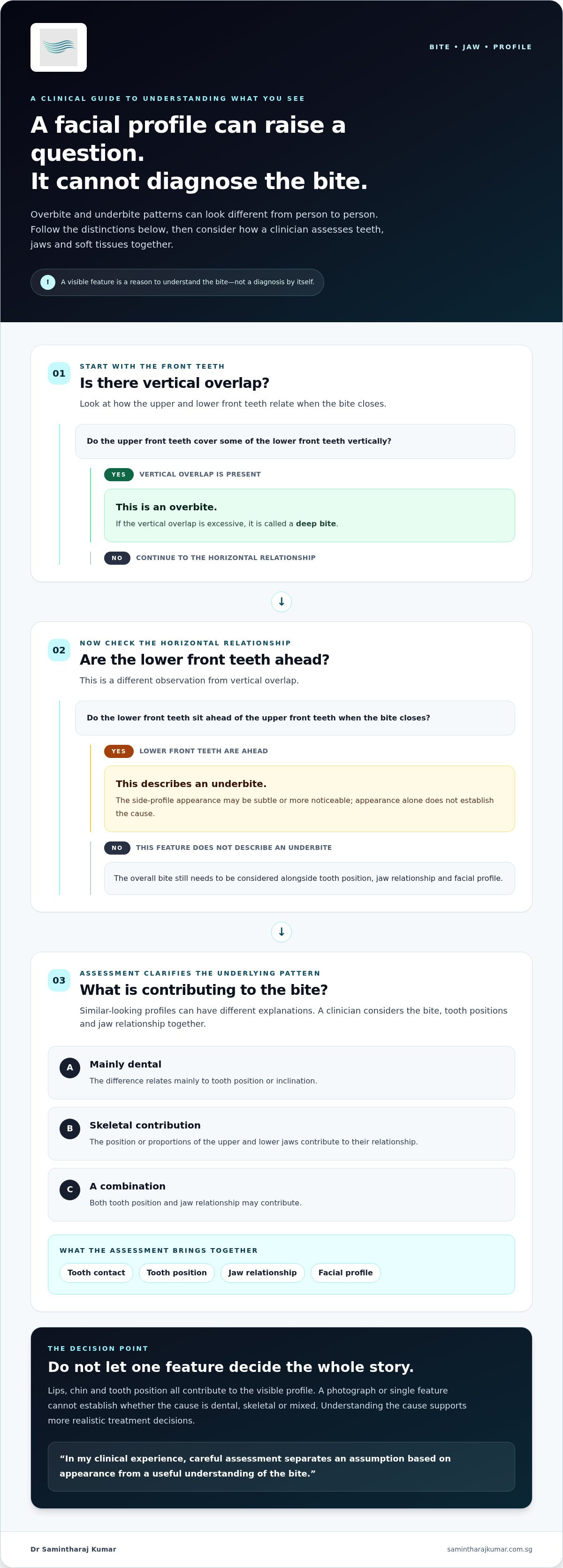
In brief: An overbite describes the vertical overlap of the upper front teeth over the lower front teeth. An underbite describes a bite in which the lower front teeth sit ahead of the upper front teeth. The cause and significance of either pattern require clinical assessment.
The word “overbite” is sometimes used casually to describe upper teeth that look prominent. Clinically, vertical overlap and forward prominence are different measurements. Teeth may also be only one part of the picture: jaw position and soft-tissue features, including the lips and chin, contribute to the side profile. In my clinical experience, distinguishing these elements helps prevent conclusions based on appearance alone.
Overbite, overjet, and deep bite: what is the difference?
An overbite concerns vertical overlap: the upper front teeth cover some of the lower front teeth when the bite closes. A deep bite refers to an excessive vertical overlap. Overjet, by contrast, is horizontal. It describes how far the upper front teeth sit in front of the lower front teeth. Viewed from the side, one describes how much the upper teeth cover the lower teeth; the other describes how far forward they sit.
These features can occur together, but they are not interchangeable. Prominent-looking upper teeth alone do not show whether the cause lies in tooth position, jaw relationship, or both.
What does an underbite look like in profile?
With an underbite, the lower front teeth may sit ahead of the upper front teeth when the bite closes. In some people, the lower part of the face may appear more prominent from the side; in others, the difference is subtle. The appearance can reflect tooth position, jaw structure, soft tissues, or a combination, so a photograph or single feature cannot establish the cause.
Terms such as prognathism describe forward positioning of part of the jaw, but they should not be treated as a simple visual label for every overbite or underbite. The overview of prognathism and its impact on facial profile can help explain the terminology; clinical interpretation still depends on examining how the teeth and jaws relate.
My philosophy has always been to understand the structure before interpreting the appearance. Two people can have a similar-looking bite but different relationships between their teeth and jaws. A considered assessment looks at the whole profile alongside the closed bite, rather than treating a chin, lip or tooth position as proof of a particular condition.
Why Bite Alignment Can Influence the Face From the Side
The teeth and jaws form part of the framework beneath the face, so their relationship can contribute to the outline seen in profile. But a bite difference does not automatically produce a visible change. Its appearance depends on where the difference lies, how pronounced it is, and how the surrounding soft tissues relate to the underlying structures.
A profile assessment considers the teeth, the relationship between the jaws, and the soft tissues together. This is why the impact of overbite/underbite on facial profile cannot be judged reliably from a single feature or photograph.
Dental position and jaw position are not the same
A dental contribution means the bite difference relates mainly to the position or inclination of the teeth. For example, the upper front teeth may angle forwards while the relationship between the jaws is less pronounced. A skeletal contribution involves the position or proportions of the upper and lower jaws relative to one another. Some people have a combination of both.
These distinctions matter because similar-looking bites can have different underlying causes. Tooth inclination can affect how the lips rest, while jaw relationships provide a broader structural context for the profile. Neither observation alone reveals the full picture. A clinical examination considers how the teeth meet, their positions, and how the jaws relate, then interprets those findings alongside the person’s facial features.
In my clinical experience, this is where precision matters. A side view may raise a useful question, but it cannot establish whether the main factor is dental, skeletal, or mixed. The same visible concern can have a different explanation from one person to another.
How lips and soft tissues shape the visible profile
The lips, cheeks, chin and other soft tissues form the visible surface over the teeth and jaws. Tooth position may influence how the lips are supported at rest, but lip shape and posture also vary between individuals. A lip that appears more prominent or less supported is therefore not, by itself, proof of a particular bite or jaw condition.
Teeth alone do not determine facial shape or symmetry. The profile reflects several interacting features, and these do not always align in a simple, predictable way. Two people with a comparable dental relationship may have different soft-tissue outlines; a similar profile impression may also arise from different dental or skeletal relationships.
The practical point is straightforward: notice what concerns you, but avoid treating a photograph, lip position or chin shape as a diagnosis. These features need to be considered in relation to the bite and jaw structure. If a profile concern is connected with broader questions about your dental health, a comprehensive dental assessment can help put the visible details into context.
Overbite vs Underbite: What Profile Differences May Be Visible?
A side-by-side comparison can help explain what people may notice, but it should not be used to diagnose a bite from appearance alone. An overbite or underbite describes a relationship between teeth; the visible profile also reflects jaw structure, tooth position and individual facial features.
The same bite label can look different from one person to another because facial structure, tooth position and soft-tissue features vary. This is central to understanding the impact of overbite/underbite on facial profile: a bite term describes a relationship, not a guaranteed facial shape.
Possible profile features associated with an overbite
From the side, an overbite may be accompanied by upper front teeth that appear more prominent, particularly if their inclination or position contributes to how the lips rest. The jaw relationship can also influence the overall balance of the profile. But neither upper-tooth prominence nor chin appearance alone reveals how much each factor contributes.
For example, two people with a similar overlap may have different lip support or facial proportions. One may notice little change in profile, while another may be more conscious of how the upper teeth or lips appear. These are possible impressions, not reliable predictions of severity or cause.
Possible profile features associated with an underbite
With an underbite, the lower front teeth sit ahead of the upper front teeth when the bite closes. A more forward-looking lower jaw can be one visible feature, especially when the jaw relationship contributes to the bite. It is not a defining sign in every case, however, and the profile can look quite different from one person to another.
A dental underbite, where tooth position is a major contributor, may present differently from a skeletal underbite, where the relationship between the jaws is more central. There may also be a combination of factors. As a clinician, I avoid treating a prominent-looking chin as proof of an underbite, just as I would not infer an overbite from lip position alone.
These patterns are possibilities, not templates. Careful interpretation connects the visible profile with the actual bite relationship, rather than promising that a particular tooth pattern will produce a particular chin, lip or jaw appearance.
How a Clinician Assesses Bite and Facial Profile Together
A profile can prompt questions, but it cannot show on its own how the teeth meet or whether the jaws contribute to what you see. Assessment should begin with the patient’s concern and move towards a clinical interpretation, rather than asking someone to diagnose themselves from a photograph. The aim is to understand the bite and facial features together, then explain what the findings mean for that individual.
A useful assessment considers contact between the teeth, their position, the relationship of the jaws and the facial profile. This broader view helps distinguish what is visible from what may be causing it. It also keeps the impact of overbite/underbite on facial profile in perspective: appearance is one part of the assessment, not a substitute for it.
What happens during a bite and profile assessment?
The first step is to understand what has prompted the concern. Is it the way the teeth meet, a feature visible from the side, or a change noticed over time? The discussion establishes what matters most to the patient and provides context for the examination.
The clinician then assesses how the teeth come together and considers their position in relation to one another. The face at rest and how its features relate to the bite are also part of the picture. This is not about matching someone to a fixed profile ideal. It is about interpreting the dental and facial findings as a whole. For a broader perspective on the connection between oral structures and appearance, I discuss how dental structure affects face shape.
Which questions help clarify what the profile shows?
The examination should help answer practical questions, not simply attach a label to the appearance:
Does the bite difference appear to relate mainly to tooth position, the relationship between the jaws, or a combination?
How do the teeth contact when the mouth closes?
Is the concern primarily about appearance, or are there functional concerns the patient wants assessed as well?
Are there jaw-related symptoms that need to be considered separately from the profile concern?
These questions matter because an aesthetic concern and a functional concern are not the same thing, though both may be relevant to one person. A visible bite difference does not necessarily cause symptoms, and concern about a profile does not by itself indicate a jaw problem. If jaw discomfort or movement is also part of the picture, a focused TMJ assessment and jaw rehabilitation discussion may help place those concerns in context.
If you are unsure what a bite difference means for your own profile, a clinical assessment of your bite can help distinguish what you notice from what the underlying relationships show.
Treatment Decisions Should Follow the Diagnosis, Not the Profile Alone
A profile can be the reason someone seeks advice, but it should not determine treatment by itself. The appropriate clinical plan depends on the assessment findings, the person’s priorities and the wider dental context. Similar-looking profiles may reflect different bite relationships, so a plan suited to one person may not be appropriate for another.
It helps to distinguish between improving a bite relationship and promising a particular cosmetic result. A treatment discussion can explain what may be addressed and what aims are realistic, but facial appearance cannot be reduced to a predictable change in one feature. The impact of overbite/underbite on facial profile is individual, and an intended improvement in how the teeth meet does not guarantee a specific chin, lip or profile outcome.
Why treatment aims must be individualised
Two people may share a similar profile concern while having different underlying dental or jaw relationships. The visible feature alone cannot determine which approach, if any, is suitable. Assessment helps connect the findings with the person’s goals and overall dental health, so options can be discussed in context rather than selected to chase a particular appearance.
A careful conversation explains the findings, the approaches relevant to them, and their intended aims. Patients should understand what a plan is designed to address, what it may not change, and how the decision relates to their priorities. Clarity is essential before considering any intervention.
Appearance and function also belong in the same conversation. Aesthetic goals deserve attention, but so do the way the teeth work together and the health of the mouth over time. This balance is explored in my discussion of functional aesthetics in cosmetic dentistry.
What patients can take away from a specialist discussion
Before drawing conclusions from a profile, seek to understand the diagnosis behind it. A useful discussion should clarify whether the concern relates mainly to tooth position, the jaw relationship, or a combination, and how that interpretation informs the options being considered. It should also distinguish an appearance goal from a functional concern rather than assuming they are the same.
Ask what the assessment shows about your bite and the relationship between your teeth and jaws.
Clarify which concerns a proposed plan aims to address, and what outcomes cannot be promised.
Consider facial balance alongside function and long-term dental wellbeing.
My philosophy has always been to make decisions from understanding, not assumption. Careful planning brings relevant priorities into focus while allowing an honest discussion about uncertainty and individual variation. To explore my approach to comprehensive dental care, explore Dr Samintharaj Kumar’s clinical perspective.
Let a Clearer Understanding Guide Your Next Step
Concern about your facial profile can feel personal, particularly when you are unsure what a visible bite difference means. The impact of overbite/underbite on facial profile is not a verdict about appearance or a reliable measure of the issue’s significance. It is a reason to seek an explanation grounded in your own dental and facial features.
My clinical perspective is shaped by experience in oral surgery and full mouth rehabilitation, as well as my Fellowship and Diplomate status with the International Congress of Oral Implantologists. I bring that background to a careful consideration of how dental relationships, function and facial balance fit together, while recognising that each person’s priorities and findings are individual.
The most useful next step is not to predict a cosmetic change from a photograph, but to understand what an assessment can clarify and what options may be appropriate to your goals. To learn more about my approach, explore Dr Samintharaj Kumar’s clinical perspective. A thoughtful diagnosis can replace uncertainty with understanding, providing a considered basis for what comes next.
Frequently Asked Questions
Can an overbite change your facial profile?
It can be associated with a difference in facial appearance, but an overbite does not determine one particular profile. The impact of overbite/underbite on facial profile depends on the person’s dental and jaw relationships and how their soft tissues sit. A side-on photograph may show what concerns you, but it cannot explain the underlying cause. Clinical assessment helps interpret the bite and profile together before conclusions are drawn.
Does an underbite always make the lower jaw look prominent?
No. A prominent-looking lower face does not, by itself, prove that someone has an underbite or indicate its significance. The bite relationship may be influenced mainly by tooth position, by the way the jaws relate, or by both. If you are concerned about your profile, note what you see and consider it alongside how your teeth meet. Clinical interpretation is more reliable than judging the lower jaw from a photograph.
Is an overbite the same as an overjet?
No, they describe different directions of relationship between the front teeth. Overbite refers to how much the upper front teeth cover the lower front teeth vertically. Overjet refers to how far the upper front teeth sit ahead of the lower teeth horizontally. Both features may be considered during an examination, but one does not automatically tell you whether the other is present. A clinician can explain what applies in your bite.
Can someone have both an overbite and an underbite?
Yes. Different features of the bite can occur together because vertical overlap and the front-to-back relationship describe separate aspects. Everyday labels may not fully capture how the teeth meet. Someone’s bite, for example, may include vertical overlap while the lower front teeth sit ahead of the upper ones. A clinician assesses the actual tooth contacts and jaw relationship to describe the pattern accurately.
Can treatment change the appearance of my facial profile?
It may, depending on what the assessment identifies and what the treatment is intended to address. The visible effect varies between individuals, so a particular change in chin, lip or overall profile should not be promised from a bite label alone. Ask which findings inform the proposed aims and what outcomes are realistic. This helps distinguish a plan to address a dental concern from an expectation of a specific cosmetic result.
Does a visible bite difference mean I need treatment?
Not necessarily. Appearance alone cannot establish whether treatment is appropriate; that depends on the clinical findings, your concerns and any functional issues identified during assessment. If you are considering advice, describe what you have noticed and what you hope to understand, rather than comparing your face with someone else’s. A clear explanation of your own bite gives you a sounder basis for discussing whether any next step is relevant.



Comments