
Top Oral Surgeon for Complex Cases: A Specialist’s Guide to Advanced Rehabilitation

The difference between a standard dental procedure and a full-mouth reconstruction isn't just a matter of scale; it's a matter of biological survival and mechanical precision. If you've been told your case is too difficult or you've suffered through a failed surgery, I understand the deep sense of apprehension that follows. Finding the top oral surgeon for complex cases is often the final step in a long, exhausting journey toward reclaiming your smile and your health. You likely want more than just a practitioner. You need a specialist who views your oral health as a complex biological system rather than a series of isolated issues.
In my clinical experience, the path to total rehabilitation requires a blend of advanced surgical mastery and a commitment to long-term functional success. I've written this guide to help you discover the critical criteria for selecting a specialist surgeon capable of managing high-stakes oral reconstructions, including complex implantology like Zygomatic systems. We'll examine why precision in planning determines longevity and how a surgeon who understands biological compatibility can transform your outcome. This is where precision matters, and it begins with choosing the right expertise.
Table of Contents
The Reality of Complex Oral Surgery: When Routine Care Reaches Its Limits
Defining Clinical Mastery: What to Look for in a Specialist for High-Stakes Cases
Advanced Surgical Systems: From Zygomatic Implants to Biological Ceramic Protocols
The Patient’s Buying Guide: Evaluating Specialist Credentials and Outcomes
My Perspective: The Intersection of Innovation, Leadership, and Patient Restoration
The Reality of Complex Oral Surgery: When Routine Care Reaches Its Limits
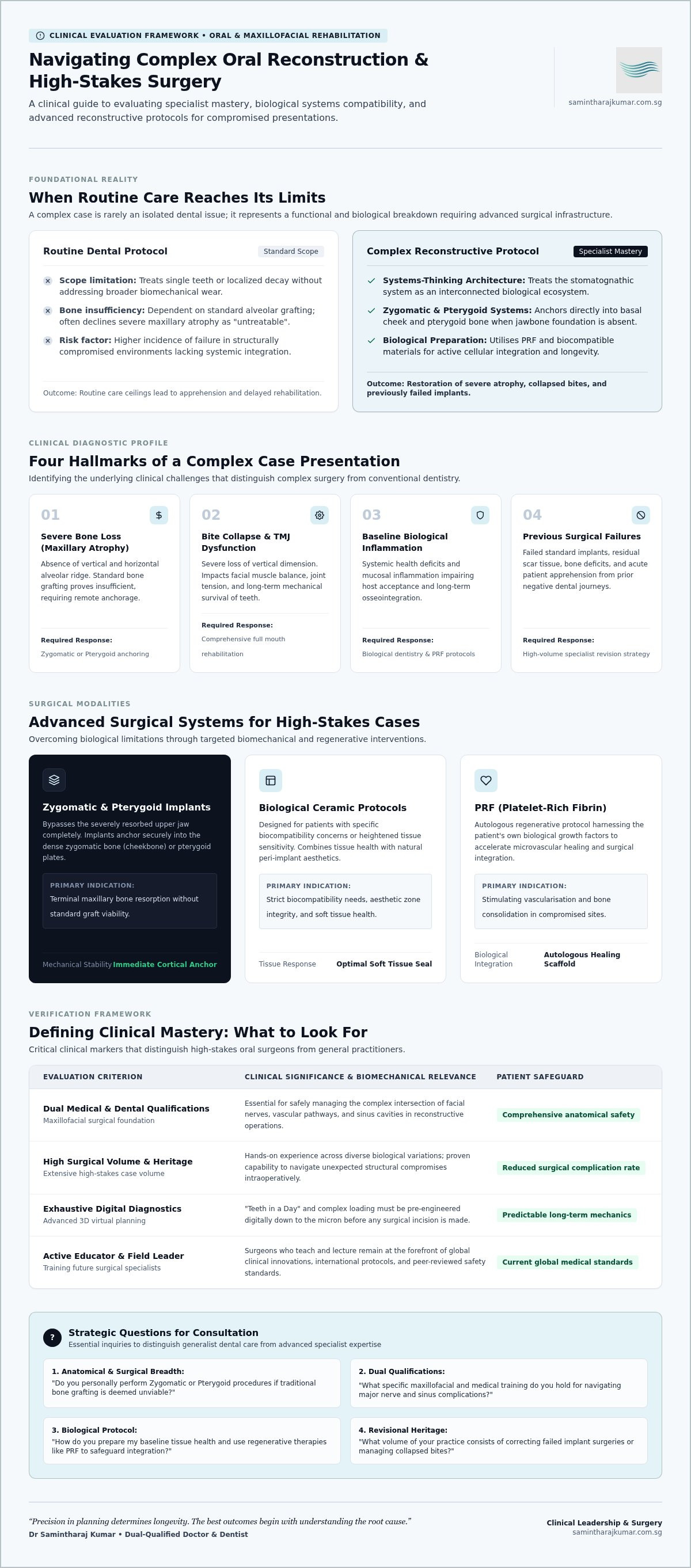
In my clinical experience, a "complex case" is rarely defined by a single missing tooth or a simple cavity. It's defined by a failure of the underlying biological system. Many patients find their way to my clinic after being told by general practitioners that their situation is "untreatable" or after a previous standard implant has failed. This is the point where routine care reaches its ceiling. Most general dental practices simply don't have the specialised surgical infrastructure, advanced digital diagnostics, or the specific training required for high-stakes reconstructions. When you're searching for the top oral surgeon for complex cases, you're looking for a specialist who can navigate what others refuse to touch.
The psychological impact on these patients is often overlooked. Carrying the label of "untreatable" creates a deep sense of anxiety and a fear of permanent functional loss. I've seen how this affects a person's confidence and quality of life. However, the scope of modern oral and maxillofacial surgery has expanded significantly. We now have the tools to restore even the most compromised smiles through precision engineering and biological insight. Finding the top oral surgeon for complex cases means looking for a clinician who understands that the body is an interconnected ecosystem.
Identifying a Complex Clinical Presentation
A complex presentation usually involves severe bone loss, or what we clinically term maxillary atrophy. In these scenarios, traditional bone grafting is often insufficient. This is where we look toward visionary solutions like Zygomatic or Pterygoid implants. These systems anchor into the stable bone of the cheek or the pterygoid plate when the jawbone foundation is absent. I also frequently manage cases requiring full mouth rehabilitation to correct a collapsed bite. This isn't just about aesthetics; functionally, this affects the TMJ, facial muscle tension, and the long-term wear of the remaining teeth.
The Biological Imperative in Advanced Surgery
What many patients don't realise is that the real differentiator in surgical success isn't just the titanium or ceramic used. From a biological perspective, your systemic health and baseline inflammation levels dictate the outcome. My philosophy has always been to integrate biological dentistry into every complex reconstruction. This involves preparing your body's internal environment to accept the intervention, using regenerative protocols like PRF (Platelet-Rich Fibrin). We focus on a holistic oral-systemic approach. We ensure that the body is not just "hosting" an implant, but actively integrating it for long-term functional success.
Defining Clinical Mastery: What to Look for in a Specialist for High-Stakes Cases
Identifying the top oral surgeon for complex cases requires looking beyond a standard dental degree. Credentials are a necessary foundation, but they don't reveal the depth of a surgeon’s clinical heritage. In my practice, I've found that the true indicator of mastery is the sheer volume and variety of high-stakes procedures a specialist has successfully navigated. When a case involves the intersection of facial nerves, sinus cavities, and severe bone atrophy, a dual qualification in both medicine and dentistry becomes a critical safeguard. It allows for a more comprehensive understanding of maxillofacial complexity that a single-degree practitioner may lack. As a clinician and founder, I believe that true mastery is also reflected in a surgeon’s commitment to education. Those who lead the field are often the ones teaching the next generation of specialists, ensuring the practice remains at the cutting edge of global medical standards.
What many patients don't realise is that a surgeon’s philosophy on innovation is just as important as their technical skill. While "Teeth in a Day" is a popular concept, it must be backed by exhaustive digital planning to ensure long-term success. I've always maintained that the real differentiator lies in the marriage of clinical mastery and patient-centred empathy. If you're facing a challenging reconstruction, understanding a dental implant surgery overview provided by institutional leaders can help set expectations, but a top oral surgeon for complex cases will go far beyond these standard protocols. This is where precision matters most.
Specialised Surgical Credentials
The distinction between a general implantologist and a specialist oral surgeon is profound. A specialist is specifically trained to manage the risks inherent in advanced protocols like All-on-4 and Zygomatic systems. These systems are not merely technical alternatives; they are life-changing interventions for those who have been told they lack the bone structure for traditional implants. My involvement in global clinical networks ensures that our practice adheres to international standards of prestige and safety. This global perspective is what allows us to handle cases that other clinics might turn away. It’s about more than just placing an implant. It’s about rebuilding a foundation that has been lost to time or trauma.
The Role of Digital Diagnostics and AI
Precision in the diagnostic workflow is non-negotiable for longevity. We utilise AI-assisted screening to improve the predictability of outcomes, allowing us to identify potential biological hurdles before the first incision. This is combined with 3D CBCT imaging and digital smile design to create a precise surgical roadmap. Functionally, this affects every stage of the healing process. When we use digital tools to plan, we aren't just looking at the bone; we're looking at the future of your smile and your systemic well-being. This level of technological integration is what defines a modern institution. If you're seeking a partner for your journey, I invite you to learn more about our expert-led approach to complex rehabilitation.
Advanced Surgical Systems: From Zygomatic Implants to Biological Ceramic Protocols
In my practice, the choice of surgical system is never arbitrary. It is a decision rooted in the unique biological profile of the patient. When you consult with the top oral surgeon for complex cases, the conversation should shift from simple mechanics to long-term systemic compatibility. We don't just look at how to replace a tooth; we look at how the body will respond to that replacement over decades. This is why I prioritise systems that work in harmony with your natural physiology, ensuring that the final result is as durable as it is beautiful. Precision in planning determines longevity, and this begins with selecting the right materials for your specific needs.
The Ceramic Revolution in Complex Cases
For patients who are sensitive to metals or simply prefer a more natural approach, zirconia has become a cornerstone of our rehabilitative work. Unlike traditional titanium, these ceramic dental implants offer superior soft tissue response and a highly aesthetic finish, particularly in the anterior "smile zone". From a biological perspective, ceramic is non-corrosive and non-allergenic, which reduces the risk of chronic inflammation around the implant site. This is where precision matters. By choosing materials that the body naturally accepts, we can achieve a level of gingival health that was once difficult to maintain with metal-based systems.
To further enhance this biological integration, I often combine implantology with regenerative protocols. We use PRF (Platelet-Rich Fibrin), derived from the patient’s own blood, to accelerate healing in complex sites. When paired with CHAO Pinhole Surgery for gum rejuvenation, we can achieve total rehabilitation of both the bone and the soft tissue simultaneously. This synergy is what allows us to rebuild a smile that feels and functions like your own. It's a holistic approach that prioritises your comfort and long-term well-being alongside technical excellence.
Restoring the 'Untreatable' Jaw
What many patients don't realise is that even severe maxillary atrophy is no longer a barrier to a fixed smile. For those who have lost significant bone in the upper jaw, Zygomatic and Pterygoid implants provide a visionary solution. Instead of relying on the jawbone itself, these specialised fixtures anchor into the stable bone of the cheek or the pterygoid plate. This approach enables us to perform All-on-4 dental implants even in cases previously deemed untreatable by generalist practices. Functionally, this affects everything from your ability to eat to the structural support of your face. By using immediate loading protocols, we can often provide a functional set of teeth in a single day, restoring confidence and quality of life without the need for extensive bone grafting. The long-term implication is a stable, permanent restoration that respects the limits of your anatomy while pushing the boundaries of modern medicine.
The Patient’s Buying Guide: Evaluating Specialist Credentials and Outcomes
What many patients don't realise is that the "cheapest" option in complex surgery is often the most expensive long-term. When you're searching for the top oral surgeon for complex cases, you're essentially investing in the avoidance of surgical failure. Revision surgery, where we must correct mistakes from previous procedures, is technically more demanding and biologically riskier than getting it right the first time. My philosophy has always been that the right diagnosis changes everything. This requires a meticulous workflow that begins with AI-assisted screening and moves through a precise digital roadmap to the final delivery of your prosthesis. This level of planning is what ensures a result that is both functionally successful and biologically compatible.
Consultation Checklist for Complex Cases
During a consultation, it's vital to ask questions that reveal the surgeon's current clinical proficiency. I often encourage patients to ask: "How many Zygomatic cases have you completed this year?" Proficiency in high-stakes implantology isn't a static skill; it requires constant practice and engagement with the latest global protocols. You should expect a comprehensive, multi-stage treatment plan that addresses your specific anatomical challenges. For example, a top oral surgeon for complex cases will identify if there is a need for sinus lift surgery or bone augmentation to build a lasting foundation. They should also be transparent about their success rates and their established rescue protocols for managing failed implants from other clinics.
Comparing Generalist vs. Specialist Approaches
The environment where your surgery takes place significantly impacts the outcome. A dedicated surgical suite provides a sterile, controlled atmosphere that is far superior to a general dental chair. This is where precision matters most. In a DSO (Dental Service Organisation) setting like Nuffield Dental, we leverage a multidisciplinary team to ensure every aspect of your care is peer-reviewed and standardised. This institutional heritage provides a level of security and long-term accountability that a solo practitioner often cannot provide.
The long-term implication of choosing a surgeon with an established institutional background is a legacy of functional excellence. As a clinician and founder, I've seen how the right infrastructure transforms the patient experience from one of anxiety to one of quiet confidence. If you've been told your case is too difficult, I invite you to explore our specialist-led approach to complex rehabilitation and discover what modern medicine can achieve for you.
My Perspective: The Intersection of Innovation, Leadership, and Patient Restoration
As a clinician and founder, my philosophy has always been that the right diagnosis changes everything. It's the cornerstone of every successful rehabilitation we perform at Nuffield Dental. When you're searching for the top oral surgeon for complex cases, you aren't just looking for a technician; you're looking for a leader who can see the path through a difficult biological puzzle. The real differentiator lies in the marriage of clinical mastery and patient-centred empathy. It's one thing to understand the mechanics of bone density, but it's quite another to understand the emotional weight a patient carries when they've lost the ability to smile or eat with confidence. This human element is what drives our commitment to excellence.
I've witnessed the profound, life-changing impact that modern protocols like teeth in a day can have on a person's quality of life. It's more than just a surgical convenience. It's a rapid restoration of dignity and function for those who have suffered for years. What this means for the future of healthcare is a transition toward predictive, AI-driven surgical precision. We're no longer just reacting to dental failure; we're planning for lifelong success before the first incision is ever made. This forward-looking approach ensures that we don't just treat symptoms, but rebuild lives.
The Vision for Nuffield Dental
My goal has always been to build an institution that survives individual practitioners through standardised excellence. This is why I prioritise investment in the latest digital and biological technologies. We're shaping an ecosystem where innovation serves the patient, not the other way around. Beyond technology, I believe in the importance of mentoring the next generation of oral surgeons in Southeast Asia. By sharing these advanced protocols and clinical insights, we ensure that the high standards we've established become the new baseline for care across the region. This is how we build a legacy of trust and elevate the entire healthcare landscape.
A Final Reflection on Patient Trust
I never take the weight of responsibility lightly when treating a patient who has lost hope. Often, they come to me as a last resort after multiple failed attempts elsewhere. This is where precision in planning determines the longevity of the restoration. We don't just fix what is broken. We look at the systemic factors, the inflammation levels, and the mechanical stressors that led to the issue in the first place. My perspective is that the best outcomes begin with understanding the root cause. This long-term thinking is what distinguishes a top oral surgeon for complex cases from a generalist practice. Precision in planning determines longevity, and the best outcomes begin with understanding the root cause.
Reclaiming Your Smile Through Specialised Expertise
Rehabilitating a complex oral condition is a significant commitment that requires more than just technical skill; it demands a visionary approach to biological compatibility and mechanical precision. Finding the top oral surgeon for complex cases is the first step toward moving past the frustration of previous dental failures and the anxiety of being told your case is "untreatable." We've explored how advanced diagnostics and a deep understanding of systemic health can transform the predictability of your outcome. My focus remains on ensuring that every restoration is built to last, respecting both your anatomy and your long-term well-being.
As a dual-qualified specialist in both medicine and dentistry and the founder of Nuffield Dental Holdings, I've spent my career pioneering solutions in ceramic and zygomatic implantology. I believe that every patient deserves a path to restoration, regardless of how challenging their history may be. The journey to restoration begins with a precise diagnosis. I invite you to consult with me to discuss your specific needs and explore the future of your oral health. The right diagnosis changes everything, and the best outcomes begin with understanding the root cause.
Frequently Asked Questions
What defines an oral surgery case as "complex"?
A case is defined as complex when it involves anatomical or biological challenges that standard protocols cannot resolve. In my clinical experience, this often includes severe maxillary atrophy, where there is insufficient bone for traditional implants, or managing failed surgical sites from previous procedures. Systemic health complications, such as chronic inflammation or autoimmune responses, also elevate a case's difficulty. Identifying the top oral surgeon for complex cases is essential for navigating these high-stakes rehabilitative puzzles.
How do I verify the credentials of a top oral surgeon for complex cases?
You should look for a dual-qualified specialist with degrees in both medicine and dentistry to ensure a comprehensive understanding of maxillofacial anatomy. It's also important to verify their clinical heritage and the volume of high-stakes procedures, such as Zygomatic or Pterygoid implants, they perform annually. Membership in global clinical networks and a leadership role in an established institution like Nuffield Dental are strong indicators of prestige and standardised excellence.
Can Zygomatic implants be used if I have been told I have no bone left?
Yes, Zygomatic implants are specifically designed for patients who have suffered severe upper jaw bone loss. Unlike traditional implants that require a foundation in the jawbone, these specialised fixtures anchor into the stable bone of the cheek, known as the zygoma. This visionary solution allows us to provide a fixed set of teeth even when you've been told traditional grafting is not an option. It's a life-changing alternative for atrophic cases that I frequently manage.
What is the success rate for full mouth rehabilitation in 2026?
Success rates for full mouth rehabilitation remain consistently high when managed by a specialist using advanced digital diagnostics and biological preparation. My practice prioritises meticulous planning to ensure long-term functional success rather than just short-term aesthetics. By using regenerative protocols like PRF and 3D CBCT imaging, we aim to minimise risks and maximise the longevity of the restoration. Precision in the diagnostic phase is the most critical factor for achieving these industry-leading outcomes.
Why should I choose a specialist surgeon over a general dentist for implants?
Specialist surgeons undergo years of additional training in oral and maxillofacial surgery, giving them the expertise to handle anatomical complexities and surgical risks. A top oral surgeon for complex cases operates in a dedicated sterile surgical suite rather than a general dental chair. This environment, combined with access to advanced systems like Zygomatic implants and AI-assisted screening, provides a level of safety and predictability that generalist practices often cannot match.
What role does AI play in modern complex oral surgery?
AI-assisted screening allows us to identify potential biological hurdles and anatomical risks with unprecedented accuracy during the planning phase. In my practice, we use AI to enhance the predictability of surgical outcomes by analysing 3D imaging data more precisely than manual methods alone. This technology doesn't replace the surgeon's skill but acts as a powerful tool for predictive diagnostics, ensuring that every restoration is tailored to the patient's unique physiology and long-term health.
How long is the recovery period for advanced surgical procedures?
The initial healing phase typically lasts between one and two weeks, though the full biological integration of implants can take three to six months. We use regenerative protocols like Platelet-Rich Fibrin (PRF) to accelerate the body's natural healing response and reduce post-operative inflammation. Most patients find they can return to routine activities shortly after the procedure, provided they follow our specific care protocols. Functionally, this affects the speed at which you regain total comfort.
Is ceramic better than titanium for complex implant cases?
Ceramic dental implants are often preferred for patients seeking high biocompatibility and a metal-free alternative. From a biological perspective, zirconia is non-corrosive and offers an exceptional soft tissue response, which is vital for long-term gingival health. While titanium remains a standard, ceramic is frequently the choice for the anterior "smile zone" due to its natural aesthetics. The real differentiator lies in choosing the material that best suits your body's unique immune profile and functional requirements.


Comments