
Is Full Mouth Reconstruction Worth It? A Specialist Surgeon’s Perspective on Total Rehabilitation

What if your oral health wasn't just a series of isolated repairs, but a fundamental pillar of your systemic longevity? In my clinical experience, many patients arrive at my practice feeling exhausted by years of patchwork treatments that never quite resolve the root cause. You're likely asking yourself the same pivotal question: is full mouth reconstruction worth it? It's a valid concern when you're navigating the daily frustrations of difficulty chewing, chronic jaw pain, or the social anxiety that comes with a compromised smile.
From a biological perspective, total rehabilitation is about much more than aesthetics. It's a sophisticated reset of your entire oral ecosystem. In this article, I'll share my perspective as a specialist surgeon on the clinical and emotional ROI of these complex procedures. You'll learn how we use advanced diagnostics and surgical expertise to restore function and peace of mind. We'll examine the science behind the transformation, the importance of specialist-led care, and how a meticulously planned restoration can ultimately redefine your quality of life for decades to come.
Key Takeaways
Learn why total rehabilitation is a comprehensive functional necessity rather than a simple aesthetic choice for long-term health.
Understand the biological advantages of using metal-free materials, such as ceramic dental implants, to harmonise with your body's natural systems.
Discover how to assess if is full mouth reconstruction worth it by weighing the initial investment against the lifelong costs of recurring patchwork repairs.
Explore my specialist framework for reconstruction, which integrates AI-assisted diagnostics with a meticulous, surgeon-led clinical ecosystem.
Realise the profound impact that restoring oral function has on systemic health, social confidence, and your overall quality of life.
Table of Contents
Understanding Full Mouth Reconstruction: More Than Just a Smile Makeover
In my clinical experience, many people confuse a smile makeover with a full mouth reconstruction (FMR). While a makeover focuses on surface aesthetics, FMR is a comprehensive rehabilitation of every tooth in both arches, a process often referred to as Full arch restoration. It's a total reset. As a clinician and founder, I view this not as an elective beauty treatment, but as a medically necessary functional restoration. It's a multidisciplinary surgical and restorative challenge that requires precision at every stage to ensure the bite is balanced and the foundation is secure.
When we look at the biological harmony between your teeth, muscles, and bone structure, we see that one cannot function correctly without the others. I often see patients who have reached a breaking point due to severe tooth wear, multiple missing units, or advanced periodontal decline. At this stage, the question of whether is full mouth reconstruction worth it becomes about more than just teeth; it's about reclaiming your systemic health and basic daily comforts.
To better understand the mechanics of this process, watch this helpful video:
The Clinical Consequences of Delay
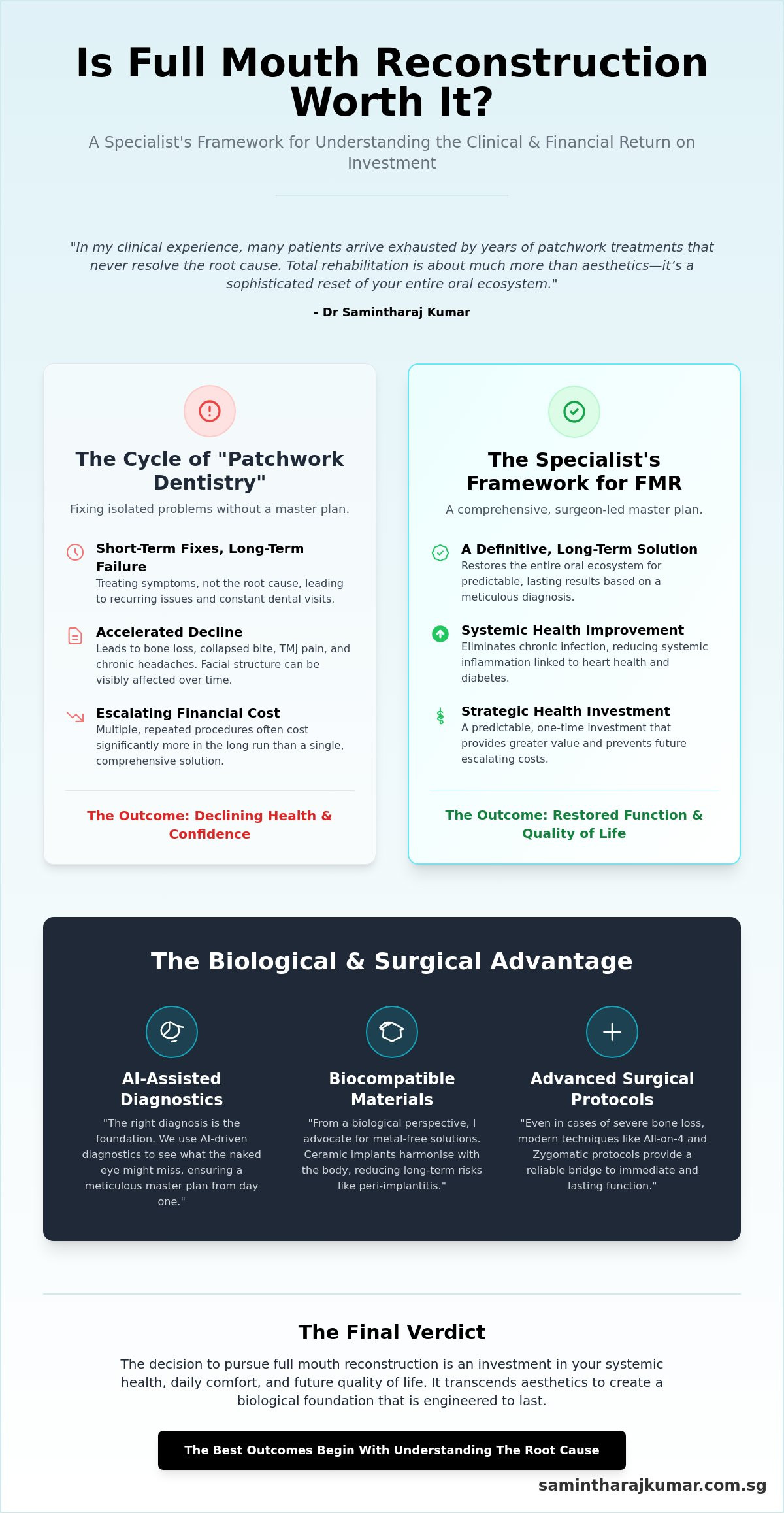
Partial tooth loss is never a static condition. From a biological perspective, when teeth are missing or failing, the jawbone lacks the stimulation it needs to maintain its density. This leads to accelerated resorption and, eventually, facial collapse where the lower third of the face appears sunken. A collapsed bite also places immense strain on the temporomandibular joint (TMJ), often manifesting as chronic headaches or neck pain. I've found that "patchwork dentistry," fixing one tooth at a time without a master plan, often costs significantly more in the long term than a unified, specialist-led reconstruction.
Identifying the Need for Total Rehabilitation
There's usually a tipping point where specialist intervention becomes unavoidable. This might be when you can no longer chew comfortably or when chronic infection begins to impact your daily energy levels. We now know there's a profound link between oral decay and systemic inflammation, which can affect heart health and diabetes management. When considering if is full mouth reconstruction worth it, I often ask patients to look beyond the immediate cost and consider the systemic benefits of removing chronic infection. I believe the right diagnosis is the foundation of any successful outcome. It's why I prioritise AI-driven diagnostics to see what the naked eye might miss.
The Science of Reconstruction: A Biological and Surgical Perspective
In my clinical experience, the success of a total oral rehabilitation hinges on one factor: the biological compatibility of the intervention. I don't view the mouth as a collection of isolated teeth but as a complex system where biology and engineering meet. When patients ask me if is full mouth reconstruction worth it, they're often focused on the final look. However, the true value lies in the invisible science of force distribution and how we integrate materials that respect the body's natural physiology.
From a biological perspective, I advocate for a shift toward metal-free solutions. Ceramic dental implants are a cornerstone of this philosophy. Unlike traditional titanium, these materials are highly biocompatible and reduce the risk of peri-implantitis. It's about creating a foundation that the body accepts as its own. This structural engineering ensures that when you chew, forces are distributed evenly across the jaw, preventing the mechanical failures often seen in traditional "patchwork" dentistry.
Advanced Implantology: From All-on-4 to Zygomatic Protocols
For many, the journey to restoration is complicated by severe bone loss. This is where advanced surgical protocols provide a bridge to hope. The "Teeth in a Day" concept, utilising the All-on-4 technique, allows for immediate functional restoration, giving patients a stable set of teeth in a single session. However, for those with extreme maxillary atrophy, I often recommend zygomatic dental implants. This procedure requires immense surgical precision, as we anchor the implants into the cheekbones rather than the jawbone. It's a life-changing solution for patients who were previously told they weren't candidates for implants.
Material Excellence: Why Porcelain and Zirconia Matter
The materials we choose define the longevity of the reconstruction. Modern ceramics like zirconia and high-grade porcelain offer superior durability compared to traditional metal-fused options. According to the American College of Prosthodontists, the goal of these procedures is to restore the mouth to a state of health, function, and aesthetics. We achieve this through "functional aesthetics"—teeth that look natural but perform with the strength of healthy original dentition.
To ensure this outcome, I utilise digital twinning. This allows us to pre-visualise the final bite and smile in a virtual environment before the first incision is made. It removes the guesswork, ensuring the surgical plan aligns perfectly with the restorative goal. As a clinician and founder, I believe that the best outcomes begin with understanding the root cause and planning for a lifetime of health rather than a temporary fix.
Quantifying the Worth: Is the Investment Justified?
In my clinical experience, the initial hesitation regarding cost is entirely understandable. However, when patients ask is full mouth reconstruction worth it, I encourage them to look at the twenty-year horizon. I don't view this as a dental expense; it's a capital investment in your systemic health. While I previously mentioned the pitfalls of patchwork dentistry, it's vital to quantify the financial leak of fixing one tooth at a time. Over a lifetime, these recurring failures and emergency visits often exceed the cost of a single, unified specialist intervention.
To understand the scope of this commitment, it's helpful to review What is Full Mouth Reconstruction? as defined by the American College of Prosthodontists. As a clinician and founder, I use AI-assisted diagnostics to ensure every restoration is placed with micron-level accuracy. This predictability protects your investment, ensuring that the results are not just beautiful, but mechanically sound for decades to come.
Functional ROI: The Ability to Eat, Speak, and Breathe
The functional returns on a total rehabilitation are often life-changing. Proper tooth alignment directly improves digestion by allowing for efficient mastication. If you can't break down food correctly in the mouth, your gut has to work twice as hard. From a biological perspective, I also evaluate the airway. In many cases, arch expansion during reconstruction can improve tongue space and support better airway health, which is a critical factor in managing sleep apnoea. We also focus on phonetics; precise prosthetic design restores the clarity of speech that is often lost with missing or shifting teeth.
Emotional Renewal: The Impact on Quality of Life
The psychological ROI of a stable smile is difficult to overstate. I've seen patients who have avoided dining in public for years suddenly reclaim their social lives. There is also a significant anti-ageing effect. By restoring the vertical dimension of the bite, we provide the necessary support for the lips and cheeks, which naturally smooths out facial lines. When considering if is full mouth reconstruction worth it, remember that the best outcomes begin with understanding your personal "why." Whether it's the confidence to lead a boardroom meeting or the simple joy of eating an apple, the emotional renewal is often the most profound result of our work together.
The Specialist’s Framework: Navigating the Reconstruction Journey
In my clinical experience, the path to a successful outcome is never accidental. It requires a meticulously engineered roadmap. As a clinician and founder, I oversee the entire clinical ecosystem at Nuffield Dental to ensure that every specialist involved adheres to a unified vision. This high-level oversight is vital when patients weigh up if is full mouth reconstruction worth it, as it prevents the fragmentation of care that can occur when multiple clinics handle different stages of treatment. I believe that a singular, accountable lead surgeon is the best way to safeguard the patient journey.
From a biological perspective, our framework begins with a "Biological Safety Net." This is a rigorous protocol designed to identify and mitigate risks such as gum recession or underlying bone loss before they compromise the reconstruction. For many of my patients, All-on-4 dental implants provide an elegant solution to complex problems. By strategically positioning implants to utilise the most robust areas of available bone, we can often bypass the need for extensive grafting while providing immediate functional stability.
The Role of AI and Digital Precision
I rely heavily on AI-driven diagnostics and 3D bone scanning to look beyond what the naked eye can see. We use these tools to create a digital twin of your oral structure, identifying hidden pathology and planning the exact trajectory of every implant. This "guided surgery" approach is a hallmark of modern specialist care. It significantly reduces surgical trauma and recovery time. Most importantly, it ensures that your final occlusion is perfectly balanced. A precise bite isn't just about comfort; it's essential for preventing future TMJ issues and protecting the longevity of your new teeth.
Recovery and Long-Term Maintenance
The first 72 hours post-surgery are focused entirely on your comfort and the stabilisation of the surgical sites. We manage swelling with precise protocols, ensuring you feel supported throughout the initial healing phase. I often tell my patients that patience is a clinical virtue. The transition from your initial temporary teeth to the final, permanent prosthetics is a phased process that respects your body's natural healing timeline. My philosophy on maintenance is simple: we aren't just building a smile; we're protecting a foundation. Regular specialist reviews are the key to ensuring your investment remains secure for decades. If you're ready to explore a specialist-led approach, learn more about our diagnostic protocols.
My Perspective: The Transformative Power of Total Rehabilitation
In my clinical experience, the most rewarding moments of my career don't occur during the surgical procedure itself. They happen months later, when a patient returns for a review and I see a person who has been fundamentally transformed. Specialising in these complex cases is a choice driven by the profound human impact of our work. When a patient asks if is full mouth reconstruction worth it, my answer is rooted in the legacy of health we establish together. It's about moving beyond the cycle of temporary fixes to create a permanent, biological foundation.
As a clinician and founder, I view my role through a lens of healthcare leadership and what I call "nation-building" in the medical sector. By establishing world-class clinical protocols at Nuffield Dental, we aren't just treating individuals; we're raising the benchmark for specialist care across Southeast Asia. I believe that cosmetic dentistry must always be underpinned by surgical integrity. A beautiful smile is a hollow victory if it isn't supported by a healthy, functional, and biologically sound structure. The future of our field lies in this intersection of biological dentistry and AI integration, where diagnostics become so precise that we can predict and prevent failure before it ever occurs.
Beyond the Surgery: A Legacy of Health
I view every reconstruction as a long-term partnership between surgeon and patient. There is an immense sense of professional satisfaction in watching a patient rediscover their zest for life, whether that's the confidence to speak at a conference or the simple pleasure of dining without pain. From a biological perspective, we are restoring more than just teeth; we are restoring the harmony of the entire oral-systemic link. From a specialist's view, the right diagnosis changes everything. It is the difference between a restoration that lasts five years and one that serves you for a lifetime.
Taking the First Step Toward Restoration
If you're considering this path, I encourage you to adopt a mindset of long-term thinking. It's easy to be swayed by immediate, lower-cost alternatives, but these often lead to further bone loss and more complex problems down the road. A comprehensive specialist consultation is essential to map out your journey and understand the unique biological factors at play in your mouth. When evaluating whether is full mouth reconstruction worth it, consider the value of your daily comfort and your systemic longevity. The right path isn't always the shortest one, but it is the one that leads to lasting peace of mind. The best outcomes begin with understanding the root cause.
Restoring Your Future with Specialist Precision
In my clinical experience, deciding to undergo total oral rehabilitation marks a profound shift from reactive dental repairs to proactive systemic health. We've examined how the integration of AI-assisted diagnostics and advanced surgical protocols like All-on-4 or Zygomatic implants provides a predictable foundation for even the most complex cases. This isn't merely about aesthetics; it's about the biological harmony of your entire oral ecosystem. As a clinician and founder, I'm dedicated to ensuring every patient benefits from this level of meticulous planning and surgical expertise.
From a biological perspective, the true answer to whether is full mouth reconstruction worth it is found in the years of comfortable chewing, clear speech, and social confidence that follow. Reclaiming your oral health is a legacy that pays dividends for decades, protecting you from the recurring costs and frustrations of failing dentition. I believe that every patient deserves a path to restoration that is grounded in surgical integrity and visionary care. Your journey toward a functional, natural-looking smile is an investment in your total well-being.
The best outcomes begin with understanding the root cause. Explore the possibilities of total rehabilitation with Dr Samintharaj Kumar.
Frequently Asked Questions
How long does a full mouth reconstruction typically take from start to finish?
In my clinical experience, the timeline depends on the complexity of your biological foundation and the specific procedures required. While the surgical phase for All-on-4 can provide "Teeth in a Day," the entire rehabilitative process usually spans three to six months. This duration allows for proper osseointegration and soft tissue healing before we transition from temporary restorations to your final, permanent set. We prioritise a phased approach to ensure long-term stability and functional excellence.
Is the procedure painful, and what are the options for surgical comfort?
Modern surgical protocols prioritise patient comfort through advanced sedation options and minimally invasive techniques. I use AI-assisted diagnostics to plan precise implant trajectories, which significantly reduces post-operative swelling and discomfort. Most patients report that the experience is far more manageable than they anticipated. We offer various levels of sedation to ensure you feel secure and relaxed throughout the entire clinical procedure, effectively lowering the emotional barriers associated with complex surgery.
What is the difference between a smile makeover and a full mouth reconstruction?
A smile makeover is primarily an elective cosmetic enhancement focusing on the aesthetics of the front teeth. In contrast, a full mouth reconstruction is a comprehensive rehabilitation of the entire oral system. It addresses deep-seated functional issues like bite collapse, missing units, and chronic jaw pain. When patients ask is full mouth reconstruction worth it, they are usually seeking a medical solution to restore their fundamental ability to eat, speak, and live without pain.
Can I get a full mouth reconstruction if I have significant bone loss in my jaw?
Significant bone loss is no longer a barrier to total rehabilitation thanks to advanced surgical protocols. For patients with extreme maxillary atrophy, I specialise in zygomatic dental implants which anchor into the cheekbones for maximum stability. We can also utilise bone grafting to rebuild the foundation where necessary. As a clinician and founder, I've found that almost every patient can be a candidate for restoration when we apply the right specialist expertise and technology.
How long do the results of a full mouth reconstruction last with proper care?
With meticulous maintenance and professional care, the results of a total rehabilitation are designed to last for twenty years or more. Ceramic dental implants and zirconia crowns are engineered for exceptional durability and biocompatibility. I view this as a long-term investment in your systemic health rather than a temporary fix. Success depends on a partnership between the surgeon's precision and the patient's commitment to oral hygiene and regular specialist reviews.
Will my insurance or CPF cover any part of the reconstruction costs?
In Singapore, Medisave can often be utilised for the surgical components of the reconstruction, such as dental implant placement or wisdom tooth surgery. Private dental insurance may also cover portions of the treatment if the procedures are deemed medically necessary for functional restoration. It's important to check with your provider regarding their specific annual maximums and coverage for major restorative care. My team provides detailed clinical documentation to assist with these claims whenever possible.
What happens if I only choose to fix certain teeth instead of a full reconstruction?
Choosing to fix only isolated teeth when the entire oral system is in decline often leads to "patchwork dentistry." This approach can cause an imbalanced bite and uneven force distribution, leading to the premature failure of new restorations. From a biological perspective, addressing the mouth as a unified whole ensures a stable foundation and prevents the recurring costs of emergency repairs. A comprehensive plan is almost always more cost-effective and predictable over the long term.
Are ceramic implants better than titanium for a full mouth restoration?
Both materials are effective, but I often recommend ceramic dental implants for their superior biocompatibility and aesthetic properties. Ceramic is metal-free and highly resistant to plaque accumulation, which reduces the risk of inflammation around the implant site. While titanium remains a reliable industry standard, ceramic options offer a more natural appearance and harmonise beautifully with the body's soft tissues. The choice depends on your specific biological profile and aesthetic goals.


Comments