
Laser Gum Reshaping in Singapore: A Patient’s Guide to Choosing the Right Treatment

Could the treatment that seems most precise be the wrong answer for your smile? If you’re considering laser gum reshaping singapore, it’s understandable to focus on whether a laser can reduce prominent gum display. But the right approach depends first on why the gums show. The cause may relate to gum tissue, tooth position or another aspect of your oral health.
In my clinical experience, a smile can look out of balance for more than one reason. Changing the visible gum line without understanding its cause may not address the concern you want to resolve. A careful diagnosis helps distinguish a cosmetic concern from one involving gum health or the position of the teeth.
In this guide, I’ll explain what gum reshaping may address, what to consider before treatment and how laser techniques compare with other approaches. I’ll also explain why suitability depends on your gums, teeth, smile movement and long-term oral health, not simply on the appeal of a particular device. The aim is to help you make a considered decision and understand which questions matter, starting with the cause.
Table of Contents
Laser Gum Reshaping in Singapore: What It Can Change, and What It Cannot
How a Dentist Assesses Whether Laser Gum Reshaping May Suit You
Laser Gum Reshaping Compared with Other Ways to Address Gum Display
What to Consider Before Choosing Laser Gum Reshaping in Singapore
My Approach to Gum Reshaping: Diagnosis, Precision, and Long-Term Perspective
Laser Gum Reshaping in Singapore: What It Can Change, and What It Cannot
A smile that shows more gum than feels comfortable can affect how you feel about your appearance, even when your teeth and gums are healthy. Patients often ask whether laser gum reshaping singapore could create a more balanced look. The answer depends on what is causing the gum display and what change would feel right to you.
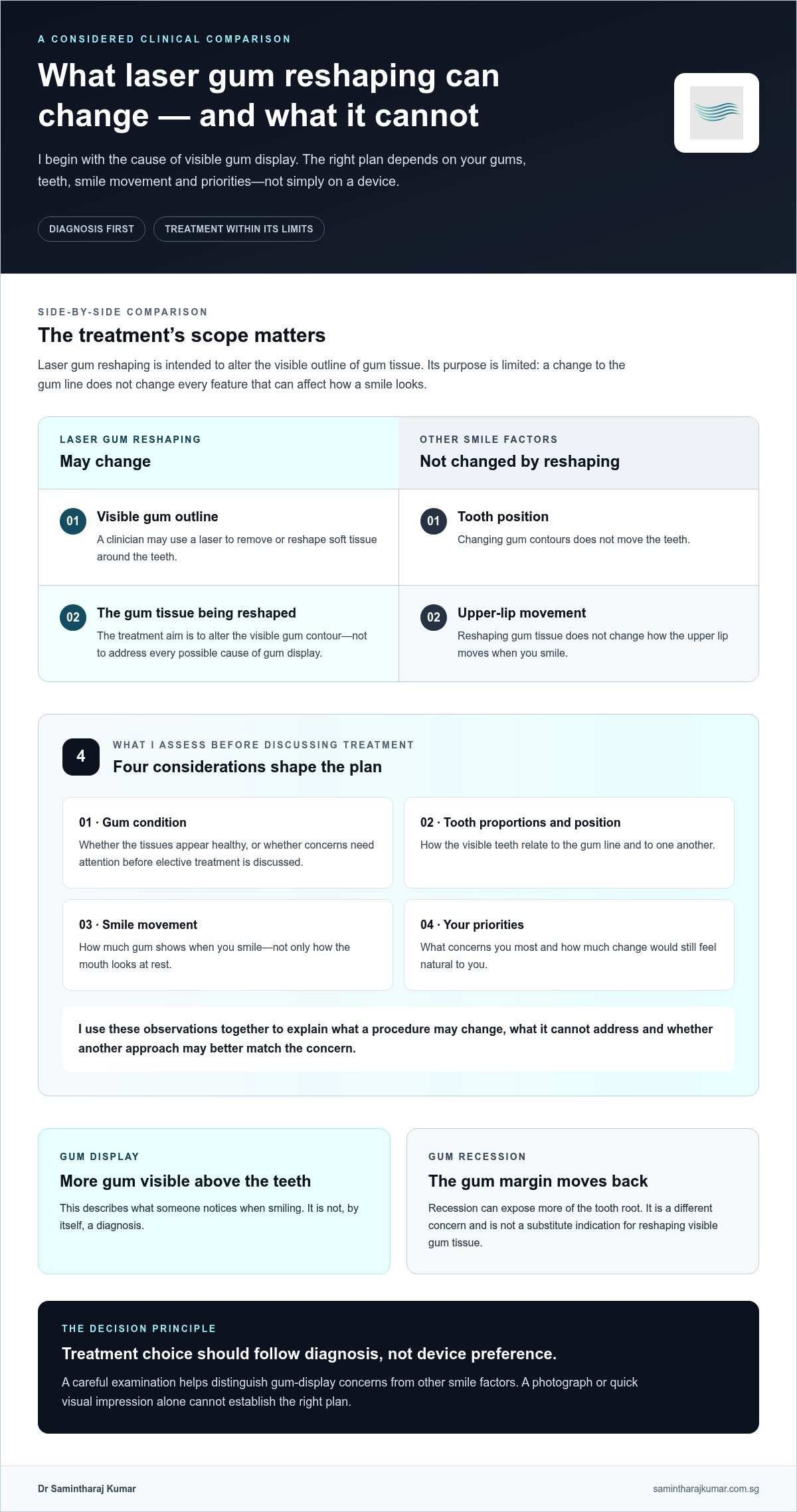
Laser gum reshaping is intended to alter the visible outline of gum tissue. In some cases, a clinician may use a laser to remove or reshape soft tissue around the teeth. The term laser gingivectomy is also used for procedures involving laser removal of gum tissue; Laser Gingivectomy on Wikipedia provides a basic overview of the term. The procedure’s name alone, however, cannot tell you whether it is suitable for your smile.
Its purpose is limited: changing gum contours does not move teeth or change the way the upper lip moves when you smile. If another factor is causing the appearance, reshaping the visible gum line may not address it. A particular cosmetic result should not be assumed in advance. The aim here is to explain what may be considered, not to promise an outcome.
What patients mean when they ask about a gummy smile
People commonly use “gummy smile” to describe a smile in which a noticeable amount of gum shows above the upper teeth. That description is personal, not a diagnosis. Some patients would like less gum visible; others are comfortable with their smile as it is. There is no single ideal balance for everyone, so I begin by listening to what you notice and what you hope to change.
Gum recession is a different concern. Rather than more gum showing above the teeth, recession involves the gum margin moving back and exposing more of the tooth root. The distinction matters because a procedure intended to reduce or reshape visible gum tissue is not a substitute for assessing recession. The concern, the tissue involved and the treatment aim are different.
Why diagnosis comes before choosing a laser
Before discussing a technique, I consider the condition of the gums, the proportions and position of the teeth, and how the smile moves. An examination helps me understand how these features relate to the appearance you’ve described. Similar-looking smiles can have different causes, so a photograph or quick visual impression alone cannot establish the right plan.
I also consider whether the gums are healthy enough for an elective change and whether the intended adjustment would respect the natural contours around each tooth. If the concern involves something a soft-tissue procedure cannot change, that limitation should shape the discussion. Treatment choice should follow diagnosis, not device preference. This is where precision matters: the right decision begins with understanding the cause, your priorities and the limits of each approach.
How a Dentist Assesses Whether Laser Gum Reshaping May Suit You
A thoughtful assessment starts with your experience, not with a device. I want to understand what you notice when you smile, how long it has concerned you and what kind of change you hope to see. This gives the discussion a clear purpose and helps distinguish a preference about appearance from a concern that may also involve oral health or function.
For anyone considering laser gum reshaping singapore, photographs can help describe a concern, but they cannot establish suitability on their own. I need to examine the teeth and gums and consider how the smile changes in movement. An examination helps distinguish gum-display concerns from other smile factors.
The clinical questions that shape treatment planning
I would explore whether the appearance is longstanding or something you have noticed changing, and ask about relevant dental and medical history. These details provide context for the examination; they do not, by themselves, determine a treatment. I also want to hear what “more balanced” means to you. One person may prefer a subtle adjustment, while another may have a different idea of the change they would welcome.
The examination considers several features together:
Gum condition: whether the tissues appear healthy and whether there are signs that need attention before elective treatment is discussed.
Tooth proportions and position: how the visible teeth relate to the gum line and to one another.
Smile movement: how much gum is visible as you smile, rather than only how the mouth looks at rest.
Your priorities: which aspect concerns you most and how much change would still feel natural to you.
Together, these observations help shape a plan. They also make it easier to explain what a procedure is intended to change, what it cannot address and whether another approach might better match the concern.
When another concern may need attention first
Visible gum above the teeth and gum recession are not the same presentation. Recession involves the gum margin moving back, while a concern about gum display relates to how much gum shows when smiling. An examination, rather than self-assessment from a photograph, helps clarify what is happening and what question the treatment plan should answer.
If the gums appear inflamed or there are other oral-health concerns, these may affect the timing and suitability of an elective change. I would consider what the examination shows and whether those concerns need attention first. That is a reason to make the decision in the right sequence. Aesthetic planning should respect the condition of the tissues as well as the appearance you hope to achieve.
My approach is to make the reasoning clear before discussing options. A considered dental assessment can bring your concerns, oral health and intended outcome into the same conversation.
Laser Gum Reshaping Compared with Other Ways to Address Gum Display
Different procedures may be described as treatments for a gummy smile, but that label doesn’t mean they do the same thing. In my clinical experience, a useful comparison starts with the concern each approach is intended to address, then considers whether that concern is present in the individual smile. A device name alone says little about suitability.
The table below is a broad guide to clinical aims, not a recommendation or a prediction of results. The precise method and its risks depend on an examination and treatment plan.
Laser treatment and other gum procedures: different aims
Laser contouring refers to reshaping visible gum contours. Other gum procedures may have different clinical purposes, so comparing them as though they were interchangeable tools for the same task can be misleading. Claims about comparative effectiveness, comfort or healing need to be considered in relation to suitable clinical evidence and the individual case, rather than treated as universal advantages.
CHAO Pinhole Surgery belongs in a separate discussion. It relates to gum recession, where the gum margin has moved back, rather than automatically addressing excessive gum display. The fact that both concerns involve gum tissue does not make their treatments equivalent.
When the concern may involve more than gum tissue
Sometimes a patient focuses on the gum line, while an assessment also considers tooth proportions, tooth position or how the smile moves. These are not conclusions to draw from a photograph. Their relevance depends on the clinical examination and the change being considered.
BTX is another option named in some discussions of gummy-smile treatment. I mention it here to distinguish categories of approach, not to recommend it: it is not gum contouring, and its relevance cannot be assumed from gum display alone. The intended aim and limitations of any option under consideration need to be explained in the context of the assessment.
Procedures should be compared by clinical purpose, not by name alone. For someone considering laser gum reshaping singapore, the central question is whether the proposed method addresses the cause identified in the examination while respecting gum health, function and aesthetic preferences.
What to Consider Before Choosing Laser Gum Reshaping in Singapore
Before deciding on a procedure, I encourage patients to turn a general wish for a different-looking smile into a clear treatment conversation. What feels out of balance? What change are you hoping for? And what does the examination show about the health of your gums and teeth? These questions help ensure that an aesthetic goal is considered alongside oral health, rather than in isolation.
For anyone considering laser gum reshaping singapore, a practical framework is to work through four steps in order:
Clarify the concern. Describe what you notice when smiling and what you would like to change. A specific concern gives the assessment a meaningful starting point.
Assess oral health. Review the condition of the gums and teeth, alongside relevant dental history. If there is an oral-health concern, understand how it affects planning.
Compare treatment aims. Consider whether the proposed approach addresses the cause identified in the examination, and how other options relate to your assessed needs.
Agree on outcomes. Discuss the intended change, its limits and what would feel like a natural, acceptable result to you.
Questions that clarify the treatment plan
A useful discussion should make the purpose of a proposed procedure understandable. I want patients to know which clinical concern it is intended to address and how that aim relates to the appearance of their smile. It is also reasonable to discuss what the procedure cannot change. Alternatives should be considered in context, based on the examination and the patient’s priorities, rather than presented as a generic menu of cosmetic options.
For example, if the aim is to alter gum contours, the discussion should address whether the assessment points to gum tissue as a relevant factor. If other features are involved, the plan should explain how they affect the decision. Clear expectations matter. The aim is not to promise a particular appearance, but to ensure that patient and clinician share an understanding of what is being considered.
How to weigh aesthetic goals against long-term gum health
Smile balance should not be planned separately from gum health. A change that sounds appealing in principle still needs to make sense for the tissues and teeth being treated. I also discuss timing, healing and aftercare in relation to the individual treatment plan, since these depend on the procedure and the patient’s circumstances. The recovery after laser gum treatment deserves its own practical discussion; it should not be reduced to a single expectation for every patient.
Before proceeding, consider whether you can explain the intended change in your own words, understand its limits and feel comfortable with the plan. A broader overview of gum contouring for a balanced smile can also help place the decision in the context of smile design. If you are considering an aesthetic change, you can explore a personalised dental assessment.
My Approach to Gum Reshaping: Diagnosis, Precision, and Long-Term Perspective
My philosophy has always been to understand the cause before discussing a procedure. A visible concern is the starting point of a clinical conversation, not a diagnosis in itself. For someone considering laser gum reshaping in Singapore, that distinction matters: the treatment plan should reflect what the examination shows and what the patient hopes to change, rather than being guided by the appeal of a particular technique.
A treatment philosophy grounded in the individual
In my clinical experience, the most considered smile plans bring appearance, oral health and function into the same discussion. Gum contours are one part of that picture. Tooth proportions and position, the way the smile moves and the condition of the gums may also shape how I think about the concern. Precision begins with understanding how these details relate in the individual patient.
This is why I don’t regard one technique as the universal answer. A method intended to reshape visible gum tissue has a different aim from an approach that addresses another feature of the smile. Treatment planning should make that distinction clear and account for the patient’s priorities, the clinical findings and the limits of what a proposed procedure can change.
Gum recession is a separate concern. If the gum margin has moved back, the discussion should focus on recession rather than treating it as excessive gum display. CHAO Pinhole Surgery is an approach associated with gum recession; it isn’t automatically a substitute for gum contouring. The treatment aim must follow the problem being assessed.
Long-term well-being also belongs in the decision. Aesthetic goals matter, but they should be considered alongside the health of the tissues and the role of the teeth. A clear plan gives the patient space to understand why an option is being discussed and whether its intended change aligns with their expectations.
The next step is a clearer understanding of the cause
A considered assessment helps turn a broad concern into a more useful discussion. It allows me to explain which factors appear relevant, what a proposed treatment is intended to address and where its limits lie. If more than one factor contributes to the appearance, that can be part of the conversation too. The aim is to make a decision with a sound understanding of the reasoning.
Patients should feel able to ask questions, express what they value in their smile and take time to consider the information. My role is to make the clinical reasoning clear, so the decision reflects both the examination and the patient’s own goals. There should be no pressure to choose a procedure before its purpose is understood.
If you would like to explore this kind of individualised discussion, you can explore my approach to cosmetic dentistry. The best decisions begin with understanding the cause, then choosing a path that respects appearance, function and long-term oral health.
Make Your Next Step an Informed One
A considered treatment decision begins with understanding what matters to you and what the clinical assessment reveals. If you’re exploring laser gum reshaping singapore, make your next step a clear discussion of the concern, the options that may address it and the limits of each approach. You deserve time to make an informed choice, without pressure to pursue a particular procedure.
As a dental surgeon and founder and CEO of Nuffield Dental Holdings, I believe trust is built through thoughtful explanation and individualised care. Treatment planning should begin with the patient’s needs, not assumptions about a technique. Each procedure has a distinct purpose, which is why diagnosis and clear communication matter.
If you would like to discuss your smile goals, explore my approach to cosmetic dentistry. A clearer understanding of the cause can help you consider your options with confidence and take a thoughtful next step.
Frequently Asked Questions
Is laser gum reshaping suitable for every gummy smile?
No, suitability depends on an examination and the reason the gums are prominent when you smile. Similar appearances can have different underlying causes, so I can’t recommend a procedure from appearance alone. During an assessment, I consider your oral health and the features contributing to your concern, then explain which options may be relevant. This gives you a clearer basis for deciding without assuming that laser treatment is right for everyone.
How does laser gum reshaping differ from gum contouring?
The terms may both refer to changing the outline of gum tissue, but they aren’t universally interchangeable. “Laser” describes a technique, while “contouring” describes the intended change; the method and purpose may differ from one case to another. I encourage patients to clarify which gum area is being considered, what the procedure is meant to change and what it won’t address. Clear language helps set realistic expectations.
Can laser gum reshaping treat receding gums?
Laser gum reshaping is not automatically the answer to recession. With recession, gum tissue has moved away from the tooth; this differs from a smile in which more gum is visible above the teeth. The two concerns may require different clinical approaches, so they shouldn’t be conflated. CHAO Pinhole Surgery is an approach associated with gum recession, but whether it is relevant depends on an individual examination and treatment discussion.
Does laser gum reshaping change the shape of teeth?
No, reshaping gum contours and changing tooth structure are different treatment aims. A smile’s appearance can reflect the relationship between the gum line and tooth proportions, so it’s useful to establish which feature contributes to your concern. I assess these together before discussing options. If the concern involves tooth shape, a gum procedure alone may not address it, and no particular visual result should be assumed before planning.
Is laser gum reshaping painful?
I can’t promise a pain-free experience or predict exactly how a person will feel. Comfort around a procedure depends on the individual and the treatment plan, so it’s sensible to raise any worries during the assessment. I can explain the approach being considered for your case and discuss what to expect in clear terms. Feeling informed is part of making a considered decision, especially if dental treatment makes you apprehensive.
What should I expect during an assessment for laser gum reshaping?
Expect a conversation about what concerns you, your relevant oral-health history and the change you hope to see. I then examine the teeth and gums and explain which options may fit the findings, including their intended aims and limitations. You can bring questions or describe situations in which the concern feels most noticeable. The proposed plan, including any expected recovery, depends on your individual assessment rather than a fixed template.
Can laser gum reshaping be combined with other smile treatments?
It may be possible to plan more than one smile treatment, but whether that makes sense depends on your oral health, the goals involved and the appropriate sequence for your case. Combining procedures shouldn’t be assumed to suit everyone. I would first clarify what each treatment is intended to achieve, how the aims relate and what outcomes are realistic. That shared understanding helps ensure the plan is coherent before any treatment is agreed.


Comments