
Maxillofacial Surgery: A Specialist Surgeon’s FAQ Guide to Total Facial Rehabilitation (2026)
- Dr Samintharaj Kumar

- May 3
- 12 min read
Why do many patients believe that complex facial reconstruction is merely an extension of routine dentistry when it is, in fact, a sophisticated architectural feat of the human skeleton? In my clinical experience, this confusion often leads to unnecessary anxiety about invasive procedures and recovery times. You might feel a deep-seated fear regarding how your facial aesthetics will change, or perhaps you're unsure if you need a dentist or a specialist surgeon. I understand that your face is your identity; any surgical intervention feels like a significant life event rather than a simple medical appointment.
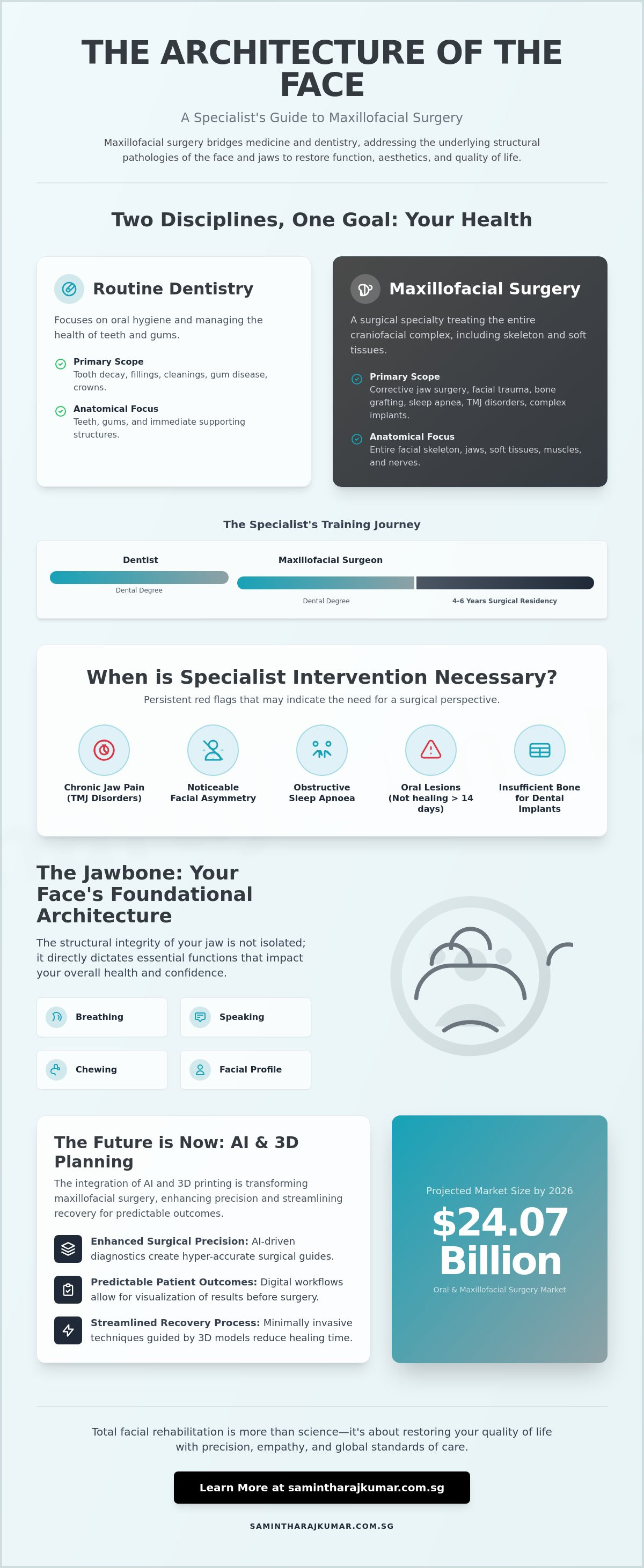
As a clinician and founder, I've seen how the integration of AI and 3D printing has transformed the $24.07 billion oral and maxillofacial surgery market in 2026. This guide is designed to provide you with a clear understanding of the clinical depth and transformative potential of maxillofacial surgery through my personal lens as a specialist. We'll explore the latest 2026 CPT code updates for anatomically driven procedures and how modern anesthesia protocols are now designed to prioritise your long-term comfort. By the end of this guide, you'll feel reassured that total facial rehabilitation is not just about science; it's about restoring your quality of life with precision, empathy, and global standards of care.
Key Takeaways
Identify the critical distinctions between routine dentistry and specialist surgical care to ensure your treatment plan is managed with the appropriate clinical depth and expertise.
Understand why the jawbone serves as the biological foundation for essential functions, including breathing and speech, and how its structural integrity dictates overall facial health.
Discover the transformative role of maxillofacial surgery in corrective jaw procedures that harmonise your facial profile while resolving complex functional biting and chewing issues.
Explore how AI-driven diagnostics and digital workflows are currently enhancing surgical precision and streamlining the recovery process for more predictable patient outcomes.
Learn how the intersection of functional rehabilitation and aesthetics can profoundly improve your long-term quality of life by restoring both confidence and comfort.
Table of Contents What is Maxillofacial Surgery? Defining the Scope of Specialist Care The Biological Perspective: Why Structural Integrity Matters Common Maxillofacial Procedures: A Specialist’s Overview The Patient Journey: Diagnostics, AI, and Recovery The Long-Term Impact: Quality of Life and Functional Aesthetics
What is Maxillofacial Surgery? Defining the Scope of Specialist Care
I often find that patients view surgery through a narrow lens; they assume it's simply an extension of routine dentistry. In my clinical experience, this is a significant misconception that can lead to confusion during the treatment journey. Oral and maxillofacial surgery (OMFS) is a dual-qualified specialty that effectively bridges the gap between medicine and dentistry. It's a discipline that requires a deep understanding of both the systemic health of the body and the intricate mechanics of the oral cavity.
To better understand this concept, watch this helpful video:
As a clinician and founder, I've seen how the scope of this field has expanded to include everything from complex facial trauma to congenital deformities. We don't just treat symptoms; we address the underlying structural pathologies of the face and jaws. This involves a delicate balance. We must ensure the functional mechanics of the jaw are sound while simultaneously achieving aesthetic harmony. It's about restoring a person's ability to breathe, eat, and speak, while giving them the confidence to smile again.
The Distinction Between a Dentist and a Maxillofacial Surgeon
The journey to becoming a specialist isn't a short path. It involves several years of intensive surgical residency beyond a standard dental degree. This training is vital because complex cases require a surgeon's mastery of facial anatomy and strict emergency protocols. While a general dentist excels at managing tooth decay and oral hygiene, a maxillofacial surgeon is equipped to handle procedures involving bone grafting, soft tissue reconstruction, and the management of facial nerves. In my view, the right specialist doesn't just perform a procedure; they manage the entire biological environment to ensure long-term stability.
When is Maxillofacial Intervention Necessary?
Identifying the need for specialist care often starts with recognising persistent red flags. You shouldn't ignore chronic jaw pain, noticeable facial asymmetry, or oral lesions that fail to heal within 14 days. These are often indicators of deeper issues that require a surgical perspective. My practice frequently addresses the following:
Obstructive Sleep Apnoea: Surgical repositioning of the jaw can open airways and resolve life-threatening breathing issues.
Chronic TMJ Disorders: When conservative treatments fail, surgical intervention can restore joint function.
Advanced Rehabilitation: Specialist expertise is vital for complex dental implant singapore cases where bone volume is insufficient for standard protocols.
From a biological perspective, early intervention prevents the cascading effects of structural failure. The best outcomes begin with understanding the root cause, ensuring that every surgical step contributes to your total facial rehabilitation.
The Biological Perspective: Why Structural Integrity Matters
From a biological perspective, the jawbone is not merely a support for teeth; it is the foundational architecture for your entire facial profile and systemic health. In my clinical experience, many patients view the jaw as an isolated structure. However, its integrity directly dictates essential human functions like breathing, chewing, and speaking. When the structural balance of the face is compromised, the consequences ripple throughout the body. I believe in treating the root cause of these imbalances rather than simply managing the surface-level symptoms. This philosophy is what distinguishes total facial rehabilitation from standard dental repairs.
Structural misalignment within the jaw often manifests as more than just an aesthetic concern. For instance, an improperly aligned bite can trigger chronic tension headaches or even digestive issues due to the inability to process nutrients effectively through proper mastication. As a clinician and founder, I’ve observed how the $1.22 billion computer-aided surgery market in 2026 has allowed us to map these biological relationships with extreme precision. We are now able to see how a few millimetres of skeletal shift can alleviate years of chronic discomfort. True health begins with understanding the biological foundation of your care.
Bone Health and Total Rehabilitation
Bone resorption is a silent biological process where the jawbone begins to shrink following tooth loss or trauma. If left unaddressed, this loss of volume leads to a collapsed facial appearance, often making individuals look significantly older than their chronological age. As a maxillofacial specialist, I use advanced bone grafting techniques to restore this lost volume, creating a robust environment for life-changing implants. This isn't just about surgery; it's about preserving the youthful scaffolding of your face. By restoring bone density, we ensure that the soft tissues of the face remain supported, maintaining functional and aesthetic vitality for decades.
The Mechanics of Jaw Alignment
The temporomandibular joint (TMJ) acts as the pilot for facial comfort and function. When this joint is stressed by an untreated underbite or overbite, the biological toll on tooth longevity is severe. Constant grinding and uneven pressure can lead to premature tooth loss and debilitating joint pain. This is where common maxillofacial procedures like orthognathic surgery become the cornerstone of rehabilitation. By surgically repositioning the jaws into their optimal biological alignment, we don't just fix a smile; we restore the seamless mechanical harmony of the entire craniofacial complex. The best outcomes begin with understanding the root cause of these mechanical failures.
Common Maxillofacial Procedures: A Specialist’s Overview
In my clinical experience, patients often view surgery as a last resort, yet many procedures within the maxillofacial remit are proactive steps toward total rehabilitation. Transitioning from the biological foundations we discussed previously, we must look at how specific surgical interventions resolve structural failures. My work involves a spectrum of care, from the precision required for impacted teeth to the complex reconstruction of facial trauma. Each procedure is a deliberate step toward restoring the seamless synchronisation of your facial features.
As a clinician and founder, I've integrated the latest 2026 advancements in computer-aided surgery to enhance our procedural accuracy. This technology, now valued at $1.22 billion globally, allows us to visualise outcomes before the first incision is made. Whether we are performing full-arch rehabilitation or managing a delicate pathology, our focus remains on long-term stability and patient comfort. The goal is always to move beyond temporary fixes toward life-changing results.
Specialist Wisdom Tooth Management
Many people assume that removing a wisdom tooth is a routine "pull." However, when a tooth is impacted or positioned near the inferior alveolar nerve, it requires the meticulous skill of a specialist surgeon. My approach to wisdom tooth extraction involves minimising trauma to the surrounding soft tissue and bone. Unlike a general extraction, a surgical management plan often involves precise bone removal and tooth sectioning to protect vital structures. This level of care significantly reduces post-operative swelling and accelerates your return to daily life.
Corrective Jaw (Orthognathic) Surgery
Corrective jaw surgery is perhaps the ultimate intersection of functional health and aesthetic beauty. We plan jaw surgery singapore using 3D digital modelling to ensure millimetre-perfect alignment. This procedure is essential for patients with significant jaw discrepancies that cannot be resolved by orthodontics alone. By reshaping the facial profile, we don't just improve the bite; we often see a profound transformation in a patient’s self-confidence. This is a collaborative journey, typically involving a period of orthodontic preparation to ensure the teeth are perfectly positioned for their new skeletal foundation.
Complex Implantology and Trauma Care
For patients facing severe bone loss, standard implants are often insufficient. In these cases, I employ advanced Zygomatic and Pterygoid protocols. These specialist techniques utilise the cheekbone or the stable bone at the back of the jaw as an anchor, bypasses the need for extensive grafting. Similarly, my role in managing facial trauma involves reconstructive surgery that restores both form and function following an injury. From a biological perspective, the best outcomes begin with understanding the root cause of the structural deficit, allowing for a truly customised path to recovery.
The Patient Journey: Diagnostics, AI, and Recovery
The journey toward facial rehabilitation is no longer a path of uncertainty. As a clinician and founder, I've seen how the integration of digital technology has transformed the patient experience from one of anxiety to one of calculated confidence. In my clinical experience, the success of a maxillofacial procedure is determined long before we enter the operating theatre. It begins with a meticulous diagnostic phase where we map your unique anatomy with a degree of precision that was simply impossible a decade ago.
By prioritising a seamless digital workflow, we significantly reduce surgical time. This isn't just about efficiency; it's about biological safety. Shorter procedures mean less time under anaesthesia and a reduced risk of infection. We use this digital-first approach to lower the "barrier of fear" that many patients feel. When you can see a 3D simulation of your expected outcome, the procedure becomes a shared goal rather than a frightening unknown. The best outcomes begin with understanding the root cause through advanced diagnostics.
My Perspective: The Philosophy of Recovery
I believe recovery is as much about mental reassurance as it is about physical healing. I advocate for a "Total Rehabilitation" mindset, which means we look beyond the surgical site to your overall well-being. Patients often worry about facial swelling or diet modifications. I tell my patients that swelling is a sign of the body’s natural healing response, usually peaking at 48 to 72 hours post-surgery. By managing these expectations early, we replace anxiety with a sense of control. From a biological perspective, your recovery environment and nutritional intake are just as critical as the surgery itself. We now utilise longer-acting local anaesthetics that provide pain relief for several days, significantly reducing the need for opioid medications in 2026.
Advanced Diagnostics in 2026
In 2026, our practice utilises high-resolution CBCT scans and AI-driven software to assist in surgical planning. These tools allow us to create patient-specific 3D-printed surgical guides. These guides ensure that every cut and implant placement is exactly where we planned it in the virtual environment. AI algorithms now help us predict aesthetic outcomes by analysing data from thousands of successful cases, ensuring that the functional correction also delivers the desired facial harmony. This digital-first approach is the hallmark of modern specialist care, where technology serves the human touch to ensure predictable, high-quality results.
The Long-Term Impact: Quality of Life and Functional Aesthetics
Maxillofacial surgery represents the ultimate intersection of functional health and aesthetic beauty. In my clinical experience, the most rewarding transformations occur when we stop treating aesthetics as a separate entity from biology. From a biological perspective, a face that functions perfectly usually looks harmonious; the two are inextricably linked. When we address the root cause of a patient’s discomfort or structural dissatisfaction, the resulting facial structure feels entirely natural. It isn't about looking like someone else. It's about restoring the most vibrant, functional version of yourself.
Investing in specialist care today is a strategic decision for your future health. By resolving skeletal discrepancies or bone loss in 2026, you prevent a cascade of complex degenerative issues that often emerge in later life. As a clinician and founder, I've seen how untreated jaw issues can lead to severe tooth wear, joint degradation, and even systemic health decline. Early, decisive intervention preserves your oral ecosystem and your overall vitality. The best outcomes begin with understanding the root cause of these structural failures.
The Aesthetic Synergy of Jaw Surgery
Correcting a jaw discrepancy naturally enhances the chin, neck, and overall facial profile. This occurs because we are moving the underlying skeletal support into its ideal biological position. Once the foundation is stable, we often integrate cosmetic dentistry singapore to finish the transformation. This multi-layered approach ensures that your new smile is perfectly framed by your corrected facial proportions. Functional surgery often yields the most impressive aesthetic results because it respects the natural geometry of the human face. It's a seamless blend of science and art that enhances your quality of life.
Choosing Your Specialist for Total Rehabilitation
Selecting a surgeon for total rehabilitation requires a careful look at credentials, technology, and clinical philosophy. I believe you should seek a multi-disciplinary team that understands the Nuffield legacy of excellence. A specialist maxillofacial practice should offer more than just surgical skill; it must provide a visionary outlook on your life trajectory. The combination of global standards and a patient-centred approach is what ensures long-term success. My final reflection for you is simple: the right diagnosis changes everything for a patient’s future. When you choose an expert-led path, you aren't just undergoing a procedure; you're securing a lifetime of confidence and comfort.
Securing Your Future with Clinical Excellence
In my clinical experience, total facial rehabilitation is more than a surgical milestone; it's the restoration of your life's trajectory. As a clinician and founder of Nuffield Dental Holdings, I've dedicated my career to refining the intersection of biological science and human aesthetics. We've explored how structural integrity forms the foundation of health and how AI-assisted diagnostics now provide a level of precision that ensures high-quality outcomes. My work focuses on the most complex cases, including Zygomatic and All-on-4 protocols, to ensure that no patient is left without a solution.
The journey through maxillofacial surgery is a collaborative path toward long-term well-being. By addressing the root cause of your concerns with visionary technology and specialist expertise, we create a result that feels entirely natural. It's about moving beyond immediate repairs toward a legacy of health and confidence. The best outcomes begin with understanding the root cause. Explore the future of specialist care with Dr Samintharaj Kumar.
I am committed to guiding you through this transformation, ensuring that your path to recovery is as seamless as the surgery itself. The right diagnosis changes everything.
Frequently Asked Questions
Is maxillofacial surgery considered a major operation?
Yes, maxillofacial surgery is considered a major surgical intervention because it involves the manipulation of the facial skeleton and deep soft tissues. Most procedures are performed under general anaesthesia and require a hospital stay of 1 to 3 nights for close monitoring. In my clinical experience, the complexity of the operation is balanced by meticulous pre-operative planning to ensure a safe and predictable recovery process.
How long is the typical recovery time after jaw surgery?
Initial recovery usually spans 14 to 21 days, during which time the majority of facial swelling begins to subside. Most patients can return to light work or school after 2 weeks, though full bone union and healing typically require 3 to 4 months. As a clinician and founder, I utilise digital workflows to reduce surgical time, which directly contributes to a more comfortable and efficient healing phase for my patients.
Will I have visible scars on my face after maxillofacial surgery?
Visible scarring is extremely rare because most incisions are made intraorally, meaning they are completely hidden inside the mouth. If an external incision is required for complex trauma or reconstructive cases, I place them within natural skin creases or the hairline to ensure they are discreet. This approach ensures your aesthetic transformation remains seamless and focused on your natural features rather than the surgical process.
Can maxillofacial surgery fix my chronic sleep apnoea?
Yes, maxillofacial surgery is often a definitive solution for obstructive sleep apnoea through a procedure known as maxillomandibular advancement (MMA). By surgically moving the upper and lower jaws forward, we physically expand the airway to prevent collapse during sleep. Clinical data from 2024 indicates that MMA has a success rate exceeding 90% for patients who cannot tolerate CPAP machines or other conservative treatments.
What is the difference between oral surgery and maxillofacial surgery?
Oral surgery typically focuses on the teeth and gums, such as simple extractions, whereas maxillofacial surgery encompasses the entire facial structure, including the jaws, sinuses, and skull. As a specialist, my training allows me to manage complex skeletal deformities and facial trauma that fall outside the scope of general dentistry. From a biological perspective, this specialty provides the necessary expertise to treat the bone as the foundation for total oral rehabilitation.
Is maxillofacial surgery covered by insurance in Singapore?
Many procedures are claimable under Medisave or private insurance in Singapore if they are deemed medically necessary for functional health. While out-of-pocket premiums for some marketplace plans are projected to rise in 2026, our team works closely with patients to navigate Integrated Shield Plans for conditions like jaw misalignment or sleep apnoea. The right diagnosis is essential for ensuring your treatment is recognised by your provider as a vital medical necessity.
How do I know if I need a maxillofacial surgeon or a plastic surgeon?
You should consult a maxillofacial surgeon if your concerns are skeletal or functional, such as a misaligned bite or jaw joint pain. A plastic surgeon generally focuses on the soft tissues and skin, such as facelifts or rhinoplasty. In my practice, I often lead a multi-disciplinary team where we combine skeletal correction with aesthetic finishing to achieve the most comprehensive results for total facial rehabilitation.
What are the risks associated with specialist jaw procedures?
The primary risks include temporary or permanent nerve paresthesia, which is a change in sensation in the lips, chin, or tongue. Other potential complications include postoperative infection or a relapse of the jaw position, though these occur in less than 5% of cases. I mitigate these risks by using AI-assisted diagnostics and 3D-printed surgical guides to ensure millimetre-perfect precision, prioritising your long-term safety and quality of life.


Comments