
The Dangers of an Untreated Collapsed Bite: A Surgeon’s Perspective on Structural Failure
- Dr Samintharaj Kumar

- 2 minutes ago
- 13 min read
A collapsed bite is not merely a dental inconvenience; it's a progressive skeletal and neurological crisis that threatens the very architecture of your face. In my clinical experience, many patients initially overlook the subtle signs of posterior bite collapse, attributing a clicking jaw or a prematurely sagging profile to the inevitable march of time. However, the dangers of an untreated collapsed bite extend far beyond aesthetics, often manifesting as chronic tension headaches and a systemic decline in well-being. When the vertical dimension of your mouth is lost, the delicate balance of your facial muscles and nerves is thrown into chaos.
I recognise the frustration of living with persistent TMJ discomfort and the worry that comes with seeing your teeth break under the pressure of a misaligned bite. You deserve to understand the root cause of these symptoms rather than just managing the pain. In this article, I'll explain why this condition is a form of structural failure and how we can intervene to restore both your function and your youthful facial volume. We'll explore the biological consequences of inaction and the sophisticated surgical protocols, such as All-on-4 and ceramic implants, that allow us to rebuild a foundation for long-term health.
Table of Contents
The Silent Erosion: Understanding the Anatomy of a Collapsed Bite
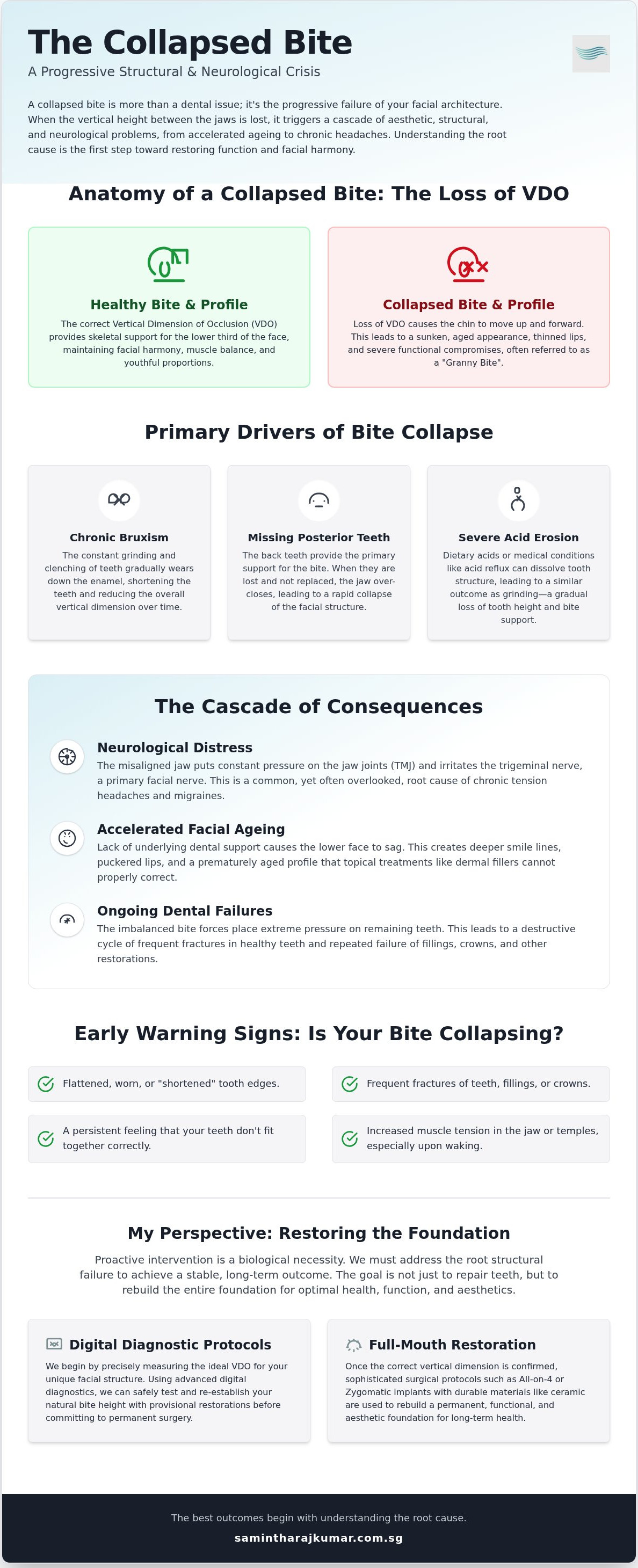
In my clinical experience, many patients come to me concerned about premature ageing or sagging jawlines without realising the root cause lies within their dentition. What we are witnessing in these cases is a progressive failure of the Vertical dimension of occlusion (VDO). Simply put, this is the distance between the upper and lower jaws when the teeth are fully meeting. When this distance decreases, the entire lower third of the face begins to lose its structural integrity. It is a slow, silent erosion of the facial foundation.
This erosion is rarely an overnight event. It is typically driven by chronic bruxism, the long-term absence of multiple posterior teeth, or severe acid erosion. As the teeth wear down or go missing, the skeletal support that maintains the height of your face literally disappears. I often describe this to my patients as a building with a sinking foundation. If the ground floor gives way, every floor above it will eventually show signs of stress and misalignment. The dangers of an untreated collapsed bite are not just cosmetic; they represent a fundamental breakdown of your biological architecture.
We often refer to the late-stage manifestation of this condition as the "Granny Bite." This is a structural failure where the chin appears to move closer to the nose, causing the lips to thin and the face to take on a sunken, aged appearance. This isn't just about looking older. It's about the loss of a functional environment where your jaw, muscles, and nerves can operate without strain.
The Mechanism of Vertical Loss
The primary mechanism of collapse involves the loss of posterior tooth support. When back teeth are missing or severely worn, the mandible must travel further to find a stable contact point. This causes the jaw to over-close, which rotates the chin forward and upward. I frequently see this lead to uneven wear on existing crowns or bridges, as they are forced to bear loads they weren't designed for. The brain is remarkably adept at adapting to these changes. It subtly adjusts your muscle movements to mask the discomfort, which often delays a patient's decision to seek help until the collapse is significant.
Recognising the Warning Signs
Detecting a collapsed bite early can prevent extensive surgical intervention later. You should look for flattened tooth edges or a smile that seems to have "shortened" over the years. From a biological perspective, you might notice your lips appearing puckered or your smile lines becoming deeper and more pronounced. Other indicators I observe in clinic include:
Frequent fractures in otherwise healthy teeth.
Fillings or restorations that seem to pop out or fail repeatedly.
A persistent feeling that your teeth don't fit together quite right.
Increased muscle tension in the jaw or temples upon waking.
Identifying these signs early allows us to intervene before the cycle of damage becomes irreversible. The best outcomes begin with understanding the root cause of these structural changes.
Beyond the Teeth: The Neurological and Systemic Dangers
In my clinical experience, treating a collapsed bite is rarely just about the teeth. It's about the nervous system. The dangers of an untreated collapsed bite extend far beyond the mouth, acting as a silent catalyst for neurological distress and systemic inflammation. When the vertical dimension of your mouth is lost, the mandible is forced into an unnatural, over-closed position. This creates direct pressure on the tissues surrounding the jaw joint, leading to chronic Temporomandibular Joint (TMJ) dysfunction. The Repercussions of a Vertical Bite Collapse often involve a cascade of muscle contractions that don't just stay in the jaw; they radiate through the face, head, and neck.
The trigeminal nerve is the primary sensory pathway for your face and is responsible for biting and chewing. When your bite is misaligned, this nerve is constantly bombarded with faulty signals. This persistent irritation often manifests as debilitating tension headaches or even migraines. From a biological perspective, the body is a single, integrated unit. A structural failure in the foundation of your bite eventually forces the rest of your body to compensate, creating a cycle of pain that many patients struggle to explain to their general practitioners.
The Trigeminal-Vagal Axis
Jaw misalignment doesn't stop at the chin. It directly affects the alignment of your cervical spine. As your bite collapses, your head position often shifts forward to compensate for the change in jaw posture. This strain reaches the trigeminal-vagal axis, sending distress signals through the central nervous system. I've found that many patients visit neurologists or physiotherapists for years before realising the cause of their discomfort is actually a dental structural failure. As a clinician and founder, I believe understanding the root cause is the only way to break this cycle of systemic decline.
Airway Compromise and Sleep Quality
One of the most overlooked consequences of vertical loss is the reduction of space within the oral cavity. When your bite height decreases, your tongue loses the room it needs to sit comfortably. It's often forced backward into the pharyngeal space, which can compromise your airway during sleep. This structural change is a significant contributor to sleep-disordered breathing and nocturnal bruxism. Your body subconsciously grinds your teeth in an attempt to open the airway, which only accelerates the collapse. This creates a dangerous loop:
Reduced bite height leads to tongue displacement.
Airway obstruction triggers nocturnal grinding.
Grinding further destroys tooth structure and bite height.
Chronic airway issues increase long-term cardiovascular stress.
This constant neuromuscular stress places a heavy inflammatory burden on the body. It isn't just "jaw pain"; it's a chronic state of physical stress that prevents true rest and recovery. Addressing these issues requires more than a simple filling; it requires a comprehensive surgical and biological restoration.
The Aesthetic Toll: How Vertical Loss Accelerates Facial Ageing
The face is supported by a sophisticated scaffold of bone and teeth. When the bite collapses, the lower third of the face essentially loses its internal frame. I often see patients who are distressed by a "shrunken" appearance where the chin seems to gravitate toward the nose. This isn't just a skin issue; it's a structural failure of the skeletal foundation. One of the most visible dangers of an untreated collapsed bite is the rapid acceleration of facial ageing. This manifests as a loss of lip fullness and the development of deep marionette lines that topical treatments simply cannot reach.
I've noticed a growing trend where patients attempt to correct these changes with dermal fillers. While injectables have their place in aesthetic medicine, they often fail or look "overfilled" when the underlying dental structure is missing. Without the proper vertical dimension, the soft tissues have nothing to drape over. You can find more detail on this in my guide on how dental structure affects face shape. When we restore the bite, we aren't just fixing teeth; we're rebuilding the architectural support for the entire face.
Structural vs. Topical Rejuvenation
From a biological perspective, we must address the skeleton of the face before we look at the skin. In my clinical experience, restoring the teeth and jaw through total mouth rehabilitation provides a natural "lift" that no topical treatment can match. By re-establishing the correct height, we provide the necessary tension for the facial muscles to function optimally. This often involves advanced protocols like All-on-4 or Zygomatic implants to rebuild the foundation. Understanding How a Collapsed Bite Affects Your Jaw is crucial because it highlights that we are treating a complex, interconnected system, not just individual units of enamel.
The Impact on Your Smile Behaviour
The psychological toll of these changes is often as significant as the physical pain. When the bite is collapsed, the muscles used for smiling are forced into an inefficient range of motion. This makes a smile feel "forced" or even strained, which can lead to a loss of social confidence. My philosophy centres on restoring the "Golden Proportion" of the face, a mathematical balance that dictates facial harmony. Through clinical precision and AI-assisted diagnostics, we can calculate the exact vertical height your face needs to look and feel its best. Restoring this balance allows for a profound personal impact, regaining the freedom to express yourself without hesitation. The best outcomes begin with understanding the root cause of the collapse.
My Perspective: Why Early Intervention is a Biological Necessity
As a clinician and founder of Nuffield Dental, I've spent my career advocating for a proactive approach to oral health. I often tell my patients that the right diagnosis changes everything. It's the difference between a temporary patch and a lifelong solution. The dangers of an untreated collapsed bite are not static; they represent a progressive biological decay. When we delay intervention, we aren't just allowing teeth to wear down. We're allowing the alveolar bone to resorb and the facial muscles to atrophy. Waiting for what some might call "total failure" significantly complicates the restorative process, as the foundation we have to work with becomes increasingly fragile.
In my clinical experience, the integration of AI-assisted diagnostics at Nuffield Dental has been a game-changer. These tools allow us to identify subtle shifts in the Vertical Dimension of Occlusion (VDO) long before they manifest as visible facial sagging. By analysing CBCT scans with high-precision algorithms, we can map out the exact path of structural failure. From a biological perspective, my preference is always for restoration using biocompatible materials. Ceramic implants, for example, offer a metal-free alternative that respects the body's natural chemistry. They provide a stable, aesthetic foundation that doesn't trigger the same immune responses as traditional materials, which is vital for long-term systemic health.
The Philosophy of Total Rehabilitation
We must move beyond the era of patchwork dentistry. When a patient presents with a collapsed bite, I don't see thirty-two individual problems; I see one compromised system. My evaluation process always considers how jaw structure influences facial harmony and airway patency. As a founder, I've ensured our practice adheres to the highest international protocols, drawing on global standards of excellence to ensure every surgical outcome is predictable. This comprehensive view is essential because a bite that is merely "fixed" without being balanced will eventually fail again. We aim for a profound personal impact that restores both function and form.
The Role of Advanced Implantology
In cases where the collapse has led to severe bone loss, standard implant protocols may not be sufficient. This is where advanced techniques like Zygomatic or Pterygoid implants become a biological necessity. These specialised protocols allow us to anchor restorations in the stable bone of the mid-face, bypassing areas of resorption. For many patients, All-on-4 dental implants offer a transformative solution, re-establishing the correct bite height and facial proportions in a remarkably short timeframe. Achieving this level of bite normalisation requires clinical mastery and a meticulous eye for detail. The best outcomes begin with understanding the root cause of your structural failure.
Restoring the Foundation: Clinical Solutions for a Collapsed Bite
In my clinical experience, the path to recovery begins with a meticulous diagnostic phase that moves beyond traditional dental exams. We utilise advanced digital imaging and neuromuscular assessments to map the current state of your jaw's relationship to your skull. This isn't just about teeth; it's about re-establishing a biological harmony that has been lost. Because the dangers of an untreated collapsed bite involve the entire craniofacial system, our diagnostic protocols must be equally comprehensive. We look at muscle activity, joint health, and airway space to ensure our intervention addresses the structural failure at its source.
A critical stage in my treatment philosophy is the use of provisional restorations. These act as a functional "test drive" for your new bite height. Before we commit to permanent changes, we allow your muscles and nervous system to adapt to the restored vertical dimension. This phased approach ensures that the final result is not only aesthetically beautiful but biologically comfortable. Once we've confirmed the optimal position, we move to the permanent restoration phase. For many, this involves the life-changing impact of Teeth in a Day, a protocol that allows us to bypass months of traditional waiting times and provide immediate structural support.
The Reconstruction Roadmap
Restoring a collapsed bite requires a disciplined, sequential approach to ensure longevity. From a biological perspective, we cannot build on a compromised foundation. My roadmap for total rehabilitation typically follows these three essential steps:
Step 1: Stabilisation. We focus on treating any underlying periodontal disease and ensuring the remaining bone and soft tissues are healthy and stable.
Step 2: VDO Determination. Using digital diagnostics, we calculate the optimal vertical dimension of occlusion that restores facial proportions and relieves neuromuscular strain.
Step 3: Implementation. This involves the surgical placement of dental implants or the application of restorative crowns to permanently lock in the new bite height.
Long-term Maintenance and Quality of Life
The impact of a restored bite extends far beyond a confident smile. When your jaw is properly aligned, the chronic tension that causes headaches and TMJ pain often dissipates. Patients frequently report significant improvements in their nutrition and digestive health, as they can finally chew a varied, healthy diet without discomfort. As a clinician and founder, I've seen how this restoration acts as a catalyst for emotional renewal. You aren't just gaining new teeth; you're reclaiming your systemic well-being and halting the cycle of premature ageing. The best outcomes begin with understanding the root cause.
Reclaiming Your Structural Integrity and Well-being
In my clinical experience, the most profound transformations occur when we move beyond addressing individual symptoms to treat the body as an integrated system. We've explored how the dangers of an untreated collapsed bite manifest through chronic neurological pain, compromised airways, and the premature erosion of facial volume. As a clinician and founder, I'm committed to global standards in oral surgery and founder-led clinical excellence, ensuring that every restoration is grounded in biological precision and long-term stability.
By choosing to intervene before structural failure becomes total, you protect your systemic health and simplify the path to recovery. My specialist focus on complex implantology allows us to rebuild even the most challenging cases, restoring a foundation that supports both functional excellence and facial aesthetics. The best outcomes begin with understanding the root cause. Explore our approach to total rehabilitation and take the first step toward a future of renewed health. I look forward to helping you rediscover the comfort and confidence you deserve.
Frequently Asked Questions
What exactly is a collapsed bite?
A collapsed bite, clinically known as the loss of vertical dimension of occlusion, occurs when the distance between your upper and lower jaws decreases. This usually happens due to severe tooth wear, multiple missing posterior teeth, or acid erosion. In my clinical experience, it isn't just a dental issue; it's a skeletal collapse. When the teeth no longer provide adequate support, the mandible rotates forward and upward, fundamentally altering your facial architecture and joint health.
Can a collapsed bite cause chronic headaches or migraines?
Yes, chronic headaches and migraines are common symptoms of this condition. When your bite height is lost, the muscles of mastication are forced into a state of constant contraction to find a stable resting position. This neuromuscular stress irritates the trigeminal nerve, which is the primary sensory pathway for the face and head. From a biological perspective, this persistent nerve irritation often triggers debilitating tension headaches that many patients don't initially realise are linked to their dental structure.
Is it possible to fix a collapsed bite without surgery?
In early stages, we can sometimes restore the vertical dimension using non-surgical restorative techniques like crowns, onlays, or bridges. However, if the collapse is caused by significant tooth loss or severe bone resorption, surgical intervention becomes a biological necessity. I often utilise advanced protocols like All-on-4 or Zygomatic implants to rebuild the foundation. The best outcomes begin with understanding the root cause, allowing us to determine if a restorative or surgical path is most appropriate.
How does a collapsed bite affect my facial appearance?
A collapsed bite causes the lower third of your face to appear "shrunken" or prematurely aged. Without the underlying support of your teeth, the soft tissues lose their tension, leading to thinned lips, deepening marionette lines, and a protruding chin. This is why the dangers of an untreated collapsed bite include aesthetic decline that dermal fillers cannot fix. Restoring the bite height provides a natural lift by rebuilding the skeletal scaffold that supports your facial features.
Will insurance cover the treatment for a collapsed bite?
Coverage varies significantly depending on your specific policy and the underlying cause of the collapse. Many insurance providers recognise the functional necessity of restoring a bite to prevent further skeletal or joint damage. While purely aesthetic components might not be covered, the restorative elements, such as crowns or certain implant protocols, often qualify for partial reimbursement. I recommend contacting your provider to discuss your diagnostic findings and the proposed clinical roadmap for your rehabilitation.
How long does the full mouth rehabilitation process take?
The timeline for full mouth rehabilitation depends on the complexity of your case. For some patients, we can achieve immediate structural support through our Teeth in a Day protocol. In other instances, a phased approach is required to allow the jaw muscles and nerves to adapt to a new vertical height. This can take several months of using provisional restorations before we place the final, permanent ceramic implants. My priority is always long-term stability and functional excellence.
Are dental implants the only way to restore vertical dimension?
No, they aren't the only solution, but they're often the most effective for severe cases. If you have enough healthy natural teeth, we can use ceramic crowns or onlays to increase the bite height. However, when multiple teeth are missing, dental implants provide the necessary mechanical strength to support the new vertical dimension. As a clinician and founder, I advocate for the use of biocompatible materials like zirconia to ensure your restoration integrates seamlessly with your biology.
What happens if I choose to leave my collapsed bite untreated?
Choosing to delay treatment leads to a cycle of progressive structural failure. The dangers of an untreated collapsed bite include accelerating tooth fractures, irreversible jawbone loss, and chronic TMJ pain. From a biological perspective, you may also face compromised airway space and sleep-disordered breathing as the tongue is forced backward. Over time, the surgical intervention required to fix the damage becomes significantly more complex and invasive, making early diagnosis a vital step for your well-being.


Comments