
Oral Maxillofacial Surgeon Singapore: Understanding Specialist Surgical Care

Choosing surgical care starts with understanding the concern, not with assuming a procedure is needed. If you’re searching for an oral maxillofacial surgeon singapore, you may be wondering which parts of the specialty relate to your needs, what experience matters and what questions to raise.
Oral and facial concerns can be difficult to place. The specialty covers a broad area, while each patient’s questions are personal. I’ll explain the scope of oral and maxillofacial surgery, distinguish that broad field from my own clinical interests and services, and outline how to make a discussion about care more focused.
I’ll also explain how to read professional credentials, what comfort options I offer for nervous patients and how to prepare useful questions. The aim is to help you understand the conversation, not to assume what care is right for you.
Table of Contents
What Does an Oral Maxillofacial Surgeon in Singapore Treat?
It can be difficult to know whether a concern affecting your teeth, jaw or face calls for surgical care. A painful wisdom tooth, a difficult extraction or questions about replacing missing teeth may prompt someone to explore their options. The specialty is broad, so the care relevant to you depends on the concern and clinical assessment.
In plain English, oral and maxillofacial surgery is surgical care involving the mouth, jaws and face. The specialty encompasses conditions related to disease, injury or defects in these areas. The Oral and maxillofacial surgery overview offers further background on the field. This describes the specialty broadly, rather than the qualifications or services of any one clinician.
How oral and maxillofacial surgery relates to dental care
Dentistry and oral surgery both concern the mouth, but oral surgery may extend beyond teeth to the jaws and facial structures. That distinction can help clarify what you want to discuss. An oral or facial concern does not automatically mean that an operation is needed.
My clinical interests include complex implantology, oral surgery and full mouth rehabilitation. My services include dental implants, wisdom tooth surgery and difficult extractions, as well as TMJ pain management. These are specific areas of my practice, not a claim to cover every aspect of oral and maxillofacial surgery.
Concerns that may lead someone to explore surgical care
Patients may have questions about wisdom teeth or what a proposed extraction involves. Others may be discussing a difficult extraction or dental implants to replace missing teeth. TMJ pain management is relevant to concerns involving the jaw joint. These examples describe areas of care to discuss, not diagnoses or recommendations for a particular treatment.
For a closer look at one common concern, my guide to wisdom tooth extraction explains the subject in more detail. A symptom or treatment question is a starting point, not a conclusion. In my clinical experience, it helps to describe where the concern is and what you want to understand. That gives the discussion a clearer focus, whether the question relates to teeth, the jaw or facial structures.
If you’re considering an oral maxillofacial surgeon singapore, distinguish the specialty’s broad scope from the clinician’s specific experience and services. That helps you ask more focused questions about the concern that brought you to seek care.
How Clinical Assessment Connects a Concern to an Oral Surgery Plan
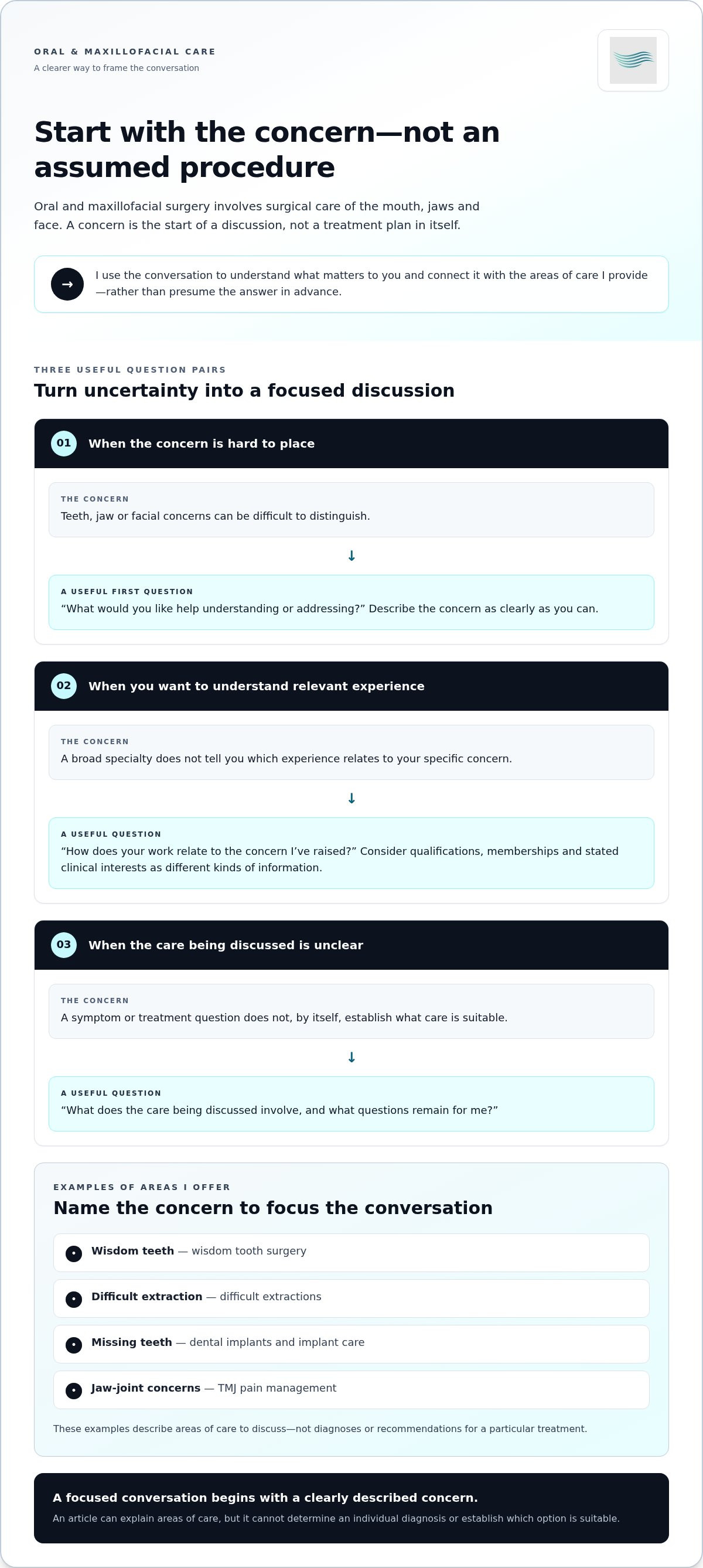
A concern begins a clinical conversation; it is not a treatment plan in itself. You may arrive with a specific question, a proposed procedure or uncertainty about the type of care that could be relevant. I use the discussion to understand what matters to you and connect it with the areas of care I provide, rather than presume the answer in advance.
To prepare for that conversation, you can:
Describe the concern. Explain what you would like help understanding or addressing.
Ask about relevant experience. Find out how the clinician’s work relates to the concern you have raised.
Clarify the options. Ask what the care being discussed involves and what questions remain for you.
This is a practical way to organise your questions, not a prescribed clinical workflow. An article can explain areas of care, but it cannot determine an individual diagnosis or establish which option is suitable for you.
Why the same broad concern can involve different care
Everyday descriptions can sound similar while relating to different areas of practice. Dental implants involve implant care; a difficult extraction is a distinct area of oral surgery; TMJ pain management relates to concerns involving the jaw joint. Naming your concern as clearly as you can helps focus the conversation. The clinical discussion can then explore what care is relevant.
For general context on the specialty’s education and scope, the American Association of Oral and Maxillofacial Surgeons describes oral and maxillofacial surgery and the conditions and procedures associated with it. This is a broad overview, not an assessment of an individual patient or a statement about my own credentials.
Planning with function, comfort and long-term care in mind
In my clinical experience, precision begins with understanding the concern rather than rushing towards a procedure. Function, comfort and the wider context of your care all deserve consideration. For implant-related concerns, this may include discussing full mouth rehabilitation as part of a broader restorative picture. Whether that connection is relevant depends on the concern being assessed.
Comfort matters, too. I want patients to have space to explain what is troubling them and understand the care being discussed. A thoughtful assessment can make the conversation clearer, but it cannot promise a particular experience, recovery or result. The aim is to help you understand the concern and the care under consideration.
If you’re considering oral maxillofacial surgeon singapore care, focus the discussion on your concern and the experience relevant to it. You can learn more about my approach to complex oral surgery as part of that wider consideration.
What Credentials and Experience Matter When Considering Oral Surgery?
Credentials can help you understand a clinician’s professional background, but they are most useful when considered alongside the care you want to discuss. A qualification, a professional membership and a stated clinical interest are different kinds of information. Reviewing them separately gives you a more accurate picture than assuming one credential represents expertise across every area of oral surgery.
I am a Diplomate and Fellow of the International Congress of Oral Implantologists, and a member of the Association of Dental Implantology (UK), the Academy of Osseointegration and the American Academy of Cosmetic Dentistry. These credentials and memberships provide context for my professional background and interests, particularly in implantology. They should be understood as stated, rather than as a claim of separate specialist accreditation or expertise in every surgical field.
Dr Samintharaj Kumar’s listed professional credentials
When reviewing a clinician’s profile, distinguish formal qualifications from memberships and clinical interests. Each offers a different kind of context. My Diplomate and Fellowship status is with the International Congress of Oral Implantologists; my memberships are with the three organisations named above. I also lecture nationally and regionally on implant dentistry.
When researching an oral maxillofacial surgeon singapore, look beyond the number of credentials in a profile. Consider whether the clinician’s stated experience relates to the care you want to discuss, and whether that connection is explained clearly. Credentials should be described accurately, without suggesting qualifications they do not state.
Matching clinical interests to the concern being considered
My clinical interests include complex implantology, oral surgery and full mouth rehabilitation. These areas connect with services such as dental implants, wisdom tooth surgery and difficult extractions, as well as TMJ pain management. The relevance of any service depends on the concern being discussed. Examples help describe my practice, but do not establish a diagnosis or determine which care is appropriate for you.
For example, a question about replacing missing teeth relates to my implantology interests, while a difficult extraction relates to my oral surgery services. A concern involving TMJ pain is a distinct area of care. Understanding these differences can help you see how a clinician’s stated experience may relate to your question, without treating different concerns as interchangeable.
In my clinical experience, trust grows when patients understand both what a qualification says and what it does not say. That clarity supports a more useful conversation about relevant experience, the care being discussed and any questions that remain. I explain my background precisely and keep the discussion centred on your concern. Credentials provide context; clear, relevant communication helps make that context meaningful.
Which Oral Surgery and Implant Care Areas Does Dr Kumar Offer?
Oral surgery and implant care relate to different concerns, so I make the areas of my practice clear. My services include implantology, wisdom tooth surgery, difficult extractions, TMJ pain management and facial aesthetic rejuvenation. The overview below connects each concern with a service I provide, without suggesting that a particular procedure is right for everyone.
Implantology and complex tooth replacement
My implant care includes dental implants for single or multiple missing teeth, as well as full mouth rehabilitation involving implants. I also offer All-on-4 and Teeth in a Day, zygomatic dental implants and ceramic dental implantology. These are distinct areas of care, not a guarantee of suitability or a particular outcome. A discussion about them needs to relate to your concern and clinical circumstances.
I see All-on-4 as one part of a wider implant conversation, rather than a one-size-fits-all answer. My interest in complex implantology connects with considering function and restoration as a whole. A discussion about full mouth rehabilitation may involve broader restorative needs, while a question about one missing tooth may be more focused. Each conversation begins with the concern being considered.
Wisdom teeth, difficult extractions and TMJ concerns
I provide wisdom tooth surgery and difficult extractions as part of my oral surgery services. I also offer TMJ pain management, a distinct area of care for concerns involving the jaw joint. These services help clarify which part of my practice relates to your question; the service name alone does not determine what care is appropriate. A TMJ concern and an extraction question call for different discussions.
Facial aesthetics and the wider picture
I offer facial aesthetic rejuvenation as a separate area of care alongside implant and extraction services. My aim is to help patients understand which service relates to the concern they want to discuss, rather than treating every oral or facial question as the same kind of problem. This distinction matters when considering oral maxillofacial surgeon singapore care and the relevance of specific services.
To explore these areas of my practice, you can view my oral surgery and implant services.
How Dr Samintharaj Kumar Approaches Patient Comfort and Next Steps
I know that considering oral surgery can bring practical questions as well as anxiety. I give patients room to explain their concerns and understand the care being discussed. Everyone’s concerns are different, so I do not assume that one kind of reassurance suits all. A calm, open conversation is an important part of patient-centred care.
Comfort options for nervous patients
For nervous patients, I offer intravenous sedation at Nuffield Dental clinics. General anaesthesia is available at Orchard Day Surgery or Aptus Day Surgery. These are distinct options in different settings. I share this information so patients know they can raise comfort as part of a discussion about oral surgery. The appropriate option depends on the individual assessment.
My philosophy has always been to approach complex care with respect for the person behind the clinical concern. If you feel uneasy, tell me during the discussion. That helps me understand what you would like clarified, without making assumptions or promising a particular experience. Reassurance begins with clear, honest communication.
Knowing about these comfort options can help you prepare questions and decide what you would like to discuss. I explain my clinical work in a measured way, giving patients space to reflect on relevant information rather than feel rushed towards a decision.
A trust-led next step
My guiding motto is “The pursuit of perfection with commitment to excellence.” For me, that means approaching care with precision and making patient understanding part of the process. Precision matters, as does explaining the discussion in clear language. I keep function, comfort and long-term well-being in view without promising a particular outcome.
A useful next step is to identify what you want to ask: which service relates to your concern, what the options involve or how comfort can be considered. These are reasonable questions. A clear understanding of the discussion can help you approach decisions with greater confidence.
To learn more, I invite you to explore my clinical work and services and consider how they relate to the care you’re seeking.
Move Forward with Clarity and Confidence
Choosing an oral maxillofacial surgeon singapore is not simply about identifying a procedure. It means understanding your concern, the clinician’s relevant experience and the questions you want answered before considering care. That clarity can help you take a more considered next step.
My professional background includes Diplomate and Fellow status with the International Congress of Oral Implantologists, alongside memberships in the Association of Dental Implantology (UK), the Academy of Osseointegration and the American Academy of Cosmetic Dentistry. For nervous patients, I offer intravenous sedation at Nuffield Dental clinics, and general anaesthesia is available at Orchard Day Surgery or Aptus Day Surgery. These are details to include in an open conversation about care, not a promise of a particular experience or outcome.
My guiding principle remains “The pursuit of perfection with commitment to excellence.” To me, this means approaching each concern with precision and ensuring patients have the information and space to understand their options. The best next step begins with understanding what matters to you.
Explore my clinical work and approach to oral surgery, and take your next step with greater confidence.
Frequently Asked Questions
What is the difference between an oral surgeon and an oral and maxillofacial surgeon?
The terms can be used differently depending on context, so the title alone may not explain a clinician’s full training or practice. Oral and maxillofacial surgery broadly refers to surgical care involving the mouth, jaws and face. “Oral surgeon” is sometimes used as a shorter description. It is useful to review the practitioner’s stated qualifications and experience rather than assume the terms mean exactly the same thing everywhere.
Can an oral and maxillofacial surgeon help with a difficult tooth extraction?
Yes. I provide difficult extractions as part of my oral surgery services. A tooth that is challenging to remove can be a reason to discuss surgical care, but that description alone does not determine what treatment is appropriate. Explain which tooth is concerning you and what you would like clarified. The assessment is an opportunity to understand the issue and discuss relevant care.
Does every dental implant procedure involve oral surgery?
Dental implant placement is a surgical procedure, but not every discussion or stage of implant care is itself surgery. Planning and restoration are also part of implant treatment. My implant services include single, multiple and full mouth implants, as well as All-on-4, Teeth in a Day, zygomatic implants and ceramic dental implantology. These are different areas to discuss, not a prediction that any particular approach will suit you.
Can TMJ pain be discussed with a surgeon even when surgery is not planned?
Yes. TMJ pain management can be discussed without assuming that surgery is planned. You can explain what you would like addressed, and we can discuss whether my TMJ pain management service is relevant. An article cannot identify the cause of an individual’s discomfort or recommend treatment. An assessment provides an opportunity to understand the concern and consider relevant care.
What credentials does Dr Samintharaj Kumar hold in implantology?
I am a Diplomate and Fellow of the International Congress of Oral Implantologists. I’m also a member of the Association of Dental Implantology (UK), the Academy of Osseointegration and the American Academy of Cosmetic Dentistry. These details describe my stated credentials and professional memberships, particularly in the context of implantology. They should be understood precisely, rather than taken to imply a separate oral and maxillofacial specialist accreditation.
Can nervous patients receive intravenous sedation or general anaesthesia?
Yes. I offer intravenous sedation to nervous patients at Nuffield Dental clinics, while general anaesthesia is available at Orchard Day Surgery or Aptus Day Surgery. These are distinct options provided in different settings. Their mention here is not a recommendation about which option is right for you. If anxiety is part of your concern, raise it during a discussion about the care being considered.
Are facial rejuvenation treatments part of oral and maxillofacial surgery?


Comments