
Protecting Your Investment in Cosmetic Dentistry: A Surgeon’s Perspective on Longevity
- Dr Samintharaj Kumar

- Jun 22
- 11 min read
Updated: Jul 2
Most patients view the completion of a smile makeover as a finish line, yet as a clinician and founder, I see it as the start of a vital biological partnership. It's entirely natural to feel a sense of anxiety after committing to a transformative procedure. You've invested significant emotional and financial resources into your appearance, and the fear of a restoration failing or losing its lustre is a common concern I hear in my consultation room. You deserve the certainty that your new smile is built to last, and protecting your investment in cosmetic dentistry is the only way to ensure that happens.
In my clinical experience, long-term success requires moving far beyond basic brushing and flossing into the realm of strategic clinical preservation. From a biological perspective, the longevity of your results depends on how we manage the relationship between your restorations and the living tissue of your mouth. In this article, I will outline the specific clinical protocols and maintenance roadmaps required to preserve the functional aesthetics and structural integrity of your smile for decades. We will explore the difference between simple hygiene and professional preservation, giving you the confidence to enjoy your results for a lifetime.
Table of Contents
Beyond Aesthetics: Why Protecting Your Investment in Cosmetic Dentistry is a Biological Mandate
The Science of Stability: How Material Choice and Biological Integration Influence Success
Professional Monitoring Protocols: The Role of AI and Specialist Oversight
Daily Rituals and Mechanical Safeguards: Preserving Functional Aesthetics
Beyond Aesthetics: Why Protecting Your Investment in Cosmetic Dentistry is a Biological Mandate
When I speak with patients about a smile makeover, I often describe the process as a sophisticated fusion of art, engineering, and biology. It isn't merely about the surface-level lustre of a new veneer or the shade of a crown. Instead, it's an intricate rehabilitative project that must integrate seamlessly with your living tissues. Cosmetic dentistry, when performed at a specialist level, is an investment in your long-term health and self-confidence. However, the true work begins once the final restoration is placed. Protecting your investment in cosmetic dentistry requires a shift in mindset from seeing your smile as a finished product to viewing it as a dynamic ecosystem that requires precise, ongoing management.
To better understand the clinical necessity of long-term care, watch this helpful video:
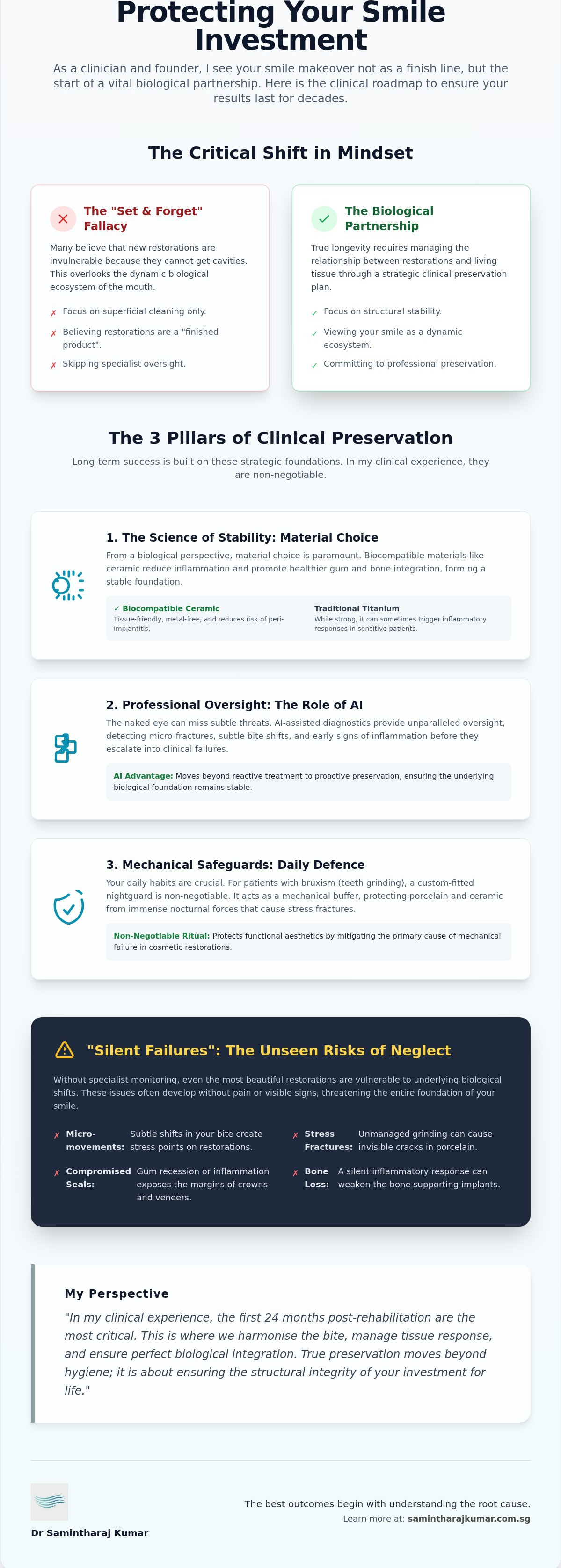
In my clinical experience, the first 24 months following a major rehabilitation are the most critical for ensuring decades of success. This is the window during which your bone density, gingival tissues, and neuromuscular bite patterns adapt to the new structures. I often encounter "silent failures" where a restoration looks flawless to the naked eye, yet the underlying biology is shifting in ways that threaten the entire foundation. If the bite isn't perfectly harmonised with the jaw, or if the inflammatory response isn't managed, even the most expensive materials will eventually fail. True preservation isn't about superficial cleaning; it's about structural stability and biological integration.
The Problem: Why "Set and Forget" is a Risk
Many patients fall into the trap of believing that because their new teeth can't get "cavities" in the traditional sense, they no longer need specialist oversight. This is a dangerous misconception. Neglecting professional check-ups allows micro-movements in the jaw to go unnoticed. Over time, these subtle shifts in your occlusion can create stress points on porcelain and ceramic, leading to fractures or debonding. Biological dentistry serves as the foundation of lasting aesthetics by ensuring the living environment supports the artificial restoration.
The Science: Why It Happens
The longevity of a smile depends heavily on the health of the gingival margins. If the gums recede or become inflamed, the seal of a veneer or crown is compromised, exposing the tooth structure underneath to bacteria. Additionally, the body's natural inflammatory response can react to certain materials or poorly fitted margins, leading to bone loss around implants. Structural integrity depends on the harmonious interaction between the material used and your body's immune system. Without specialist monitoring, these biological shifts can undo years of meticulous surgical work before you even feel a hint of discomfort.
The Science of Stability: How Material Choice and Biological Integration Influence Success
Understanding the mechanical limits of different materials is vital for durability. While dental veneers crafted from high-quality porcelain offer unmatched translucency and aesthetics, Zirconia provides superior fracture resistance for posterior teeth that endure heavy biting forces. We don't just choose a material for its beauty; we choose it for its engineering. By selecting high-tier manufacturing standards and verified material origins, we significantly reduce the risk of late-stage failure that often plagues generic, mass-produced restorations.
The invisible bond of osseointegration is what truly secures your investment. This biological process, where the jawbone fuses directly with the implant surface, provides the necessary stability for complex rehabilitations. For patients requiring full-arch restoration, all-on-4 dental implants play a pivotal role in maintaining jawbone density. By stimulating the bone through functional loading, we prevent the natural resorption that occurs after tooth loss, ensuring the facial structure remains supported for years to come.
Biocompatibility and Longevity
Selecting materials that mimic natural tooth wear is a cornerstone of my treatment philosophy. Metal-free options often lead to a more stable soft tissue response, preventing the "dark line" at the gum margin that can occur with older porcelain-fused-to-metal crowns. I evaluate material success through years of clinical data, ensuring that every component of your smile makeover is selected for its proven ability to integrate with your biology rather than just its initial appearance.
Structural Rejuvenation
A smile makeover is not just about the teeth; it's about the entire facial architecture. By preventing facial collapse with dental implants, we protect the aesthetic investment by maintaining the vertical dimension of your face. This structural rejuvenation restores lost volume in the lower third of the face, providing a natural lift that topical treatments cannot achieve. The foundation of your smile is far more important than the finish, as a stable foundation ensures the longevity of the aesthetic work. The best outcomes begin with understanding the root cause of structural instability.
Professional Monitoring Protocols: The Role of AI and Specialist Oversight
Protecting your investment in cosmetic dentistry is not a task for a generalist alone. While a standard "scale and polish" is essential for basic oral hygiene, it doesn't address the complex mechanical and biological needs of a full-mouth rehabilitation. In my clinical experience, a specialist-led review is a comprehensive audit of your oral ecosystem. I look for subtle changes in tissue health and mechanical stability that a routine check-up might overlook. Dental implants and advanced ceramic restorations require a surgeon's understanding of how these components interact with the surrounding bone and nerves over time.
At my practice, I've integrated AI-assisted diagnostics to provide a level of precision that was previously impossible. This technology allows me to detect micro-fractures in porcelain or ceramic long before they become visible to the eye or lead to a clinical failure. We also utilise 3D CBCT scans to monitor bone levels around surgical sites with sub-millimetre accuracy. This proactive approach is why I insist that a cosmetic dentistry singapore specialist reviews your functional alignment at least once a year. By prioritising these advanced monitoring protocols, we aren't just cleaning teeth; we're protecting your investment in cosmetic dentistry through every stage of its lifecycle.
From a biological perspective, checking the "occlusion", or your bite, is a clinical necessity. Even a tiny shift in how your teeth meet can create uneven pressure, leading to "stress shielding" or premature wear of the restoration. As a clinician and founder, I ensure that our reviews focus on the harmony of the entire jaw. We verify that the bite remains balanced and that no excessive forces are being placed on individual implants or veneers, which is the only way to guarantee functional longevity.
Advanced Diagnostic Tools
Digital scanning allows us to track wear patterns across several years by overlaying scans to see exactly where your bite is shifting. This represents a fundamental shift from reactive to proactive dental maintenance through AI. I believe diagnostic precision is the ultimate form of insurance for your smile, catching issues while they're still manageable and invisible to the patient.
Specialist vs. Generalist Maintenance
Complex rehabilitations, such as those involving Zygomatic or Pterygoid implants, require a surgeon's eye for review. These aren't standard procedures; they involve deep anatomical structures that need specialised monitoring. We use specific protocols for cleaning under implant-supported bridges to ensure no biofilm accumulates in hard-to-reach areas. We also monitor the health of the periodontal ligament in natural-tooth restorations to ensure the foundation remains resilient and inflammation-free.
Daily Rituals and Mechanical Safeguards: Preserving Functional Aesthetics
Home Care for High-End Restorations
Standard hygiene isn't enough for complex rehabilitations. For those who have undergone a teeth in a day procedure explained during our consultations, the cleaning protocol is highly specific. I mandate a few non-negotiables for my patients:
Water Flossing: This is essential for flushing out biofilm from under bridge work where traditional floss cannot reach.
Non-Abrasive Enzymatic Toothpastes: These formulas break down bacteria without scratching the delicate lustre of porcelain or ceramic.
Sonic Toothbrushes: I recommend models with pressure sensors to prevent aggressive brushing that leads to gingival recession.
Maintaining meticulous interdental health preserves the bone-to-implant connection by preventing the inflammatory cascades that lead to bone loss. As a clinician and founder, I've seen that patients who master these rituals enjoy significantly higher success rates over a twenty-year horizon.
Mechanical Stress Management
In my clinical experience, the greatest threat to a smile makeover isn't decay, it's mechanical force. If you suffer from Bruxism, a custom-fitted nightguard is the "seatbelt" for your smile. It absorbs nocturnal grinding forces that can reach up to 250 pounds of pressure, protecting your porcelain from fatigue and fractures. From a biological perspective, I sometimes use Botox to manage muscular tension in the masseter muscles, which prevents restoration chipping at the source. We also carefully adjust the bite to distribute forces evenly across the entire arch, ensuring no single tooth bears the brunt of your daily function.
Dietary habits also play a role. While porcelain is stain-resistant, high-acid environments can etch the surrounding natural enamel, creating margins where bacteria can thrive. Finally, I must be blunt: never use your teeth as tools. Your restorations are designed for chewing, not for opening packaging or biting nails. These simple mechanical safeguards are what separate a restoration that lasts five years from one that lasts decades. Protecting your investment in cosmetic dentistry is about being mindful of these forces every single day. The best outcomes begin with understanding the root cause of mechanical wear before it compromises your aesthetics.
My Perspective: The Legacy of a Restored Smile
As a clinician and founder, I've spent my career observing the profound impact that a comprehensive restoration has on a person's life. A smile makeover is never just about aesthetics. It's a fundamental restoration of self-confidence and functional health. When I reflect on the work we do, I don't see individual procedures; I see the creation of a sustainable biological legacy. Protecting your investment in cosmetic dentistry is about ensuring that the transformation we achieve today remains a source of joy and health for twenty or thirty years. It's an exercise in ecosystem-building where every component must work in harmony with your body's natural systems.
From a biological perspective, the mouth is the gateway to systemic wellness. There's a clear link between oral health and long-term quality of life, which is why I've dedicated my life to refining the protocols that support longevity. My commitment to ethical scale and visionary care across Southeast Asia is rooted in this philosophy. I want to ensure that every patient who walks through our doors receives a level of care that prioritises their long-term well-being alongside technical excellence. The best outcomes always begin with understanding the root cause of dental issues rather than simply treating the symptoms.
Clinical Insights from the Founder
I recently reviewed a patient whose full-mouth rehabilitation I completed over a decade ago. The restorations remain as stable and vibrant today as they were on the day of placement. This success wasn't an accident. It was the result of our shared commitment to "Functional Aesthetics" over pure vanity. We prioritised bone density, soft tissue health, and a perfectly balanced bite. In my clinical experience, when we place the patient's comfort and biological needs at the centre of the treatment plan, the aesthetics naturally follow and endure. This patient-centred mastery is what distinguishes a specialist practice from a generalist one.
The Future of Care
The future of dentistry lies at the intersection of AI-assisted diagnostics and biological principles. These tools allow us to predict failure points before they occur, redefining what longevity means for modern patients. As I continue to focus on institution-building through Nuffield Dental, my goal is to create a regional ecosystem where specialist care is consistent, innovative, and deeply human. We're moving toward a model where your dental history is managed with the same precision as a high-tier medical record, ensuring your restorations are protected by the latest global standards. The right diagnosis changes everything, providing the clarity needed to build a smile that lasts a lifetime.
Securing Your Smile for a Lifetime of Confidence
As a clinician and founder of Nuffield Dental, I've spent years refining the protocols that bridge the gap between surgical excellence and lifelong durability. We've explored how material science, AI-assisted diagnostics, and a deep understanding of biological integration are the true pillars of longevity. Protecting your investment in cosmetic dentistry isn't a passive task; it's a strategic partnership between patient and specialist. Whether you've received Zygomatic implants or a full-arch All-on-4 rehabilitation, our commitment to global standards ensures your results are built to endure.
I'm dedicated to providing visionary care that respects the complexity of your oral ecosystem. By prioritising functional aesthetics and structural integrity, we can ensure your new smile remains a source of pride for decades. The right diagnosis is the first step toward a legacy of health and personal renewal. The best outcomes begin with understanding the root cause. Explore our clinical approach to total rehabilitation.
Frequently Asked Questions
How long can I expect my cosmetic dental work to last with proper care?
In my clinical experience, the longevity of your restorations depends heavily on the materials used and your commitment to maintenance. Porcelain veneers and crowns typically last between 15 and 20 years, while ceramic dental implants are designed to serve as a lifelong solution. Protecting your investment in cosmetic dentistry involves regular specialist oversight to ensure the biological and mechanical foundations remain stable over these decades.
Can I still get cavities under porcelain veneers or crowns?
Yes, the natural tooth structure supporting a veneer or crown remains susceptible to decay. While the porcelain itself cannot rot, bacteria can accumulate at the margins where the restoration meets the tooth. If hygiene is neglected, a cavity can form underneath, potentially compromising the entire restoration. This is why I emphasise meticulous interdental cleaning to protect the underlying foundation of your smile.
What happens if a dental implant or veneer chips?
If you notice a chip, it's vital to seek a clinical assessment immediately to determine if the damage is purely aesthetic or structural. Minor chips in porcelain can often be polished and contoured, but significant fractures may require the restoration to be replaced. As a clinician and founder, I use digital scanning to check if the chip was caused by a bite misalignment that needs correction to prevent future failures.
Is it necessary to use a special type of toothpaste for cosmetic restorations?
I recommend using non-abrasive, enzymatic toothpastes rather than standard whitening formulas. Many commercial whitening toothpastes contain gritty abrasives that can create microscopic scratches on the surface of your porcelain, causing it to lose its lustre over time. From a biological perspective, a gentle approach that focuses on biofilm removal without mechanical abrasion is the best way to preserve your results.
How often should I see a specialist after a full mouth rehabilitation?
You should schedule a specialist-led functional review at least once a year in addition to your regular hygiene visits. These reviews allow me to use AI-assisted diagnostics to monitor bone levels and bite pressure. We look for subtle changes in your occlusion that could lead to restoration fatigue, ensuring that your investment remains secure and your bite remains perfectly balanced.
Can teeth whitening treatments damage my existing cosmetic work?
Professional whitening treatments will not damage your porcelain veneers or crowns, but they will not change their shade either. Porcelain is colour-stable, so only your natural teeth will respond to the whitening gel. If your natural teeth darken over time, it can create a visible discrepancy between them and your restorations, which may require periodic whitening "top-ups" for your natural teeth to maintain a cohesive look.
Is a nightguard really necessary if I don’t think I grind my teeth?
A custom nightguard is a non-negotiable safeguard for almost every patient with extensive cosmetic work. Many people clench or grind their teeth during deep sleep without realising it, especially during periods of high stress. I view a nightguard as the "seatbelt" for your smile; it absorbs nocturnal forces that could otherwise cause your porcelain to fracture or your implants to experience excessive stress.
How do I know if my cosmetic dentistry investment is failing?
Early warning signs of failure include persistent gum inflammation at the margins, sensitivity to temperature, or a feeling of slight movement in a crown or veneer. You may also notice a dullness in the porcelain or visible recession of the gum line. Protecting your investment in cosmetic dentistry means acting on these signs early, as the best outcomes begin with understanding the root cause of any biological shift before it leads to clinical failure.


Comments