
Pterygoid Implants: A Surgeon’s Perspective on Graftless Upper Jaw Rehabilitation
- Dr Samintharaj Kumar

- Aug 15
- 11 min read
The notion that severe bone loss makes you a "hopeless case" for dental restoration is a clinical myth that modern implantology has long since debunked. I've met many patients who arrive at my practice feeling defeated by unstable dentures or the daunting prospect of invasive sinus lift surgeries. You likely feel that your options are exhausted, especially if you've been told that your upper jaw simply cannot support a permanent bridge without months of painful preparation.
I agree that the traditional path of extensive bone grafting is often a source of significant anxiety and physical strain. In my clinical experience, we should work with your existing anatomy rather than against it. By utilising pterygoid implants, we can provide a sophisticated, graftless solution that anchors into the dense, stable cortical bone of the pterygoid plate. This article explores how this advanced protocol restores facial volume and provides a fixed set of teeth without the need for traditional grafting. I'll explain the clinical science behind these specialised fixtures and how they facilitate a predictable, life-changing transformation for the atrophic maxilla.
Table of Contents
The Challenge of the Atrophic Maxilla: Why Standard Implants Fail
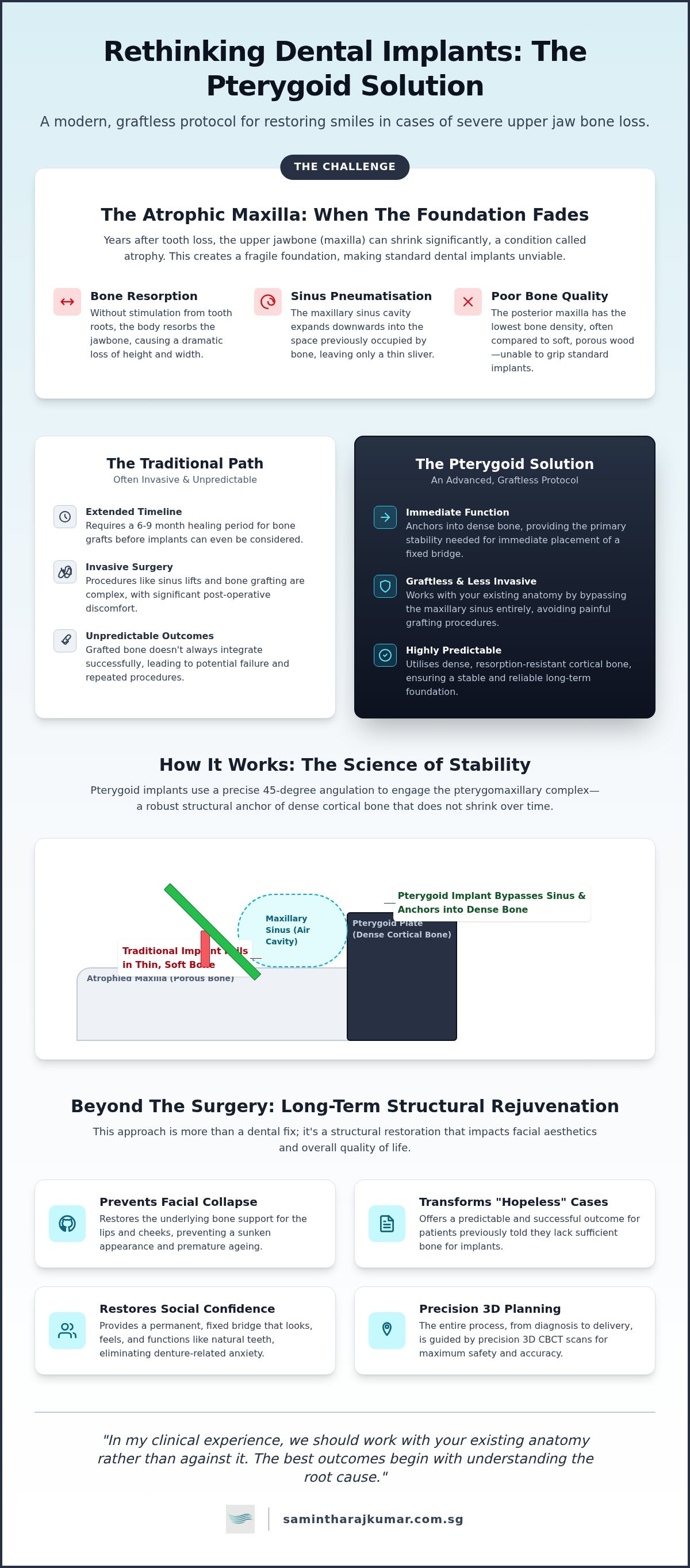
The atrophic maxilla refers to the severe shrinkage of the upper jawbone, a condition I frequently encounter in patients who have lived with tooth loss for several years. From a biological perspective, bone is a dynamic tissue that requires constant stimulation from tooth roots to maintain its volume. When teeth are lost, this stimulation ceases and the body begins to resorb the bone tissue, often making pterygoid implants a necessary consideration for total rehabilitation. This resorption leads to a significant loss in both bone height and width, creating a fragile foundation for restoration.
To complicate matters, the maxillary sinus often undergoes a process called pneumatisation. As the bone resorbs from the ridge, the sinus cavity expands downwards. This creates a pincer effect where the available bone for traditional dental implants is sandwiched into a thin, insufficient sliver. Without enough vertical height, standard implants cannot achieve the primary stability required for success.
To better understand the anatomical challenges of the upper jaw, watch this helpful video demonstration:
The Anatomy of Bone Loss
The posterior maxilla inherently possesses the lowest bone density in the oral cavity. It's often compared to soft, porous wood rather than the dense, resilient bone found in the lower jaw. When you combine this low density with an encroaching sinus, standard vertical implants simply have nothing to grip. I've seen the profound psychological toll this takes on patients. Being told your case is hopeless or that you've "run out of bone" creates a sense of functional despair that affects every aspect of daily life, from nutrition to social confidence.
Why Traditional Solutions Often Fall Short
Traditionally, the answer to this problem has been sinus lift surgery or extensive bone grafting. While these procedures are established, they're inherently invasive and involve a high degree of biological waiting. Patients often face a six to nine-month healing period before we can even consider placing an implant. Results can be unpredictable, as the body doesn't always integrate the graft as expected. As a clinician and founder, I believe we must seek more efficient, predictable protocols. Pterygoid implants offer a way forward by anchoring into stable, cortical bone that does not resorb, avoiding the delays and unpredictability of traditional grafts. The best outcomes begin with understanding the root cause of bone depletion.
The Science of Pterygoid Stability: Harnessing Cortical Bone
In my clinical experience, the key to successful rehabilitation in the posterior maxilla isn't just about the volume of bone available; it's about the quality of the bone we engage. While the alveolar bone, where teeth once resided, is often soft and porous, the pterygoid region offers a different biological profile. It's composed of dense, cortical bone. This type of bone is structurally programmed to resist resorption, even decades after tooth loss. By placing pterygoid implants into this "hard" bone pillar, we achieve a level of primary stability that standard implants simply cannot match in atrophic cases.
Understanding the Pterygomaxillary Complex
The pterygomaxillary complex is a robust anatomical junction where the maxilla, the palatine bone, and the sphenoid bone meet. This area acts as a structural anchor for the entire midface. Because these bones are part of the skull's core architecture, they don't disappear when teeth are lost. An in-depth anatomical study on pterygoid implants confirms that this region provides a predictable foundation for support, even in cases of extreme facial bone loss. We use a precise 45-degree angulation to engage this stable bone pillar. This specific angle allows the implant to bypass the sinus entirely and lock into the dense cortical layers, providing the necessary grip for immediate function.
Graftless Rehabilitation: A Biological Advantage
From a biological perspective, the best surgery is the one that respects the body's existing systems. Traditional bone grafting creates extra trauma and requires multiple healing phases. By choosing a graftless approach, we significantly reduce surgical time and postoperative discomfort. This efficiency is crucial for achieving "teeth in a day," where a fixed provisional bridge is placed almost immediately. This philosophy aligns with my biological dentistry perspective, focusing on minimally invasive techniques that promote long-term systemic health. It's about working with the patient's anatomy to restore function as quickly as possible.
Supporting a full-arch prosthesis requires a balanced distribution of force. The pterygoid region provides the necessary posterior support to prevent the "cantilever effect," where a bridge puts too much pressure on the front implants. This structural integrity is what allows for a truly permanent transformation. The best outcomes begin with understanding the root cause of stability and choosing a path that prioritises long-term well-being.
My Perspective: Why I Favour the Pterygoid Approach
In my clinical experience, the most profound transformations occur when we move beyond the limitations of standard dentistry to address cases previously deemed "hopeless." As a clinician and founder, I have encountered many patients who were told they had no bone left for restoration. These individuals aren't just looking for teeth; they are seeking a return to normalcy. I favour pterygoid implants because they allow me to honour that need for immediate results without the biological toll of invasive bone grafting.
My philosophy of "Total Rehabilitation" is rooted in restoring the whole person. When we bypass the traditional, months-long waiting periods associated with sinus lifts, we give the patient back their confidence and function almost instantly. This immediate impact on quality of life is why I have prioritised graftless solutions throughout my career. It's a commitment to efficiency and excellence that defines the standard of care at Nuffield Dental.
Refining the Surgical Craft
Placement in the pterygoid region is often described in literature as a "blind technique." I view this not as a risk, but as a sophisticated discipline mastered through thousands of procedures. It requires a deep, intuitive tactile sensitivity and an absolute anatomical mastery. While the procedure is technically demanding, I integrate AI-assisted diagnostics to map the pterygomaxillary complex with surgical precision before we even begin. This technological edge, combined with intravenous sedation, ensures that the patient experience remains calm and premium from start to finish.
The Ethics of Innovation
Specialisation carries an inherent ethical weight. As a specialist, I believe it's my responsibility to offer advanced solutions like pterygoid implants to those who have been rejected by generalist practices. This is part of a broader "nation-building" effort to elevate the standards of healthcare delivery across the region. We aren't just building clinics; we're building a legacy of clinical mastery. For many, choosing the right specialist is the most critical decision in their journey toward health. Ultimately, the best outcomes begin with understanding the root cause of the patient's struggle and applying the most sophisticated science available to solve it.
What to Expect: The Clinical Journey of Pterygoid Placement
The path to total rehabilitation is not a series of isolated events but a carefully orchestrated clinical journey. I've found that clarity at the outset is the most effective way to lower the emotional barriers often associated with complex surgery. Our process begins with a comprehensive consultation where we utilise high-resolution 3D CBCT scanning to map your unique anatomy. This digital foundation allows me to visualise the bone quality and volume with absolute clarity before any surgical intervention takes place.
Preparation and Planning
In my clinical experience, successful outcomes are designed long before the day of surgery. We use Digital Smile Design to envision the final aesthetic and functional result, ensuring the new teeth complement your facial structure. A critical part of this phase is evaluating your sinus health and identifying nerve pathways with precision. This meticulous planning ensures that the placement of pterygoid implants is executed with a level of accuracy that respects your biological boundaries. We focus on preparing you both physically and mentally for what is ultimately a transformative shift in your quality of life.
The Procedure and Immediate Loading
On the day of the procedure, efficiency and patient comfort are my primary concerns. Most patients choose intravenous sedation, which allows the surgery to proceed in a calm, controlled environment. The procedure follows a disciplined sequence. I first secure the anterior implants and then precisely anchor the pterygoid implants into the dense cortical bone of the pterygomaxillary complex. Because these posterior anchors provide immediate primary stability, we can often connect a fixed provisional prosthesis on the same day. This "Teeth in a Day" protocol ensures you leave the clinic with a functional smile, bypassing the months of waiting required by traditional grafting methods.
Post-operative care is managed with advanced protocols to minimise swelling and ensure a smooth recovery. While you enjoy the function of your provisional teeth, the biological process of osseointegration continues over the following months. Once the implants have fully integrated with the bone, we transition you to a final, custom-engineered bridge. This permanent restoration is the culmination of our "Total Rehabilitation" philosophy, restoring not just your bite, but your self-esteem. The best outcomes begin with understanding your unique clinical needs through a specialist lens.
Beyond the Surgery: Structural Rejuvenation and Long-Term Impact
The successful integration of a dental restoration is only the beginning of a much larger transformation. In my clinical experience, the true value of pterygoid implants lies in their ability to halt the progressive cycle of bone loss and facial collapse. When we replace missing posterior teeth, we aren't just restoring a bite. We are rebuilding the skeletal foundation that supports the soft tissues of the face. This is a legacy investment in your systemic health and personal confidence.
Structural Rejuvenation
One of the most significant consequences of an atrophic maxilla is the loss of vertical dimension. Without posterior support, the distance between the nose and chin decreases, leading to a sunken appearance and premature ageing. By utilising pterygoid implants, we provide a robust foundation that supports the facial structure, specifically the upper lip and cheeks. This restoration of volume often results in a more youthful profile without the need for dermal fillers or surgical lifts.
From a biological perspective, a correct bite is essential for the health of the temporomandibular joint (TMJ). When the posterior teeth are missing, the jaw joint often overcompensates, leading to chronic pain or dysfunction. Restoring this posterior support balances the forces of mastication. It protects the joint and ensures that your new smile is as comfortable as it is beautiful. I've seen patients rediscover the joy of nutrition and speech, free from the frustration of unstable dentures.
The Future of Your Care
The long-term success of these procedures is well-documented. Modern research, including a 2026 systematic review, shows a 6-year cumulative survival rate of 95.5% for modern rough-surface pterygoid implants. This high predictability is why I advocate for this approach in complex cases. We use advanced, biocompatible materials in the final prosthesis to ensure it integrates seamlessly with your oral environment. These materials are designed to resist plaque accumulation and maintain their aesthetic excellence for years to come.
As a clinician and founder, I believe that the journey doesn't end with the final fitting. Maintaining the health of your restoration requires a commitment to annual checkups and professional maintenance. This proactive approach allows us to monitor the health of the implants and the integrity of the prosthesis. My goal is to ensure that your "Total Rehabilitation" remains a source of strength and vitality throughout the second half of your life. The best outcomes begin with understanding the root cause of your dental challenges and choosing a path of clinical mastery.
Restoring Function and Facial Volume through Clinical Mastery
The journey toward total rehabilitation is defined by moving past the limitations of traditional grafting and embracing the sophisticated science of the pterygomaxillary complex. In my clinical experience, pterygoid implants represent a definitive shift in how we manage severe bone loss, offering a predictable, graftless path to a permanent smile. By engaging dense cortical bone, we don't just secure teeth; we restore the structural integrity of your face and the quality of your daily life.
As a clinician and founder of Nuffield Dental, I've dedicated my career to mastering these advanced protocols for patients who were previously told their cases were hopeless. My global affiliations and commitment to international surgical standards ensure that you are in capable, experienced hands throughout this transformative process. The best outcomes begin with understanding the root cause. Explore your options for total rehabilitation with me.
I believe that every patient deserves a solution that prioritises long-term well-being and immediate renewal. Your path to a restored smile is a legacy investment in your health, and I look forward to helping you reclaim the confidence you deserve.
Frequently Asked Questions
Are pterygoid implants safe given their location near the back of the jaw?
Yes, pterygoid implants are safe when executed using precise international surgical protocols. A 2026 study confirmed that even when these implants interact with the medial pterygoid muscle, patients remain free of pain or muscular disorders. My practice uses 3D CBCT scanning and AI-assisted diagnostics to map these posterior regions with extreme accuracy. This meticulous planning avoids critical structures and ensures the anchor remains stable within the dense cortical bone.
How do pterygoid implants differ from zygomatic implants?
The primary difference lies in the anatomical site of anchorage. Zygomatic implants are longer and anchor into the malar bone, which is the cheekbone. In contrast, pterygoid implants are placed at a 45-degree angle into the pterygoid plate of the sphenoid bone. Both are graftless solutions. I often use them together in a "Total Rehabilitation" framework to provide the most stable posterior support for a full-arch bridge.
Can I really get teeth in a single day with this procedure?
Yes, achieving "Teeth in a Day" is a hallmark of this advanced protocol. Because the pterygoid plate provides high primary stability immediately upon placement, we can often connect a fixed provisional bridge within 24 hours. This allows you to regain function and aesthetics almost instantly. You'll transition to your final, custom-engineered prosthesis once the biological process of osseointegration is complete, which typically takes a few months.
What is the success rate of pterygoid implants compared to traditional ones?
Success rates for these specialised fixtures are remarkably high. A 2026 systematic review reported a 6-year cumulative survival rate of 95.5% for modern rough-surface implants. Another prospective study documented a 3-year survival rate of 99.9% for the implants themselves. These figures are comparable to, and in many atrophic cases superior to, traditional implants that rely on unpredictable bone grafts or invasive sinus lift procedures.
Will I need general anaesthesia for pterygoid implant surgery?
General anaesthesia is rarely required for this procedure. In my clinical experience, intravenous (IV) sedation provides a calm, premium experience where you remain relaxed and unaware of the surgery. This "twilight sleep" is highly effective for managing anxiety and ensuring patient comfort. We monitor your vitals throughout the process, allowing for a swifter recovery compared to the heavy grogginess often associated with general anaesthesia.
How long is the recovery period after the surgery?
Most patients experience an initial recovery period of seven to ten days. While some swelling and minor discomfort are expected, these are managed with our advanced post-surgical protocols. You can typically return to light activities within a few days. I advise a soft food diet for several weeks to protect the implants during the early stages of healing. The best outcomes begin with following these specific recovery guidelines.
Am I a candidate if I have been told I have 'no bone' left?
You are likely an ideal candidate for this approach if you've been told you have insufficient bone for traditional implants. These implants are specifically designed for the atrophic maxilla. By bypassing the resorbed areas of the jaw and anchoring into the stable pterygoid plate, we can provide a fixed solution where others see a "hopeless" case. A comprehensive 3D scan is the first step in confirming your suitability.
How do I clean and maintain my new pterygoid-supported teeth?
Maintaining your new restoration is straightforward but essential for long-term success. You should clean around the implants and under the bridge using a water flosser and specialised interdental brushes. While the implants cannot decay, the health of the surrounding gum tissue is vital. Annual checkups at Nuffield Dental are mandatory. These visits allow me to monitor the integrity of the restoration and ensure your systemic health remains optimal.


Comments