
Recovery from Full Mouth Reconstruction Surgery: A Specialist Surgeon’s Perspective

What if the most transformative part of your smile journey isn't the time spent in the surgical chair, but the quiet biological renewal that begins the moment you leave it? It's natural to feel a sense of trepidation when considering the recovery from full mouth reconstruction surgery, especially when faced with the immediate "teeth-in-a-day" transition. In my clinical experience, most patients arrive with a mix of excitement and anxiety, often worrying about managing post-operative discomfort or navigating dietary restrictions during those first critical weeks.
I believe that clarity is the best antidote to fear. As a clinician and founder, I've designed this guide to offer you a transparent, specialist-led perspective on what to expect as your body heals. We'll explore the predictable stages of the healing timeline, from the initial cellular integration of your implants to the lifestyle habits that ensure your new smile remains a lifelong asset. By the end of this article, you'll have the practical knowledge to manage your recovery at home with absolute confidence and peace of mind.
Understand that recovery from full mouth reconstruction surgery is an active biological phase where initial inflammation serves as a necessary catalyst for tissue repair and bone integration. In my clinical experience, viewing this period as a proactive journey rather than a passive waiting time is essential for achieving optimal results.
Navigate a structured healing timeline that manages the transition from your "teeth-in-a-day" temporaries to your final, high-tier restorations. This guide details the immediate, intermediate, and long-term phases of your rehabilitation to ensure predictable success and functional excellence.
Learn to distinguish between expected post-operative sensations and signs that require specialist intervention. We also address the natural, temporary psychological dip in energy that can occur as your body focuses its internal resources on the healing process.
Recognise why a strict "no-chew" diet is clinically non-negotiable for maintaining the primary stability of your implants. We highlight specific nutritional strategies designed to support collagen synthesis and bone mineralisation during this critical window of renewal.
Explore a specialist-led philosophy that views total oral rehabilitation as more than just a clinical procedure. From my perspective as a clinician and founder, the ultimate goal of our protocols is to restore your confidence and enhance your long-term quality of life.
Table of Contents
The Biological Foundation of Healing After Full Mouth Reconstruction
Full mouth reconstruction isn't merely a series of dental procedures; it's a synchronised restoration of bone, gum, and dental function. Successfully navigating the recovery from full mouth reconstruction surgery requires an understanding that your body is undergoing a profound physiological shift. From a biological perspective, we aren't just replacing missing teeth; we're re-establishing a complex biomechanical system. This process relies heavily on the principles of Prosthodontics, ensuring that every restoration supports the underlying tissue and skeletal structure.
Many patients find the initial inflammatory response concerning, yet this swelling is actually a necessary catalyst for tissue repair. It's the body's way of delivering essential nutrients and growth factors to the surgical sites. In my clinical experience, when we embrace this biological reality, we can better manage the healing process rather than simply reacting to symptoms. This phase is the engine of your recovery, setting the stage for everything that follows.
To better understand this concept, watch this helpful video:
The first 72 hours are the most critical for long-term success. During this window, the formation and stabilisation of blood clots at the surgical sites act as a scaffold for new tissue. If these clots are disturbed, the healing process can stall, potentially leading to complications. This is why I emphasise strict adherence to our post-operative protocols during these three days; it's about protecting the foundation of your future smile and ensuring primary stability.
The Science of Tissue Regeneration
Soft tissue begins to bridge surgical incisions within the first week, a delicate process where cells migrate to seal the wound. Maintaining a sterile environment is vital here, as any bacterial interference can disrupt this cellular journey. We look for specific biological markers of healthy healing, such as the transition from bright red to pale pink tissue, which signals that the initial inflammatory phase is giving way to active regeneration. If healing stalls, it's often due to micro-movements or poor oral hygiene, which we monitor closely during your follow-up visits.
Why a Specialist Perspective Matters
As a clinician and founder, I've seen how understanding the "why" behind recovery protocols reduces patient anxiety. There's a significant difference between standard healing and an "optimised" biological recovery. We use advanced diagnostics, including AI-assisted imaging, to monitor your progress at a granular level. This allows us to tailor our recovery from full mouth reconstruction surgery plans to your unique biological signature, ensuring that every phase of your journey is backed by data and clinical mastery rather than guesswork.
The Recovery Timeline: What to Expect in the Days and Months Ahead
Predictability is the cornerstone of patient trust. When navigating the recovery from full mouth reconstruction surgery, it's vital to view the timeline as a series of biological milestones rather than a single surgical event. While modern protocols often allow for "Teeth in a Day," this immediate aesthetic result marks the beginning of a complex physiological journey. In my clinical experience, the most successful patients are those who understand that while the visible transformation is often instant, the underlying structural integration takes time.
We manage this through a concept called "functional loading." This means your temporary prosthetics are engineered to allow for speech and light aesthetics without overstressing the surgical sites. According to the American College of Prosthodontists, this phase is crucial for restoring function while protecting the integrity of the reconstruction. Speech usually returns to normal within days as the tongue adapts to the new contours, but chewing capacity increases more gradually as we prioritised bone stability.
The First 14 Days: Acute Healing
The initial fortnight focuses on managing the body's immediate response and protecting the delicate surgical work.
Days 1-3: You'll experience peak swelling. Thermal control is essential; using cold compresses helps regulate the inflammatory response and promotes comfort.
Days 4-10: You'll transition from a liquid diet to very soft foods. We'll adjust your hygiene routine to keep the area sterile without disturbing the healing incisions.
Days 10-14: We typically perform suture removal and conduct our first assessment of the gum tissue's adaptation to the new prosthetic framework.
The Osseointegration Phase: Months 3 to 6
This is the "silent" phase of recovery from full mouth reconstruction surgery. During these months, osseointegration occurs. This is the sophisticated process where your jawbone physically fuses to the surface of the ceramic dental implants. It's a period of intense cellular activity beneath the surface. We monitor bone density and implant stability through regular specialist reviews, often using AI-assisted diagnostics to ensure the foundation is strong enough for your final, permanent restorations. This transition from temporary to final teeth is the ultimate milestone of your rehabilitation.
The right diagnosis changes everything. If you are ready to explore how these protocols can restore your quality of life, understanding the science behind the journey is the first step.
Navigating the Nuances: Managing Discomfort and Biological Responses
Discomfort is often the primary concern for patients facing total oral rehabilitation. However, I always advise patients to distinguish between the natural biological response and signs that require clinical intervention. In my clinical experience, adopting an interdisciplinary approach to full mouth rehabilitation allows us to preemptively manage these responses. This isn't just about prescribing medication. It's about understanding how the body's systems interact during the recovery from full mouth reconstruction surgery to ensure a seamless transition to your new smile.
Beyond physical sensations, I often speak to patients about the "post-surgical dip." This is a temporary drop in mood or energy that can occur around day three or four. Your body is diverting significant metabolic resources toward healing. It's a sign of a healthy biological engine at work, not a reason for alarm. Recognising this early helps lower emotional barriers and allows you to focus on rest.
Complex cases involving Zygomatic implants or extensive bone grafting require even more meticulous management. These procedures involve deeper anatomical structures, which might lead to slightly more pronounced bruising or a different sensation of pressure. From a biological perspective, we use specific protocols to ensure these advanced components integrate with your existing skeletal architecture while prioritising your comfort.
Managing Swelling and Bruising
Swelling usually reaches its peak 48 hours after the procedure. This "peak rule" represents intense biological activity as the body floods the area with repair cells. To minimise haematoma and bruising, we employ precise surgical techniques and recommend strict thermal control. While some bruising is normal, you should contact the clinic if you notice "red flags" such as a sudden increase in pain after day four, a persistent fever, or an unpleasant taste that doesn't resolve with gentle rinsing. These are rare, but early detection ensures we maintain the integrity of your treatment.
Addressing the Fear of Implant Rejection
Many patients fear their body will "reject" the new components. I want to reassure you that true rejection is exceptionally rare. Usually, what people call rejection is actually "non-integration." This is often due to manageable factors like smoking or uncontrolled systemic conditions like diabetes. As a clinician and founder, I prioritise using AI-assisted diagnostics and precision planning to mitigate these risks long before we begin. We look at your bone density and vascular health to ensure the recovery from full mouth reconstruction surgery is predictable. The best outcomes begin with understanding the root cause of any potential healing delay.
Optimising Your Outcome: Nutrition and Care Protocols for Total Rehabilitation
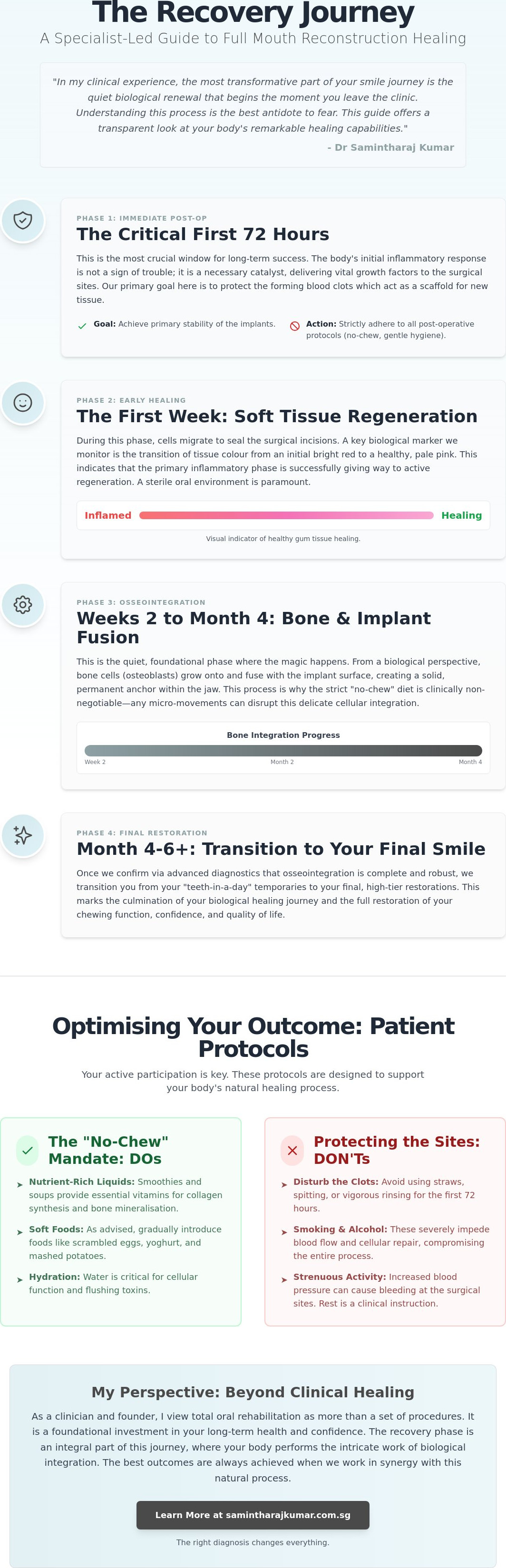
Recovery is not a passive waiting period. It is an active, biologically demanding phase where your choices at home directly influence the success of the surgical work. During the recovery from full mouth reconstruction surgery, your body requires a specific environment to facilitate cellular repair and bone integration. In my clinical experience, patients who strictly adhere to structured nutrition and care protocols experience significantly smoother transitions and more predictable long-term results.
From a biological perspective, the "No-Chew" diet is a non-negotiable clinical requirement for primary stability. Even though your "Teeth in a Day" may look and feel robust, the interface between the implant and your bone is initially fragile. Mechanical rest prevents micro-movements that could disrupt the delicate process of osseointegration. By avoiding any chewing forces for the first few months, you allow the bone to knit securely around the implants without interference.
The Specialist’s Nutritional Programme
To support this internal renewal, your diet must be nutrient-dense. I advise prioritising high-quality proteins and Vitamin C, which are essential for soft tissue repair and collagen synthesis. These building blocks ensure that your gums heal tightly around the new restorations. Additionally, I often recommend supplementing with Vitamin D3 and K2. These specific nutrients act as the "conductors" for bone mineralisation, ensuring that calcium is directed exactly where it is needed: the jawbone. You should avoid "sharp" textures like crusty bread or crisps, as well as extreme temperatures, which can irritate sensitive surgical sites and trigger unnecessary inflammation.
Long-term Maintenance of Your New Smile
As you move beyond the acute phase, the focus shifts from healing to preservation. This involves transitioning from post-operative care to a lifetime of cosmetic dentistry maintenance. Even though implants cannot decay, the surrounding gum and bone remain susceptible to biological stress. Regular professional scaling and polishing is vital to remove biofilm that a standard toothbrush cannot reach. For patients with a history of bruxism, I often prescribe customised night guards to protect the porcelain restorations from nocturnal grinding forces.
To ensure your journey remains on track, consulting with a specialist is the most effective way to tailor these protocols to your specific physiological needs. The best outcomes begin with understanding the root cause of every healing requirement.
My Perspective: Beyond Clinical Healing to Quality of Life
In my clinical experience, the most profound moments don't happen in the operating theatre. They happen months later, when a patient returns for their final review and I see a person who has truly reclaimed their life. As a clinician and founder, my goal has always been to build an institution that treats the person, not just the teeth. We aren't merely performing a procedure; we're facilitating a total transformation. The power of full mouth rehabilitation lies in its ability to restore not just function, but a sense of self that may have been lost for years.
The emotional cadence of the recovery from full mouth reconstruction surgery often follows a predictable path. It begins with the initial anxiety of the unknown, moves through a period of quiet discipline during the acute healing phase, and culminates in the final "reveal." I've watched many patients move from a place of hesitation to one of absolute confidence. This shift occurs because we prioritised the right diagnosis and surgical execution from the outset. When the foundation is laid with precision, the recovery experience becomes a journey of renewal rather than a struggle against complications.
The Future of Post-Operative Care
We are currently entering a new era of patient support. I am focused on integrating AI-assisted diagnostics and remote monitoring to ensure our patients feel supported every hour of their recovery. From a biological perspective, the shift towards biological dentistry is already yielding faster healing times and reduced inflammatory responses. By aligning our surgical protocols with the body's natural rhythms, we are building a legacy of excellence rooted in patient-centred innovation. This is the future of care I am committed to building in Southeast Asia and beyond.
A Final Word on Total Rehabilitation
I often remind my patients that the recovery from full mouth reconstruction surgery is a temporary investment for a permanent improvement in quality of life. It requires patience and a mutual understanding of the biological journey we're undertaking together. My commitment to your long-term success extends far beyond the operating theatre. We are partners in this restoration, and our team is here to guide you through every milestone until your functional excellence is fully realised.
The best outcomes begin with understanding the root cause. If you are ready to take the first step toward a comprehensive restoration, remember that the right diagnosis changes everything.
Embracing Your Path to Functional Excellence
The journey toward a restored smile is as much about the biological renewal that happens at home as it is about the precision of the surgery itself. In my clinical experience, successful recovery from full mouth reconstruction surgery relies on a deep respect for the body's healing timeline; from managing the initial inflammatory response to ensuring the primary stability of your implants through strategic nutrition. As the founder of Nuffield Dental and a specialist in Zygomatic and All-on-4 protocols, I've dedicated my career to refining these pathways across our clinical presence in Singapore and London.
We've explored how advanced diagnostics and a patient-centred philosophy transform a complex medical procedure into a predictable, life-changing event. My commitment to your well-being doesn't end when you leave the clinic; it continues through every phase of your rehabilitation. The right diagnosis changes everything. Discover our approach to total rehabilitation. Your new smile is a testament to both modern science and your personal commitment to a higher quality of life. I look forward to seeing the transformative impact of your renewed confidence as you embrace this next chapter.
Frequently Asked Questions
How much pain should I expect after full mouth reconstruction surgery?
Most patients experience a sense of pressure or a dull ache rather than sharp, acute pain. In my clinical experience, the combination of advanced local anaesthesia and our specific post-operative protocols ensures that discomfort remains manageable. By the third day, many find that standard over-the-counter relief is sufficient as the initial surgical sensitivity begins to subside.
Can I go back to work the next day after full mouth implants?
I typically recommend taking at least two to three days of rest to allow the initial inflammatory response to stabilise. While our "Teeth in a Day" protocol provides an immediate aesthetic result, your body requires quiet recovery time to manage peak swelling. Returning to a high-stress environment too early can raise your blood pressure and potentially disrupt the early stages of recovery from full mouth reconstruction surgery.
What happens if I accidentally eat something hard during the recovery phase?
If you accidentally bite something firm, don't panic, but please contact the clinic for a specialist review. A single incident rarely leads to total failure, but it can cause micro-movements that interfere with the delicate biological bond forming between the implant and your bone. We may use precision imaging to ensure the primary stability of your restorations hasn't been compromised.
How do I clean my mouth if I cannot brush the surgical sites?
You should use a prescribed antimicrobial mouthwash and gentle salt-water rinses during the first week of healing. Direct brushing of the surgical sites must be avoided to protect the blood clots and delicate incisions that are essential for tissue repair. Once the initial acute phase passes, I'll guide you on transitioning to an ultra-soft surgical toothbrush to maintain hygiene safely.
Will I be without teeth at any point during the recovery process?
No, you won't be without teeth at any stage of our total rehabilitation process. Our protocols are designed so that you leave the clinic with a functional set of temporary teeth on the same day as your surgery. These restorations allow you to smile and speak with confidence while your implants undergo the months-long process of osseointegration beneath the surface.
How does smoking affect the recovery from full mouth reconstruction?
Smoking significantly hinders recovery from full mouth reconstruction surgery by constricting blood vessels and reducing oxygen flow to the healing gums. This lack of oxygenated blood slows down tissue repair and increases the risk of the implants failing to integrate with the bone. I strongly advise patients to stop smoking for several weeks before and after the procedure to ensure the best possible outcome.
When can I resume my normal exercise routine after oral surgery?
You should avoid strenuous physical activity for at least seven to ten days to prevent complications. High-intensity exercise raises your heart rate, which can cause throbbing or bleeding at the surgical sites. I suggest starting with gentle walks after the first few days and only returning to your full routine once the initial soft tissue healing is well-established.
Is swelling after the third day a sign of a serious problem?
Swelling typically peaks around 48 to 72 hours, so it's normal to see it persist on the third day. It is a sign of your body's active biological response to the surgery. However, if you notice a sudden, new increase in swelling or pain after the fourth day, you should contact us for a review to rule out any secondary issues.


Comments