
Replacing a Single Missing Front Tooth: Your Options Compared

A natural-looking front tooth replacement depends on more than matching the shade of your smile. The best choice for replacing a single missing front tooth also takes account of the gums, jawbone and neighbouring teeth, along with how the replacement will function.
It’s understandable to focus first on the visible gap and wonder whether an implant, a bridge or a removable tooth will look most like your own. The right option depends on the condition of the teeth beside the gap, the supporting tissues and your priorities for treatment. An implant is supported in the jawbone, while a bridge relies on neighbouring teeth. A removable replacement may also be worth discussing in some circumstances.
This article compares these options and explains what a clinician assesses before making a recommendation. We’ll look at appearance, function, treatment stages and the health of the surrounding teeth, so you can prepare useful questions for a consultation. A personalised assessment brings these considerations together in a plan shaped around your smile and oral health.
Table of Contents
Replacing a Single Missing Front Tooth: What Patients Need to Weigh
A missing front tooth can change how a smile looks and feels. Some people feel self-conscious when speaking or smiling; others are more concerned about biting or understanding their options. Replacing a single missing front tooth starts with considering what matters to you and what the examination reveals.
An implant-supported crown, a tooth-supported bridge or a removable replacement may each be worth discussing, depending on your circumstances. Consider appearance alongside function, supporting tissues and the condition of neighbouring teeth. These findings, together with your preferences, should guide the conversation rather than appearance alone.
For a general introduction to implant components and osseointegration, read this overview of the dental implant. The following video also explores the question of restoring a missing front tooth:
What does replacing one front tooth involve?
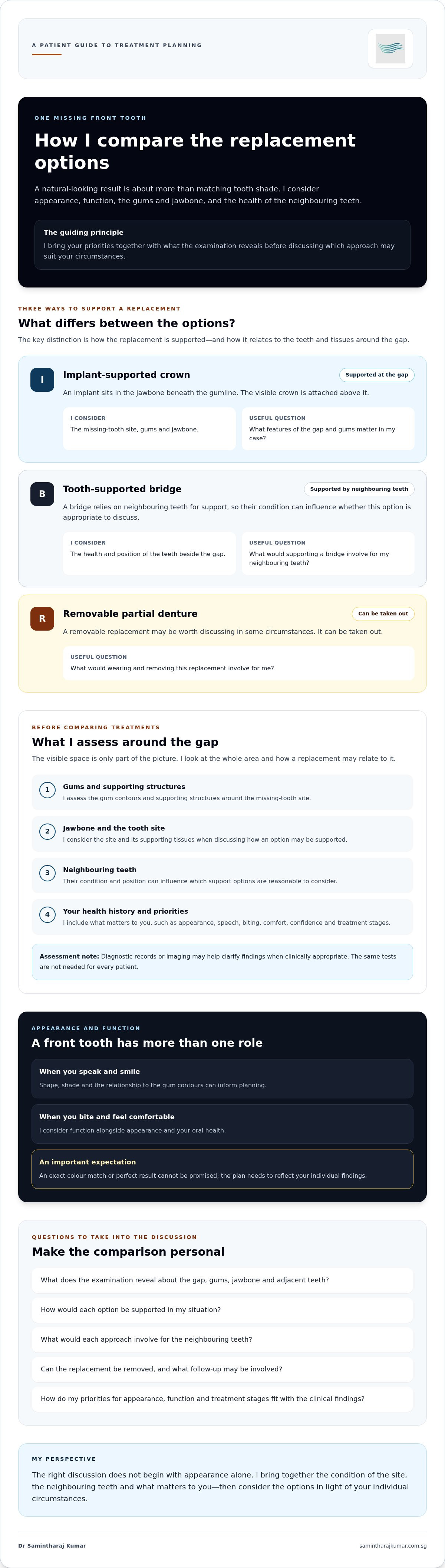
Planning involves the visible replacement, how it will be supported and how it relates to the gums, jawbone and adjacent teeth. With an implant-supported crown, the implant sits in the jawbone beneath the gumline, and the crown is the visible tooth attached above it. A bridge relies on neighbouring teeth for support, while a removable partial denture can be taken out. An examination is needed before recommending an approach.
Why the front-tooth position changes the conversation
A front tooth is visible when you speak and smile, so its shape, shade and relationship to the gum contours matter. These features can inform planning, but an exact colour match or perfect result cannot be promised. The neighbouring teeth also matter, since their health and position may influence which support options are appropriate to discuss.
Share whether speech, biting, comfort or confidence is a particular concern. These priorities help shape the discussion, but they need to be considered alongside the clinical findings. The aim is to explore a replacement that takes appearance, function and oral health into account, with a plan based on your circumstances.
Why Bone, Gums and Neighbouring Teeth Matter Before Choosing
A front-tooth gap may look straightforward, but the site beneath the gumline and the condition of nearby teeth can affect which replacement options are reasonable to consider. Replacing a single missing front tooth begins with understanding the whole area, not choosing a treatment based on appearance alone.
The condition of the tooth site and its neighbours helps determine how a replacement can be supported and what each option may involve for the surrounding tissues.
Your health history, priorities and preferences are also relevant. You may value a fixed replacement, wish to avoid altering adjacent teeth, or want to understand the treatment stages before deciding. These are important parts of an individualised discussion alongside the clinical findings.
What a clinician assesses at the missing tooth site
The assessment includes the gum contours and supporting structures around the gap, as well as how the area relates to your other teeth. Diagnostic records or imaging may help clarify the findings when clinically appropriate; the same tests are not needed for every patient. The aim is to understand the site well enough to discuss suitable options and any relevant limitations.
How the neighbouring teeth can influence the options
An implant-supported crown is supported by an implant at the missing-tooth site; a bridge relies on neighbouring teeth. The condition of those teeth may therefore influence bridge planning. Harvard Health Publishing offers a useful comparison of implants and bridges, though an examination is essential to apply general information to your circumstances.
Ask how each option relates to your teeth and tissues. For example, are the neighbouring teeth healthy, and what would supporting a bridge involve for them? If an implant is being considered, what features of the gap and gums are relevant? The answers should connect the examination findings with your goals rather than treat one option as automatically preferable.
A useful treatment discussion explains what the assessment shows, why further records may or may not help, and how each option’s support method relates to your priorities. To explore an individualised discussion, read about specialist-led dental implant care. A considered plan starts with the details of your own case.
Implant, Bridge or Removable Tooth: Comparing Front-Tooth Options
Compare these options by considering how each replacement is supported, what it involves for neighbouring teeth and whether it can be removed. An implant-supported crown is supported at the missing-tooth site, a bridge relies on neighbouring teeth, and a removable partial denture can be taken out. This comparison can guide a discussion, but it does not make one approach right for every patient.
The American Dental Association provides an overview of options for missing teeth. General guidance is a starting point for questions, not a substitute for applying the information to your examination findings.
When an implant-supported crown may be considered
An implant supports a separate crown that replaces the visible tooth. A dental implant, including a ceramic dental implant, may be discussed when clinically appropriate. An implant is not automatically the least invasive or most suitable choice; the site, supporting tissues, health history and your priorities all need to be assessed. Read more in my specialist perspective on dental implants.
How a bridge or removable replacement differs
For a bridge, the condition of the teeth that would support it needs to be assessed. A removable partial denture is another approach, but it may not suit everyone. Ask how each option relates to your teeth, tissues, function and daily preferences. My guide to functional aesthetics in cosmetic dentistry explores how appearance can be considered alongside function.
For replacing a single missing front tooth, treatment sequence and expected outcomes depend on the examination and individual circumstances. A clear discussion of the relevant trade-offs helps you compare options without treating any one of them as universally preferable.
How to Choose: Questions to Ask Before Replacing a Front Tooth
A consultation can help you move from understanding the gap to comparing options that may fit your circumstances. For replacing a single missing front tooth, ask why an approach is being recommended, what alternatives may be reasonable and what the treatment could involve.
The right option depends on clinical findings and your goals. These questions can help make the discussion clear and practical.
Questions that clarify suitability and trade-offs
What did the examination show? Ask which findings at the missing-tooth site, gums, supporting structures or neighbouring teeth inform the recommendation.
What options are clinically reasonable for me? Ask whether an implant-supported crown, bridge or removable partial denture could be considered, and why some alternatives may not suit your circumstances.
How would each option affect my adjacent teeth and surrounding tissues? Ask how each approach is supported and what that may mean for the teeth beside the gap.
What uncertainties should I understand? Discuss relevant limitations, maintenance needs and how the replacement would be monitored over time.
What stages and follow-up should I expect? Ask for an outline of the proposed sequence, what may affect it and when progress would be reviewed.
What to expect from consultation and planning
The discussion should start with your medical and dental history, your concerns and what you hope treatment will address. The clinician will examine the area and consider whether diagnostic records or imaging are relevant to your case. A recommendation should connect those findings with your priorities, whether they centre on appearance, function, neighbouring teeth or practical treatment preferences.
Don’t assume timelines or treatment stages based on general examples. If an implant is being considered, ask about the possible sequence for your case and what may influence healing. For a bridge or removable replacement, ask about the planned steps and follow-up. Make sure you understand what is known, what remains uncertain and how that affects the plan.
Ask for clarification if anything feels unclear. An informed decision comes from a considered conversation, not pressure to choose quickly. Review the trade-offs and whether an option aligns with the clinical assessment and your expectations.
To learn more about individual treatment planning, explore Dr Samintharaj Kumar’s dental implant care.
A Specialist-Led Plan for Replacing One Missing Front Tooth
Replacing a front tooth is a personal decision as well as a clinical one. The visible result matters, but so do the way the replacement is supported, how it functions and what it means for the surrounding teeth and tissues. The aim is to bring these considerations together and explain which options may be appropriate based on the examination.
How I approach treatment planning
Patients often arrive with a clear concern, such as the appearance of the gap, comfort when biting or the effect on their confidence. I listen to those priorities and consider them alongside the clinical findings, including the condition of the missing-tooth site and neighbouring teeth. Neither preference nor appearance should be considered in isolation from oral health.
If an implant-supported crown is being considered, I assess whether that approach is appropriate for the individual case. Ceramic dental implants are one option to discuss where clinically suitable. A bridge or removable replacement may also be considered, depending on the findings and the patient’s needs. The recommendation should follow the diagnosis, not a default preference for one treatment.
Before a decision, I discuss the potential benefits, limitations and uncertainties of the options relevant to you. I also explain whether further assessment or diagnostic records may help with planning. Clear communication gives you space to consider how each approach fits your priorities and ask questions before proceeding.
What long-term care and follow-up should address
Treatment planning includes thinking beyond the initial restoration. Follow-up and maintenance depend on the replacement selected, the condition of your teeth and tissues, and the clinical advice for your circumstances. At review, questions may include how the restoration is functioning and whether the surrounding area remains healthy. I’ll explain what to monitor and when follow-up is appropriate for your plan, rather than apply a universal schedule.
My philosophy is to make decisions with the whole picture in view: appearance, function, supporting structures and your longer-term oral health. No examination can justify a guaranteed result, but careful diagnosis and a shared understanding of the choices can support a considered plan.
If you would like to learn more about how I approach individual treatment planning, explore Dr Samintharaj Kumar’s clinical approach.
Take the Next Step Towards a Considered Treatment Plan
Replacing a single missing front tooth is not simply a choice between an implant, a bridge and a removable replacement. The condition of the gums, supporting structures and neighbouring teeth helps determine what may be suitable, while your priorities shape the discussion. A careful assessment brings appearance, function and oral health into one plan.
Patients are better prepared when they understand why an option is being considered, what its trade-offs may be and what follow-up could involve. I specialise in complex dental implantology and oral surgery. Ceramic dental implants are among the options available to discuss when appropriate, alongside other treatments that may fit the clinical findings.
You don’t need to arrive with a decision already made. A clear conversation can help you understand the choices and decide which questions matter most for your circumstances. To discuss your options, contact Dr Samintharaj Kumar through his website.
The right plan begins with understanding your individual needs, and that is a reassuring place to start.
Frequently Asked Questions
What is the best way to replace a single missing front tooth?
There isn’t one best option for everyone. Replacing a single missing front tooth may involve an implant-supported crown, a bridge or a removable partial denture, depending on the examination findings and your preferences. The condition of the gums, supporting structures and neighbouring teeth matters, alongside appearance and function. A consultation helps clarify which options are clinically reasonable for your circumstances and what their trade-offs may be.
Is a dental implant better than a bridge for one missing front tooth?
Not automatically. An implant-supported crown and a bridge rely on different forms of support, so the condition of the missing-tooth site and adjacent teeth matters. An implant may be discussed if the site and your overall circumstances make it appropriate; a bridge may be considered in light of the supporting teeth. Compare the relevant benefits, limitations and uncertainties based on your examination, rather than relying on a general rule.
Can a single missing front tooth be replaced with a ceramic dental implant?
Yes, a ceramic dental implant may be considered to support a crown replacing one missing front tooth, if it is appropriate for your individual case. Ceramic dental implants are among the options offered in my practice. Suitability depends on clinical assessment, including the missing-tooth site, surrounding tissues and your health history. I can discuss this option alongside other reasonable approaches and explain what further assessment may be needed.
How soon can a missing front tooth be replaced after an extraction?
The timing depends on the condition of the extraction site, surrounding tissues, your health and the proposed treatment. There isn’t a single schedule that applies to every patient, and immediate replacement shouldn’t be assumed. An assessment helps determine whether treatment can proceed or whether a different sequence is advisable. Ask what stages may apply in your case, what could affect timing and whether an interim option is appropriate.
Will a replacement front tooth look natural?
A replacement can be planned to suit the appearance of your smile, but an exact match or perfect result can’t be promised. Planning considers the tooth’s shape and shade in relation to adjacent teeth, as well as the gum contours and how the restoration sits in the smile. These details are particularly relevant for a front tooth. An examination helps establish what may be achievable and where limitations or uncertainties exist.
What should I ask at a consultation for one missing front tooth?
Ask what the examination shows about the gap, gums, supporting structures and neighbouring teeth, and why a particular option is being recommended. Ask whether alternatives are reasonable, how each approach may affect adjacent teeth, what treatment stages and follow-up may involve, and what uncertainties or maintenance needs to consider. Share your priorities, such as appearance, function or treatment preferences, so the discussion reflects your individual goals.


Comments