
Seeking a TMJ Specialist in Singapore: A Surgeon’s Perspective on Total Jaw Rehabilitation
- Dr Samintharaj Kumar

- Jul 13
- 12 min read
What if the chronic headaches and facial tension you've endured for years aren't actually a neurological issue, but a structural misalignment hidden within your jaw? Seeking a tmj specialist singapore often begins with a search for answers to persistent pain that other practitioners have overlooked. It's a deeply frustrating experience to live with a condition that silently dictates how you eat, speak, and even smile, leaving you caught between dental confusion and muscular discomfort.
In my clinical experience, true resolution requires looking beyond the surface to the biological root of the disorder. My promise is to help you discover the clinical pathways available to resolve chronic jaw pain through a specialist's lens. From a biological perspective, we must address the underlying skeletal and muscular harmony to achieve lasting results and total rehabilitation.
This article provides a surgeon's perspective on the diagnosis and advanced treatment of TMD. I'll outline how we use sophisticated diagnostics to identify structural causes and detail a sequential treatment plan designed to restore your facial symmetry and comfort. By the end, you'll have a roadmap for returning to a life defined by functional excellence rather than persistent pain.
Table of Contents
Understanding Temporomandibular Joint Disorders (TMD) in 2026
The temporomandibular joint is arguably the most sophisticated hinge in the human body. It doesn't just open and close; it slides, rotates, and glides in a three-dimensional space to facilitate speech and nutrition. In my clinical experience, patients often view jaw pain as an isolated dental nuisance. However, Understanding Temporomandibular Joint Disorders (TMD) requires a much broader perspective. I frequently see TMD not as a standalone issue, but as a critical symptom of a deeper structural imbalance within the craniofacial complex.
National trends in Singapore suggest a rising prevalence of jaw dysfunction, likely exacerbated by modern sedentary postures and the psychological weight of professional stress. When searching for a tmj specialist singapore, it's vital to find a clinician who can differentiate between simple muscular fatigue and complex joint pathology. This distinction is the foundation of effective rehabilitation.
To better understand the mechanics of this condition, watch this helpful video:
Recognising the Symptoms of a Dysfunctional Jaw
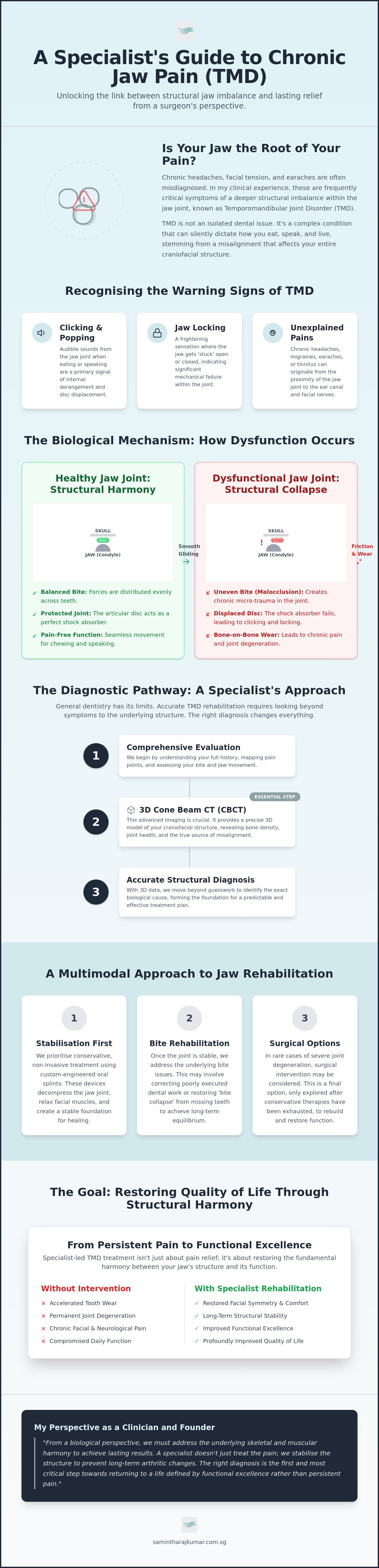
TMD is a collective term for functional disturbances of the masticatory system. Recognising the early warning signs is essential before the condition escalates. You might notice clicking or popping sounds when eating, or perhaps a frightening sensation of the jaw locking in place. These aren't just quirks of your anatomy; they're signals of internal derangement. Often, the symptoms aren't even felt in the teeth. Many of my patients suffer from chronic earaches or tinnitus, unaware that the proximity of the jaw joint to the ear canal is the true source of their discomfort. Ignoring a limited range of motion today can lead to significant functional deficits tomorrow.
Why Chronic Jaw Pain Requires Specialist Intervention
General dentistry is excellent for maintaining oral hygiene, but it has limitations when managing complex internal joint derangements. From a biological perspective, untreated TMD can lead to permanent joint degeneration and accelerated tooth wear as the body attempts to compensate for a misaligned bite. This is why the involvement of a board-certified oral surgeon is critical in the diagnostic chain. We look at the bone density, the health of the articular disc, and the neurological pathways involved. A specialist doesn't just treat the pain; we stabilise the structure to prevent long-term arthritic changes. The right diagnosis changes everything.
The Biological Mechanism: Why Jaw Dysfunction Occurs
From a biological perspective, the health of your jaw isn't merely about the absence of pain. It's about a delicate, kinetic equilibrium between bone, cartilage, and ligaments. When this balance is disrupted, the results are rarely confined to the mouth. As a clinician and founder, I've observed that many patients who seek a tmj specialist singapore have suffered from chronic micro-trauma within the joint capsule for years without realising it. This trauma is often the result of malocclusion, or an uneven bite, which forces the joint to compensate during every swallow and chew.
The articular disc acts as a shock absorber between the condyle and the skull. In a healthy system, this disc glides seamlessly during movement. However, when structural stress becomes too great, the disc can become displaced. This displacement is what causes the characteristic clicking or locking I mentioned previously. If left unaddressed, this mechanical failure leads to structural collapse, where the joint begins to wear down the bone itself, resulting in chronic facial pain and a loss of functional stability.
The Relationship Between Bite Alignment and Jaw Stress
Missing teeth or poorly executed dental restorations are more than just aesthetic concerns. They often lead to a phenomenon known as 'bite collapse'. When the vertical height of your teeth is lost, the jaw joint is forced into an unnatural, retruded position, placing immense strain on the surrounding ligaments. I've written extensively on how dental structure affects face shape, as this loss of structural support doesn't just damage the joint; it alters the very silhouette of your face. Restoring this height is often the first step in alleviating joint pressure.
Systemic Factors and Jaw Health
We cannot view the jaw in isolation from the rest of the body. Systemic inflammatory conditions and sleep apnoea frequently manifest as bruxism, or nocturnal jaw clenching. This constant loading prevents the joint from recovering overnight, leading to a cycle of inflammation and pain. In my practice, I utilise AI-assisted diagnostics to detect subtle bone density changes in the condyle that traditional X-rays might miss. This technology allows us to see the early signs of degeneration before they become irreversible.
A truly effective recovery plan requires A Multimodal Approach to Jaw Rehabilitation, addressing both the mechanical and systemic drivers of dysfunction. If you're experiencing these symptoms, the best outcomes begin with understanding the root cause of your specific structural imbalance.
Diagnostic Precision: How I Evaluate TMJ Cases
As a clinician and founder, I've always maintained that the right diagnosis changes everything; it is the cornerstone of my clinical philosophy. When patients visit a tmj specialist singapore, they're often seeking clarity after years of vague explanations or failed symptomatic treatments. My approach prioritises objective data over guesswork. We must distinguish with absolute certainty between myofascial pain, which is primarily muscular, and internal derangement, which involves the physical components of the joint itself.
To achieve this, I utilise 3D Cone Beam Computed Tomography (CBCT) for every complex TMJ assessment. Traditional 2D X-rays simply cannot capture the intricate, three-dimensional relationship of the condyle within the glenoid fossa. By understanding The Biological Mechanism: Why Jaw Dysfunction Occurs, we can map out a precise path toward restoration rather than just temporary relief. This level of detail is non-negotiable for predictable outcomes.
Advanced Imaging and Clinical Assessment
Moving beyond static images, I also incorporate digital jaw tracking technology to evaluate the range of motion in real-time. This allows us to observe how the joint behaves during function, rather than just at rest. CBCT provides sub-millimetre accuracy in joint visualisation. In my clinical experience, the integration of AI-assisted diagnostics has been transformative. AI algorithms help us analyse joint space with incredible precision, identifying early-stage degenerative changes in bone density that the human eye might overlook. This proactive detection is vital for preventing long-term structural collapse.
The Multi-Specialist Diagnostic Review
TMD is rarely a simple dental problem. At Nuffield Dental, my team and I collaborate closely to rule out referred pain from the teeth, sinuses, or even cervical spine issues. Understanding what kind of doctor treats tmj is essential for patients, as a multi-specialist approach ensures that psychological and lifestyle factors, such as chronic stress or sleep disorders, are integrated into the final diagnostic summary. From a biological perspective, we must treat the patient as a whole system. The best outcomes begin with understanding the root cause, ensuring that our treatment plan is as unique as the patient's anatomy.
A Multimodal Approach to Jaw Rehabilitation
In my clinical experience, the most successful outcomes are achieved through a structured, multimodal approach. I don't believe in jumping straight to surgery, nor do I believe in endless palliative care that only masks symptoms. My treatment philosophy follows a logical, result-oriented progression designed to restore function and eliminate pain. When you consult a tmj specialist singapore, you should expect a clear roadmap that moves from stabilisation to definitive correction.
Phase 1 focuses on stabilisation. We often utilise custom-engineered occlusal splints and specialised physical therapy to offload the joint. From a biological perspective, this allows the surrounding tissues to heal and reduces the inflammatory load. Phase 2 introduces minimally invasive interventions, such as arthrocentesis, to 'wash out' inflammatory mediators within the joint capsule. Finally, Phase 3 involves definitive structural correction, which may include orthodontics or surgical reconstruction to ensure long-term stability and facial harmony.
Non-Surgical Interventions and Management
The science behind using botulinum toxin for TMD is quite compelling. It's particularly effective for relieving masticatory muscle hypertrophy, where overactive jaw muscles have become enlarged and painful. However, I always remind my patients that this is a tool for symptom management, not a cure for structural misalignment. It's also vital to understand why 'off-the-shelf' night guards often fail. These generic devices aren't calibrated to your specific bite, which can actually increase muscle activity and exacerbate joint strain. A custom-fit appliance, combined with targeted physiotherapy to restore joint mobility, is a far more sophisticated and effective solution.
Surgical Solutions for Complex Joint Pathology
While most cases respond to conservative care, surgery becomes necessary when there is severe disc displacement or advanced osteoarthritis. In these instances, the joint's internal architecture has deteriorated to a point where mechanical intervention is required. I utilise advanced techniques in arthroscopy to repair the joint with minimal trauma. These procedures allow us to reposition the articular disc and remove adhesions that limit movement. Patients should expect a dedicated rehabilitation phase following surgery, as the muscles and ligaments need time to adapt to the restored joint mechanics.
The right intervention at the right time is what defines clinical mastery. If you're ready to move beyond temporary relief, our team at Nuffield Dental is here to guide your recovery. Explore our comprehensive TMJ pain management options to begin your journey toward lasting comfort.
My Perspective: Restoring Quality of Life Through Structural Harmony
As a clinician and founder, I've always believed that my role extends far beyond the technicalities of a surgical procedure. The ultimate goal of any intervention is the restoration of the person, not just the joint. When you seek a tmj specialist singapore, you're not just looking for a way to stop a clicking sound or a dull ache. You're looking to reclaim your ability to eat with joy, speak with confidence, and live without the constant shadow of chronic tension.
There is a profound link between a stable jaw and long-term facial aesthetics. From a biological perspective, the jaw joint acts as the structural anchor for the lower third of the face. When this anchor is compromised, we see a loss of facial symmetry and a premature collapse of facial volume that topical treatments simply cannot fix. Resolving TMJ pain often acts as the necessary catalyst for total oral rehabilitation, providing the stable foundation required for any lasting functional or aesthetic improvement.
The Journey Toward Total Oral Rehabilitation
In my clinical experience, we cannot separate joint health from the rest of the dental system. For instance, when I am planning complex cases involving dental implants, I must first ensure the temporomandibular joint is stable. If we place high-quality restorations on a dysfunctional foundation, the resulting bite forces can lead to mechanical failure or continued pain. I view jaw stability as the non-negotiable prerequisite for any functional aesthetic makeover. By achieving structural harmony, we don't just fix a bite; we support the natural ageing process and preserve the youthful proportions of the face.
A Vision for Future Jaw Care
The future of jaw care lies in the intersection of AI-assisted diagnostics and biological dentistry. We're moving toward an era where we can predict joint degeneration years before it manifests as acute pain. My commitment at Nuffield Dental has always been to build an ecosystem of care that prioritises this level of precision alongside clinical excellence and patient comfort. We're not just treating symptoms; we're innovating new protocols to ensure that our patients benefit from global standards of surgical care right here in Singapore.
Embarking on a journey toward jaw rehabilitation requires patience and a commitment to understanding the root cause of your discomfort. It's a transformative process that rewards you with more than just a functional bite; it offers a profound renewal of your daily well-being. The right diagnosis changes everything, and it remains the essential first step toward a life defined by comfort rather than pain.
Advancing Toward a Future of Structural Harmony
Navigating the complexities of chronic jaw pain requires more than just symptomatic relief; it demands a commitment to understanding the biological root cause. In my clinical experience, the most profound transformations occur when we move beyond generic dental care toward a specialised, multimodal rehabilitation plan. We've seen how advanced 3D CBCT imaging and AI-assisted diagnostics allow us to map the joint with sub-millimetre precision, ensuring that every intervention is grounded in objective data. As a clinician and founder, I've made it my mission to integrate these global standards across the Nuffield Dental network.
Choosing a tmj specialist singapore is the first step in a journey that restores not only your ability to chew and speak with ease but also your long-term facial symmetry and confidence. Whether your path involves stabilisation through custom splints or minimally invasive surgical repair, the focus remains on your comfort and functional excellence. The best outcomes begin with a meticulous diagnostic foundation and a vision for total oral rehabilitation. The right diagnosis changes everything; consult with a specialist today. A life defined by comfort and structural harmony is well within your reach.
Frequently Asked Questions
What is the difference between a dentist and a TMJ specialist?
The primary difference lies in the depth of surgical training and the use of advanced diagnostic technology. While a general dentist focuses on oral hygiene and restorative care, a specialist possesses the surgical expertise to manage complex internal derangements of the joint. In my clinical experience, this involves using 3D CBCT imaging and AI diagnostics to evaluate the relationship between bone, disc, and muscle, ensuring the root cause is addressed rather than just the dental symptoms.
Can TMJ disorders be permanently cured without surgery?
Yes, the vast majority of patients achieve long term relief through non surgical, conservative pathways. From a biological perspective, our first goal is always to stabilise the joint using custom engineered occlusal splints and physical therapy. Surgery is typically reserved for severe structural failures, such as advanced osteoarthritis or significant disc displacement. Most cases respond exceptionally well to a multimodal approach that restores functional harmony without the need for invasive procedures.
How do I know if my headaches are caused by my jaw?
Jaw related headaches often manifest as persistent tension in the temples or a dull ache that is most severe upon waking. If your headaches are accompanied by clicking, popping, or a limited range of motion in the jaw, it's highly likely they're linked to TMD. This occurs because the muscles used for chewing are interconnected with those of the head and neck; when the jaw is misaligned, it creates a chain reaction of muscular strain.
Is TMJ treatment covered by insurance in Singapore?
Coverage depends entirely on your specific policy, but it's important to note that many non surgical treatments are classified differently than standard dental care. According to current guidelines in Singapore, treatments such as mouth splints and BTX injections for TMJ are generally not covered by MediSave or CHAS. However, if the condition requires surgical intervention in a hospital setting, some private medical insurance plans may offer partial coverage. I recommend checking with your provider for a detailed breakdown.
What happens during a first consultation with a TMJ specialist?
When you consult a tmj specialist singapore, the first priority is establishing an objective baseline through a comprehensive clinical examination. I utilise 3D CBCT imaging to visualise the joint architecture in sub millimetre detail and digital jaw tracking to monitor your movement in real time. We don't just look at your teeth; we evaluate your systemic health, posture, and muscle function to create a sequential, personalised treatment plan that prioritises long term stability.
How long does it take to see results from non-surgical TMJ therapy?
Most patients begin to notice a meaningful reduction in pain and tension within four to twelve weeks of starting a stabilisation programme. This timeline allows the inflammation within the joint capsule to subside and the masticatory muscles to adapt to a more neutral position. While immediate relief is often felt after the initial phase of therapy, achieving total rehabilitation and structural harmony is a gradual process that requires consistent commitment to the prescribed protocol.
Can stress alone cause severe TMJ dysfunction?
Stress is a powerful exacerbator of TMD, but it's rarely the sole biological cause. High stress levels often trigger bruxism, or nocturnal teeth grinding, which places immense pressure on the joint. However, in my clinical experience, there is usually an underlying structural predisposition, such as a misaligned bite or joint wear, that makes the system vulnerable. We must address both the psychological triggers and the mechanical imbalances to achieve a lasting resolution.
Are there any specific exercises I can do at home for jaw pain?
Gentle stretching and tongue posture exercises can be helpful, but they must be performed with precision to avoid further injury. I often recommend the "N-position," where you rest the tip of your tongue on the roof of your mouth just behind your upper teeth to encourage muscle relaxation. However, exercises should always be part of a supervised plan. Without a proper diagnosis, self treatment can sometimes inadvertently increase the strain on a displaced articular disc.


Comments