
Sleep Dentistry for Major Dental Procedures: A Specialist Surgeon’s Perspective on Comfort and Precision

Most people believe that dental anxiety is merely a psychological hurdle to overcome; however, in my clinical experience, it's a physiological barrier that can actively hinder the success of complex oral surgery. I understand that the prospect of sitting in a surgical chair for several hours, facing instruments and needles, can feel completely paralysing. You're certainly not alone in this feeling, as studies show that roughly one in three patients in Singapore experiences significant dental fear, which often causes them to delay essential care.
I want to show you how we use sleep dentistry for major dental procedures to bridge the gap between deep-seated anxiety and functional excellence. We'll explore how advanced sedation protocols transform complex oral rehabilitations into seamless, stress-free journeys where you can wake up with a new smile through our Teeth in a Day workflow. My goal is to explain how prioritising your comfort through hospital-grade safety standards doesn't just ease your mind. It actually enhances surgical precision and triggers a faster biological healing response by keeping your body in a state of rest throughout the entire process.
Table of Contents
The Challenge of Major Dental Rehabilitation: Why Comfort Matters
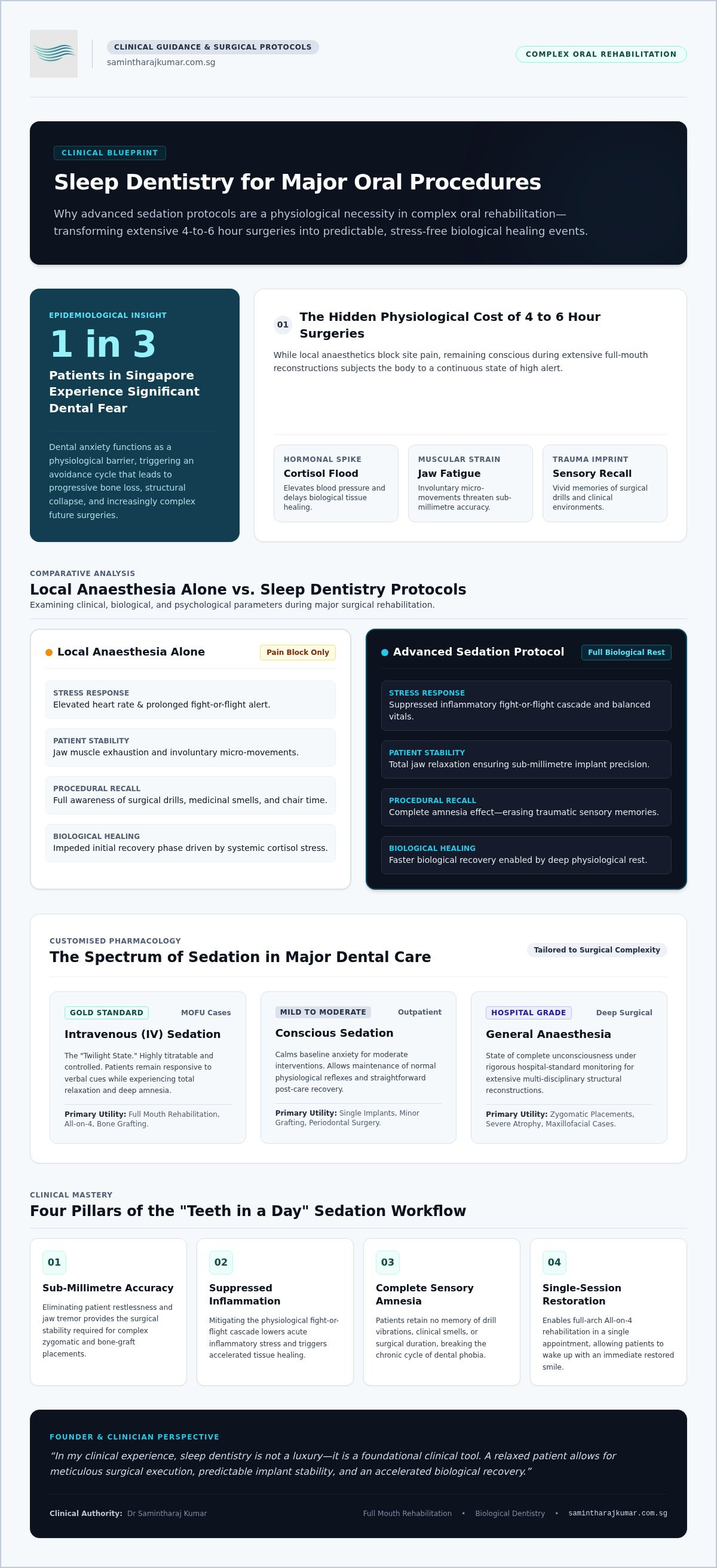
In my clinical experience, major procedures like full mouth rehabilitation require more than just local numbing. While local anaesthetics effectively block pain signals at the site, they don't address the systemic physiological toll of a 4 to 6 hour surgery. When a patient remains conscious for such an extended period, the body often enters a prolonged state of high alert. This stress response can lead to elevated blood pressure and heart rate, which can actually impede the initial stages of biological healing by flooding the system with cortisol.
What many patients do not realise is that involuntary movements and jaw fatigue are significant factors in surgical outcomes. Even the most stoic patient will struggle to keep their mouth open for hours on end. These micro-movements can compromise the meticulous precision required for complex cases. My philosophy has always been that a relaxed patient allows for a more meticulous surgical execution, which is why I view sleep dentistry for major dental procedures as a clinical necessity rather than a luxury.
To better understand how we manage this process, watch this helpful video:
The Reality of Complex Oral Surgery
Complex cases, such as those involving all on 4 dental implants, require immense physical endurance from both the surgeon and the patient. Local anaesthesia alone is often insufficient for advanced techniques like bone grafting or Zygomatic placements, where we're working deep within the facial structure. The spectrum of care ranges from Conscious Sedation to General Anaesthesia, and selecting the right level is vital for managing the body's inflammatory response. By keeping a patient in a state of controlled rest, we ensure the stability needed for sub-millimetre accuracy in implant placement.
Addressing the Psychological Barrier
I've seen how paralysing dental phobia prevents many from seeking a dental implant singapore solution. This leads to an "avoidance cycle" where missing teeth result in progressive bone loss and structural collapse, making future surgery even more complex. By removing the "experience" of the trauma through sleep dentistry for major dental procedures, we facilitate emotional renewal. Patients can undergo life-changing restoration without the lingering memory of the dental chair, breaking the cycle of fear and allowing them to reclaim their quality of life.
Decoding Sleep Dentistry: From Conscious Sedation to General Anaesthesia
Sleep dentistry is not a single, fixed treatment but rather a spectrum of pharmacological interventions designed to alter a patient's state of consciousness. In my clinical experience, the real differentiator lies in selecting the right level of sedation for the specific surgical complexity. We don't believe in a one size fits all approach; instead, we evaluate your physiological needs alongside the technical requirements of the surgery. IV sedation is the gold standard for MOFU surgical cases due to its titratability. What this means for you is a highly controlled, predictable environment where your safety is never compromised.
One of the most profound benefits of sleep dentistry for major dental procedures is the amnesia effect. You won't remember the clinical sounds of the drill, the medicinal smells of the clinic, or the physical sensations of the procedure itself. This effectively erases the potential for post-operative psychological trauma, turning a significant medical event into a neutral or even positive memory. By the time you feel fully alert, the complex work is already complete.
Intravenous (IV) Sedation: The Twilight State
IV sedation allows you to remain responsive to verbal commands while feeling deeply relaxed and detached from the environment. This "twilight state" is incredibly effective because it maintains your natural protective reflexes while providing profound comfort. I find that the benefit of prograde amnesia is vital here; it ensures you have no recollection of the surgery's duration. This is my preferred method for wisdom tooth extraction and single implant placements where we need patient cooperation but want to eliminate anxiety.
General Anaesthesia for Complex Rehabilitation
When we move into deep sleep, we are typically addressing the most complex rehabilitations. Deep sleep is necessary for procedures like Zygomatic implants and multi-stage bone grafting, where the surgical site is extensive and the duration is significant. In these cases, we follow the ADA Guidelines for Sedation to maintain a controlled, hospital-grade environment. A specialist anaesthetist remains at your side throughout, monitoring every vital sign with absolute precision.
While general anaesthesia requires a slightly longer recovery timeline compared to IV sedation, it remains the safest and most efficient choice for total mouth reconstructions. Patients usually require a few hours of supervised recovery before they are ready to return home. The best outcomes begin with understanding the root cause of your dental needs and matching them to the appropriate level of care. Sleep dentistry for major dental procedures ensures that regardless of the complexity, your journey toward restoration remains entirely painless.
Why Sleep Dentistry is Essential for Complex Oral Surgery
From a biological perspective, sedation does far more than just manage patient anxiety. It actively suppresses the body’s inflammatory "fight or flight" response, which is crucial during significant surgical intervention. In my clinical experience, when we keep the autonomic nervous system in a calm, parasympathetic state, we reduce the immediate physiological shock to the oral tissues. This is a fundamental component of sleep dentistry for major dental procedures; it creates a biological environment where the body can prioritise repair over stress management from the moment the first incision is made.
The real differentiator in my approach is the synergy between sedation and the teeth in a day procedure explained in our clinical protocols. Waking up with functional aesthetics is a transformative experience for a patient who has suffered from chronic dental collapse. Because the patient is deeply relaxed, I have the necessary time to meticulously refine the prosthetic fit and bite alignment in a single session. This ensure that when you emerge from the twilight state, your new smile is both biologically integrated and functionally sound.
Enhancing Surgical Accuracy
Precision in planning determines longevity, and this precision must be translated perfectly to the surgical field. A still patient allows for sub-millimetre accuracy in implant placement, which is especially critical when performing a sinus lift surgery for dental implants. In these cases, we're working within extremely tight margins near delicate membranes. By reducing patient movement, we ensure the perfect trajectory that our digital diagnostics and AI-assisted planning have mapped out. A stable surgical field leads to better primary stability for the implant, which is the bedrock of a successful, lifelong restoration.
Biological and Systemic Benefits
Utilising sleep dentistry for major dental procedures also facilitates the core tenets of biological dentistry. It grants me the clinical window to perform thorough site disinfection using ozone and apply PRF (Platelet-Rich Fibrin) without being rushed by patient fatigue or discomfort. What many patients don't realise is that by lowering cortisol levels through sedation, we promote faster soft tissue healing and more predictable bone integration. We aren't just treating a mouth; we're managing a systemic biological event. By maintaining systemic health through controlled, hospital-grade monitoring of vital signs, we ensure that your recovery is as seamless as the surgery itself. The best outcomes begin with understanding that a calm body heals faster.
Safety Protocols and the Surgical Workflow
What this means for the future of healthcare is a move toward uncompromising safety standards in private practice. I've always maintained that the surgical environment should mirror the rigour of a hospital, regardless of the setting. When we utilise sleep dentistry for major dental procedures, safety is the primary pillar upon which technical precision is built. My dual qualification in medicine and dentistry allows me to oversee this intersection with a unique perspective, ensuring that systemic health is never secondary to surgical speed. It's about creating a foundation of trust before the first step of the procedure begins.
The real differentiator in our approach is the Nuffield protocol, which involves dedicated monitoring by a specialised anaesthesia team throughout the entire procedure. Unlike generalist practices where the surgeon might also manage the sedation, we separate these roles entirely. This allows the surgical team to focus exclusively on the complexities of your oral rehabilitation while the anaesthesia team focuses solely on your physiological stability. This division of labour is essential for maintaining the highest tier of specialised expertise.
The Pre-Surgical Consultation
I insist on a comprehensive medical screening before any sedation procedure. We review your full medical history, current medications, and any known allergies to establish a baseline of safety. It's during this phase that we identify if a specific level of sedation is contra-indicated for your medical profile. For instance, certain severe heart or lung conditions might require us to adjust the anaesthetic depth or choose a specific pharmacological agent. We also detail the escort protocols: you must have a responsible adult to accompany you home, as the effects of sedation can linger subtly for several hours. We also discuss fasting requirements, typically a "nil by mouth" period, to ensure your system is prepared for a safe session.
Advanced Intra-Operative Monitoring
Inside the surgical suite, we use advanced technology to track your oxygen saturation, heart rhythm (ECG), and blood pressure in real-time. This level of oversight is what makes sleep dentistry for major dental procedures a secure choice for long-duration surgeries. We also carefully manage the "emergence" phase, which is the transition back to consciousness. Our team ensures you wake up feeling calm and comfortable in a dedicated recovery suite before you transition home. It is a quietly premium experience where your safety and comfort are the absolute priorities. Precision in planning determines longevity, and this extends to the safety of the surgical workflow itself.
The best outcomes begin with a secure environment and a team that understands the systemic implications of surgery. If you are ready to discuss your rehabilitative journey, you can learn more about our surgical protocols to see how we prioritise your safety.
The Transformative Impact of Sedation-Led Rehabilitation
The long-term implication of a successful full-mouth reconstruction is a restored quality of life without the lingering memory of the dental chair. As a clinician and founder, I have seen how sleep dentistry turns a daunting medical event into a positive milestone for patients who previously felt their cases were hopeless. It acts as the vital bridge between a state of chronic dental neglect and one of functional excellence. By removing the barrier of fear, preventing facial collapse with dental implants is made possible for even the most anxious patients. When we restore the underlying bone and tooth structure, we aren't just fixing a smile; we're performing a structural rejuvenation that preserves the natural contours of the face.
What many patients do not realise is that the emotional renewal following surgery is often as significant as the physical change. Using sleep dentistry for major dental procedures allows you to bypass the sensory trauma typically associated with complex work. You wake up with the foundation of your new smile already in place, feeling refreshed rather than exhausted. This positive experience fundamentally shifts your relationship with healthcare, moving you away from a cycle of avoidance and toward a legacy of proactive wellness.
My Perspective: A Founder-Clinician Reflection
Reflecting on the evolution of anaesthesia in oral surgery over the last two decades, I've witnessed a profound shift toward patient-centric innovation. In my clinical experience, compassionate care must be paired with clinical mastery to achieve truly elite outcomes. We don't just aim for technical success; we aim for a seamless patient journey. The future of sedation lies in AI-monitored precision and biological optimisation. At Nuffield Dental, we're already moving toward this future by integrating advanced monitoring AI to track physiological data with sub-second accuracy. This ensures that our hospital-grade safety standards are always at the cutting edge of global medical protocols.
Your Journey to Restoration
The first step is a clinical consultation to map out your total rehabilitation. During this session, we use digital diagnostics to understand the systemic health of your jaw and the specific requirements of your case. How we tailor the sedation plan to your personal comfort levels and surgical needs is a deeply personal process. We take the time to listen to your history and your concerns. The right diagnosis changes everything, including how you feel about the process. We believe that when you feel safe, your body is better positioned to heal. My philosophy has always been that the best outcomes begin with understanding the root cause of both the dental issue and the patient's fear. Precision in planning determines longevity, and that journey starts with a single, comfortable conversation.
The future of healthcare lies in earlier detection and better decisions. The best outcomes begin with understanding the root cause.
Reclaiming Your Smile with Confidence and Care
In my clinical experience, the successful restoration of a smile is as much about the patient's journey as it is about surgical excellence. We have explored how sleep dentistry for major dental procedures serves as the cornerstone for complex rehabilitations, ensuring that precision and comfort are never at odds. By utilising dedicated anaesthesia monitoring teams and hospital-grade protocols, we create a stable environment where sub-millimetre accuracy in Zygomatic and All-on-4 systems becomes possible. This approach doesn't just manage fear; it actively promotes faster biological healing by suppressing the body's stress response.
As a dual-qualified surgeon and founder, my philosophy has always been that you shouldn't have to choose between clinical mastery and personal peace of mind. The transition from a state of dental collapse to a fully functional, aesthetic smile is a profound milestone that marks the beginning of a new chapter in your life. The right diagnosis changes everything, and that includes the way you experience the path to recovery. You deserve a restorative process that is as seamless as the final result.
The best outcomes begin with understanding. Consult with Dr Samintharaj Kumar to discuss your rehabilitation plan. Precision in planning determines longevity, and I look forward to helping you achieve a smile that lasts a lifetime.
Frequently Asked Questions
Is sleep dentistry the same as general anaesthesia?
Sleep dentistry is a broad term covering a spectrum of pharmacological interventions. In my practice, it usually refers to IV sedation, where you remain in a deeply relaxed twilight state and can respond to simple commands. General anaesthesia, however, involves complete unconsciousness and is typically reserved for the most complex oral rehabilitations. While both ensure a painless experience, the level of monitoring and the recovery process differ significantly between the two methods.
Will I be completely unconscious during my dental implant surgery?
If you undergo IV sedation for your dental implant surgery, you aren't completely unconscious but rather in a state of profound relaxation. You'll likely have no memory of the procedure due to the amnesia effect of the medication. For more extensive cases like Zygomatic implant placement, we may recommend general anaesthesia. In those instances, you would be fully unconscious under the constant supervision of a specialist anaesthetist to ensure absolute safety throughout the surgery.
How long does it take for the sedation to wear off after major surgery?
Most patients begin to feel alert within 30 to 60 minutes after the procedure in our recovery suite. However, the pharmacological agents used in sleep dentistry for major dental procedures remain in your system for longer. You might feel slightly drowsy or experience slowed reflexes for up to 24 hours. I advise all my patients to rest quietly at home for the remainder of the day to allow their body to recover fully and naturally.
Can I drive myself home after having sleep dentistry?
You cannot drive yourself home after any form of sedation. It's a mandatory safety requirement in my clinical protocol that a responsible adult accompanies you home and stays with you for several hours. Because sedatives temporarily impair your coordination, judgement, and reaction times, driving or operating machinery is strictly prohibited for at least 24 hours post-surgery. We prioritise your safety from the moment you enter the clinic until you are safely resting at home.
Are there any side effects of IV sedation for dental procedures?
Side effects from IV sedation are generally mild and temporary. Some patients report a dry mouth, a slight feeling of grogginess, or a minor headache as the medication wears off. While nausea is a possibility, it's far less common with modern sedative agents than with older anaesthetic techniques. My dedicated anaesthesia team monitors your vitals throughout the process to ensure that any physiological changes are managed promptly and effectively for a smooth, comfortable recovery.
Is sleep dentistry safe for patients with high blood pressure or diabetes?
In my clinical experience, patients with managed high blood pressure or diabetes can safely undergo sedation. In fact, sleep dentistry for major dental procedures can be beneficial as it prevents the stress response that often causes blood pressure spikes during surgery. We conduct a meticulous pre-surgical medical screening to review your health status and medications. This allows us to tailor the anaesthetic protocol to your specific systemic needs, ensuring a high tier of specialised expertise.
What happens if I wake up during the procedure?
It's a common misconception that you might wake up in distress. Because IV sedation is titratable, our anaesthesia team can adjust the level of medication instantly to maintain your comfort. If you become slightly more aware, you'll remain in a state of deep calm and won't experience pain. The amnesia effect ensures that even if you have brief moments of awareness, you won't remember them after the procedure is finished and your restoration is complete.
How much does sleep dentistry add to the cost of major dental work?
The investment for sedation depends entirely on the duration of the surgery and the complexity of the anaesthetic management required. Whether you are undergoing a simple extraction or a full mouth rehabilitation, we provide a transparent fee structure during your initial clinical consultation. This ensures you understand the surgical placement fees and anaesthesia costs upfront. My goal is to provide a quietly premium service where the value lies in both clinical precision and your total comfort.


Comments