
Smile Makeover for Receding Gums: A Specialist Surgeon’s Perspective on Functional Aesthetics

A truly transformative smile makeover is often less about the teeth themselves and more about the delicate frame that supports them. When your gums begin to recede, it does more than just expose the sensitive roots; it disrupts the entire visual balance of your face. I have met many patients who feel their teeth look "long" or uneven, often accompanied by a sharp, persistent sensitivity to cold that makes daily life uncomfortable. It is entirely natural to feel hesitant about seeking treatment, especially if you associate gum restoration with the painful, traditional grafting surgeries of the past.
I believe that a successful smile makeover for receding gums must be a biological restoration first and an aesthetic enhancement second. You deserve a solution that prioritises your long-term comfort while achieving a symmetrical, healthy gum line that looks completely natural. In this article, I will explain how a specialist approach to gum restoration can revitalise your smile's foundation and aesthetic harmony. We will look at the latest minimally invasive surgical techniques, such as the Chao Pinhole Surgical Technique, and how these modern protocols offer predictable results that allow you to smile with absolute confidence again.
Table of Contents
Understanding the Aesthetic and Functional Impact of Gum Recession
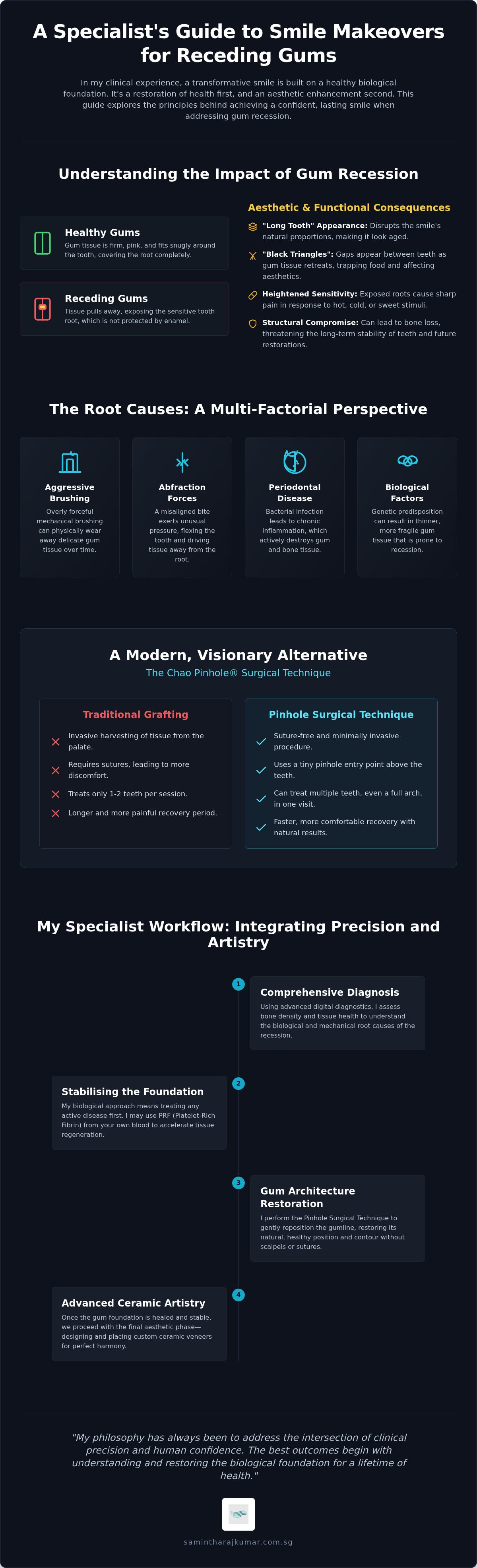
In my clinical practice, I define Gingival recession as the progressive migration of the gum tissue away from the tooth crown, which exposes the vulnerable root surfaces beneath. This isn't merely a cosmetic concern; it represents a fundamental shift in your oral architecture. Gum recession is a structural compromise to the smile’s foundation. When this foundation shifts, the entire visual harmony of your face is disrupted, often leading to a smile that looks aged or "toothy" due to the disproportionate length of the visible teeth.
One of the most significant aesthetic challenges I address during a smile makeover for receding gums is the "black triangle" effect. This occurs when the interdental papilla, the small triangle of tissue between your teeth, retreats. These dark, empty spaces don't just trap food; they create a jagged, unhealthy appearance that can severely undermine a person's confidence. I've seen many patients who have stopped smiling in photos or covering their mouths when they speak because they feel their teeth look uneven or neglected, even when they maintain excellent hygiene.
The Warning Signs: More Than Just Aesthetics
Many patients first realise they have a problem when they experience sharp thermal sensitivity. If cold water or hot coffee causes a sudden wince of pain, it's often because the protective enamel ends at the gum line, leaving the sensitive dentine of the root exposed. We typically see a steady progression from mild inflammation and occasional bleeding to visible tissue loss. I always advise that "ignoring it" is the most dangerous path. As the tissue retreats, the underlying bone often follows, which leads to far more complex restorative challenges if we don't intervene early.
Why Recession Happens: A Multi-Factorial Perspective
To achieve a predictable smile makeover for receding gums, we must first understand the root cause. It isn't always a result of poor care. In fact, many of my patients have caused recession through overly aggressive mechanical brushing. I also evaluate patients for "abfraction" forces, where misaligned teeth exert unusual pressure during chewing, literally driving the tissue away from the tooth. Your biological predisposition and any history of periodontal disease are also critical factors. I believe in a biological dentistry approach, which means we must stabilise any active disease and correct mechanical issues before we begin the journey of aesthetic restoration.
The Systemic Connection: Why Healthy Gums are Non-Negotiable
My philosophy is simple: you cannot build a premium aesthetic result on a failing foundation. While many patients focus on the shade or shape of their teeth, I prioritise the biological health of the surrounding tissue. Receding gums are often a symptom of underlying systemic inflammation, a link that many people don't realise exists. Chronic gum issues can stress the body's immune system, making a comprehensive treatment for receding gums essential for more than just a beautiful smile. A well-executed smile makeover for receding gums addresses these systemic concerns to ensure the final result is as healthy as it is beautiful.
When planning a smile makeover for receding gums, I utilise advanced digital diagnostics to assess the bone density beneath the tissue. This precision is vital because the longevity of future ceramic dental implants or veneers depends entirely on the stability of the support structure. If we ignore the recession, even the most beautiful porcelain work will eventually fail as the underlying architecture continues to collapse. I believe in getting the foundation right before we ever consider the final cosmetic layers.
Biological Dentistry and Tissue Integrity
I adopt a biological dentistry approach, which means I prioritise the bio-compatibility of every material I use. For patients requiring regeneration, I often incorporate PRF (Platelet-Rich Fibrin). This modern protocol uses your own blood's healing factors to accelerate tissue growth and improve the predictability of the result. Functionally, ensuring stable, thick tissue prevents future complications with implants, creating a lasting legacy of health. If you are concerned about your gum health, it's helpful to consult a specialist to evaluate your unique biological needs.
The Aesthetic Ratio: The "Golden Mean" of Gums
True beauty in dentistry follows the "Golden Mean"—a specific ratio between the teeth and the gums. I use AI-assisted screening to plan the "gingival zenith," which is the highest point of the gum curve for each individual tooth. This meticulous planning ensures a youthful, balanced appearance that complements your natural features. There is a profound relationship between your dental structure and face shape; by restoring the gums, we aren't just fixing a smile, we're providing structural rejuvenation for the entire face.
The Chao Pinhole® Surgical Technique: A Modern Alternative
For many years, the standard surgical response to gum recession involved invasive "cut-and-stitch" grafting. In my practice, I have moved towards a more visionary approach that prioritises patient comfort without sacrificing clinical excellence. The Chao Pinhole Surgical Technique (PST) represents a suture-free, scalpel-free revolution in how we approach a smile makeover for receding gums. Instead of harvesting tissue from the roof of your mouth, I use a tiny entry point, no larger than a pinhead, to gently reposition the existing gum tissue over the exposed roots.
The real differentiator of this technique lies in its efficiency and immediate visual impact. Because the procedure is minimally invasive, I can often treat multiple teeth, or even an entire arch, in a single clinical session. Small collagen strips are meticulously inserted through the pinhole to stabilise the tissue in its new position while it heals. This creates an immediate aesthetic improvement that traditional methods simply cannot match in such a short timeframe.
Pinhole vs. Traditional Gum Grafting
When comparing Pinhole surgery to traditional grafting, the most significant factor for my patients is the reduction in "donor site" morbidity. Traditional grafts require a secondary surgical site on the palate, which is often the primary source of post-operative discomfort. By eliminating this step, PST allows for a much faster return to your social and professional life. Clinical data supports this approach as well. A study in the Journal of Indian Society of Periodontology reported a 96.7% success rate for the technique at six months, proving that predictability and comfort can go hand in hand.
What Patients Can Expect During the Procedure
I begin the procedure by creating a small entry point in the gum tissue. Using specialised instruments, I gently loosen the tissue and glide it downwards to cover the areas of recession. This process is remarkably gentle, and most patients describe the experience as transformative yet comfortable. My post-operative instructions are straightforward but vital for maintaining the new gum line. You'll need to avoid aggressive brushing or "tugging" at the lip in the treated area for a short period to allow the collagen to integrate and the tissue to settle permanently. This measured, specialist-led care ensures that your smile makeover for receding gums provides a foundation that is as robust as it is beautiful.
Designing Your Makeover: Integrating Gum and Ceramic Artistry
Designing a smile is an exercise in architectural balance. I often see patients who have been advised to simply "cover up" recession with veneers or crowns. This is a clinical mistake. Placing ceramic over unstable, receding gums is like building a luxury home on shifting sand. My workflow for a smile makeover for receding gums always begins with stabilisation. We must ensure the tissue is healthy and the recession is arrested before initiating any cosmetic dentistry. This sequential approach is what guarantees the longevity and predictability of your final result.
For patients facing missing teeth alongside recession, I utilise ceramic dental implants. These are particularly effective because their ivory-coloured material mimics natural tooth roots. This is a vital consideration if the gum tissue is thin, as it prevents the greyish tint often seen with traditional metal implants. We also focus on the art of "Pink Aesthetics". In some complex cases, we use a combination of surgical tissue restoration and gum-coloured porcelain to achieve a perfect, natural-looking frame. Precision in this planning phase determines whether the final smile looks like a set of artificial teeth or a seamless, biological restoration.
Full Mouth Rehabilitation and Gum Harmony
When addressing extensive tooth loss alongside significant recession, All-on-4 dental implants often provide the most predictable outcome. In these comprehensive rehabilitations, I am meticulous about the "transition line" where the prosthesis meets your natural gum tissue. By carefully sculpting the underlying bone and tissue architecture, I ensure this line remains invisible, even when you laugh or speak. This structural work often provides a secondary benefit of facial rejuvenation, restoring the youthful volume that receded gums and bone loss once took away.
The Role of Digital Smile Design
I use 3D intraoral scans and Digital Smile Design to map your predicted outcome before we begin surgery. This technology allows us to measure your bite alignment with extreme accuracy. If your bite is "heavy" in certain areas, it can put excessive stress on newly restored gums, potentially causing them to recede again. By balancing these functional forces, we protect your aesthetic investment. The final reveal is a delicate balance of vibrant tooth shades and healthy, vibrant gum tones. If you are ready to explore a comprehensive restoration, I invite you to book a specialist consultation to discuss your custom smile design.
My Perspective: The Intersection of Clinical Precision and Human Confidence
As a specialist surgeon and the founder of this practice, I've always viewed my work as more than just a series of clinical procedures. A smile makeover for receding gums is a life-changing intervention that restores not just the physical foundation of the mouth, but the emotional confidence of the patient. I've spent my career refining techniques that prioritise biological harmony. My philosophy is that a surgeon’s skill is ultimately measured by the invisibility of their work. When a patient looks in the mirror after a procedure, they shouldn't see evidence of a scalpel; they should see a healthy, natural smile that feels as though it has always been there.
The future of healthcare lies in these minimally invasive, biologically driven protocols. By leveraging modern techniques, we move away from the trauma of traditional grafting. This shift allows me to focus on the transformative power of a confident smile, ensuring that the health of the tissue supports the beauty of the teeth for decades to come. Seeing a patient rediscover their self-assurance after years of feeling self-conscious about "long" teeth is the most rewarding aspect of my role as a clinician.
The Long-Term Impact of Quality Care
Investing in a specialist surgeon for your smile makeover for receding gums pays dividends in oral longevity. When we address recession with clinical precision, we aren't just improving aesthetics; we're protecting against tooth loss and bone resorption. There is a documented connection between a restored smile and overall systemic well-being, as healthy gums reduce the burden of chronic inflammation on the body. My commitment to global standards means I am constantly integrating international protocols and innovative healthcare delivery into my practice to ensure my patients receive world-class care.
Taking the First Step Toward Restoration
The journey begins with a comprehensive consultation. We must identify the root causes of recession, whether it's mechanical trauma, bite misalignment, or biological factors, before we can design a predictable solution. I encourage patients to look closely at a specialist’s credentials, their affiliations with international medical networks, and their history with complex oral rehabilitation. A well-restored smile is a legacy of health that lasts a lifetime. It is the intersection where meticulous surgical science meets the profound renewal of human confidence.
Restoring the Foundation of Your Confident Smile
Reclaiming your smile's health is a journey that requires both surgical precision and a meticulous aesthetic eye. We've explored how a biological approach ensures that any cosmetic enhancement rests on a stable, healthy foundation. Modern protocols like the Chao Pinhole Surgical Technique have changed the landscape, offering a gentle path toward restoration without the trauma of traditional grafting. As a specialist in complex oral and maxillofacial surgery and the founder of Nuffield Dental Holdings, I've seen firsthand how correcting the gum line revitalises a person's entire appearance.
A successful smile makeover for receding gums is more than just a surface-level fix; it's a profound investment in your long-term systemic well-being. By addressing the root causes of recession and integrating advanced ceramic artistry, we create results that are both durable and indistinguishable from nature. I'm proud to be a pioneer in these minimally invasive protocols, helping patients regain their comfort and social confidence through visionary care.
You don't have to live with persistent sensitivity or self-consciousness. Your path to a harmonious, healthy smile is closer than you think, and I look forward to helping you achieve it.
Frequently Asked Questions
Is a smile makeover possible if I have active gum disease?
You must treat active gum disease before beginning any aesthetic work. I prioritise a biological approach where we eliminate infection and stabilise the supporting bone first. Attempting a smile makeover for receding gums while periodontal disease is present will lead to predictable failure. Once your oral health is stable, we can then design a restoration plan that ensures your results are both healthy and beautiful.
How long does the recovery take after Pinhole surgical technique?
Recovery after the Chao Pinhole Surgical Technique is remarkably fast compared to traditional methods. Most patients return to their normal social activities within 24 to 48 hours. While the initial pinhole entry point heals almost immediately, the underlying tissue takes a few weeks to fully integrate with the collagen strips. I provide specific instructions to avoid aggressive brushing during this period to ensure the new gum line remains undisturbed and stable.
Will insurance cover a smile makeover for receding gums?
Insurance coverage typically depends on whether the procedure is deemed medically necessary or purely cosmetic. Many dental plans cover 40 to 80 percent of gum restoration when it's required to treat root exposure or periodontal disease. However, because CHAO Pinhole Surgery is a modern technique, some insurers may classify it differently. I always recommend obtaining a written pre-treatment estimate from your provider to understand your specific out-of-pocket costs before proceeding.
Can veneers fix the appearance of receding gums without surgery?
Veneers cannot truly fix receding gums and placing them over unstable tissue is a clinical error. If you hide recession with porcelain without addressing the underlying tissue loss, you risk further recession and potential implant or tooth failure. A successful smile makeover for receding gums requires us to restore the gum architecture first. This creates a healthy, symmetrical frame that allows your veneers or ceramic dental implants to look natural and last for decades.
How painful is the gum restoration process compared to a standard filling?
The Pinhole process is generally described as a gentle experience, often comparable to the pressure felt during a standard filling. Because there are no scalpels or sutures involved, the post-operative discomfort is significantly lower than traditional grafting. I focus on meticulous pain management and minimally invasive protocols to ensure you feel secure. Most patients find that any mild sensitivity after the procedure is easily managed with standard over-the-counter relief.
How long do the results of a gum makeover typically last?
Results from a professional gum restoration can last a lifetime if the original causes of recession are addressed. While the procedure physically repositions the tissue, you must also correct habits like aggressive brushing or bite misalignment. I view every makeover as a long-term partnership in health. By maintaining excellent hygiene and attending regular specialist reviews, you can protect your investment and enjoy a youthful, symmetrical gum line for many years to come.
What is the difference between a periodontist and a specialist oral surgeon for this procedure?
While both periodontists and specialist oral surgeons treat gum issues, a specialist surgeon often focuses on complex, full-mouth rehabilitation. As a specialist in oral and maxillofacial surgery, I look at the structural relationship between your bone, tissue, and facial aesthetics. This perspective is vital for patients requiring integrated care, such as combining gum restoration with ceramic dental implants or Zygomatic implants to achieve a comprehensive, life-changing result.
Can receding gums grow back naturally with better oral hygiene?
Gum tissue does not grow back naturally once it has receded from the tooth. While improving your oral hygiene is essential to stop further loss, clinical intervention is the only way to restore the original gum line. Techniques like Pinhole surgery allow me to glide the existing tissue back into its proper position. Waiting for natural regrowth often leads to more complex bone loss, making early specialist intervention the most predictable path to recovery.


Comments