
Snap-On Dentures vs Permanent Implants: A Surgeon’s Perspective on Total Rehabilitation
- Dr Samintharaj Kumar

- Jun 19
- 11 min read
What if the decision to replace your missing teeth was less about the smile itself and more about the structural integrity of your entire face? In my clinical experience, many patients approach the choice between snap-on dentures vs permanent implants as a simple matter of budget or convenience. Yet, for those living with the daily anxiety of a slipping prosthesis or the frustrating inability to enjoy a meal, the stakes are far higher than mere mechanics.
I understand the quiet exhaustion that comes from worrying if your teeth will stay in place during a dinner with friends. It's a heavy burden to carry. This article will help you navigate the critical biological and functional differences between removable overdentures and fixed permanent implants so you can make a legacy-focused decision for your oral health. We'll explore how these two paths differ in their ability to halt jawbone deterioration, restore full chewing function, and preserve a natural, youthful appearance for the long term.
Key Takeaways
Understand that full-arch rehabilitation exists on a spectrum, where snap-on dentures offer a removable hybrid and permanent implants provide a fixed, non-removable solution.
Learn why preserving the alveolar bone is vital for facial integrity and how permanent implants stimulate bone density to prevent a prematurely aged appearance.
Evaluate the functional differences in snap-on dentures vs permanent implants, including how fixed options restore nearly all natural biting force.
Discover how permanent dental structures act as a scaffold for facial muscles to prevent the sagging often associated with traditional dentures.
Understand why immediate, fixed restoration through protocols like Teeth in a Day is often the most predictable path for long-term quality of life.
Table of Contents
Understanding the Spectrum of Full-Arch Rehabilitation
In my clinical experience, patients often view the choice between traditional dentures and dental implants as a binary decision. They see it as a choice between a loose plastic plate and a complex surgical procedure. However, as a clinician and founder, I prefer to frame this as a spectrum of care. Total rehabilitation isn't a one-size-fits-all solution; it's a tailored approach based on your specific biological needs and lifestyle goals.
To better understand how these options differ from traditional solutions, watch this helpful comparison:
On one end of this spectrum, we have the Overdenture, commonly known as snap-on dentures. These act as a hybrid. They are implant-supported but remain removable by the patient. On the other end, we find permanent implants, such as the All-on-4 dental implants protocol. From a biological perspective, understanding the nuances of snap-on dentures vs permanent implants is the first step toward reclaiming your quality of life. The fundamental choice depends on your desire for stability, long-term health, and lifestyle seamlessness.
What are Snap-On Dentures?
Snap-on dentures use a locator attachment mechanism. This involves placing two to four implants into the jawbone, which then "snap" onto an acrylic base. I often consider these an entry-level implant solution for those transitioning from traditional dentures. While they provide significantly more stability than a floating denture, the mechanical reality is that the acrylic base still rests on the gums. This has implications for comfort. Over time, the pressure on the soft tissues can lead to minor sore spots if the fit is not perfectly maintained.
The Permanent Implant Standard
Permanent implants represent the gold standard in modern restorative dentistry. This approach involves a fixed bridge supported by four to six implants. Through the teeth in a day procedure explained in my clinical protocols, we can often provide a functional set of teeth in a single session. I prioritise fixed solutions for patients seeking total functional renewal. Because these teeth don't move or come out, they offer a level of confidence and chewing efficiency that removable options simply cannot match. This is the ultimate goal of full-arch rehabilitation: a smile that feels like your own.
The Biological Reality: Bone Preservation and Stability
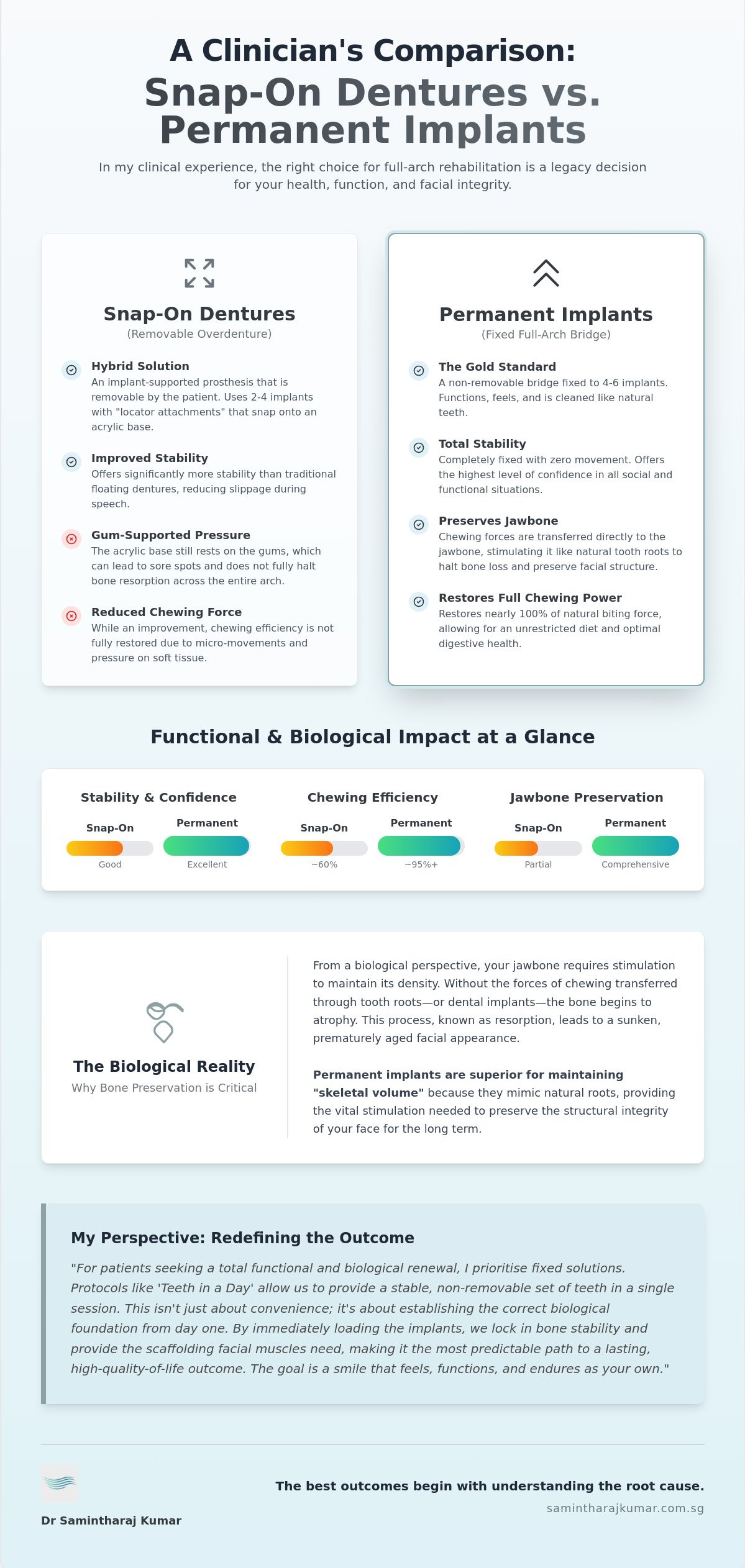
From a biological perspective, the health of your alveolar bone is the most critical factor in long-term success. Bone is a dynamic tissue that requires constant stimulation to maintain its density and volume. Permanent implants transfer chewing forces directly into the bone, acting much like a natural tooth root. This stimulation prevents atrophy and preserves the skeletal structure of your face. When we look at the comparison of snap-on dentures vs permanent implants, we must consider what is happening beneath the surface of the gums.
Snap-on dentures represent a significant improvement over traditional prosthetics, but they aren't without biological compromise. While the implants provide anchorage, the acrylic base still rests on the gingival tissue. This can allow for micro-movements that irritate the soft tissue during speech or mastication. In my clinical experience, I often see "denture sores" even with snap-on systems due to this inherent instability. As the Cleveland Clinic explains implant-supported dentures, the stability of the foundation is what ultimately dictates your comfort and functional capacity.
Osseointegration and the Foundation of Health
The success of any implant relies on osseointegration. This is the biological process where titanium or ceramic surfaces fuse directly with your jawbone. Permanent implants are superior for maintaining "skeletal volume" because they involve more points of contact with the bone. Research indicates that traditional dentures can reduce chewing force by up to 75 per cent. This loss of function leads to rapid bone resorption. The clinical consequence is often a "collapsed" facial appearance, where the distance between the nose and chin shortens, leading to premature ageing. Permanent solutions halt this process by providing the necessary mechanical load to the jaw.
Biocompatibility: Titanium vs Ceramic
In my practice, I often discuss ceramic dental implants with patients who have metal sensitivities or high aesthetic demands. Material choice affects how your soft tissue responds. Ceramic options often provide a more natural aesthetic at the gum line, avoiding the greyish tint sometimes associated with titanium. This is particularly important for patients with thin gum biotypes. Choosing a material that aligns with your body’s unique biology is essential for a legacy-focused outcome. Understanding these biological nuances is key to a successful restorative journey. The best outcomes begin with understanding the root cause of dental instability.
Snap-On Dentures vs Permanent Implants: A Comparative Analysis
When we examine the functional realities of snap-on dentures vs permanent implants, we are looking at two entirely different categories of human experience. In my clinical experience, the most immediate shift for a patient isn't just aesthetic; it's the restoration of biting force. While traditional dentures can reduce chewing efficiency by up to 75 per cent, snap-on systems typically restore only 40 to 60 per cent of natural biting force. Permanent implants, by contrast, offer a profound 90 to 95 per cent restoration. This isn't just a statistic. It is the difference between tentatively nibbling a meal and enjoying it with complete confidence.
There's a significant psychological threshold between a prosthetic you remove at night and one that becomes a part of your anatomy. Snap-on dentures require daily removal and specific cleaning protocols to prevent infection. Permanent bridges are maintained exactly like natural teeth, through standard brushing and flossing. As a clinician and founder, I've observed that "fixed" teeth provide a sense of wholeness that removable options cannot replicate. They move from being a medical device to being your teeth.
Dietary Freedom and Speech
Permanent implants allow you to enjoy steak, nuts, and apples without fear of displacement. This is largely due to the palate design. Permanent bridges leave the roof of the mouth open, which significantly improves taste and speech clarity. Snap-on dentures often still require a bulkier acrylic base to provide stability, which can affect phonetics and the sensory experience of eating. In my practice, I prioritise fixed solutions because they offer the most seamless transition back to a normal lifestyle.
Longevity and Value
Permanent implants are designed as a lifetime solution. While the prosthetic bridge may eventually need maintenance, the implant posts themselves can last decades with proper care. Snap-on dentures, however, may need relining every three to five years as the underlying bone and tissue continue to change. When evaluating the "total cost of ownership" over 20 years, the initial surgical investment for permanent implants often proves more economical than the ongoing adjustments and replacements required for removable systems. The success of these complex systems depends heavily on surgical expertise and the use of high-tier international protocols. The best outcomes begin with understanding the root cause of your dental challenges.
Structural Longevity: Beyond the Smile
As a clinician and founder, I am deeply interested in how dental structure affects face shape. It is a common misconception that teeth only serve the purpose of mastication. In reality, they are the pillars of the face. Permanent implants act as a rigid scaffold for your facial muscles, providing the internal support necessary to prevent the premature sagging and skin laxity that often follow tooth loss. While we evaluate snap-on dentures vs permanent implants, we must consider the long-term architectural impact on your appearance.
Snap-on dentures do not provide this same level of structural support. Because they remain removable and partially rely on the soft tissue for stability, they aren't truly integrated into the facial architecture. The goal of total rehabilitation is structural rejuvenation, not just a cosmetic fix. I believe that a successful outcome should be measured by how well it restores your natural profile and preserves the harmony of your features for decades to come.
Preventing Facial Collapse
The loss of natural teeth and the subsequent resorption of the jawbone leads to a clinical condition known as facial collapse. This involves the shortening of the vertical distance between the nose and the chin, which creates a sunken, aged appearance. Permanent implants maintain this vertical dimension by stimulating the bone and providing a fixed foundation for the prosthetic teeth. My clinical insights on preventing facial collapse with dental implants highlight that fixed solutions are far more effective at halting this progression than removable alternatives. Choosing between snap-on dentures vs permanent implants is ultimately a choice between managing a condition and correcting its root cause.
The Role of Advanced Diagnostics
In my practice, I utilise AI-assisted diagnostics to map the ideal position for each implant. This technology allows us to plan with sub-millimetre precision, ensuring that the final restoration supports your facial aesthetics perfectly. A meticulous, surgeon-led plan is necessary for complex full-mouth cases where the relationship between bone, muscle, and teeth is delicate. You should expect a treatment plan that prioritises your long-term facial health through evidence-based protocols. The best results emerge when we combine surgical mastery with the latest technological innovations. I invite you to learn more about our approach to comprehensive facial rejuvenation through specialist implantology.
My Perspective: Why "Teeth in a Day" Redefines the Outcome
I believe that every patient deserves a solution that restores their dignity and quality of life immediately. In my clinical experience, the emotional weight of tooth loss is often as significant as the functional deficit. When we discuss the choice between snap-on dentures vs permanent implants, we are really discussing the difference between a temporary compromise and a definitive restoration. While snap-on dentures have their place as a transitionary tool, they rarely serve as the final destination for my patients who seek a truly seamless lifestyle.
My philosophy prioritises permanent, fixed solutions because they offer the most predictable long-term biological results. From a biological perspective, a fixed bridge provides the stability necessary for the jawbone to remain healthy and the facial muscles to stay supported. The right diagnosis changes everything. We must look at the root cause of tooth failure to build a foundation that won't just last for a few years, but for a lifetime.
A Founder’s Philosophy on Care
As a clinician and founder, I established Nuffield Dental to provide a higher tier of specialised expertise that was previously difficult to access. My goal was to build an institution that adheres to rigorous international protocols and global standards in oral surgery. This commitment to excellence is rooted in biological dentistry, where we don't just replace teeth; we consider the systemic health of the patient. By integrating advanced technologies like AI-assisted diagnostics, we ensure that every surgical intervention is precise, minimally invasive, and designed for long-term well-being.
The Path Forward
Reflecting on the many cases I've handled, the transformative power of a fixed, permanent smile is profound. It's about more than just aesthetics. It's about the ability to speak clearly, eat heartily, and live without the constant awareness of a prosthetic. If you are weighing the merits of snap-on dentures vs permanent implants, the first step is a comprehensive specialist consultation to map out your unique anatomy. We focus on ecosystem-building in healthcare, ensuring that your journey is supported by a team that values legacy and clinical mastery. The best outcomes begin with understanding the root cause.
Reclaiming Your Future Through Structural Restoration
In my clinical experience, the choice between snap-on dentures vs permanent implants is a decision that extends far beyond immediate aesthetics. It is a commitment to your long-term biological health and the structural integrity of your face. We've explored how permanent solutions act as a scaffold for your features, preventing the "collapsed" look often associated with traditional tooth loss. These fixed systems restore up to 95 per cent of natural biting force, providing a level of freedom that removable options simply cannot match.
As the founder of Nuffield Dental Holdings and a specialist in Zygomatic and All-on-4 protocols, my mission is to bring global standards of surgical excellence to every patient. With a clinical presence in both Singapore and London, I remain dedicated to a patient-centred philosophy that prioritises comfort and technical excellence. Your journey shouldn't be about managing a condition, but about achieving a total renewal of your quality of life. The best outcomes begin with understanding the root cause. Explore our approach to total rehabilitation.
Frequently Asked Questions
Are snap-on dentures as stable as permanent implants?
Snap-on dentures are not as stable as permanent implants. While they offer a significant upgrade over traditional dentures by using locator attachments to secure the base, they still allow for slight micro-movements during heavy chewing. Permanent implants are fixed prostheses that don't move at all, providing a level of stability that feels identical to natural teeth.
Can I upgrade from snap-on dentures to permanent implants later?
You can usually upgrade, but the timing is critical to your success. From a biological perspective, the jawbone beneath a snap-on denture continues to resorb over time because the removable base still applies pressure to the gums. If you wait too many years to transition, you might require additional bone grafting to create a sufficient foundation for a fixed bridge.
What is the recovery time for permanent dental implants?
Initial healing from the surgical procedure typically takes seven to ten days, during which any minor swelling subsides. However, the biological process of osseointegration, where the bone fuses to the implant, requires three to six months for completion. With our modern protocols, you'll leave the clinic with functional teeth on the same day, though a soft-food diet is necessary during the early healing phase.
Do snap-on dentures feel like natural teeth?
Snap-on dentures don't feel entirely natural because they still involve an acrylic base that covers a portion of your gum tissue. This can sometimes interfere with the taste of food or the sensation of temperature. Permanent implants feel much more like your original teeth because they lack this bulky material, leaving the roof of your mouth open and allowing for more natural speech phonetics.
How many implants are needed for a permanent bridge vs a snap-on denture?
A snap-on denture typically requires two to four implants per arch to provide adequate anchorage. In contrast, a permanent bridge usually requires four to six implants to ensure the prosthesis is fully supported and can withstand the high forces of mastication. This higher number of implants is what allows the bridge to be fixed permanently without the need for a removable base.
Is the surgery for permanent implants more painful than for snap-ons?
The surgical experience for permanent implants isn't more painful than the procedure for snap-ons. We utilise advanced anaesthesia and intravenous sedation to ensure you're completely comfortable throughout the process. Most of my patients find the post-operative recovery quite manageable, often describing it as similar to the discomfort felt after a standard tooth extraction.
How do I clean permanent dental implants?
You maintain permanent implants exactly like natural teeth by brushing twice daily and using a non-abrasive toothpaste. Because the bridge is fixed, you'll also use specialised floss or an interdental brush to clean the small space between the bridge and your gum line. Regular professional maintenance is essential to ensure the long-term health of the surrounding tissue and the integrity of the restoration.
Will insurance cover the difference between snap-ons and permanent implants?
Insurance coverage depends on your specific provider, but many plans only cover the "least expensive alternative treatment." When weighing the choice of snap-on dentures vs permanent implants, it's vital to review your 2026 PEHP Dental Guidelines or specific policy details. Many patients find that while insurance covers a portion of the base prosthetic, the investment in a permanent, fixed solution is a personal choice for long-term quality of life.


Comments