
Speaking and Chewing with a New Prosthesis: A Surgeon’s Guide to Adaptation
- Dr Samintharaj Kumar

- May 27
- 13 min read
What if the most critical phase of your dental restoration isn't the surgery itself, but the neuro-muscular "relearning" that happens in the weeks that follow? Many of my patients initially feel a sense of trepidation, wondering if a slight lisp or the unfamiliar sensation while eating will ever truly fade. It's natural to feel a level of social anxiety about speaking and chewing with a new prosthesis, particularly when you're concerned about the stability of your restoration during a professional dinner or a conversation with friends.
In my clinical experience, I've found that mastery over your new smile begins with understanding the biological transition your body is undergoing. This guide will provide you with expert clinical insights into neuro-muscular adaptation and functional recovery to help you regain phonetic clarity and the ability to enjoy a full variety of food textures. I'll explain how we bridge the gap between complex surgical engineering and your daily quality of life, ensuring your transition is as seamless and confident as the restoration itself.
Key Takeaways
Gain a clinical understanding of why your new restoration feels foreign initially and how your brain maps these new boundaries during the first 48 hours.
Discover expert strategies for speaking and chewing with a new prosthesis to eliminate common phonetic errors and restore your natural dietary range.
Follow a structured three-week protocol designed to transition your jaw muscles from a soft food phase to full functional recovery.
Learn how precise adjustments to your vertical dimension of occlusion can resolve persistent clicking sounds and enhance facial support.
Understand the deeper biological impact of total rehabilitation, from improved digestive efficiency to the restoration of youthful facial volume.
Table of Contents
Navigating the Transition: What to Expect When Speaking and Chewing with a New Prosthesis
The Science of Adaptation: How Your Brain and Jaw Relearn Function
Overcoming Speech and Masticatory Hurdles: Clinical Solutions for Common Challenges
A Specialist’s Protocol for Mastering Your New Bite and Voice
Beyond Function: The Biological and Psychological Impact of Total Rehabilitation
Navigating the Transition: What to Expect When Speaking and Chewing with a New Prosthesis
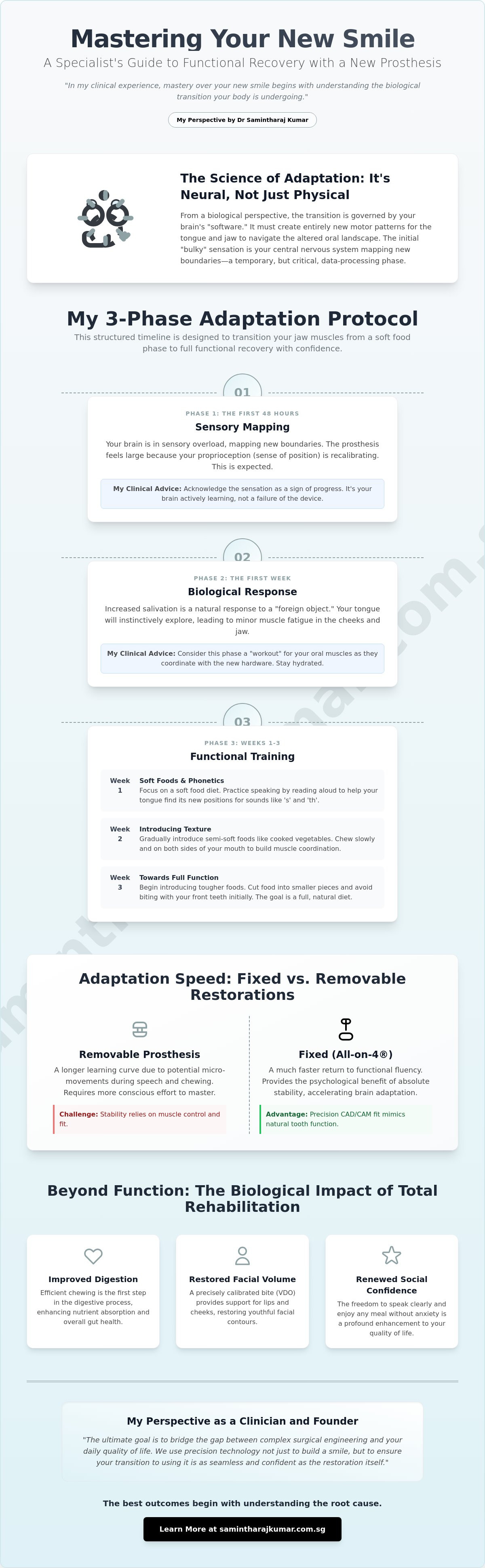
In my clinical experience, the first 48 hours after receiving a restoration are often the most intense for my patients. Your brain is essentially undergoing a period of sensory overload as it attempts to map new boundaries within the oral cavity. It's common for a new prosthesis to feel "large" or "foreign" at first. This happens because your proprioception, the sense of where your teeth and tongue are positioned, has been calibrated to your previous dental state for years. Any change in the thickness of the material or the height of the teeth triggers an immediate alert in the central nervous system.
When you begin speaking and chewing with a new prosthesis, every millimetre of change is magnified by the sensitive nerve endings in your mouth. For those seeking foundational knowledge on how these devices function, Wikipedia offers a comprehensive guide to dentures that explains the mechanics of prosthetic mastication and pronunciation. Understanding that this "bulky" sensation is a temporary data-processing error by your brain is the first step toward successful adaptation.
To better understand this concept of functional adaptation, watch this helpful video:
The Initial Sensory Phase
During the first week, you'll likely notice increased salivation. This is a natural biological response as your brain identifies the prosthesis as a "foreign object" and attempts to initiate the digestive process. Your tongue will also instinctively explore the new tooth positions and palatal contours. This constant movement can lead to minor muscle fatigue in the cheeks and jaw. I often tell my patients that this is simply your muscles "working out" as they learn to coordinate with the new hardware. It's a sign of progress, not a failure of the device.
Fixed vs. Removable Adaptation
The experience of speaking and chewing with a new prosthesis differs significantly depending on the type of restoration. While removable options require a longer learning curve due to potential movement, All-on-4 dental implants offer a much faster return to functional fluency. Because these are fixed, they provide the psychological benefit of absolute stability. We use digital CAD/CAM precision at my practice to ensure the prosthetic contours match your biological requirements as closely as possible. This technology reduces the physical adjustment period. While most patients achieve functional fluency within two to six weeks, the transition is much smoother when the restoration doesn't shift during speech.
The Science of Adaptation: How Your Brain and Jaw Relearn Function
From a biological perspective, the transition to a dental restoration is less about the physical hardware and more about the neural "software" that governs your mouth. Your brain must create entirely new motor patterns for the tongue and jaw to navigate the altered landscape of your oral cavity. When patients begin the journey of speaking and chewing with a new prosthesis, they are often surprised by the mental effort required. This isn't a sign of a poor fit. It's a sign of your central nervous system rewiring itself to accommodate a new functional reality.
One critical factor I consider during design is the Vertical Dimension of Occlusion (VDO). This refers to the specific distance between your upper and lower jaws when your teeth meet. If this height is altered even slightly to restore facial volume, it changes the tension in your muscles of mastication. While innovative protocols like "Teeth in a Day" provide immediate aesthetic renewal, they require a phased approach to full functional load. We must allow your muscles to calibrate to the new bite height before introducing heavy chewing forces. This prevents fatigue and ensures the long-term integrity of the restoration.
Neuro-muscular Reprogramming
There is a complex feedback loop between dental mechanoreceptors and the central nervous system. When we use high-tier materials such as zirconia or ceramic, the weight and tactile response differ from natural enamel. Your brain needs time to calculate the exact force required for efficient chewing without over-exerting the jaw. In my clinical experience, precise bite alignment is the only way to facilitate this "reprogramming" safely. Ensuring the fit is neurologically sound is just as important as the surgical placement itself. If the alignment is off by even a fraction of a millimetre, the brain struggles to find a comfortable resting position.
Phonetic Relearning
Speech is a highly coordinated muscular act that relies on the precise relationship between the tongue and the prosthetic edge. The mechanics of "S" and "F" sounds are particularly sensitive to changes in tooth position. Clinical research into Maxillofacial prosthetic solutions for speech confirms that even minor adjustments in prosthetic contour can significantly impact pronunciation. I recommend reading aloud as the most effective clinical tool for speech rehabilitation. It forces the brain to process phonetic errors in real-time and correct them. I've found that patients with higher linguistic demands, such as public speakers or educators, often adapt faster because they engage in this intentional practice more frequently.
My Perspective: The Founder’s Philosophy
As a clinician and founder, I view a prosthesis not as a static object, but as a dynamic component of your biology. True excellence in restorative dentistry isn't just about how the teeth look in a mirror; it's about how they integrate with your nervous system. We aren't just replacing teeth. We are restoring a vital human connection through speech and nutrition. Understanding the root cause of functional discomfort is the first step toward a natural-feeling result. If you feel your bite isn't quite settling, a specialist review of your TMJ pain management needs can often provide the clarity required for total comfort.
Overcoming Speech and Masticatory Hurdles: Clinical Solutions for Common Challenges
I often see patients who are concerned about a persistent lisp or an occasional clicking sound shortly after their procedure. These aren't just technical glitches. They are functional hurdles that can impact your social and professional confidence. A lisp typically occurs because the tongue is struggling to find the precise "strike zone" on the back of the upper teeth for sibilant sounds like "S" or "T". By adjusting your tongue position slightly, you can usually resolve this within days. Clicking, however, requires a more nuanced clinical look. It might be a simple habit of clacking the teeth together, or it could indicate that the bite height needs a minor adjustment. Identifying "high spots" where the teeth meet prematurely is vital. In my clinical experience, even a few microns of difference can make the prosthesis feel cumbersome.
The neurological basis for this adaptation is quite complex. Research into the science of speech neuroprostheses highlights how the brain integrates artificial components into its motor schema. When you are speaking and chewing with a new prosthesis, your brain is essentially learning to drive a new vehicle. It takes time to calibrate the exact movements required for fluidity. If you find yourself accidentally biting your cheek or tongue, don't be discouraged. This usually happens because the brain hasn't yet fully mapped the new boundaries of your teeth. Slowing down your chewing and focusing on deliberate movements during the first week will significantly reduce these incidents.
My Perspective: The Human Side of Phonetics
As a clinician and founder, I understand that speech is deeply tied to your identity. If you're a CEO, a public speaker, or a teacher, a phonetic error isn't just a minor annoyance; it's a barrier to your professional presence. That's why I prioritise intensive phonetic testing during the try-in phase of total oral rehabilitation. I often use the "mirror technique" with my patients. This involves visualising your lip support and tooth display while you talk. It helps bridge the gap between how you sound to yourself and how you appear to others, ensuring the final result feels authentic.
Chewing Challenges and Solutions
Transitioning your diet involves more than just muscle strength. When speaking and chewing with a new prosthesis, you must account for the lack of periodontal ligament sensation. Natural teeth have tiny sensors that tell the brain how hard you're biting. Implants don't. You have to "relearn" your bite force through conscious practice. I always advise bilateral chewing, which means using both sides of your mouth simultaneously. This balances the pressure across the entire restoration and prevents the uneven wear that can lead to prosthetic fractures. The right diagnosis and a few minor clinical tweaks can change everything, turning a period of adjustment into a lifetime of functional excellence.
A Specialist’s Protocol for Mastering Your New Bite and Voice
Most patients want to rush the process of adaptation. I understand the desire to return to "normal" immediately, but in my clinical experience, a structured timeline is the most reliable way to ensure long-term success. Think of this as a rehabilitation programme for your mouth. During the first week, we focus entirely on the "Liquid and Soft" phase. This isn't just about comfort; it's about allowing the surgical sites to settle and the muscles of mastication to relax. If you push too hard early on, you risk muscle spasms or unnecessary soreness that can delay your progress in speaking and chewing with a new prosthesis.
The Dietary Progression Programme
From a biological perspective, avoiding sticky or brittle foods during the initial weeks is vital. Sticky items like toffee or crusty bread can create "shear stress," which pulls at the restoration in ways it isn't yet ready to handle. Brittle foods like nuts or ice can cause sudden, sharp impacts that may jeopardise the early stages of osseointegration. I recommend bridging the gap with protein-rich, soft options such as flaky steamed fish, soft-boiled eggs, and well-cooked quinoa. The phased loading protocol for immediate implants involves managing the distribution of mechanical stress to ensure the bone heals securely around the titanium or ceramic surface. By week four, you can begin the "Texture Challenge," gradually reintroducing firmer foods like cooked vegetables or tender meats.
Speech Exercises for Clarity
While chewing is mechanical, speech is rhythmic. By week two, your focus should shift to the "Phonetic Drill." I often suggest my patients read the "Rainbow Passage" aloud. This specific text contains almost every sound in the English language, making it an excellent clinical tool for identifying which syllables need more practice. If you feel your speech lacks its usual flow, try singing your favourite songs. Singing requires more exaggerated lip and tongue movements than speaking, which helps "reset" your prosody and rhythm. Using a recording device on your phone is also a practical way to track your progress. Listening to yourself allows you to identify exactly where a lisp or clicking occurs, so we can address it during your follow-up appointment.
My Perspective: Protecting Your Investment
As a clinician and founder, I view your prosthesis as a high-precision medical device. It requires the same level of care as any other significant health investment. Long-term maintenance isn't just about hygiene; it's about the relationship between the hardware and your living tissue. Regular checkups allow me to monitor how your bite is settling and make the tiny adjustments that prevent wear and tear. If you're ready to refine your functional recovery, a consultation regarding our smile makeovers and restorative protocols can help you reach your goals with confidence. The best outcomes begin with understanding the root cause of any functional challenge.
Beyond Function: The Biological and Psychological Impact of Total Rehabilitation
Once you have mastered the mechanics of speaking and chewing with a new prosthesis, you begin to notice a transformation that extends far beyond the oral cavity. In my clinical experience, the successful integration of a restoration marks the beginning of a profound biological and psychological renewal. We aren't just replacing missing units; we are restoring the structural foundation of the lower third of the face. This transition from functional struggle to effortless utility is where the true value of specialist care becomes evident.
From a biological perspective, efficient mastication is the critical first step in the digestive process. Many of my patients report a significant improvement in their overall digestive health once they can properly process a diverse range of nutrient-dense foods. When you can chew without hesitation, you move away from a restrictive, soft-food diet that often lacks essential fibre and micronutrients. This nutritional upgrade, facilitated by a stable and well-aligned prosthesis, supports systemic health and longevity.
Restoring Facial Harmony
The relationship between tooth position and the support of the lips and cheeks is a cornerstone of my treatment philosophy. Without the correct prosthetic volume, the soft tissues of the face can collapse, leading to a prematurely aged appearance. We meticulously measure your bite alignment to ensure the results are both youthful and functional. A correctly designed prosthesis acts as an internal scaffold, restoring the natural proportions of your profile. For those interested in the technical details of this process, I have written extensively on how dental structure affects face shape and the role of bone preservation in aesthetics.
The Long-term Vision of Care
As a clinician and founder, I am deeply committed to the future of restorative excellence. This includes the integration of AI-assisted diagnostics to create prostheses with unparalleled precision. The landscape is changing rapidly. As of May 2026, new FDA guidance mandates that AI-powered digital dental devices must validate their algorithms against recognised anatomical databases. This ensures that the digital workflows we use at my practice meet the highest global standards for safety and accuracy. Choosing a specialist who understands the intersection of surgery, biology, and advanced technology is essential for a successful outcome.
The psychological shift I witness in my patients is perhaps the most rewarding aspect of my work. Moving from a state of "hiding a smile" to "confident engagement" in social and professional settings changes your entire life trajectory. I view every prosthesis as a tool for life renewal, not just a dental fixture. It is a legacy of health that allows you to speak your mind and enjoy your life without compromise. The best outcomes begin with understanding the root cause of your dental challenges and addressing them with a long-term, visionary perspective on care.
The Path to Long-Term Oral Excellence
Mastering the art of speaking and chewing with a new prosthesis is a journey of biological integration. In my clinical experience, the transition depends on a synergy between high-tier surgical engineering and patient-led practice. We've explored how neuro-muscular reprogramming allows your brain to map new boundaries, while a structured dietary progression protects your restoration during the critical healing phase. This process isn't merely about mechanical adjustment; it's about reclaiming your voice and your systemic health.
As a clinician and founder, I've dedicated my career to pioneering AI-assisted diagnostics and complex Zygomatic and All-on-4 protocols. These innovations ensure that every restoration is a sophisticated tool for life renewal, rather than a simple dental fixture. By prioritising a specialist-led approach, you're choosing a path that values both technical mastery and compassionate care. Your new smile is the foundation for a healthier, more confident future where you can engage with the world without hesitation.
Frequently Asked Questions
How long does it take to speak normally after getting a new dental prosthesis?
Most of my patients return to phonetic fluency within two to six weeks. In my clinical experience, the brain requires this period to recalibrate motor patterns for the tongue and lips. Consistent practice, such as reading aloud for ten minutes each day, significantly accelerates this timeline. It's a process of neural adaptation rather than a mechanical issue with the restoration itself.
Why do I have a lisp with my new teeth, and will it go away?
A lisp occurs because your tongue hasn't yet found the correct "strike zone" on the back of your new teeth for sibilant sounds like "S" and "T". This is a common phase when speaking and chewing with a new prosthesis. It is almost always temporary. As your neuro-muscular system adapts to the new contours, your pronunciation will naturally return to its original clarity.
What are the best foods to eat during the first week with a new prosthesis?
During the first week, I recommend a "liquid and soft" diet to facilitate tissue healing and muscle relaxation. Focus on nutrient-dense options like flaky steamed fish, soft-boiled eggs, and well-cooked quinoa or porridge. These choices provide essential nutrition without placing undue mechanical stress on your new restoration. This phased approach is vital for the long-term success of the procedure.
Is it normal for my jaw muscles to feel tired after talking or eating?
It's entirely normal for your muscles of mastication to feel fatigued during the initial weeks. Your jaw is effectively undergoing a "workout" as it learns to coordinate with the new hardware and adjusted bite height. This sensation is a sign of your body adapting to the change. If the tiredness persists beyond the first month, we may need to review your bite alignment.
Can I eat steak or crunchy apples with my new implant-supported teeth?
You can eventually enjoy firmer textures like steak or apples, but you must wait until the osseointegration phase is fully complete. I typically advise waiting at least six to twelve weeks before introducing high-impact or "brittle" foods. This cautious progression ensures the implants are securely anchored in the bone before they are subjected to significant biting forces.
How do I stop my tongue from constantly touching my new prosthesis?
Your tongue instinctively explores new objects in the mouth as a natural biological sensory response. To minimise this, I suggest engaging in intentional speech exercises or singing to give the tongue a specific functional task. Over time, the prosthesis will become "background noise" to your central nervous system, and the urge to explore the new surfaces will fade away naturally.
What should I do if my new teeth feel too big for my mouth?
A new prosthesis often feels "large" because your proprioception is still calibrated to your previous dental state. Every millimetre of change is magnified by the sensitive nerve endings in your oral cavity. If the sensation of bulkiness doesn't improve after two weeks of speaking and chewing with a new prosthesis, please contact my clinic. A minor adjustment to the prosthetic contours can often resolve this.
How often should I return to the clinic for adjustments during the adaptation period?
I typically schedule a follow-up appointment one to two weeks after the initial placement to check for "high spots" in the bite. After this initial review, you should only need to return if you experience persistent sore spots or phonetic challenges that don't improve with practice. Regular six-monthly maintenance remains essential to monitor the health of the underlying bone and the integrity of the restoration.


Comments