
The Relationship Between Jaw Structure and Facial Aesthetics

Updated: 16 hours ago
The relationship between jaw structure and facial aesthetics involves more than bone shape. Bite alignment, tooth position and the soft tissues all contribute to how the lower face looks and functions. A recessed chin, uneven smile or prominent jaw may have different explanations, and appearance alone cannot reveal the full picture.
It is understandable to wonder whether a concern is cosmetic, functional or both. In my clinical experience, these questions are best considered together. The way the jaws meet can affect how the teeth contact and how the muscles work, while the underlying structure supports the lips and other facial tissues. These connections matter, but a visible difference does not automatically signal a problem or mean treatment is needed.
In this article, I explain how jaw form, bite and soft tissues interact, and what a balanced clinical assessment considers. I also distinguish functional concerns from aesthetic ones, and explain why careful diagnosis should come before decisions about change. My aim is to help you understand the possibilities so that any next step can take both comfort and appearance into account.
Table of Contents
How Jaw Structure Can Influence Facial Appearance
You may notice that your chin, lips or smile seem connected to your facial proportions. Perhaps your profile looks different from one angle, or your teeth meet unevenly when you close your mouth. It is natural to wonder whether the jaw is involved. In my clinical experience, the relationship between jaw structure and facial aesthetics is best understood by considering several features together, rather than assuming one visible detail explains everything.
In simple terms, jaw structure is the form and position of the upper and lower jaws; facial aesthetics describes how facial features relate visually to one another. This relationship is not defined by one measurement or a single ideal shape. Appearance reflects skeletal form, tooth position, the way the teeth meet, and the soft tissues that cover and move around the jaws. A visible difference on its own does not establish a diagnosis or mean treatment is needed.
What does jaw structure include?
The maxilla is the upper jaw, which supports the upper teeth and sits beneath the nose. The mandible is the lower jaw, which holds the lower teeth and moves during activities such as speaking and chewing. Their shape and position contribute to facial balance, but they are only part of it. Tooth position, bite relationships and soft-tissue appearance are related but distinct features, and should not be treated as interchangeable.
Which facial features may appear related?
The lower facial profile, chin and lips can influence how balanced the face appears from the front or side. For example, the position of the jaws and teeth may affect how the lips rest together, while the chin contributes to the outline of the lower face. These are observations about appearance, not conclusions about its cause. Faces vary naturally, and there is no single standard that everyone should match.
A photograph captures an expression, angle or moment in which features may seem more or less prominent. It cannot, by itself, show how the teeth meet, how the jaws relate in three dimensions or whether a difference affects function. That is why I do not draw conclusions from an isolated feature. A careful assessment considers the face as a whole and separates what can be observed from what needs clinical evaluation.
In some cases, jaw position may be part of a wider discussion about function and facial appearance. Orthognathic surgery and facial aesthetics describes corrective jaw surgery as an approach used in selected circumstances. This does not mean that every difference in profile calls for surgery. The first step is to understand the individual relationships between the jaws, teeth, bite and soft tissues. This is where precision matters: a clear diagnosis keeps any later discussion grounded in the person’s needs, rather than a narrow ideal of facial balance.
How the Jaw, Bite and Soft Tissues Work Together
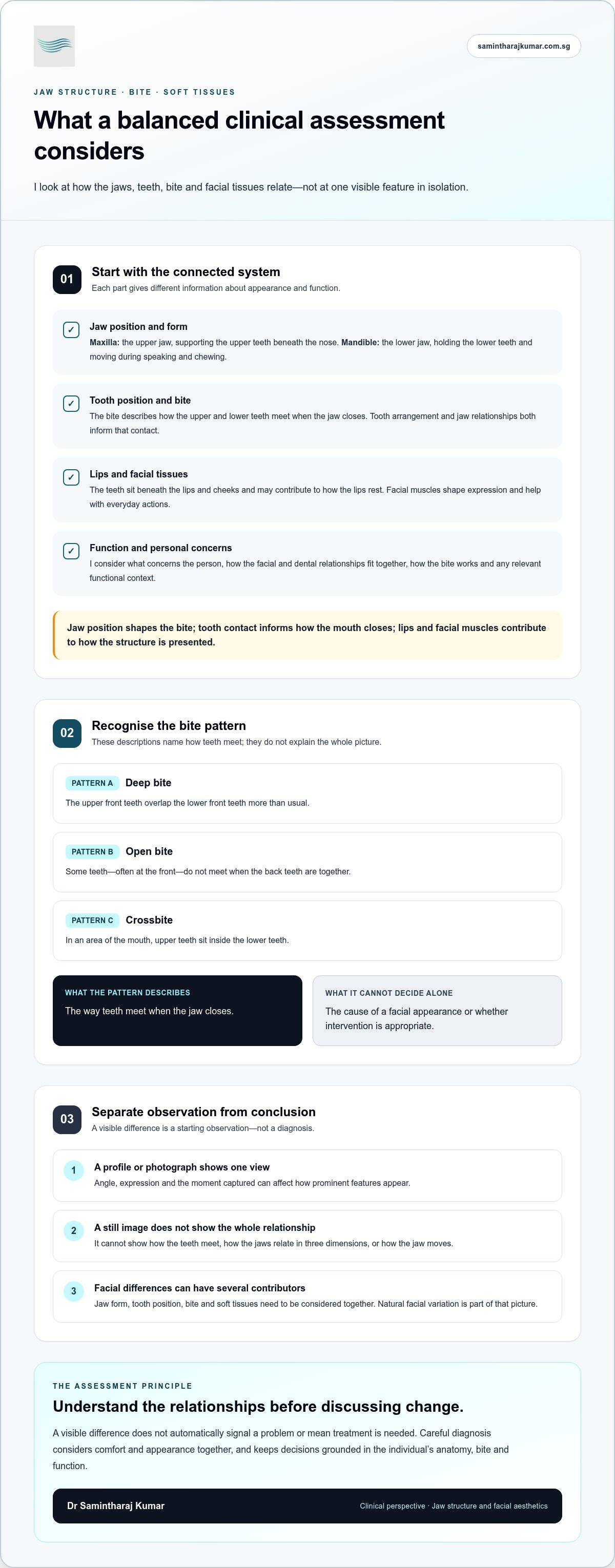
The teeth, jaws and facial tissues form a connected system. Dental occlusion is the way the upper and lower teeth meet when the jaw closes. That contact depends on the positions of the jaws and the arrangement of the teeth. The teeth and their supporting structures sit beneath the lips and cheeks, contributing to how the face appears at rest and during expression.
Jaw position shapes the bite, tooth contact informs how the mouth closes, and the lips and facial muscles contribute to how that structure is presented. This is a useful way to understand the connection, but it does not mean that one feature directly causes a particular facial appearance. Clinical observations describe patterns that need to be interpreted alongside an individual’s anatomy and function.
How bite alignment relates to facial proportions
Bite differences describe how the teeth meet; they are not diagnoses by themselves. In a deep bite, the upper front teeth overlap the lower front teeth more than usual. In an open bite, some teeth, often at the front, do not meet when the back teeth are together. A crossbite occurs when upper teeth sit inside the lower teeth in an area of the mouth. Each pattern can be associated with differences in how the lower face appears, but that relationship is not the same for everyone.
The same bite pattern may occur alongside different jaw positions, tooth arrangements and facial proportions. The label alone cannot explain someone’s profile or show whether intervention is appropriate. I consider how the teeth meet, how the jaws relate and whether the person has functional concerns. The relationship between jaw structure and facial aesthetics cannot be read from bite alignment in isolation; individual anatomy and clinical findings determine its significance.
Why lips and facial muscles matter
Teeth provide support beneath the lips, so their position may contribute to lip posture and the way the mouth appears at rest. Facial muscles also shape expression and help with everyday actions such as speaking and chewing. Appearance and movement provide different information: what seems prominent in a still photograph may look different during a smile, conversation or jaw movement.
A photograph captures one angle and one moment. It cannot show how the teeth meet, how the jaw moves or whether the lips rest comfortably during ordinary function. An apparent difference in lip position or facial contour may reflect several interacting features, so it should not be assumed to reveal one structural cause.
In my clinical experience, it is more useful to understand how these parts work together than to focus on one feature as a problem. If your concern involves both your bite and facial appearance, an individualised dental assessment can put those observations in context. The aim is not to fit every face to one standard, but to understand what matters for the person in front of me.
What Jaw Asymmetry and Bite Differences Can, and Cannot, Tell You
Facial asymmetry can have more than one contributor. A difference around the jaw may involve underlying skeletal form, tooth position, soft-tissue variation or habitual positioning. When tension or musculoskeletal strain around the head and neck influences how the jaw is held, practices like Yuba Sutter Chiropractic & Wellness take a whole-body approach to uncovering the root causes of physical discomfort. These factors can also occur together, so a visible feature does not always point to one explanation.
Facial asymmetry can reflect skeletal, dental, soft-tissue or positional factors, and its relevance varies from person to person. Similar-looking features may arise from different combinations of causes. For example, an uneven smile may relate to tooth position or soft tissues, while a difference in the jawline may have a skeletal or positional component. These are possibilities, not a way to diagnose yourself.
When a visible difference may have several contributors
Skeletal asymmetry concerns differences in the form or position of the jaws. Dental asymmetry relates to the arrangement of the teeth or how they meet. Soft-tissue variation involves features such as the lips and cheeks, while positional differences may appear as someone holds or moves the jaw. Each category offers a different way to understand facial balance, but appearance alone does not identify which applies.
In my clinical experience, it is important to distinguish these contributors while recognising that they can overlap. A bite difference does not, by itself, establish a skeletal concern; equally, a visible jawline difference does not tell us whether the teeth or soft tissues are involved. The relationship between jaw structure and facial aesthetics depends on the individual pattern of findings.
Why appearance should not be assessed in isolation
A still image captures a particular expression and position. Clinical interpretation can also consider how the teeth relate and how the jaw moves, helping distinguish a feature that is primarily visible from one with functional context. This broader view prevents the discussion from focusing only on the jawline when dental relationships or movement may also be relevant.
If you are reflecting on a facial difference, it may help to note which features you notice and whether they seem to change with expression or jaw position. Those details can guide a clinical conversation without assigning a cause in advance. Looking at how teeth and supporting structures relate to facial shape can also help put individual features in context. For broader structural concerns where posture, spinal alignment, or neck tension play a role, facilities such as The Chiropractic Centre provide specialized care to support overall physical balance.
A considered assessment brings these possible contributors into focus, so the discussion can centre on what is relevant to you rather than on one feature in isolation.
What a Clinical Assessment of Jaw Structure and Facial Aesthetics Considers
A balanced assessment begins with your concern, not an assumption about its cause. You may be unsure whether a change in your profile relates to your jaw, whether your bite feels comfortable or why your smile looks different to you. These are useful starting points. What I explore depends on the question and the clinical findings.
A clinical assessment connects your concern with relevant functional and aesthetic findings. I consider what you have noticed alongside how your teeth, jaws and facial features relate, rather than treating appearance and function as separate issues from the outset.
Start with the concern and functional context
It can help to describe what you would most like to understand. Is your main concern your profile, the way your teeth meet or an aspect of your smile? You might also mention discomfort with your bite or difficulty moving your jaw, if relevant. These details do not diagnose the cause, but they help focus the clinical conversation on what matters to you.
From there, I may consider facial and dental relationships, your bite and jaw movement in the context of your concerns. Jaw-related discomfort or movement concerns can also be discussed as part of TMJ assessment and care. Not every aesthetic question points to a functional issue, and not every functional finding explains a visible difference.
Further investigation, including imaging, depends on the clinical question. It is not automatically required simply because someone notices asymmetry or is concerned about facial proportions. The purpose is to gather information that helps clarify the individual situation, rather than collect tests without a clear reason.
Connect findings before discussing options
Interpretation comes before planning. A dental consideration may relate to tooth position or the way the teeth meet; a surgical consideration may involve the relationship of the jaws; and a facial-aesthetic consideration may focus on how features work together in appearance. These areas can overlap, but they are not interchangeable. Identifying which findings are relevant helps prevent the discussion from narrowing too quickly to one feature or procedure.
If you are concerned about your smile, aesthetic goals can be discussed alongside the dental context. A guide to cosmetic dentistry can offer broader background, while an individual assessment helps relate general ideas to your own teeth and facial features. Possible directions should follow from the full clinical picture, not from a photograph or one preference alone.
My philosophy has always been to make the reasoning clear before discussing change. If you would like to understand how your concerns relate to function and appearance, you can explore an individualised assessment. A clear diagnosis creates a considered foundation for any next discussion.
A Function-First Perspective on Jaw Structure and Facial Harmony
In my clinical experience, facial harmony is not a fixed ideal to pursue. It is personal. A feature that draws one person’s attention may be part of what another values about their face. My responsibility is to take those priorities seriously while keeping comfort and function in view. That is how I think about the relationship between jaw structure and facial aesthetics: not as a template, but as a conversation grounded in the individual.
Why precision matters more than pursuing an idealised face
Precision is not only technical. It also means understanding what you hope to change, what you wish to preserve and how you feel about your appearance. Those priorities give meaning to the clinical discussion. My philosophy has always been to support informed, proportionate care, rather than assume that facial balance means looking a particular way.
Function and appearance belong in the same conversation because both shape a person’s experience of their mouth and face. Neither should automatically take precedence over your own concerns. There may be more than one way to approach a concern, and there may be no need to pursue change. A thoughtful discussion respects that complexity without promising a particular result.
The next step begins with understanding
For me, good care is not defined by how much is changed. It is defined by whether decisions reflect the person’s needs and values. That principle keeps the focus on meaningful outcomes and trust, rather than an abstract standard of perfection.
If you would like to learn more about how I approach facial and dental care, you can explore my clinical approach. Understanding what matters to you is a valuable place to begin.
Let Understanding Guide Your Next Step
A useful next step is a clearer conversation about what you notice and what you hope to understand. You do not need to arrive with a diagnosis or a decision about change. Naming your priorities can make the discussion more personal and relevant.
As Dr Samintharaj Kumar, I believe care should respect both your experience and the clinical findings. Questions about the relationship between jaw structure and facial aesthetics are best approached with curiosity, not pressure to match a particular ideal. Understanding your concern can help you consider what matters to you and what, if anything, you wish to explore further.
If you would like to discuss your concerns, explore my approach to facial and dental care and take the first step towards an individualised assessment. A considered next step begins with understanding.
Frequently Asked Questions
Can jaw structure change the way the lower face looks?
Yes. The position and form of the jaws can contribute to the appearance of the lower face, including the chin and profile. But they are only part of what you see. Tooth position, soft tissues and natural facial variation also influence appearance. A feature such as a chin that looks more prominent in a photograph does not, by itself, show that the jaw is misaligned or that treatment is needed.
Is facial asymmetry always caused by the jaw?
No. Facial asymmetry can have skeletal, dental, soft-tissue or positional contributors, and sometimes more than one may be relevant. For example, an uneven smile may relate to tooth position rather than jaw form, while a posed expression can make one side appear different. A visible difference alone cannot identify its source or show whether it affects function. An individual assessment helps clarify which findings, if any, matter clinically.
Can a bite problem affect the way the lips rest?
It can be associated with differences in lip posture because the teeth provide support beneath the lips. However, lip position also reflects soft-tissue characteristics, facial expression and how the mouth is held at rest. A closed-mouth photograph may not show how the lips behave during speech or smiling. If lip posture concerns you, describing when you notice it is more useful than assuming the bite is the sole cause.
What is the difference between jaw structure and dental occlusion?
Jaw structure refers to the form and position of the upper and lower jaws. Dental occlusion describes how the upper and lower teeth contact when the mouth closes. They are related but not identical: tooth position can influence how the teeth meet, while jaw position provides the framework for that contact. Appearance alone may not reveal whether a bite difference is skeletal, dental or a combination.
Can facial appearance alone show whether the jaw is misaligned?
No. Facial appearance can raise a question, but it cannot confirm jaw misalignment. A photograph does not show how the teeth contact, how the jaw moves or whether the appearance changes during everyday activities. A chin that seems off-centre in one image, for example, may look different from another angle. Clinical interpretation considers your concern alongside dental relationships and relevant function before drawing conclusions.
Does jaw structure continue to change in adulthood?
Jaw growth generally takes place during development, but adult facial appearance can still change over time. Changes in teeth, supporting bone, soft tissues or habitual jaw position may influence how the face looks without necessarily meaning the jaw itself has shifted. A new or noticeable change is best understood in context, especially if it occurs alongside a change in bite comfort or jaw movement. Appearance alone cannot identify the reason.
How is jaw structure assessed in relation to facial aesthetics?
An assessment usually begins with what you have noticed and what you hope to understand. I may then consider facial and dental relationships, tooth contact and relevant jaw movement. Further investigation, including imaging, depends on the clinical question and examination findings. The aim is to distinguish observations from conclusions, then explain how the findings relate to your priorities. Assessment guides a discussion; it does not automatically mean treatment is required.


Comments