
What to Expect 10 Years After Dental Implants: A Surgeon’s Perspective on Longevity
- Dr Samintharaj Kumar

- Jun 23
- 12 min read
Updated: Jul 2
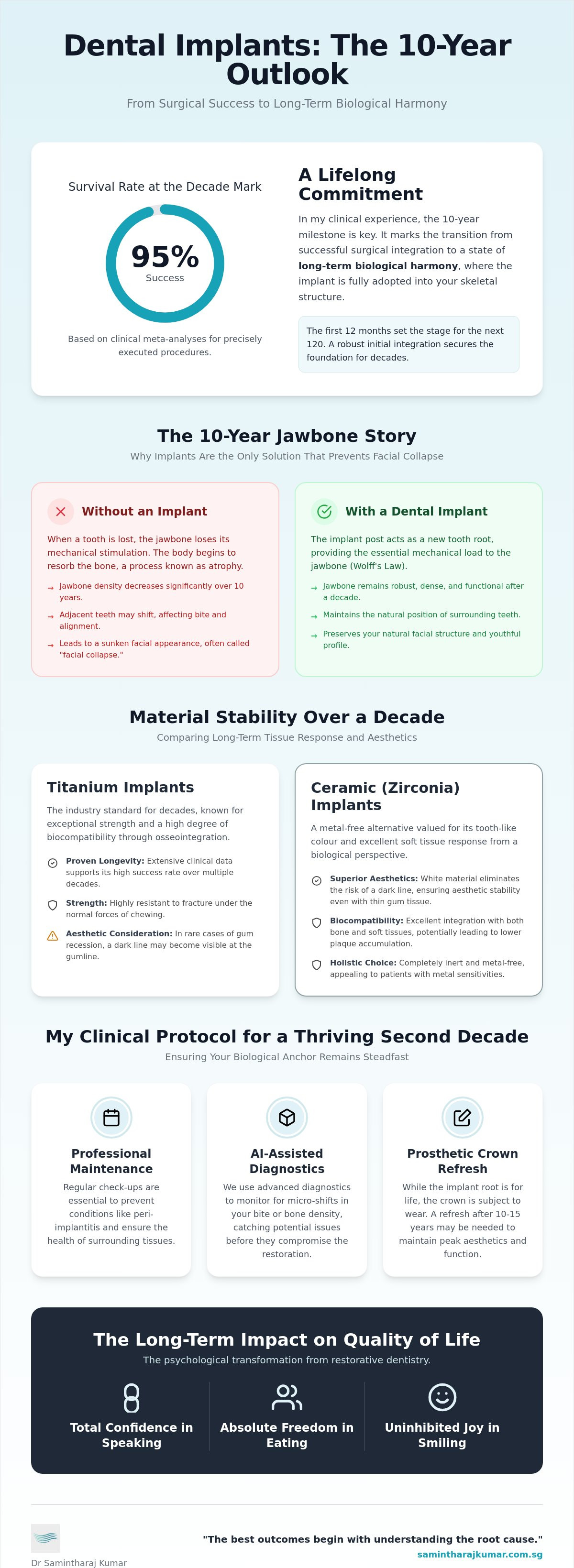
A dental implant is not a temporary fix; it's a lifelong commitment to your biological health. Many patients arrive at my clinic with a quiet anxiety, wondering if their investment will eventually falter or if they'll face the hidden costs of bone loss. In my clinical experience, understanding what to expect 10 years after dental implants is the key to moving from a state of worry to one of absolute confidence. Statistics show that these restorations maintain a success rate of approximately 90 to 95 percent at the decade mark, provided they are managed with clinical precision.
I understand that you want more than just a functional bite. You want the assurance that your facial structure remains youthful and your smile stays vibrant. In this article, I will share my perspective as a surgeon on the biological and aesthetic reality of living with implants for ten years. We'll explore how these anchors preserve your jawbone, when you might need to refresh a prosthetic crown, and the simple protocols that help your restoration last a lifetime.
Table of Contents
Beyond the Procedure: The Biological Reality of Dental Implants After 10 Years
The 10-Year Jawbone Story: Why Implants Are the Only Solution That Prevents Facial Collapse
Ceramic vs. Titanium: Evaluating Tissue Response and Aesthetic Stability Over a Decade
My Clinical Protocol: Ensuring Your Implants Thrive into the Second Decade
The Long-term Impact: How Total Rehabilitation Transforms the Quality of Life
Beyond the Procedure: The Biological Reality of Dental Implants After 10 Years
In my clinical experience, the first decade of a dental implant's life is a fascinating study in biological resilience. We often speak about the surgery as the climax of the journey, but as a clinician and founder, I view the placement as merely the introduction. The true success reveals itself at the ten-year milestone. This is the point where we transition from simple "successful integration" into what I call long-term biological harmony. From a biological perspective, your body has stopped treating the implant as a foreign object and has fully adopted it into the skeletal structure.
To better understand this concept, watch this helpful video:
Current clinical meta-analyses suggest that when procedures are executed with precision, patients can look forward to a 95 percent or higher survival rate. However, it's vital to distinguish between the components of your restoration. A Dental implant overview shows that while the titanium or ceramic post acts as a permanent root, the prosthetic crown atop it is subject to the same daily mechanical stresses as natural teeth. Understanding what to expect 10 years after dental implants involves recognising that while the "root" is designed for a lifetime, the crown may eventually require a refresh to maintain its aesthetic and functional excellence.
The Science of Osseointegration: A Decade of Stability
Bone is not a static material. It's a living tissue that constantly remodels itself in response to physical stress. After the initial healing phase, the bone around your implant continues to adapt and strengthen. In my practice, I've observed that the surgical precision applied in the first hour of treatment dictates the stability of the next ten years. I often tell my patients that the first 12 months set the stage for the next 120. If the initial integration is robust and the surrounding soft tissue is healthy, the biological foundation remains secure for the long term.
Clinical Consequences: Why the 10-Year Mark Matters
Neglecting professional maintenance can lead to peri-implantitis, a condition similar to gum disease that threatens the bone supporting the implant. Over a decade, your natural teeth may also undergo minor shifts in position. These subtle movements can alter your bite, placing uneven stress on the implant structure. Osseointegration is a dynamic, ongoing biological process rather than a static state. Regular monitoring with advanced diagnostics allows us to catch these micro-shifts before they compromise the restoration. Total oral rehabilitation is a lifelong journey, and my role is to ensure your biological anchor remains steadfast.
The 10-Year Jawbone Story: Why Implants Are the Only Solution That Prevents Facial Collapse
The principle of biological stimulation. Bone needs a reason to exist. In my clinical experience, the jawbone is one of the most responsive tissues in the human body. It operates under a biological principle known as Wolff’s Law, which states that bone density and strength are directly influenced by the mechanical loads placed upon them. When you lose a tooth, that stimulation vanishes. Without the mechanical load provided by a tooth root or an implant, the body essentially reabsorbs the minerals for use elsewhere. In my practice, what to expect 10 years after dental implants is a jawbone that remains robust and functional, rather than one that has progressively withered away.
Bone density and denture wearers. The American Dental Association on implants highlights their unique ability to fuse with the bone, a process that provides the necessary stimulation to keep the jaw healthy. Contrast this with traditional dentures. Over a decade, dentures often accelerate bone loss because they sit on top of the gums, exerting pressure that can diminish the underlying ridge. This leads to a cycle of refitting and discomfort. Implants, however, act as biological anchors that maintain the bone's volume and density for the long term.
Maintaining Vertical Dimension and Facial Volume
Structural rejuvenation through oral surgery. As a clinician and founder, I view dental implants as more than just teeth; they are the scaffolding for the lower third of your face. By preserving the height of the jawbone, we are effectively preventing facial collapse with dental implants. When the jawbone resorbs, the distance between the nose and the chin decreases, leading to a "sunken" appearance and premature wrinkling around the mouth. My perspective on structural rejuvenation is that the most effective way to maintain a youthful facial volume is to support the soft tissues from within. Implants ensure your lips and cheeks retain their natural position, preserving your aesthetic identity ten years down the line.
The Consequences of Untreated Tooth Loss Over a Decade
Alveolar ridge resorption. If tooth loss is left unaddressed for ten years, the alveolar ridge can undergo significant resorption. This depletion makes future dental work far more complex, often requiring extensive bone grafting to recreate a foundation. I have seen many patients who struggled with these issues before choosing all on 4 dental implants, a protocol designed to maximise available bone and provide immediate stability. Proactive restoration is always the superior path to long-term health. The best outcomes begin with understanding the root cause of bone loss and addressing it before the facial structure is compromised.
Ceramic vs. Titanium: Evaluating Tissue Response and Aesthetic Stability Over a Decade
Aesthetic stability through material science. In my clinical experience, the choice between ceramic and titanium is a strategic decision for the next decade of your life. While titanium provides a robust foundation, health-conscious patients increasingly prefer ceramic, or zirconia, for its superior biocompatibility. When considering what to expect 10 years after dental implants, the interaction between the material and the soft tissue is the primary driver of long-term aesthetic success. From a biological perspective, we aim to create a seal that remains visually seamless as the surrounding tissues mature.
Managing the grey margin phenomenon. As gums naturally recede over ten years, titanium implants can occasionally reveal a dark, metallic shadow at the gum line. Zirconia, being tooth-coloured, eliminates this risk and maintains a natural appearance regardless of minor tissue migration. Furthermore, zirconia surfaces are inherently plaque-resistant. These surfaces tend to accumulate less bacterial biofilm than titanium, which is a vital advantage for supporting the health of the transmucosal seal over the long term.
The Biological Perspective on Material Choice
Thin gingival biotypes and biocompatibility. I often favour ceramic dental implants for patients with delicate gum tissue. The white material ensures that no dark shadows compromise the smile's vibrancy in natural light. Zirconia is also chemically inert and hypoallergenic, promoting systemic health for those with metal sensitivities. Ten-year aesthetic success depends as much on the gum-to-implant seal as the bone-to-implant bond.
Prosthetic Wear and Tear: Replacing the Crown
Prosthetic maintenance and crown longevity. It is vital to distinguish between the permanent implant post and the prosthetic crown. While the long-term success rate of dental implants is exceptionally high, the crown may require replacement after 10 to 15 years of daily mechanical stress. Modern monolithic zirconia has significantly enhanced crown durability, offering superior resistance to chipping compared to traditional porcelain-fused-to-metal options. Regular evaluation ensures the prosthetic remains functional and visually seamless as your bite evolves over the second decade.
My Clinical Protocol: Ensuring Your Implants Thrive into the Second Decade
In my clinical experience at Nuffield Dental, the transition from year ten to year twenty is where meticulous oversight pays its greatest dividends. I am Dr Samintharaj Kumar, and I have developed the "Nuffield Standard" to serve as a rigorous framework for long-term monitoring. We don't just look for stability; we look for biological perfection. I have integrated AI-assisted diagnostics into our routine protocols at Nuffield Dental to detect micro-changes in bone levels that are often invisible to the naked eye on standard radiographs. By identifying these shifts early, we can intervene before a minor issue becomes a biological failure.
Occlusal management is another pillar of my protocol. Unlike natural teeth, implants lack a periodontal ligament to cushion force. Over ten years, your bite naturally evolves. We use digital pressure mapping at Nuffield Dental to ensure your implants aren't being subjected to mechanical fatigue. Professional maintenance goes far beyond simple scaling. It involves checking the integrity of the abutment screw and the health of the transmucosal seal. These are the technical details that determine what to expect 10 years after dental implants in terms of total functional freedom.
The Founder’s Philosophy on Maintenance
I firmly believe that the best outcomes begin with understanding the root cause of any physiological change. We use high-resolution digital scans to create a longitudinal record of your soft tissue. This allows us to track gum health with millimetre precision over a decade. Maintaining this data is essential for early detection of peri-implant diseases. This is why I mandate a comprehensive annual checkup for dental implants for all my patients. If you are approaching your first decade post-surgery, it's time to elevate your monitoring. Consult with our specialist team to ensure your oral rehabilitation remains structurally sound.
Home Care for the Long Term
Daily rituals are the silent engine of implant longevity. I often advise my patients to switch from traditional string floss to high-quality water flossing or interproximal brushes. Traditional floss, if used aggressively, can sometimes damage the delicate perimucosal seal that protects the implant. Lifestyle factors matter too. If you suffer from bruxism, a custom-fitted night guard is non-negotiable to protect the prosthetic from excessive wear. From a biological perspective, your home care routine is the first line of defence against late-stage complications. Understanding what to expect 10 years after dental implants means accepting that your role in the journey is just as vital as the surgeon's precision.
The Long-term Impact: How Total Rehabilitation Transforms the Quality of Life
Ten years after a successful procedure, the most profound changes often occur far beyond the clinical chair. In my clinical experience, the psychological shift from being a "dental patient" to a "confident individual" is the true benchmark of success. When patients first seek treatment, they're often burdened by the limitations of failing teeth or uncomfortable dentures. Understanding what to expect 10 years after dental implants means recognising that the hardware in your jaw eventually fades into the background of your consciousness. You simply become someone who can eat, speak, and smile without hesitation.
This functional freedom has significant implications for systemic health. From a biological perspective, the ability to maintain a varied and nutritious diet is a cornerstone of healthy ageing. Research indicates that dental implants can restore chewing strength to approximately 90 to 98 percent of natural capacity. This is a staggering improvement over traditional dentures, which often provide only 25 percent. Over a decade, this translates to better digestion, improved nutrient absorption, and a higher overall quality of life. As a clinician and founder, I find that this contribution to long-term wellness is the most rewarding aspect of my work.
My Perspective: The Legacy of a Restored Smile
I have seen many patients return to my clinic a decade after their initial surgery. Seeing their lives transformed is a powerful reminder of why I view complex implantology as a tool for Total Rehabilitation. One patient recently shared that they had forgotten they even had implants until they were reminded of their annual checkup. This level of biological integration is our ultimate goal. It's a testament to the fact that the right diagnosis and meticulous surgical execution change everything. We aren't just replacing teeth; we're restoring a person's social and functional identity for the long term.
Looking Toward the Next 10 Years
The future of dental longevity is incredibly promising. As we look toward the next decade, we're seeing the emergence of regenerative techniques and bio-active materials that may further enhance the lifespan of existing restorations. I encourage my patients to view their implants as a strategic investment in their "future self". By maintaining a standardised monitoring programme, you ensure that your oral health remains a constant in an ever-changing world. The journey to a decade of success is not a solo endeavour; it's a partnership between patient and specialist. The best outcomes begin with understanding the root cause and planning for a lifetime of health.
Securing Your Oral Health for the Decades Ahead
The journey to a decade of success is built on a foundation of surgical precision and proactive biological care. In my clinical experience, the most resilient outcomes are achieved when we combine high-tier materials, like ceramic implants, with the meticulous oversight of AI-assisted diagnostics. We've explored how these advanced protocols prevent facial collapse and maintain the structural integrity of your smile. Understanding what to expect 10 years after dental implants allows you to move beyond the anxiety of potential failure and toward a future of total confidence.
As a clinician and founder, my commitment is to uphold international standards of biological dentistry, whether we are implementing complex zygomatic protocols or routine monitoring. Your oral health is a legacy that deserves visionary care and a long-term perspective. It's about ensuring your investment thrives well into the second and third decades. The best outcomes begin with understanding the root cause. Explore the future of your smile with a specialist consultation. Your journey toward a permanent, vibrant smile starts with a single, expert-led conversation.
Frequently Asked Questions
Is it normal for a dental implant to feel slightly loose after 10 years?
An implant should never feel loose; if it does, it's a clinical emergency that requires an immediate specialist assessment. In my clinical experience, mobility usually indicates that the prosthetic screw has loosened or, more seriously, that the biological bond with the bone has been compromised. While the success rate at ten years is high, any movement warrants an evaluation to protect the underlying structure.
Will I need a bone graft if I decide to get another implant 10 years later?
You'll likely require a bone graft if the site of the new implant has been missing a tooth for a decade. Without the mechanical stimulation of a root or implant, the jawbone naturally resorbs over time. From a biological perspective, we must ensure there's sufficient volume to support the new anchor. We use 3D diagnostics to determine exactly how much augmentation is necessary for a stable result.
Can peri-implantitis develop even after 10 successful years?
Peri-implantitis can develop at any stage, even after a decade of perfect stability. It's often triggered by changes in systemic health or a lapse in professional maintenance. This is exactly what to expect 10 years after dental implants if the protective gum seal is breached by bacteria. Regular monitoring and AI-assisted diagnostics are our best tools for catching these inflammatory changes before they cause bone loss.
How many times can the crown on top of an implant be replaced?
The crown can be replaced multiple times throughout your life without affecting the integrity of the underlying implant post. Think of the implant as a permanent foundation and the crown as the functional surface that endures daily wear. In my practice, we often refresh crowns after 10 to 15 years to maintain optimal aesthetics and bite alignment. This ensures your total oral rehabilitation remains in peak condition.
Do 10-year-old implants show up differently on modern AI-assisted X-rays?
Older implants appear clearly on modern scans, but AI-assisted diagnostics provide a much deeper level of analytical detail than traditional X-rays. These systems can compare current bone density against historical data to identify microscopic patterns of bone loss. As a clinician and founder, I find this technology invaluable for monitoring 10-year-old restorations. It gives us a level of predictive insight that was simply unavailable a decade ago.
What happens if the screw inside the dental implant breaks after a decade?
A broken internal screw is a mechanical complication that we can usually resolve without removing the actual implant post. We use specialist retrieval kits to remove the fractured fragment under high magnification. Once the internal chamber is cleared, we simply fit a new, high-strength abutment screw. This process restores the structural integrity of the restoration while preserving the established biological bond with your jawbone.
Can medical conditions like diabetes affect my implants 10 years after placement?
Systemic conditions like uncontrolled diabetes can certainly impact the long-term health of your implants by affecting blood circulation and the body's inflammatory response. High blood sugar levels can make the surrounding tissue more susceptible to infection. If you're managing a chronic condition, it's vital to maintain strict glycaemic control. This is a key part of what to expect 10 years after dental implants as your general health evolves.
Is there an age limit for maintaining dental implants long-term?
There's no upper age limit for maintaining implants as long as you're able to manage effective oral hygiene. Many of my patients in their eighties and nineties continue to enjoy the functional benefits of their restorations. If manual dexterity becomes a challenge, we often recommend automated tools like water flossers. The goal is always to preserve your ability to eat and speak with confidence regardless of your age.


Comments