
Who is a Candidate for Pinhole Surgery? A Surgeon’s Perspective on Gum Rehabilitation
- Dr Samintharaj Kumar

- Aug 16
- 12 min read
What if the most effective way to restore your receding gum line didn't involve a scalpel, sutures, or the painful harvesting of tissue from the roof of your mouth? I've seen many patients struggle with the sharp discomfort of hot and cold sensitivity or the self-consciousness of a "toothy" smile, yet they remain paralysed by the fear of traditional grafting. It's a valid concern; the biological cost of surgical trauma can be significant. However, modern restorative techniques have evolved to prioritise both your comfort and your clinical outcome.
Determining who is a candidate for pinhole surgery is the first step toward a transformative recovery. In this guide, I'll provide a surgeon's perspective on the CHAO Pinhole Surgical Technique, an innovative approach that eliminates the need for invasive donor sites. You'll learn about the specific candidacy requirements, the biological principles that drive rapid healing, and why this method offers a more stable, aesthetic alternative to traditional surgery. We'll look at how we can move from simply managing recession to achieving profound, long-term oral rehabilitation.
Table of Contents
Understanding Gum Recession: The Biological Need for Rehabilitation
Gum recession is far more than an aesthetic grievance. It represents the gradual loss of the protective keratinised tissue that acts as a resilient shield for your tooth roots. In my clinical practice, I treat Understanding Gum Recession as a critical biological event that requires prompt intervention. When this barrier retreats, the cementum of the root is exposed. Unlike the hard enamel of the crown, this material is porous and remarkably susceptible to decay and sensitivity. This migration of tissue is usually driven by chronic inflammation or mechanical trauma, such as aggressive brushing or orthodontic movement.
The consequences of untreated recession extend deep into the dental foundation. It's not just about the appearance of "long teeth" or a "toothy" smile. It's about structural instability. When the gum line recedes, the underlying alveolar bone often follows suit. This loss of support can lead to tooth mobility and, in severe cases, tooth loss. For those asking who is a candidate for pinhole surgery, the answer often starts with patients who recognise that their dental foundation is being compromised and want to restore it before irreversible damage occurs.
To better understand this concept and see if you might be eligible for this procedure, watch this helpful video:
Why Traditional Approaches Often Deter Candidates
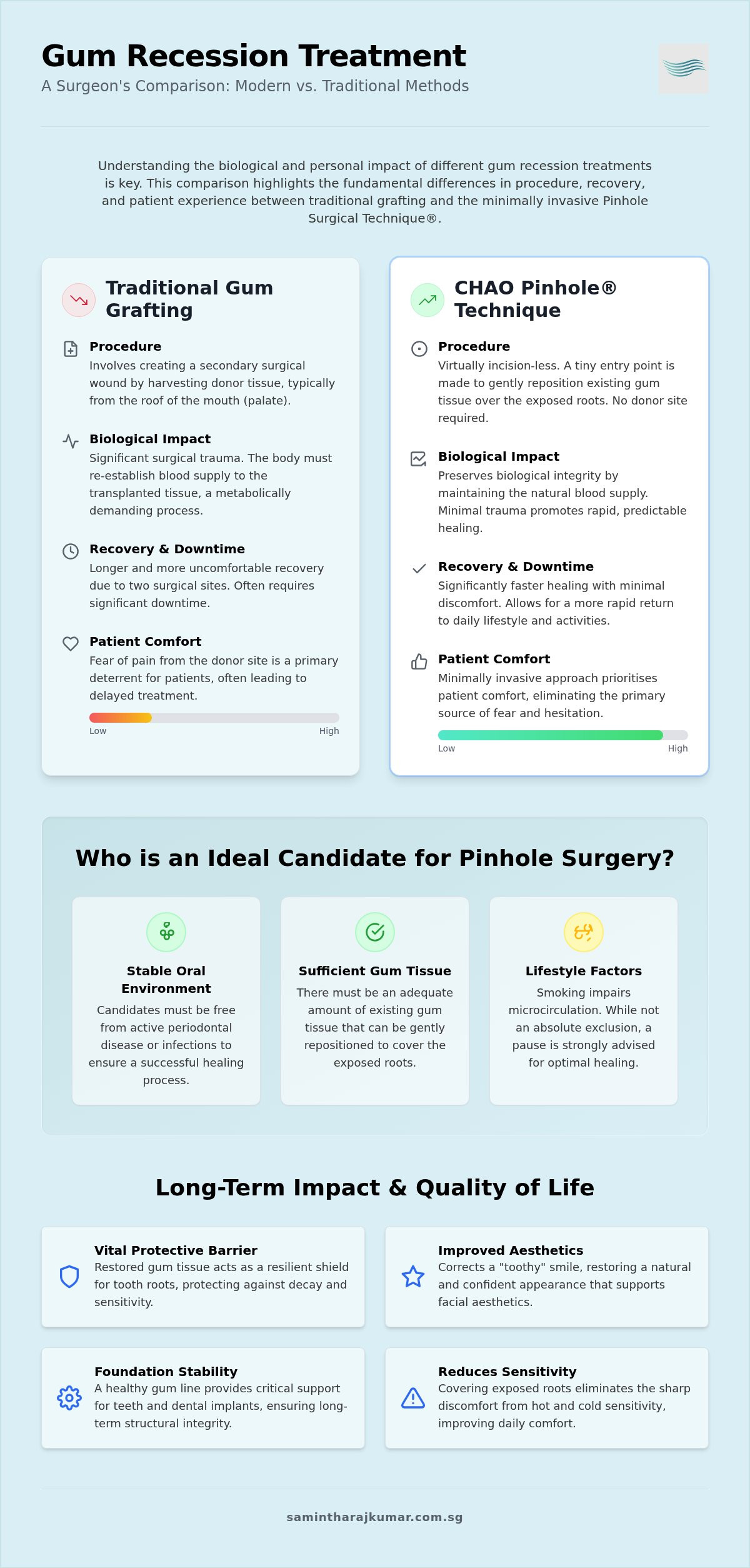
For decades, the standard treatment for recession was connective tissue grafting. This involves harvesting tissue from the roof of the mouth, which creates a secondary surgical wound. I've found that the psychological barrier of this "donor site" is the primary reason many patients delay treatment. They fear the recovery process, which can be uncomfortable and involve significant downtime. Unfortunately, delaying care only allows the recession to progress. Beyond the physical, the self-consciousness caused by recession often impacts a person's social confidence and willingness to engage in professional settings.
The Shift Toward Minimally Invasive Periodontics
In my experience as a surgeon, patients prioritise comfort and long-term stability alongside clinical success. This demand has driven a shift toward minimally invasive techniques like CHAO Pinhole Surgery. My philosophy is rooted in preserving the natural blood supply. Traditional grafting often disrupts this supply through large incisions and sutures. In contrast, the pinhole technique is virtually incision-less. We use a tiny entry point to gently reposition the existing tissue over the exposed roots. This approach respects the biological integrity of the gums, leading to faster healing and a more predictable outcome for those wondering who is a candidate for pinhole surgery.
The Science of Candidacy: Why PST Preserves Biological Integrity
Determining who is a candidate for pinhole surgery requires a deep understanding of the metabolic demands of oral tissue. In my clinical assessment, I prioritise biological integrity over mere mechanical repair. Traditional grafting is essentially a tissue transplant. It requires the body to re-establish a blood supply to a detached piece of donor tissue. This process is metabolically expensive and carries risks of necrosis if the site isn't perfectly managed. Evidence, such as a clinical trial comparing Pinhole Surgical Technique to connective tissue graft, highlights how different surgical approaches impact the healing trajectory and patient comfort.
The most successful candidates are those with a stable oral environment. This means being free from active periodontal disease or infection. I also look closely at lifestyle factors. Smoking significantly impairs microcirculation and slows the healing response. While I don't always exclude smokers, I strongly advise a pause in the habit to ensure the tissue has the oxygenation it needs to thrive. The "pinhole" mechanism itself is a marvel of conservative surgery. By using a microscopic entry point, we avoid large incisions. We then use specialised collagen strips to hold the gum in its new, healthy position. These strips act as a temporary scaffold, stabilising the tissue without the need for sutures until your body's natural collagen takes over.
The Role of Vascularity in Tissue Integration
Maintaining the original blood supply is the cornerstone of CHAO Pinhole Surgery. Unlike a graft, where the tissue is cut away and moved, PST keeps the tissue connected to its source. This preservation of the periosteum, the dense layer of vascular connective tissue covering the bone, ensures more predictable and rapid healing. In traditional periodontal surgery, poor vascularity often leads to graft failure or prolonged pain. By keeping the blood flowing, I can ensure a more rhythmic and comfortable recovery for my patients, as the tissue never loses its vital nutrient supply.
Evaluating Tissue Quality and Recession Severity
I carefully evaluate whether a patient's recession is mild, moderate, or severe. While PST is highly versatile, very thin or fragile gum tissue requires a more meticulous hand and specialised surgical approach. One of the greatest clinical advantages for those wondering who is a candidate for pinhole surgery is the ability to treat multiple sites in a single session. This efficiency reduces the overall biological burden and surgical time. If you're considering how this fits into your own health journey, you might consult with a specialist to review your unique tissue profile and oral health goals.
Recovery Journey: Pinhole Surgery vs Traditional Grafting
The recovery trajectory is perhaps the most stark differentiator between these two rehabilitative methods. In traditional grafting, your healing is largely dictated by the donor site on your palate. This secondary wound is often described by patients as a persistent, sharp discomfort similar to a severe "pizza burn" that lasts for several days. For anyone asking who is a candidate for pinhole surgery, the promise of avoiding this secondary surgical site is frequently the primary motivation for choosing this advanced technique.
During the first 24 hours after CHAO Pinhole Surgery, the body begins the delicate process of stabilising the repositioned tissue. Because I don't use scalpels or sutures, the inflammatory response is significantly muted compared to conventional surgery. We focus on protecting the microscopic entry points and allowing the collagen strips to begin their work as a biological scaffold. While traditional grafting involves managing both the recipient site and the palatal wound, PST allows the body to focus its metabolic energy on a single, minimally traumatised area.
The First 48 Hours: Managing Patient Expectations
Within the first 48 hours of PST recovery, patients typically experience minimal swelling and almost no bleeding. The aesthetic improvement is often visible immediately, providing a sense of emotional renewal. In contrast, grafting recovery involves managing palatal irritation and the physical sensation of sutures, which can be distracting during speech or rest. I recommend specific post-operative protocols, including cold compresses and a refined anti-inflammatory regimen, to accelerate cellular repair and ensure the tissue integrates predictably with the underlying bone.
Activity and Lifestyle Restrictions
Functional recovery happens in stages, and I'm meticulous about the rules regarding hygiene and physical strain. For both methods, I implement a strict "no brushing" rule at the surgical site for several weeks. We use specialised antiseptic rinses to maintain hygiene without mechanical disturbance to the healing gums. However, the social downtime differs greatly. PST is frequently called the "Lunchtime Gum Lift" because the physical trauma is so low that many of my patients return to their professional lives the very next day.
I advise a brief pause in high-intensity exercise for about 48 hours following PST to prevent blood pressure spikes from disturbing the site. Traditional grafting often requires a longer hiatus from physical activity to protect the delicate graft and the donor wound. Long-term stability is achieved once the collagen scaffold has fully matured, usually within a few months. This journey is a collaborative effort between my clinical precision and your commitment to these gentle recovery protocols.
My Perspective: Why I Prioritise CHAO Pinhole Surgery
As a clinician and the founder of Nuffield Dental, my surgical philosophy is guided by a single principle: achieving the most profound personal impact with the least amount of biological trauma. I look for procedures that offer predictable, high-prestige outcomes that stand the test of time. While traditional grafting has served the industry for decades, it often carries a biological cost that I find increasingly unnecessary in the age of modern medicine. My preference for the CHAO Pinhole Surgical Technique (PST) is rooted in its respect for the body's natural architecture.
The primary biological advantage lies in the preservation of the periosteum. This is the vital, vascular layer of connective tissue that nourishes your underlying alveolar bone. In traditional grafting, this layer is often disrupted to accommodate the donor tissue, which can lead to unpredictable healing. By using PST, I keep this life-support system intact. I use AI-assisted diagnostics to meticulously evaluate who is a candidate for pinhole surgery, mapping the exact thickness of the gingiva and the degree of bone support. This data-driven approach ensures that we only proceed when the biological conditions for success are optimal.
Founder Philosophy on Patient Comfort
My work with complex oral rehabilitation and "Teeth in a Day" has taught me that patients value immediate restoration of both function and aesthetics. I believe that the best outcomes begin with understanding the root cause of recession, whether it's mechanical trauma or biological predisposition. By focusing on patient-centred care, I aim to reduce the deep-seated anxiety often associated with dental surgery. PST allows me to offer a transformative experience where the patient walks out with a restored gum line and minimal physical burden, mirroring the efficiency and care we bring to our most complex implant cases.
The Future of Periodontal Restoration
The landscape of biological dentistry is shifting away from aggressive tissue harvesting. We are entering an era where we work with the body's existing resources rather than moving tissue from one site to another. This approach is a cornerstone of the broader cosmetic dentistry singapore journey, where functional health and aesthetic beauty are inextricably linked. Our institutional heritage at Nuffield Dental ensures that we remain at the cutting edge of these protocols, providing access to specialist-level care that prioritises your long-term well-being.
I am always honest with my patients; there are specific structural defects where traditional grafting remains the superior choice, particularly when there is a total lack of keratinised tissue. However, for the majority of those asking who is a candidate for pinhole surgery, the clinical advantages of PST are clear. If you are ready to explore how this innovative technique can restore your smile and protect your dental health, contact my practice for an expert evaluation.
Long-Term Impact: Quality of Life and Structural Integrity
The true value of gum rehabilitation reveals itself long after the initial procedure is complete. Beyond the immediate relief from thermal sensitivity, restored gum tissue provides the essential structural support for your entire dental architecture. For instance, maintaining a healthy, robust gum line is vital for the long-term success of a dental implant singapore. Without sufficient soft tissue coverage, implants are vulnerable to peri-implantitis, a condition that can compromise the bone and lead to eventual failure. Additionally, the health of your gums plays a pivotal role in preventing facial collapse. When recession and subsequent bone loss go unchecked, the underlying support for facial muscles weakens, often resulting in a prematurely aged appearance.
Maintaining these results requires a commitment to both proper home care and regular clinical reviews. I emphasise to my patients that while the CHAO Pinhole technique is a powerful tool, it's not a "set and forget" solution. We need to address the mechanical or biological factors that caused the recession in the first place to ensure the new gum position remains stable for decades. Regular monitoring allows us to verify that the tissue has integrated perfectly and that your oral ecosystem remains in balance.
Functional Aesthetics and Personal Renewal
A balanced gum line is a hallmark of a youthful, healthy smile. When we restore the natural proportions of your teeth, it creates a sense of harmony that goes beyond simple repair. The psychological impact of resolving chronic sensitivity is often profound; it removes a daily source of discomfort and replaces it with a sense of security. These outcomes are most successful when they integrate seamlessly with your lifestyle, allowing you to eat, speak, and smile without hesitation or self-consciousness. It's about achieving a level of functional excellence that feels entirely natural.
Next Steps in Your Rehabilitation Journey
If you've been struggling with the effects of recession, the first step is to determine who is a candidate for pinhole surgery through a meticulous clinical evaluation. This isn't a decision that can be made through a cursory glance. It requires a comprehensive consultation where we use advanced diagnostics to map your tissue health and bone density. This level of detail allows us to create a bespoke rehabilitation plan that respects your unique biology and clinical needs.
Ultimately, the right diagnosis changes everything for your oral health journey. By understanding the root cause of your gum recession, we can choose the most effective, minimally invasive path to restoration. My goal is to guide you toward a state of total oral health where your gums are not just repaired, but truly rehabilitated. The best outcomes always begin with a deep understanding of your biological foundation and a commitment to precision care.
Embracing the Future of Periodontal Restoration
Gum rehabilitation is no longer a choice between enduring a painful graft or living with the risks of chronic recession. By prioritising the preservation of your natural blood supply and avoiding the trauma of a palatal donor site, CHAO Pinhole Surgery offers a more refined path to long-term health. We've explored how this technique supports the structural integrity of your smile, protecting everything from your natural teeth to complex dental implants. It's a shift toward a more empathetic, biology-first approach to periodontics that respects your comfort as much as clinical outcomes.
Determining who is a candidate for pinhole surgery is a nuanced process that requires clinical precision and a deep understanding of biological healing. At Nuffield Dental, I combine founder-led clinical excellence with advanced surgical protocols to ensure your total oral rehabilitation journey is both predictable and comfortable; my specialist expertise in the CHAO Pinhole technique allows for a seamless integration of health and aesthetics. The right diagnosis changes everything. Consult with Dr Samintharaj Kumar to explore your options for gum restoration. I look forward to helping you reclaim a smile that feels as healthy as it looks.
Frequently Asked Questions
How long does the pain last after Pinhole surgery compared to grafting?
Post-operative discomfort after CHAO Pinhole Surgery is typically minimal, often resolving within the first 24 to 48 hours. In contrast, traditional grafting involves a secondary surgical site on the palate, which frequently causes sharp irritation for up to two weeks. Because I don't use scalpels or sutures, the inflammatory response is significantly reduced. Most of my patients find that over-the-counter pain relief is sufficient for only the first day of recovery.
Can I eat normally immediately after CHAO Pinhole Surgery?
You won't be able to return to a completely normal diet immediately. While the procedure is minimally invasive, we must protect the repositioned tissue while it stabilises. I recommend a soft-food diet for approximately three weeks. You should avoid crunchy, spicy, or sticky foods that could mechanically disturb the surgical area. This gentle approach ensures the collagen strips remain in place while your body's natural healing processes secure the new gum line.
Is Pinhole surgery as permanent as a traditional gum graft?
Yes, the results are designed to be long-term and stable. Research indicates that the Pinhole Surgical Technique has success rates over 90 percent, comparable to traditional grafting. However, permanence depends on addressing the root cause of your recession, such as aggressive brushing or untreated bruxism. When combined with meticulous oral hygiene and regular clinical reviews, the restored gum line provides a durable, protective barrier for your dental health for many years.
What happens if I choose not to treat my receding gums?
Ignoring gum recession often leads to progressive structural damage. When the protective tissue barrier is lost, the porous root surface becomes vulnerable to decay and extreme sensitivity. Over time, the underlying alveolar bone may also begin to resorb, leading to tooth mobility or eventual loss. Determining who is a candidate for pinhole surgery early is essential to prevent these irreversible consequences and maintain the functional integrity of your smile.
Are there any risks specific to the Pinhole Surgical Technique?
Every surgical intervention carries some risk, but the Pinhole technique is remarkably safe due to its conservative nature. Specific risks include temporary swelling, minor bruising, or a very low chance of infection at the entry point. Because there are no large incisions or donor site harvests, the risk of tissue necrosis or severe bleeding is significantly lower than with traditional grafting. I use precise diagnostic tools to mitigate these risks before we begin.
How many teeth can be treated in one Pinhole surgery session?
One of the greatest advantages of this technique is the ability to treat multiple teeth in a single session. I can often rehabilitate an entire arch or even the full mouth during one appointment. This efficiency is a primary factor for those deciding who is a candidate for pinhole surgery, as it reduces the overall biological burden and surgical time. Traditional grafting usually requires multiple staged procedures to achieve the same comprehensive results.
Does insurance typically cover Pinhole surgery in the same way as grafting?
Insurance coverage for the Pinhole Surgical Technique varies significantly between providers. Some plans cover 40 to 80 percent of the cost if the procedure is deemed medically necessary to prevent tooth loss. However, many insurers still classify it as an elective or cosmetic treatment. I recommend checking your specific annual maximums, which often range between $1,000 and $2,000, as these limits may not cover the full extent of a multi-tooth rehabilitation.
Will I need a follow-up procedure after the initial recovery period?
Most patients don't require additional surgical procedures once the initial healing phase is complete. I schedule regular clinical reviews to monitor the maturation of the tissue and ensure the new gum line remains stable. These visits are a crucial part of your total oral rehabilitation journey. If we identify any areas of concern early, we can manage them through non-invasive maintenance rather than further surgery, ensuring your long-term comfort and health.


Comments