
Zygomatic Implants in Singapore: A Surgeon’s Perspective on Structural Rehabilitation

What if the news that you have "insufficient bone" for dental implants wasn't the final verdict on your oral health? In my clinical experience, many patients seeking zygomatic implants in Singapore arrive at my practice feeling a profound sense of defeat, often burdened by the prospect of ill-fitting dentures or the anxiety of complex bone grafting failures. It's a heavy emotional weight to carry when you feel your facial structure and ability to enjoy a simple meal are slipping away. I understand these concerns deeply, and I want to reassure you that modern surgical innovation has created a reliable, permanent path forward.
What many patients don't realise is that we can achieve a fixed set of teeth without months of preparatory surgery. In this article, I'll share my perspective on how these specialised implants serve as a structural rescue for the face, restoring function and aesthetics even in cases of severe bone loss. We'll examine how anchoring into the dense zygomatic bone allows us to bypass extensive grafting, often enabling a "Teeth in a Day" transformation. I'll guide you through the biological precision behind this procedure and how it restores your long-term facial volume and confidence.
Table of Contents
When Traditional Implants Fail: Addressing Severe Maxillary Bone Loss
The Science of Zygomatic Implants: Anchoring into the Foundation of the Face
Zygomatic Implants vs. Complex Bone Grafting: A Comparative Analysis
The Clinical Workflow: Digital Precision and the Teeth in a Day Protocol
My Perspective as a Clinician-Founder: Restoring More Than Just a Smile
When Traditional Implants Fail: Addressing Severe Maxillary Bone Loss
In my clinical experience, many patients arrive at my practice feeling a sense of profound defeat after being told they lack sufficient bone for traditional dental implants. This news often feels like a final verdict, leaving patients to believe that ill-fitting dentures or complex, multi-stage surgeries are their only options. However, what many don't realise is that the jawbone is not the only foundation available for zygomatic implants in Singapore. We can look beyond the compromised maxilla to find a more stable, biological bedrock.
To better understand the structural principles behind this surgical alternative, watch this clinical overview:
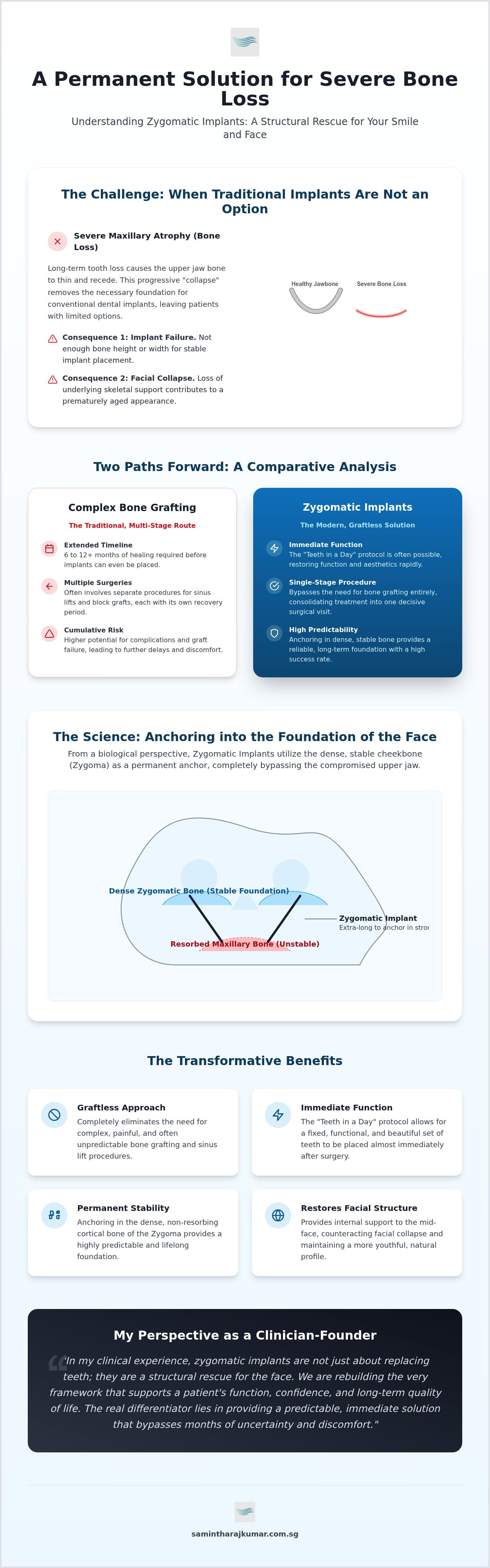
Bone resorption is an inevitable biological reality after tooth loss. Without the root to stimulate the bone, the upper jaw naturally thins and recedes over time. A Zygoma implant addresses this by utilising extra-long fixtures that anchor into the dense zygomatic bone, or cheekbone, rather than the maxilla. This bone remains stable even when the jawbone atrophies, making this approach the gold standard for those who have experienced significant bone loss but desire a fixed, permanent solution.
The Problem of Maxillary Atrophy
Long-term tooth loss leads to a progressive "collapse" of the upper jaw bone. Traditional implants require a minimum bone height and width that many patients simply don't have, especially after years of wearing dentures. Functionally, this loss of volume makes chewing difficult and causes existing appliances to slip. Aesthetically, it contributes to facial collapse, where the face appears prematurely aged because the underlying skeletal support has vanished.
Why Bone Grafting Isn’t Always the Answer
In extreme cases of atrophy, traditional solutions like sinus lifts and block grafts have clear limitations. These procedures often require an extended "down-time" that can span six to twelve months before implants can even be placed. There's also a cumulative risk when undergoing multiple surgical stages. My philosophy has always been to prioritise predictability and patient comfort. By recommending zygomatic implants in Singapore, I often suggest bypassing the graft entirely for a more direct structural solution that provides immediate stability and a faster return to function.
The Science of Zygomatic Implants: Anchoring into the Foundation of the Face
From a biological perspective, the zygomatic bone represents a unique physiological opportunity for patients who have been told they have no other options. Unlike the alveolar bone of the jaw, which depends on the presence of teeth for its volume and health, the zygoma remains dense and structurally sound throughout a person's life. This is the real differentiator for those considering zygomatic implants in Singapore. While the upper jaw is primarily composed of cancellous bone, which is softer and more prone to resorption, the cheekbone consists of high-quality cortical bone that offers exceptional stability.
In my clinical experience, the biomechanical advantage of cortical bone is the primary reason for the high predictability we see in these cases. Cortical bone is much denser and provides superior initial torque for the implant fixture. This immediate stability is what allows us to load the implants with a fixed bridge almost straight away. By anchoring into this stable foundation, we also maintain the integrity of the sinus cavity. The implants are strategically positioned to bypass the air-filled spaces that often complicate traditional surgery, avoiding the need for invasive sinus augmentations.
Anatomical Precision in the Zygoma
Navigating the complex mid-face anatomy requires a high degree of surgical expertise and digital diagnostic precision. The cheekbone remains stable even when the jawbone recedes because it's part of the primary skeletal structure of the face, unaffected by the biological changes that follow tooth loss. The zygomatic anchor is the bedrock of facial dental restoration. In a surgeon's perspective on zygomatic implants, the focus is always on this anatomical reliability. To ensure comprehensive support, I often utilise Pterygoid implants as a complementary system. These provide posterior stability in the very back of the mouth, creating a balanced tripod effect that supports the entire dental arch.
Biological Integration and Longevity
The long-term success of this procedure depends on osseointegration, the process where the bone cells grow directly onto the implant surface. In the dense cortical bone of the zygoma, this integration creates a remarkably strong bond that can last a lifetime. This is why biocompatibility is non-negotiable; we select materials that the body accepts as its own to ensure long-term health. This stability is the cornerstone of the All-on-4 dental implants protocol for patients with severe atrophy. When we achieve this level of integration, the results aren't just functional; they are transformative for the patient's quality of life. If you're ready to explore how this precision applies to your case, a detailed clinical assessment is the first step toward structural renewal.
Zygomatic Implants vs. Complex Bone Grafting: A Comparative Analysis
In my clinical experience, the real differentiator between traditional methods and zygomatic implants in Singapore lies in the timeline and the predictability of the final outcome. For years, patients with severe bone loss were steered toward a "Graft-Heavy Approach." This typically involves multiple surgical stages, such as sinus lifts or bone blocks, to build up enough volume for standard implants. While I still perform sinus lift surgery for dental implants as a viable alternative for many, it's a different journey altogether.
The "Graftless Approach" offered by zygomatic systems bypasses the need for these preparatory steps. By anchoring directly into the cheekbone, we reduce the number of surgical interventions. This significantly improves patient comfort. There's a common misconception that zygomatic surgery is "more dangerous" than extensive grafting. However, what many don't realise is that each additional surgery in a multi-stage grafting process carries a cumulative risk of infection and complications. A single, precise zygomatic procedure often represents a more direct and safer path to rehabilitation.
Predictability and Success Rates
Clinical data consistently supports the reliability of this technique. Studies report success rates for zygomatic implants at over 96% in selected patient cases. This high degree of predictability is one reason why I advocate for this method in complex cases. When we avoid multiple surgeries, we naturally lower the risk of biological failure. My philosophy has always been that precision in planning determines longevity. By using the dense zygomatic bone, we create a stable foundation that isn't dependent on the success of a bone graft, which can sometimes be unpredictable.
Time-to-Teeth: The Immediate Advantage
The most profound benefit for my patients is the "Time-to-Teeth." Zygomatic implants facilitate the "Teeth in a Day" workflow, where a fixed, non-removable bridge is attached shortly after surgery. The psychological impact of this cannot be overstated. Leaving the clinic with a fixed bridge rather than a removable denture changes how a person feels about themselves immediately. I prioritise efficiency because I know my patients want to return to their lives without the "down-time" of traditional grafting. What this means for the future of healthcare is a shift toward more patient-centric, immediate results without compromising on clinical excellence.
The Clinical Workflow: Digital Precision and the Teeth in a Day Protocol
This is where precision matters. My approach to zygomatic implants in Singapore is rooted in a digital-first philosophy that prioritises safety and predictability. We begin with advanced 3D CBCT imaging and AI-assisted screening to visualise the mid-face architecture in three dimensions. This isn't just about finding bone; it's about mapping the safest, most stable path for structural rehabilitation. What many don't realise is that the success of the surgery is often decided in this diagnostic phase, long before the first incision is made.
The workflow follows a logical, highly organised progression:
Comprehensive consultation and biological assessment
Digital trajectory mapping and AI simulation
Customised surgical guide fabrication
Surgical placement under conscious sedation
Immediate loading of the provisional, fixed bridge
Diagnostics and AI-Assisted Screening
Using digital diagnostics allows us to map the exact trajectory of each implant with sub-millimetre accuracy. This is critical because we must ensure the absolute safety of vital structures like the infraorbital nerves and the delicate lining of the sinus cavity. By integrating AI-assisted planning, we can simulate the entire surgical event in a virtual environment. This level of foresight allows for the creation of a customised surgical guide for every patient. This guide acts as a precise roadmap during the procedure, ensuring that the implants are placed exactly where the digital plan intended, leaving no room for guesswork.
The Teeth in a Day Experience
The Teeth in a Day procedure explained from a surgical viewpoint is a marvel of modern clinical coordination. To ensure a comfortable patient experience, I almost always utilise conscious sedation. My goal is to lower the emotional barriers often associated with surgery. This state of deep relaxation allows the patient to remain calm while I focus on the technical excellence required to secure the implants into the dense zygomatic bone.
Once the implants achieve the necessary torque, we attach a fixed temporary bridge. This bridge is meticulously designed for both immediate aesthetics and functional healing. It provides the internal structural support needed to prevent facial collapse while your tissues recover. During the first 24 hours, you can expect some mild swelling and a sensation of fullness in the mid-face. However, most of my patients are pleasantly surprised by how manageable the recovery is when compared to the "down-time" of extensive bone grafting. The transition to your final, permanent restoration occurs after several months of biological integration.
The right diagnosis changes everything. If you are ready to begin your journey, you can request a specialist consultation to see how digital precision can restore your quality of life.
My Perspective as a Clinician-Founder: Restoring More Than Just a Smile
My philosophy has always been that we are not just replacing teeth; we are restoring a person’s quality of life. When a patient arrives at my practice after being told they are a "dental cripple" due to severe bone loss, the impact is more than just functional. It's deeply personal. The long-term implication of successful rehabilitation is a return to systemic health through better nutrition, a surge in restored confidence, and a renewed sense of self. We aren't just performing surgery; we're facilitating a profound personal transformation.
What many patients don't realise is how zygomatic implants in Singapore serve as a vital internal scaffold. By anchoring into the cheekbone, these fixtures prevent facial collapse by providing the internal structural support that the upper jaw can no longer offer. Without this support, the mid-face loses its volume, leading to a prematurely aged appearance. As a clinician and founder, I see every procedure as an opportunity to reverse this decline and provide a foundation that lasts a lifetime.
Structural Rejuvenation and Facial Aesthetics
I consider this procedure a form of functional facial rejuvenation. There's a direct, biological relationship between the underlying jaw structure and the mid-face "lift" provided by fixed prosthetics. When we secure a bridge to a stable zygomatic foundation, we're effectively restoring the skeletal support for the soft tissues of the face. This creates a more youthful profile and a vibrant smile that traditional dentures simply cannot replicate. The transformative power of a stable, healthy bite on overall longevity is immense. A patient who can once again enjoy a varied, healthy diet and speak without fear of their teeth slipping is a patient who has regained their vitality.
Leading the Future of Specialist Care
As a founder, my goal has always been to institutionalise these high-tier surgical standards across the healthcare landscape in Singapore. This is where precision matters most. We don't just aim for successful surgery; we aim for global excellence in patient outcomes. This requires a commitment to mentorship and constant innovation in complex oral surgery. I believe that the best outcomes begin with understanding the root cause of bone loss and addressing it with the most advanced biological and digital tools available. My perspective is that we must always look forward, ensuring that the future of complex implantology is defined by safety, predictability, and a deeply human-centred approach. Precision in planning determines longevity, and the right diagnosis changes everything.
Embracing a New Standard of Structural Rehabilitation
Choosing to address severe bone loss is a significant step toward reclaiming your quality of life. As a specialist in Zygomatic and Pterygoid systems, I've seen firsthand how bypassing complex bone grafting in favour of anchoring into the dense zygoma provides a predictable, permanent solution. My philosophy as the founder of Nuffield Dental Holdings has always been to combine this clinical mastery with the Teeth in a Day protocol; this ensures you leave our care with immediate functional and aesthetic results. What this means for your future is a foundation that supports not just your smile, but your systemic well-being and facial structure.
Precision in planning determines longevity, and the right diagnosis changes everything. When considering zygomatic implants in Singapore, it's vital to partner with a team that understands the biological and anatomical complexities of the mid-face. The best outcomes begin with understanding the root cause. Explore our approach to complex dental rehabilitation at Nuffield Dental. You don't have to settle for the limitations of traditional dentures; a fixed, confident future is well within reach.
Frequently Asked Questions
What exactly are zygomatic implants and how do they work?
Zygomatic implants are specialised, extra-long dental fixtures designed for patients with severe bone loss in the upper jaw. Unlike standard implants that sit in the jawbone, these anchor into the dense zygomatic bone, also known as the cheekbone. This provides a stable foundation for a full arch of teeth. In my clinical experience, this method works by bypassing the resorbed maxilla entirely, allowing us to provide a fixed bridge without the need for extensive bone grafting.
How long do zygomatic implants typically last?
These implants are designed to be a long-term, permanent solution for structural rehabilitation. When correctly placed and maintained, they can last for many decades or even a lifetime. Clinical studies have reported success rates for zygomatic implants at over 96% in selected patient cases. Longevity depends on maintaining excellent oral hygiene and attending regular professional reviews. In my practice, we prioritise precision in planning to ensure the durability of the restoration for every patient.
Is the zygomatic implant procedure painful?
The procedure itself is not painful because it's performed under conscious sedation or general anaesthesia. My goal is to lower the emotional barriers associated with surgery by ensuring you're in a state of deep relaxation. After the procedure, it's normal to experience some swelling or a sensation of fullness in the mid-face for a few days. We provide comprehensive post-operative care and medication to manage any discomfort effectively as your tissues begin to heal.
Am I a candidate for zygomatic implants if I have osteoporosis?
Yes, patients with osteoporosis are often still excellent candidates for this procedure. What many don't realise is that the zygomatic bone typically retains its density and volume even when other bones in the body, including the jaw, are affected by systemic conditions. From a biological perspective, the cheekbone provides a reliable anchor that is less susceptible to the resorption seen in the alveolar bone. A detailed clinical assessment is necessary to confirm your suitability for zygomatic implants in Singapore.
How does the cost of zygomatic implants compare to traditional implants?
The investment for zygomatic implants is typically higher than standard implants because of the surgical complexity and specialised hardware required. However, when you consider the total cost of multiple bone grafts, sinus lifts, and the extended "down-time" of traditional methods, the "graftless" approach often proves more efficient. It's a definitive solution for complex cases. We provide a transparent breakdown of fees during your consultation so you can make an informed decision about your care.
What is the recovery time after zygomatic implant surgery?
Most patients return to their normal daily routines within a week of surgery. While the initial soft tissue healing takes about seven to ten days, the "Teeth in a Day" protocol allows you to leave the clinic with a functional, fixed bridge almost immediately. Full osseointegration, where the bone grows onto the implant surface, typically occurs over four to six months. During this period, I recommend a softer diet to protect the healing foundation as it integrates.
Can zygomatic implants be used for both the upper and lower jaw?
Zygomatic implants are exclusively used for the upper jaw because they require the cheekbone for anchorage. There is no equivalent anatomical structure for the lower jaw. For patients with severe bone loss in the lower jaw, we utilise different specialised protocols, such as short implants or specific regenerative techniques. If you're seeking zygomatic implants in Singapore, it's important to understand that this specific technology is the gold standard for maxillary rehabilitation only.
How do I choose the right surgeon for zygomatic implants in Singapore?
You should look for a surgeon with dual-qualification and a proven track record in complex oral surgery. It's essential that the practice utilises advanced digital diagnostics and AI-assisted planning to ensure precision. As a clinician and founder, I believe the best outcomes begin with a surgeon who follows international protocols and maintains high-tier affiliations. Choosing a practitioner who treats the procedure as a form of structural facial rejuvenation is key to achieving a successful result.


Comments