
Restoring Vertical Dimension of Occlusion: A Patient-Focused Guide

What if a reduced bite height is affecting more than the appearance of your smile? Worn or missing teeth can change how the teeth meet and may influence chewing, speech and facial balance. Yet restoring vertical dimension of occlusion is not simply a matter of making the bite taller.
It is understandable to feel uncertain about what treatment might involve, particularly if you are concerned about extensive or irreversible dental work. In my clinical experience, the first step is to understand the whole bite and why it has changed, rather than assume one approach will suit every patient.
In this guide, I explain how I assess tooth wear, the way your teeth come together, jaw and muscle comfort, speech and facial proportions. I also outline how these findings can inform a restorative plan, including how provisional restorations may help review a proposed bite before definitive treatment is considered.
Whether a plan involves removable or fixed restorations depends on your clinical needs and long-term restorative goals. The aim is to weigh those choices carefully and explain their purpose, implications and place in the plan. That gives you a more informed starting point for a restorative consultation.
Table of Contents
Restoring vertical dimension of occlusion: what does a reduced bite height mean?
How clinicians assess vertical dimension before recommending restoration
Comparing approaches to restoring vertical dimension of occlusion
From diagnosis to restoration: how a VDO treatment plan is evaluated
A specialist perspective on full-mouth rehabilitation and restored VDO
Restoring vertical dimension of occlusion: what does a reduced bite height mean?
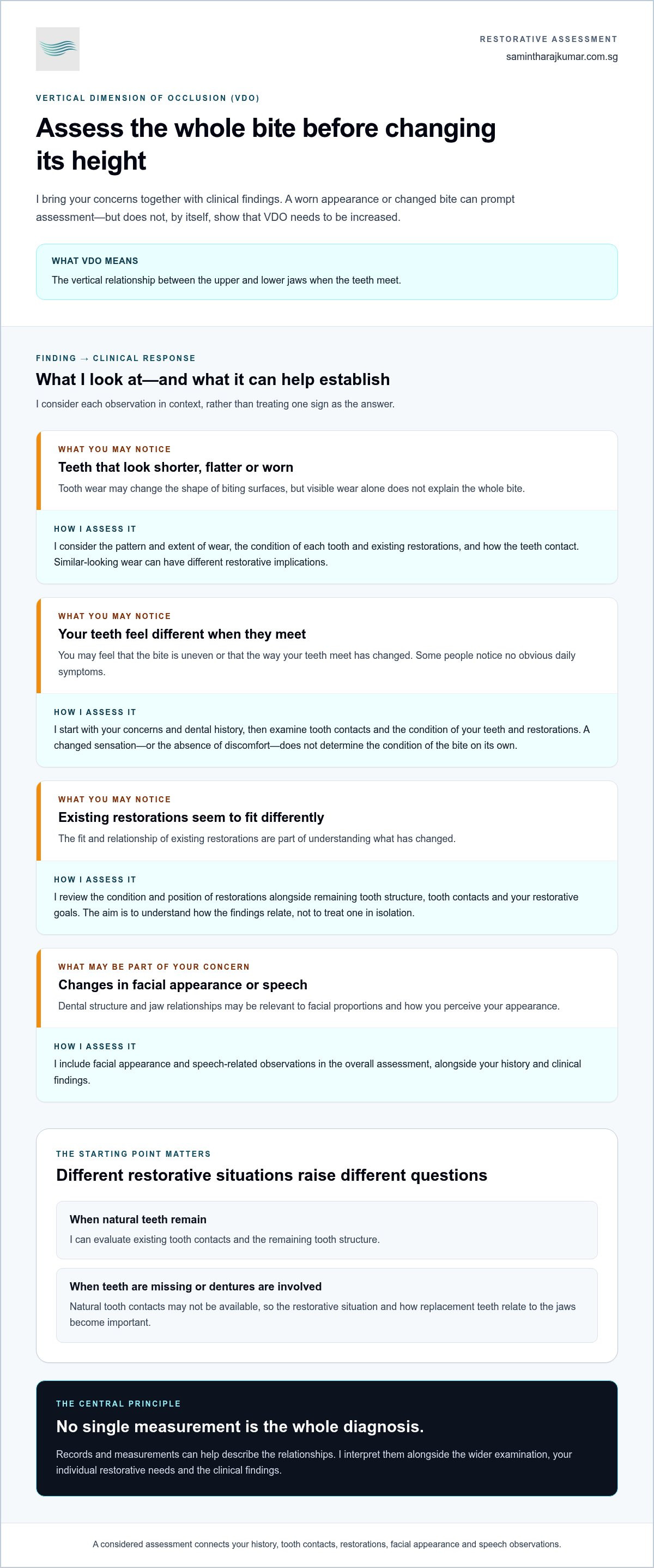
You may notice teeth that look shorter or flatter, a bite that feels different, or concerns about how existing restorations fit together. These observations can raise questions about bite height, but they do not, by themselves, show that it needs to be increased. Restoring vertical dimension of occlusion begins with understanding what has changed and how your teeth function as a whole.
Featured definition: Occlusal vertical dimension (VDO) is the vertical relationship between the upper and lower jaws when the teeth meet.
To see the term explained visually, watch this short video:
How tooth wear can relate to vertical dimension
Tooth wear is one finding I consider, not an automatic reason to alter the bite. Attrition describes the gradual loss of tooth structure where teeth rub against one another. Over time, this may flatten biting surfaces or change their shape. But the visible amount of wear does not tell the whole story. Teeth may shift or continue to meet in ways that affect the overall bite. The clinical question is whether the relationship between the jaws has changed and whether restoration is appropriate for that person.
A worn appearance can prompt assessment, but it does not supply the answer. I consider the pattern and extent of wear alongside the condition of each tooth, existing restorations and the way the teeth contact. Two people with similar-looking wear may have different restorative needs. A careful examination helps distinguish a concern that may be addressed by treating particular teeth from a situation where broader restorative planning could be considered.
Why patients may notice changes in bite or appearance
Some people describe a changed sense of how their teeth meet, difficulty feeling that the bite is even, or concern that their smile looks different. Others may have no obvious daily symptoms and discover wear during an examination. These experiences are individual. Noticing a change does not confirm that VDO has reduced, and the absence of discomfort does not determine the condition of the bite.
Facial appearance can also be part of the conversation. Teeth and jaw relationships contribute to the support and proportions of the lower face, so changes in dental structure may be relevant to how someone perceives their appearance. This is one aspect of how dental structure affects face shape. Your perception matters, but it needs to be considered alongside clinical findings. The overview of vertical dimension of occlusion (VDO) on Wikipedia offers further background on the concept. In my view, precision matters here: first understand the cause and functional context, then consider whether any change to bite height is appropriate.
How clinicians assess vertical dimension before recommending restoration
A restorative assessment starts with your concerns and dental history, then connects them with what I can observe clinically. I want to understand what has changed, whether you have had previous restorative treatment, and what matters to you in everyday function. The condition of your teeth and existing restorations, along with the way your upper and lower teeth meet, all help build that picture.
No single measurement is the whole diagnosis. A measurement or record may provide useful information, but it needs to be interpreted alongside the wider examination and your individual restorative needs.
What the examination and records help establish
I look at patterns of tooth wear, the condition and position of existing restorations, and how the teeth contact when the jaws meet. I also consider facial appearance and speech-related observations as part of the overall assessment. Records and measurements can help describe these relationships, but they do not replace clinical judgement or explain the cause of a finding on their own.
This assessment helps connect findings with decisions. For example, wear on particular teeth may prompt closer attention to how those teeth meet the rest of the bite, while existing restorations may affect what can be considered next. The aim is to understand how the findings relate, rather than treat one observation in isolation. The principles behind bite alignment measurements in dental restorations are most useful when considered in that broader context.
Why the same VDO assessment does not fit every patient
Assessment differs according to whether natural teeth remain, some teeth are missing, or a person relies on dentures. With natural teeth, I can evaluate existing tooth contacts and remaining tooth structure. Where teeth are missing or dentures are involved, those same natural contacts may not be available. The restorative situation and the way replacement teeth relate to the jaws then become important parts of the evaluation.
These distinctions matter because the starting point shapes the questions that need answering. The amount and condition of remaining tooth structure, the presence of restorations and the intended restorative goals all influence how the bite is assessed. A finding that matters in one person’s plan may have a different significance in another’s. A standard measurement or comparison with someone else’s experience cannot determine what is appropriate for you.
My approach is to bring your account together with clinical observations before discussing whether a change in vertical dimension should form part of a restorative plan. If you are preparing to discuss bite concerns, you may find it helpful to explore my approach to restorative care and note which changes you have noticed and when they began. A clear understanding of the starting point makes the planning conversation more purposeful.
Comparing approaches to restoring vertical dimension of occlusion
Changing the bite height is a clinical decision, not a procedure chosen on appearance alone. In my clinical experience, the right approach depends on the condition of the teeth, the restorative goals and how a proposed change fits the overall treatment plan. A removable appliance, a provisional restoration and a definitive fixed restoration each serve a different purpose. None is suitable for every patient.
The comparison below explains these distinctions. It is not a substitute for an individual assessment, and the approaches do not represent a sequence every patient follows.
Removable and provisional approaches
A removable overlay may be considered where the restorative circumstances make a removable option relevant. Its use in a reported case does not make it the right choice for someone else. Provisional restorations, when clinically appropriate, offer a planning stage in which the proposed arrangement can be reviewed. The decision to use either approach rests on individual findings, not a standard pathway.
Definitive restorative approaches
Fixed restorations may form part of comprehensive rehabilitation when the clinical assessment supports them. I consider the remaining tooth structure, existing restorations, and functional and restorative objectives together. The long-term implication matters: a definitive approach should make sense within the whole plan, rather than be selected simply to create a particular appearance.
As a clinician with an interest in full-mouth rehabilitation, I see comparison as a way to clarify choices, not to rank them universally. A useful discussion explores what each approach is intended to achieve, what it involves and how it relates to your findings. You can learn about my approach to full-mouth rehabilitation. Precision in planning begins with understanding the reasons behind each option.
From diagnosis to restoration: how a VDO treatment plan is evaluated
A considered plan for restoring vertical dimension of occlusion is not a fixed sequence applied to everyone. It develops from your concerns, clinical findings and restorative priorities. My aim is to make each decision understandable, including why an option is being considered and what questions need answering before proceeding.
A plan should address both function and restorative goals. A change that looks appropriate must also make sense for the way the teeth work and the condition of the mouth.
Clarify your concerns. We begin with what you have noticed and what you hope to address. This may include changes in your bite, speech, comfort, chewing or smile, though not every concern calls for a change in bite height.
Assess the bite and restorative context. Clinical findings help establish how the teeth relate, what restorative needs are present and whether other factors should shape the discussion.
Consider relevant options. Depending on those findings, the plan may involve a restorative approach, further evaluation or no VDO change. The options should reflect your circumstances rather than a standard formula.
Review the proposed plan. We discuss its intended purpose, the steps involved and how function and appearance fit into the overall goals. You should have space to raise questions and explain what matters most to you.
Proceed when appropriate. Definitive treatment is considered when the clinical rationale and proposed plan are clear. The pathway may differ from one patient to another.
Planning around function, aesthetics and restorative needs
Function and appearance are connected, but neither should be considered in isolation. I weigh how the teeth meet and their restorative needs alongside facial and smile-related goals. The principles discussed in a guide to cosmetic dentistry and functional aesthetics reflect this broader view: consider the mouth as a connected system, rather than pursue visual change without regard to dental function.
That balance can influence which options are worth discussing and how they fit into a wider restorative plan. The appropriate emphasis depends on the individual findings and your priorities.
Reviewing the proposed plan before definitive treatment
When provisional restorations form part of the plan, they can provide an opportunity to review a proposed restorative arrangement before definitive work is considered. Speech, comfort and function may be discussed during this review. Responses vary, so this stage should not be presented as a guarantee of adaptation or a promise of a particular result. It is one source of information for the ongoing clinical discussion.
I encourage patients to describe their experience clearly: what feels acceptable, what remains concerning and whether the plan still reflects their goals. Those observations can inform the next discussion alongside clinical findings. You can discuss your restorative goals with me as part of considering how individual restorative planning relates to your concerns.
A specialist perspective on full-mouth rehabilitation and restored VDO
Restoring vertical dimension of occlusion can be one consideration within a wider restorative plan, rather than a standalone goal. In my clinical experience, the important question is not simply whether the bite can be changed, but whether a proposed change is relevant to the overall condition of the teeth and your functional and restorative needs.
I specialise in complex dental implantology, oral surgery and full-mouth rehabilitation. I am a Diplomate and Fellow of the International Congress of Oral Implantologists. This experience informs how I approach complex restorative planning, but it does not predetermine what any individual should have. Each plan must be grounded in clinical findings and shaped around that person’s priorities.
What comprehensive rehabilitation means in this context
Full-mouth rehabilitation considers restorative needs across the mouth as a whole. A change in VDO may be discussed as part of that wider picture, alongside the condition of the teeth and the intended restorative goals. It is not automatically required, and a comprehensive plan does not imply that every tooth needs the same type of treatment. The scope depends on the individual assessment.
This wider perspective is reflected in my approach to total oral rehabilitation: decisions about one part of the bite need to make sense in relation to the rest of the mouth. The aim is thoughtful planning, not an assumption that a particular treatment will produce a particular outcome.
My perspective: precision begins with understanding the root cause
My philosophy has always been that diagnosis should come before intervention. A change in bite or concern about worn teeth is a reason to understand the underlying restorative picture, not to jump immediately to a chosen procedure. Precision matters because a treatment decision should have a clear clinical purpose.
Comfort also deserves careful attention. A plan should take your experience seriously while remaining guided by examination findings and long-term restorative considerations. That means discussing what the proposed care is intended to address, how it relates to function and appearance, and what choices or uncertainties need further explanation. I value this conversation as part of responsible planning, not as an afterthought.
If you are considering treatment, it may help to bring a clear account of what concerns you most, what changes you have noticed and what you hope to achieve. These points can guide a focused discussion, while the clinical assessment helps determine which options are relevant. You do not need to arrive with a treatment decision already made.
If questions about your bite, teeth or existing restorations are affecting your confidence in the next step, I welcome a considered conversation about your restorative concerns and goals. The best starting point is understanding the root cause, then deciding together what the findings support.
Move forward with clarity and a plan built around you
The next step need not be choosing a treatment. It can be preparing for a thoughtful conversation about what you have noticed, what you hope to change and what matters most to you in the long term. That shared understanding helps keep decisions grounded in your individual restorative needs rather than appearance alone.
In my practice, full-mouth rehabilitation and complex oral surgery call for careful planning and clear communication. As a Diplomate and Fellow of the International Congress of Oral Implantologists, I bring that perspective to discussions about restoring vertical dimension of occlusion, while recognising that each person’s findings and goals are different. A consultation is an opportunity to understand the concerns behind the question and consider the options with care.
If you are ready to explore your restorative priorities, explore my approach to comprehensive dental care. Begin with your questions and let a clear understanding of your needs guide the conversation. A considered next step can make the path ahead feel more manageable.
Frequently Asked Questions
What is vertical dimension of occlusion?
Vertical dimension of occlusion (VDO) describes the vertical relationship between the upper and lower jaws when the teeth meet. In everyday terms, it is how your teeth and jaws come together when you close your mouth. I explain it as one part of understanding a bite, not a score that can be judged from a photograph. I interpret it alongside your dental condition and restorative needs.
Is restoring vertical dimension of occlusion always necessary when teeth are worn?
No. In my clinical assessment, worn teeth may prompt closer examination, but wear alone does not show that increasing VDO is appropriate. I consider the pattern of wear, the condition of the affected teeth and the wider restorative needs. For example, wear may be limited to particular teeth while other parts of the bite remain stable. Treatment decisions should follow individual findings, not appearance alone.
Can vertical dimension be restored without full-mouth crowns?
Possibly. I consider restorative options in light of the clinical findings and treatment goals. Full-mouth crowns are not the only approach that may be discussed: removable appliances or provisional restorations may be relevant in selected circumstances, while fixed restorations may address particular teeth or a broader area. Each option has different purposes and implications. I relate any proposed approach to your remaining tooth structure and overall restorative plan.
Does increasing vertical dimension of occlusion affect speech?
Speech may be relevant to planning because the relationship between the teeth can influence how the mouth feels and functions. When reviewing a proposed restorative arrangement, I may discuss speech observations as part of that review. This does not mean everyone notices a change, and I cannot predict an individual response in advance. If particular sounds feel different, sharing that observation can inform our discussion.
Can restoring vertical dimension cause jaw discomfort?
I cannot predict jaw discomfort from the treatment description alone. As part of planning, I consider jaw comfort, muscle function and how the teeth meet in the context of your findings. If you already experience discomfort, tell me when it occurs and what seems to affect it. If concerns arise during a restorative review, let me know so I can consider them alongside the other clinical information.
How do dentists decide whether a proposed bite height is appropriate?
I decide whether a proposed bite relationship is appropriate by considering the individual clinical findings, rather than relying on one measurement or a preferred appearance. I interpret records alongside tooth condition, existing restorations, jaw relationships and your restorative priorities. If provisional restorations form part of the plan, observations during that stage may inform our discussion. The proposed change should have a clear clinical purpose and fit the wider treatment plan.
Does a change in bite height alter facial appearance?
I may consider facial and smile appearance when discussing bite height, because dental and jaw relationships contribute to the support of the lower face. Any visible effect depends on your anatomy and restorative situation. I cannot guarantee a particular facial change from a proposed VDO adjustment. I consider aesthetic aims alongside function and dental health, rather than treating appearance as the sole reason to alter the bite.



Comments